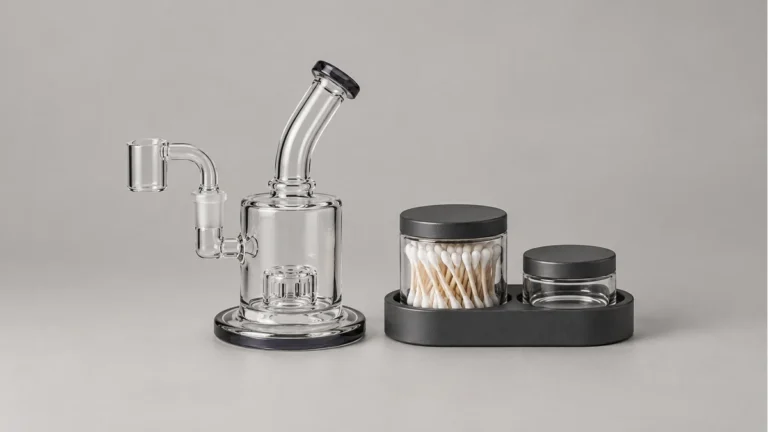
The term 510 vape pen refers to any portable vaporizer battery that uses the 510-thread connection standard to attach to a vape cartridge. It is the dominant format for portable oil vaporizers worldwide — and understanding it from a hardware perspective matters whether you are a consumer choosing your first device, a dispensary buyer stocking shelves, or a brand sourcing private-label hardware.
This guide covers what the “510” standard actually means, how these devices work internally, the different battery types available, how to choose voltage settings, and what separates average hardware from premium OEM-grade builds.
For broader category context, readers can also review AOVAPE’s 510 thread battery page, the wider portable vaporizer section, and related technical articles on the AOVAPE blog.
⚙️ 1. What Is a 510 Vape Pen?
🔍 A 510 vape pen is a portable rechargeable vaporizer built around a standardized threaded connector. The “510” is mechanical in origin — it describes a threading specification of 10 threads at 0.5 mm pitch, creating the screw-on interface between the battery body and the cartridge.
Before this standard became universal, every vape brand used its own proprietary thread format. A cartridge from one manufacturer would only work with that manufacturer’s battery. The rise of the 510 thread broke this lock-in entirely. Today, a 510-threaded cartridge from virtually any brand connects to a 510-threaded battery from any other — making it the de facto universal connector of the portable vaporizer world.
- 🔩 Standardized threaded connector: 10 threads at 0.5 mm pitch
- 🔋 Rechargeable lithium-ion power source
- ⚡ Wide compatibility across cartridge brands and oil types
- 🔌 Modern designs typically include USB-C charging
📌 “510 vape pen” is not one single product — it is a hardware category built around a shared connection standard, with significant variation in everything else.
🔬 2. How a 510 Vape Pen Works
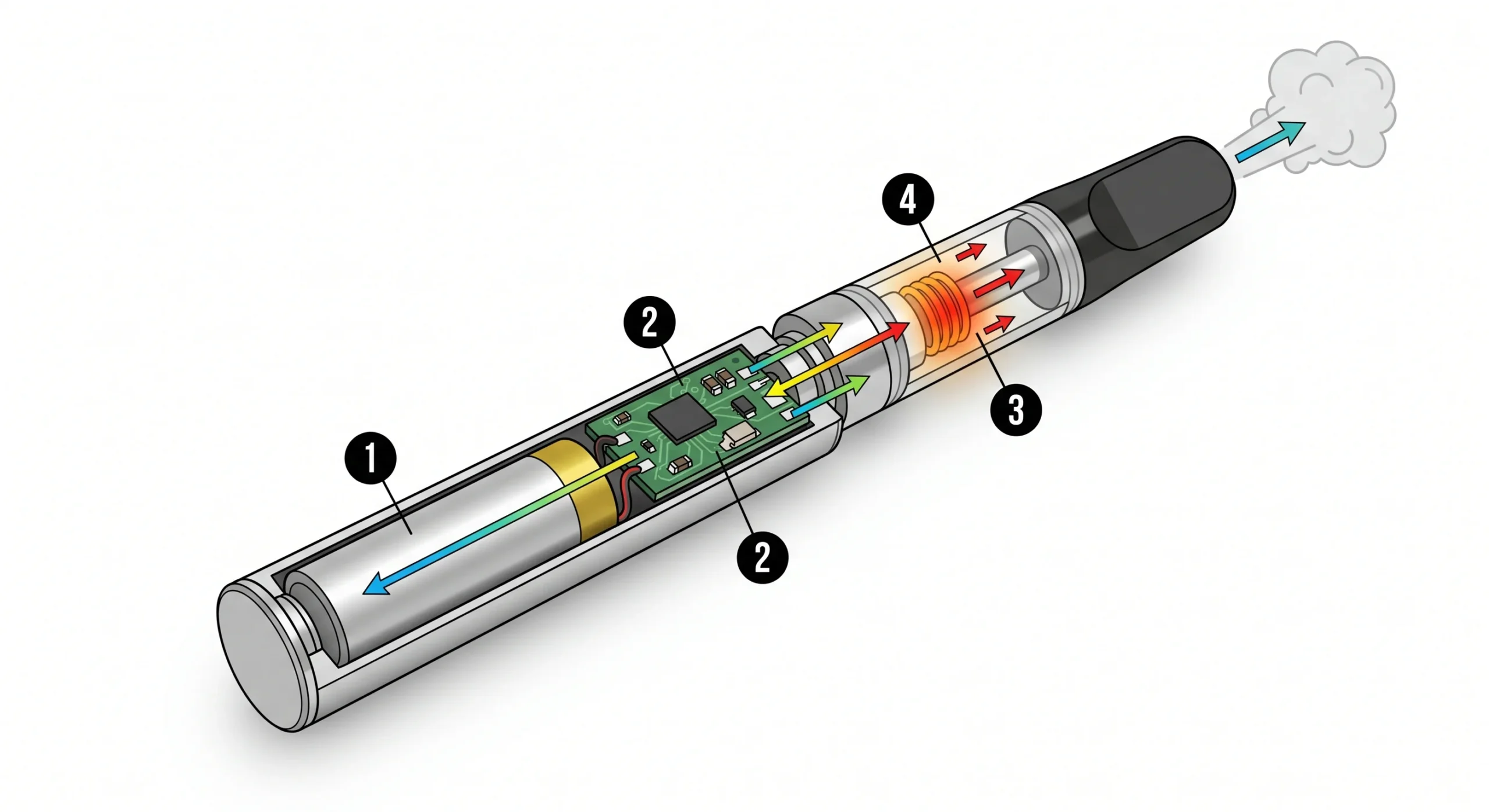
At its core, a 510 vape pen is an energy delivery system. Here is what happens from activation to vapor:
⚡ Step 1 — Battery to Connection Pin
The lithium-ion cell stores electrical energy. When activated — by pressing a button or by inhaling — it sends current down through the 510 center pin at the base of the connection socket.
🔥 Step 2 — Center Pin to Atomizer Coil
The current travels into the cartridge’s atomizer coil, a resistive heating element typically made from ceramic or metallic materials, which heats rapidly when electricity passes through it.
💨 Step 3 — Atomizer Coil to Vapor
The heated coil warms the surrounding oil held in the cartridge reservoir — whether THC distillate, CBD oil, terpene blends, or nicotine liquid — converting it from liquid into inhalable vapor.
🫁 Step 4 — Vapor to Mouthpiece
The vapor travels upward through the cartridge chimney and out through the mouthpiece. The quality of each component — cell consistency, coil resistance, ceramic purity, airflow geometry — determines whether that vapor is smooth or harsh, flavorful or burnt.
💡 The entire sequence takes less than a second. But the engineering decisions behind each step are where real product differentiation happens.
🧩 3. The 4 Main Components of a 510 Vape Pen
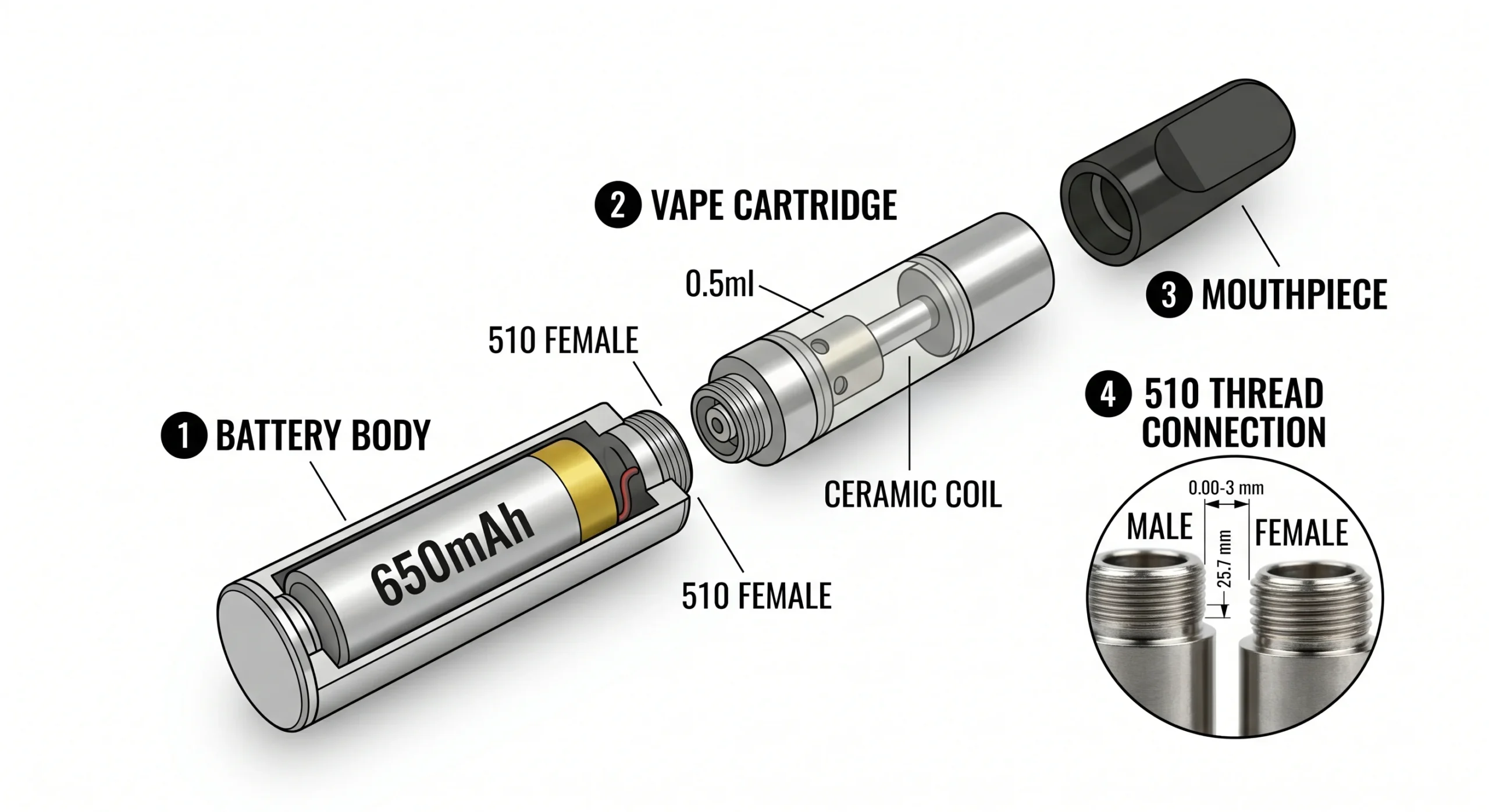
🔋 3.1 Battery Body
The battery body houses the lithium-ion cell, control circuit board, voltage regulation electronics, LED indicators, and the 510-thread female socket. Capacity is measured in milliamp-hours (mAh), typically ranging from 280 mAh in ultra-compact pen-style designs to 900+ mAh in high-capacity box-style devices. A higher mAh means more sessions between charges — but also a physically larger device.
🛢️ 3.2 Vape Cartridge
The cartridge is a separate, interchangeable component that screws onto the battery. It contains the oil reservoir, the atomizer assembly (coil and ceramic element), and the mouthpiece. Cartridges are available in 0.5 ml and 1.0 ml capacities, in glass, plastic, or composite housings. The quality of the ceramic core has an outsized effect on vapor flavor and consistency.
👄 3.3 Mouthpiece
Usually integrated into the cartridge rather than the battery, mouthpieces vary by material (ceramic, metal, food-grade plastic) and shape (flat, round, elongated). Mouthpiece geometry directly affects airflow resistance and the user’s draw experience.
🔩 3.4 510 Thread Connection
The threaded interface itself — 10 threads, 0.5 mm pitch — on the battery (female socket) and cartridge (male connector). This mechanical connection also serves as the electrical pathway. A worn, dirty, or overtightened connection is one of the most common causes of inconsistent firing in the field.
🖊️ 4. Types of 510 Vape Pen Batteries
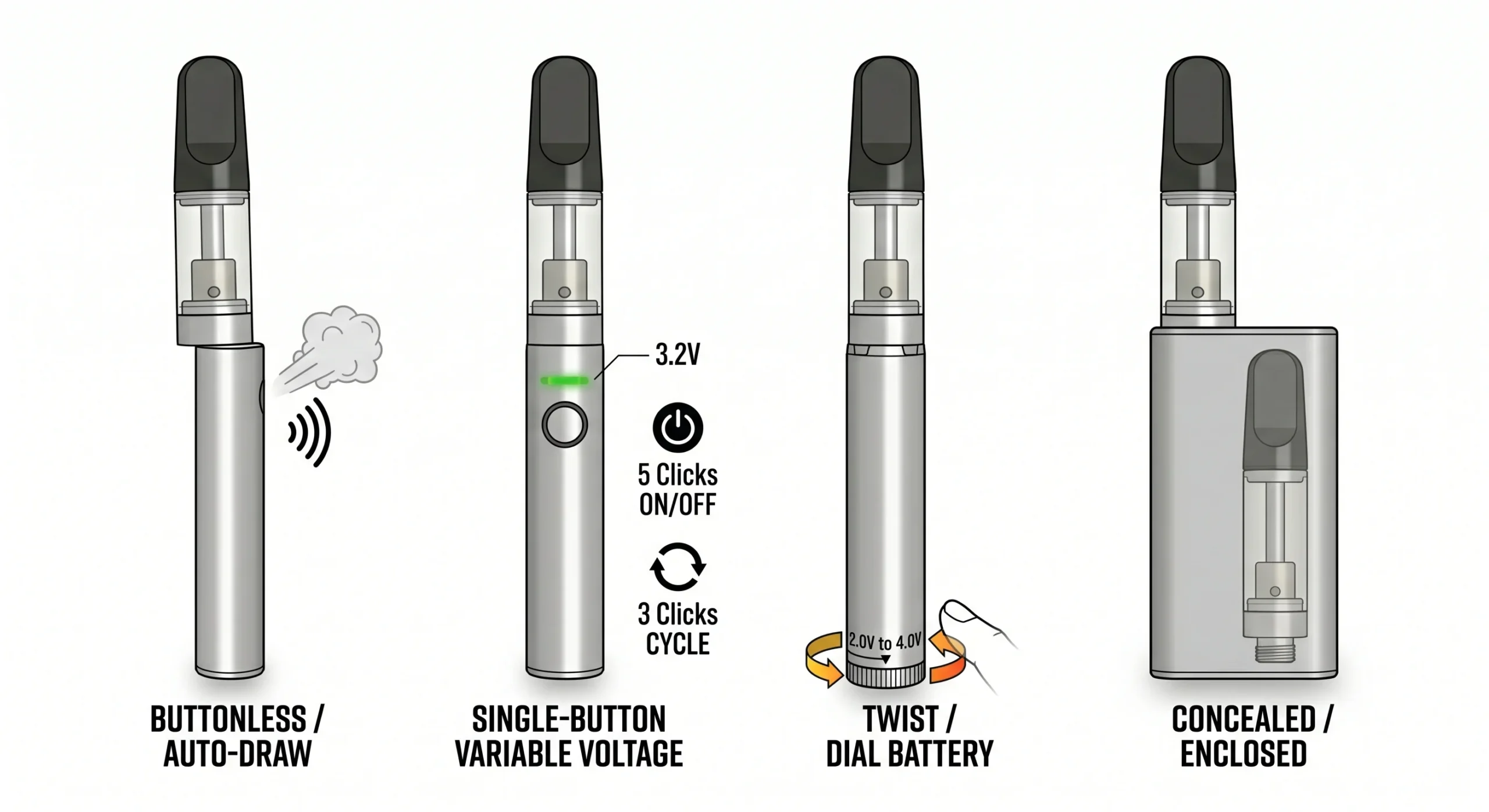
Not all 510 vape pen batteries are built the same. The format varies considerably depending on intended use case, target consumer, and price point.
4.1 Buttonless / Auto-Draw Batteries
The simplest design. An airflow sensor detects inhalation and fires automatically — no button required. Popular for beginners and dispensary-bundled products because there is zero learning curve. The tradeoff is less user control: the battery fires at a fixed voltage and cannot manually pre-heat the oil.
4.2 Single-Button Variable Voltage Batteries
The most common type in retail. A single button handles power on/off (5 rapid clicks) and voltage cycling (3 clicks). Most offer three preset voltage levels — commonly 2.4V, 3.2V, and 4.0V — displayed via color-coded LED indicators. The preheat function (2 clicks) is valuable for thick distillate oils that need warming before vaporization.
4.3 Twist / Dial Batteries
A physical dial at the base adjusts voltage continuously rather than in discrete steps. Intuitive and durable. Popular in dispensary environments where a wide range of consumer experience levels need to be accommodated without complex button interfaces.
4.4 Concealed / Enclosed Batteries
Batteries with a housing that fully encloses the cartridge, hiding it from view. These devices look nothing like a traditional pen — they resemble small rectangular blocks or compact tubes. The enclosure protects the cartridge from damage and provides a highly discreet profile. Popular among lifestyle-oriented and premium hardware brands.
4.5 Box Mod / High-Output 510 Batteries
Larger devices with full digital displays, precise voltage or wattage control, extended battery life, and USB-C pass-through charging. These represent the premium end of the 510 battery category and are typically used by experienced consumers working with a wide range of oil viscosities and cartridge coil resistances.
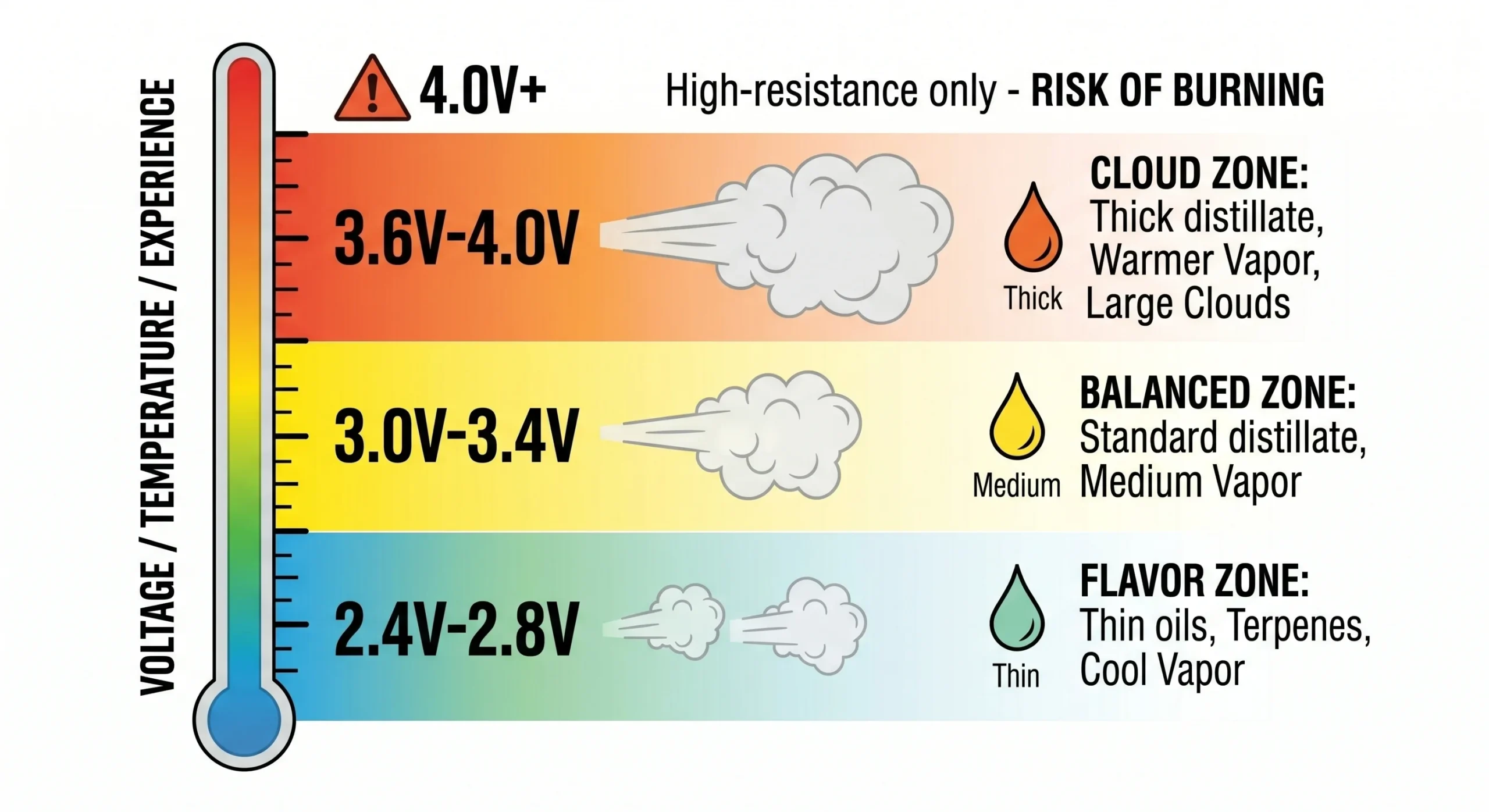
🌡️ 5. Voltage Settings: What They Mean and Why They Matter
Voltage is one of the most misunderstood aspects of the 510 vape pen. Here is the practical breakdown:
| Voltage Range | Best For | User Experience |
|---|---|---|
| 2.4V – 2.8V | Thin oils, terpene-rich cartridges, live resin | Smooth, flavorful, cooler vapor |
| 3.0V – 3.4V | Standard distillate, medium-viscosity oils | Balanced flavor and vapor density |
| 3.6V – 4.0V | Thick distillate, winterized oils | Larger clouds, warmer vapor, higher throughput |
| 4.0V+ | High-resistance coils only | Risk of burning thin oils — use with caution |
📌 The key insight: higher voltage is not always better. Running a terpene-forward live resin cartridge at 4.0V destroys the delicate aromatic compounds that make that oil expensive. Conversely, running a thick winterized distillate at 2.4V may produce almost no vapor. Matching voltage to oil type is the single most practical user skill for getting consistent results from a 510 vape pen.
For OEM hardware designers, this means building devices with well-separated voltage steps and clear user feedback — LED color changes, haptic signals — that guide users toward the appropriate setting for their cartridge type.
⚖️ 6. 510 Vape Pen vs. Disposable Vape: Key Differences
One of the most common points of confusion is the distinction between a 510 vape pen (rechargeable battery with a separate swappable cartridge) and a disposable vape (self-contained, single-use device). Here is how they compare:
| 510 Vape Pen | Disposable Vape | |
|---|---|---|
| Reusability | Battery reusable; cartridges swappable | Single use, discard when empty |
| Cartridge compatibility | Works with any 510 cartridge | Only works as sold |
| Consumer cost | Higher upfront, lower per-session cost | Lower upfront, higher per-session cost |
| Environmental impact | Less battery waste over time | Generates more electronic waste |
| OEM customization | Battery and cartridge branded separately | Single integrated unit |
| Consumer control | Variable voltage, preheat, oil choice | Fixed output, single oil type |
For brand operators, the 510 vape pen format offers significantly more flexibility in building a hardware line because the battery and cartridge are separate SKUs — they can be mixed, matched, updated, and priced independently.
🏭 7. What to Look for in Quality 510 Vape Pen Hardware
Whether sourcing for wholesale, OEM production, or personal use, these hardware quality indicators separate reliable 510 vape pens from inferior ones:
🔋 Cell Quality
The internal lithium-ion cell determines cycle life and consistent power output. Quality manufacturers use cells with verified capacity ratings. Budget batteries frequently use cells that do not match their stated mAh — resulting in shorter runtime and faster capacity degradation.
⚡ PCBA / Control Circuit
The printed circuit board assembly governs voltage regulation, short-circuit protection, overcharge protection, and firing logic. A well-designed PCBA maintains consistent output voltage across the discharge curve rather than allowing power to sag as the battery depletes.
🔩 510 Socket Construction
Threading material (brass or stainless steel preferred), center pin spring tension, and socket tolerance all affect connection reliability. A socket with too-loose tolerance produces intermittent contact; too tight makes cartridge threading difficult and risks damage to the cartridge pin.
🔌 Charging Port
USB-C is the current standard for quality hardware. Micro-USB indicates an older or lower-tier design. Pass-through charging — the ability to use the device while it charges — is a meaningful feature for frequent users.
🛡️ Safety Certifications
Reputable OEM-grade 510 vape pen batteries carry CE, RoHS, and relevant safety certifications, along with functional overcharge protection, short-circuit cutoff, and a timed auto-shutoff (typically 10–15 seconds of continuous firing).
📊 8. Practical Evaluation Checklist
| Evaluation Area | Why It Matters | What to Check |
|---|---|---|
| Thread Standard | Determines base connection fit | Connector quality and machining consistency |
| Voltage Control | Affects output behavior and oil compatibility | Preset levels, output stability, adjustment logic |
| Activation Method | Shapes ease of use and control | Button activation vs draw activation |
| Battery Capacity | Influences runtime and body size | mAh rating and real-world recharge frequency |
| Charging Interface | Affects daily convenience | USB-C vs Micro-USB; pass-through capability |
| Safety Protections | Supports long-term reliability | Short-circuit, overcharge, heat and low-voltage protection |
✅ This kind of checklist is less flashy than trend-heavy feature lists, but far more useful for understanding real hardware quality across the 510 vape pen category.
❓ FAQ: 510 Vape Pen
What is a 510 vape pen?
A 510 vape pen is a portable rechargeable vaporizer built around the standardized 510 threaded connection standard, allowing it to work with a wide range of compatible oil cartridges from different manufacturers.
What does “510” mean?
It refers to the physical thread specification: 10 threads at 0.5 mm pitch. This became the near-universal connection standard across the vaporizer and cannabis oil industry, replacing dozens of proprietary formats from earlier device generations.
Are all 510 vape pens compatible with all cartridges?
Physically, yes — the thread standard ensures a mechanical fit. But performance compatibility depends on whether the battery’s voltage output matches the cartridge’s coil resistance and oil viscosity. A physical fit does not guarantee optimal system behavior.
What voltage should I use on a 510 vape pen?
Start low (2.4V–2.8V) for thin or terpene-rich oils. Move to medium (3.0V–3.4V) for standard distillate. Use higher settings (3.6V–4.0V) only for thick, high-viscosity oils. Running too high a voltage on a thin-oil cartridge will burn the oil and damage the ceramic coil.
What is the preheat function on a 510 vape pen?
Preheat delivers a short, lower-power warm-up phase before normal firing begins. It is especially useful for thick distillate oils that solidify between sessions, preventing clogging and improving vapor production from the first draw.
What safety features should a quality 510 vape pen have?
Quality hardware includes short-circuit protection, overcharge protection, low-voltage cutoff, overheat protection, and a timed auto-shutoff. These protect both the device and the user during normal and abnormal operating conditions.
📌 Final Thoughts
The 510 vape pen remains the dominant format in portable oil vaporizer hardware because it combines a universal connector standard with wide flexibility in battery design, voltage behavior, and form factor. That combination is what makes it the starting point for most consumer purchases and the foundation of most brand hardware lines in the cannabis and CBD oil space.
Understanding the thread standard, internal components, voltage control, battery types, and quality indicators explains not just how these devices work — but why two 510 vape pens at very different price points can deliver very different real-world experiences despite sharing the same connector.
For broader supporting context, readers can also review the AOVAPE homepage, the 510 thread battery page, the portable vaporizer section, the blog archive, and the contact page.