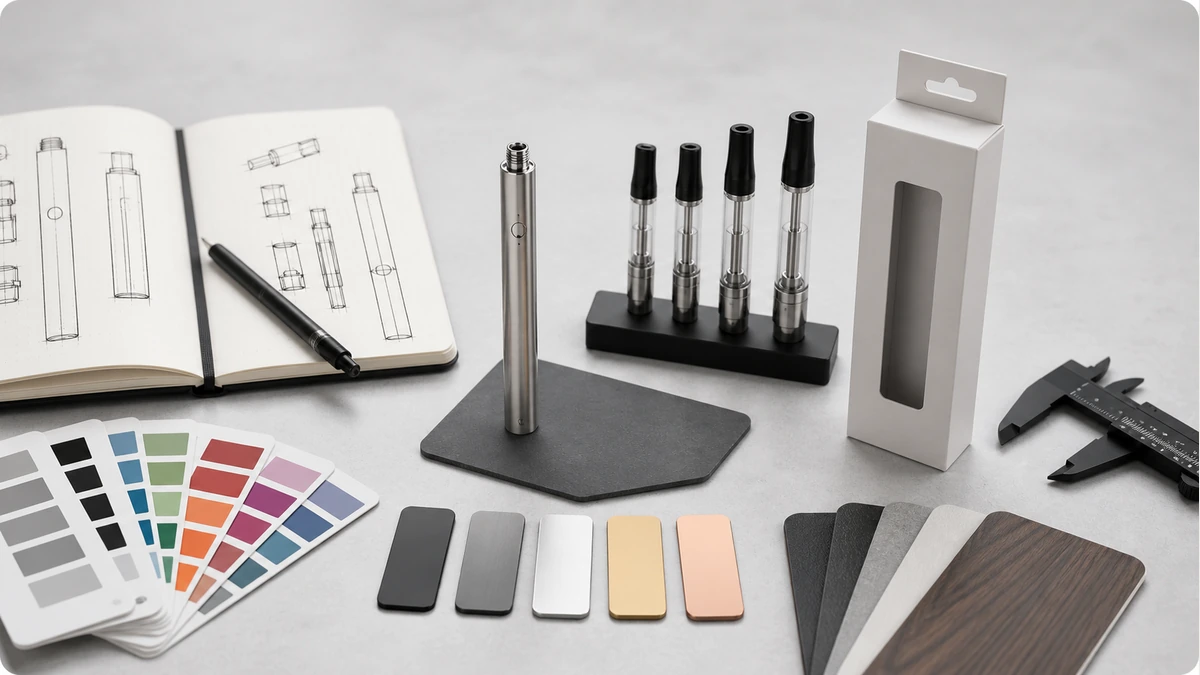
🔎 1. The moment a brand idea has to become a spec sheet
It usually starts with a photo. A brand owner finds a battery shape they like on a competitor’s site, or sketches a rough outline on a napkin during a trade show dinner, and sends it to their supplier with a one-line message: “Can we do something like this, but ours?” That question feels simple. It isn’t. Between a napkin sketch and a battery that ships in a box with your logo on it, there are a dozen decisions that have to be made in a specific order, and most of them have nothing to do with how the pen looks.
A custom vape pen battery project succeeds or fails on the quality of the brief that starts it, not on the artwork or the color story. That document is where a brand owner tells the factory what the device needs to do, what it needs to fit, and what it needs to say on the outside. Skip a line item in that brief and you find out about it three weeks later, when the golden sample arrives and the cartridge you already committed to doesn’t sit flush in the chamber.
This article walks through that brief in the order hardware engineers actually think about it: cartridge first, then enclosure and connector, then the line between what’s cosmetic and what’s electrical, then controls and charging, then the markings and packaging that turn a working device into a sellable one. If you’re new to the category generally, AOVAPE’s vape pen battery guide is a useful primer on how these devices work before you get into customization specifics.
🧩 2. Start with the cartridge, not the shell
The instinct for most first-time buyers is to design the outside of the battery first — pick a shape, pick a finish, then figure out what goes inside it. That’s backward. The cartridge is the constraint everything else has to respect, because the battery’s entire top section exists to hold, align, and power that cartridge. If the cartridge changes after the shell is tooled, the shell is wrong.
🧩 2.1 Diameter and thread engagement
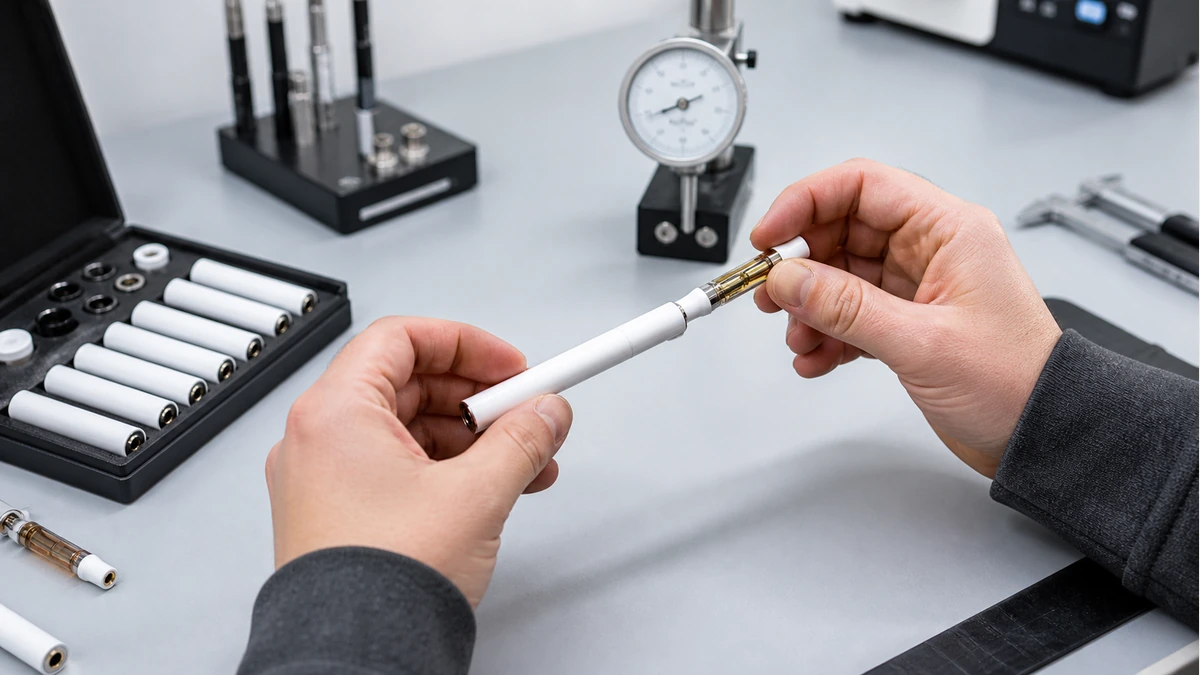
Cartridges from different sources are not interchangeable in the way people assume. The threading might nominally be “510,” but the outer diameter of the cartridge body, the depth of the connector pin, and the width of the mouth all vary from one cartridge supplier to the next. A battery chamber built around one cartridge’s dimensions can leave a visible gap around a different cartridge, or worse, create enough side-to-side play that the connection loosens with handling.
This is also where brand owners get burned by switching cartridge vendors mid-project to save a fraction on unit cost. A cheaper cartridge that doesn’t match the tooled chamber isn’t actually cheaper once you account for the redesign.
🧩 2.2 Connector alignment and airflow path
Beyond diameter, the connector has to align vertically with the cartridge’s pin depth so contact stays consistent, and the chamber has to leave an open path for air to move from the cartridge’s intake to the mouthpiece without being blocked by internal structure or a decorative element that looked fine on a rendering but wasn’t checked against airflow. Engineers call this the cartridge envelope — the three-dimensional space the cartridge occupies plus the clearance it needs to seat and seal properly. Get the envelope right and everything downstream, connector choice, chamber depth, spring tension, becomes straightforward. Get it wrong and no amount of exterior polish fixes a device that doesn’t draw evenly. For a broader look at how connector and thread choices interact with battery performance, AOVAPE’s 510 thread battery complete buying guide covers the mechanics in more depth.
⚙️ 3. What actually changes when you customize appearance
Once the cartridge envelope is settled, the conversation moves to what the brand owner actually came in wanting: a battery that looks like theirs. This part of the brief is genuinely flexible, and it’s worth being precise about what “customization” covers here, because appearance changes and electrical changes are handled by different teams on the factory side, on different timelines.
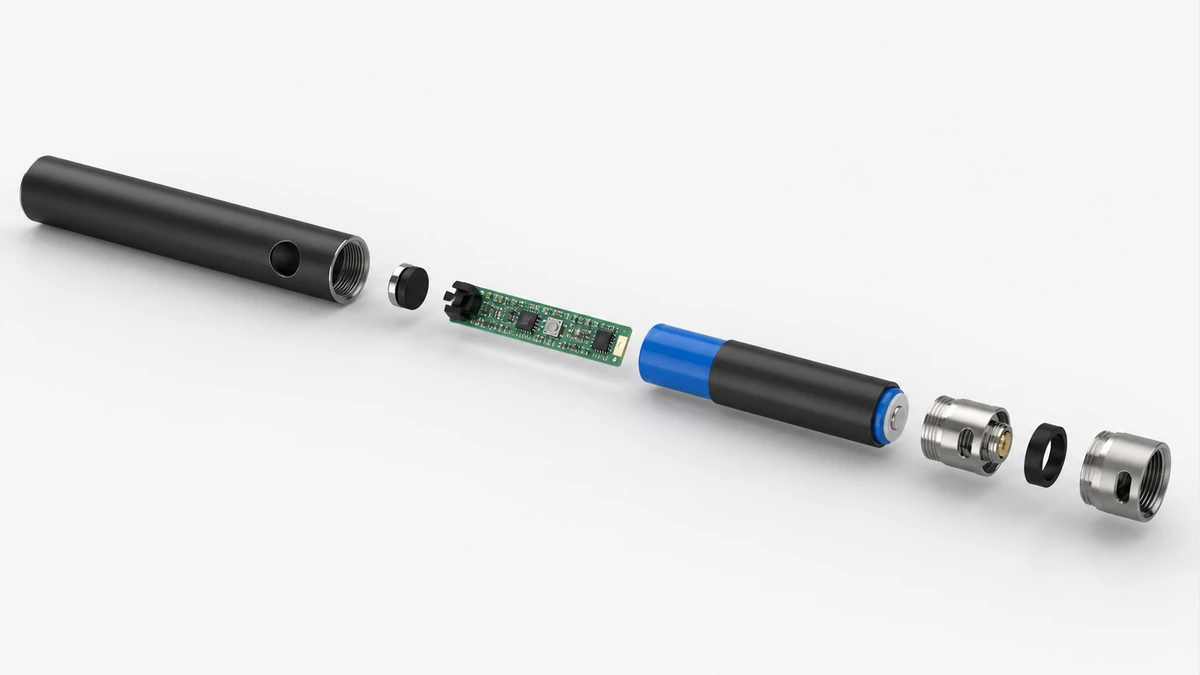
🧩 3.1 Shell, finish, and printing
Appearance customization typically covers the outer shell material (metal, resin, or a composite), the finish (matte, gloss, soft-touch coating, anodized color), and the branding method — laser engraving, pad printing, or a printed wrap under a protective coat. Shape falls into this category too, within limits: a hexagonal barrel instead of a round one, a squared-off base instead of a tapered one, a window cut into the shell to show a battery level indicator. These changes affect tooling cost and lead time, but they don’t touch how the device functions.
Finish choice has practical downstream effects worth flagging in the brief, too. A matte soft-touch coating shows fingerprints and wear differently than an anodized metal finish, and laser engraving reads better on some base colors than others. None of this is a durability claim — it’s simply something to confirm with the factory’s finishing team using physical samples rather than a screen render, since color and texture rarely translate perfectly through a monitor.
🧩 3.2 Where appearance stops and electronics begin
Electrical customization is a different category entirely: output voltage behavior, button function, preheat settings, LED color logic, charging port type, and any pass-through or safety cutoff behavior. These require firmware or circuit-level changes, not just new tooling, and they typically run through their own qualification cycle separate from the cosmetic sample round. A brand owner who assumes that changing the shell color also opens the door to a different voltage curve, without realizing that’s a separate engineering task with its own timeline, is the single most common source of project delay in this category.
🧰 4. Voltage behavior and controls are a different conversation
Where functional customization is involved, voltage behavior and controls are where a battery’s actual identity as a product gets decided.
🧩 4.1 Fixed output vs adjustable
A fixed-output battery delivers one voltage regardless of what the user does, which keeps the device simple, keeps the button count low, and removes a category of user error. An adjustable-output battery gives the user a way to step between voltage levels, usually through a button-press sequence or a dial, which appeals to buyers who want to position the product as more premium or more flexible. Neither approach is inherently better; the right choice depends on the target retail tier and how much the brand wants to invest in user instructions, since an adjustable device only helps if the person holding it actually understands what the settings do.
🧩 4.2 Button cycles, preheat, and LED logic
If the battery has a button, the brief needs to define exactly what each press pattern does: single click to activate, hold to preheat, five rapid clicks to lock, and so on. LED behavior needs the same level of specificity — what color signals a full charge, what signals low battery, whether the light pulses during preheat or stays solid. Left unspecified, these details get decided by the factory’s default firmware, which may not match what the brand wants to tell its customers in the box insert. It’s far cheaper to nail down button logic at the brief stage than to request a firmware change after tooling is already committed.
🔋 5. Charging port, markings, and compliance-adjacent details
Charging port selection is a practical decision with real supply-chain consequences. Whatever port the battery uses needs to be paired with a compatible cable that the brand either sources separately or includes in the box, and the brief should state clearly which of those two paths the project is following.
Markings are the other detail that gets overlooked until it’s urgent. Any text or symbol printed, engraved, or molded onto the battery — brand name, logo, capacity marking, warning text — needs to be specified with exact wording and placement before tooling, because correcting a mold after the fact is slower and more expensive than getting the artwork file right the first time. This is also where a brand owner should confirm with their own legal or regulatory advisor what markings their target market actually requires; that determination sits outside what a hardware brief can settle on its own, and outside what any factory or agency can promise on a brand’s behalf.
🧪 6. The golden sample is the contract
Everything discussed so far — cartridge fit, shell, finish, voltage behavior, button logic, charging, markings — converges into a single physical object: the golden sample. This is the unit both sides agree represents exactly what mass production should replicate, down to the finish texture and the LED color sequence. Once it’s approved, it becomes the reference point for every quality check that follows, so it needs to actually be complete before approval, not a stand-in with placeholder artwork or a temporary firmware build.
🧩 6.1 What to lock before mass production
A golden sample review, done properly, follows a rough sequence:
- Confirm the cartridge seats correctly and the connector makes consistent contact across several insertion cycles.
- Check the shell finish and branding against the approved artwork file, in daylight and under indoor lighting, not just under a supplier’s photo studio lights.
- Run through every button and LED behavior described in the brief and confirm the sample matches, not an earlier draft.
- Test the charging cycle from empty to full using the actual cable that will ship with the product, if one is included.
- Verify all markings, wording, placement, and any required symbols, against the final approved file.
- Sign off in writing, ideally with dated reference photos attached, so there’s a clear record of what “approved” meant if a later production batch drifts from it.
That written sign-off matters more than it sounds like it should. Buyers researching this category online often describe frustration with batteries that arrived looking or behaving differently from what they thought they’d approved, and the recurring thread in those accounts isn’t bad faith on the factory’s part — it’s that the approval step was rushed or informal. A clear, documented golden sample removes most of that ambiguity before it can become a dispute.
📐 7. Packaging and presentation decisions
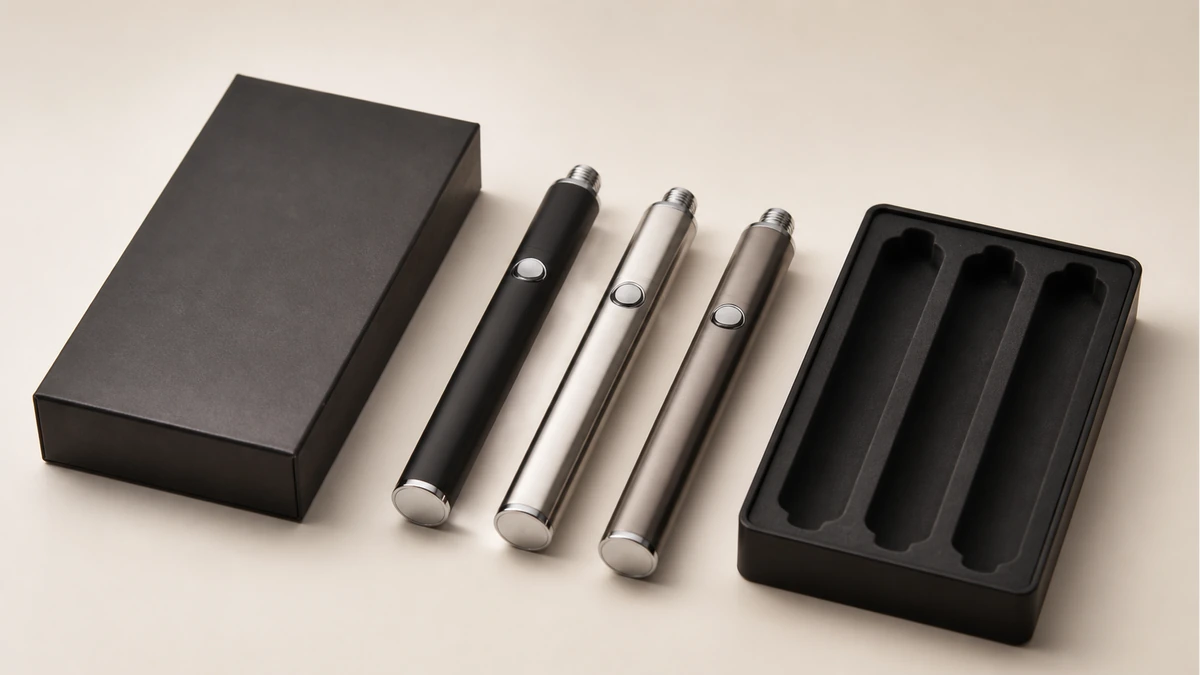
Packaging tends to get pushed to the end of the project timeline, which is a mistake, because box structure, insert design, and any accessory bundling all need to be finalized early enough that they don’t hold up the shipping date after the battery itself is ready. Decide early whether the battery ships alone, with a charging cable, or as part of a kit with cartridges or other accessories, since that decision affects box dimensions, insert layout, and how instructions are written.
Presentation should also match how the product will actually be sold. A battery destined for retail shelf display needs packaging that communicates the brand at a glance; a battery shipping direct to a private-label partner for their own repackaging may need nothing more than protective, unbranded packaging. Brands exploring this path for the first time can find a general overview of how OEM and ODM sourcing works, including where responsibilities typically split between brand and factory, on AOVAPE’s OEM/ODM page.
🧼 8. Frequently asked questions
Does changing the battery’s shell color affect how it performs?
No. Shell color, finish, and printing are cosmetic and don’t touch the circuit or firmware, though a finish change can affect tooling lead time.
Can one custom battery mold fit cartridges from different suppliers?
Only if those cartridges share the same outer dimensions and connector depth. Otherwise the chamber needs to be designed around one specific cartridge from the start.
Is an adjustable-voltage battery automatically better than a fixed-voltage one?
No — it depends on the target buyer and how clearly the brand can explain the settings. A fixed-output device is simpler and leaves less room for user confusion.
What’s the one thing brand owners most often forget to specify in the brief?
Exact button and LED logic. Without a written definition, the factory’s default firmware fills the gap, which may not match what the brand wants printed in its instructions.
A custom battery project isn’t really a design exercise — it’s a specification exercise that happens to end with a nicely finished object. The brands that move through this process smoothly are the ones who settle the cartridge fit first, keep appearance and electrical requests clearly separated, define controls and charging in writing, and treat the golden sample as the actual agreement, not a formality on the way to a bigger order. Get those four things right and the rest of the project — tooling, sampling, production — tends to move the way it’s supposed to.