Search for “empty 510 thread cartridge” and you’ll land in a strange middle ground: hardware listings with sparse specs, forum threads asking whether a cart is “compatible with everything,” and Reddit posts from people whose cartridge stopped drawing oil three days after they filled it. The confusion is understandable. A 510 thread cartridge looks simple from the outside — a small cylinder with a screw-in base — but the internal geometry varies enough between models that “empty” and “compatible” are two very different questions.
This article stays at the component level. It won’t tell you what to put inside a cartridge or how to do it. Instead, it walks through what the hardware actually consists of, why the oil path matters more than the outer thread, and what to look at before you assume an empty cartridge will behave the way you expect.
🧵1. Outer Thread vs. Center Contact: Two Different Compatibility Questions
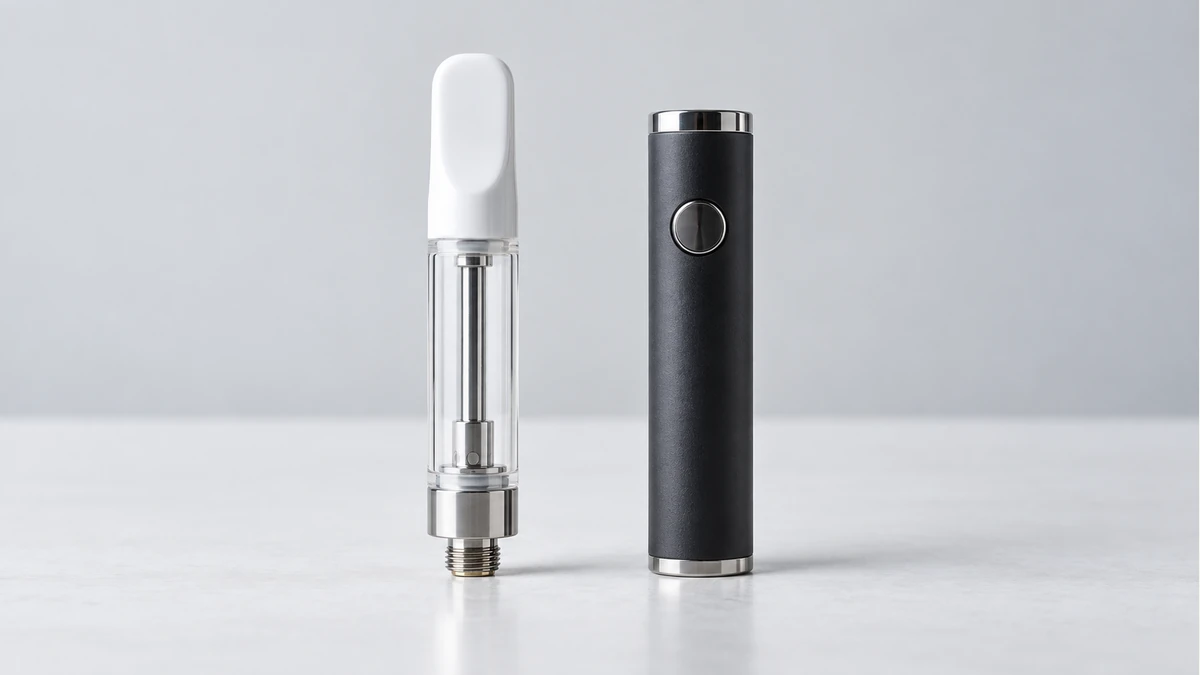
The “510” in 510 thread refers to a screw pattern — a standardized outer thread that lets a cartridge attach to a battery. Because this thread is widely shared across cannabinoid-oil hardware and, confusingly, some nicotine vape hardware, people often assume that if the threads match, everything else will too. That assumption is where a lot of the Reddit confusion comes from: someone assembles a cartridge and battery from two different sources, screws them together, and the fit feels normal even though the cartridge doesn’t perform as expected.
The outer thread only governs mechanical attachment. It says nothing about the center contact pin — the small metal point at the base of the cartridge that completes the electrical circuit with the battery. Contact pins vary in height, spring tension, and sometimes polarity behavior. A cartridge can thread on perfectly and still deliver a weak or inconsistent connection if the pin geometry doesn’t match what the battery expects. This is a common reason people report a cart that “screws on fine but doesn’t hit.”
For readers trying to understand this distinction in more depth, our 510 cartridge guide breaks down thread and contact specifications side by side.
🛢️2. Reservoir Design: Where the Oil Actually Sits
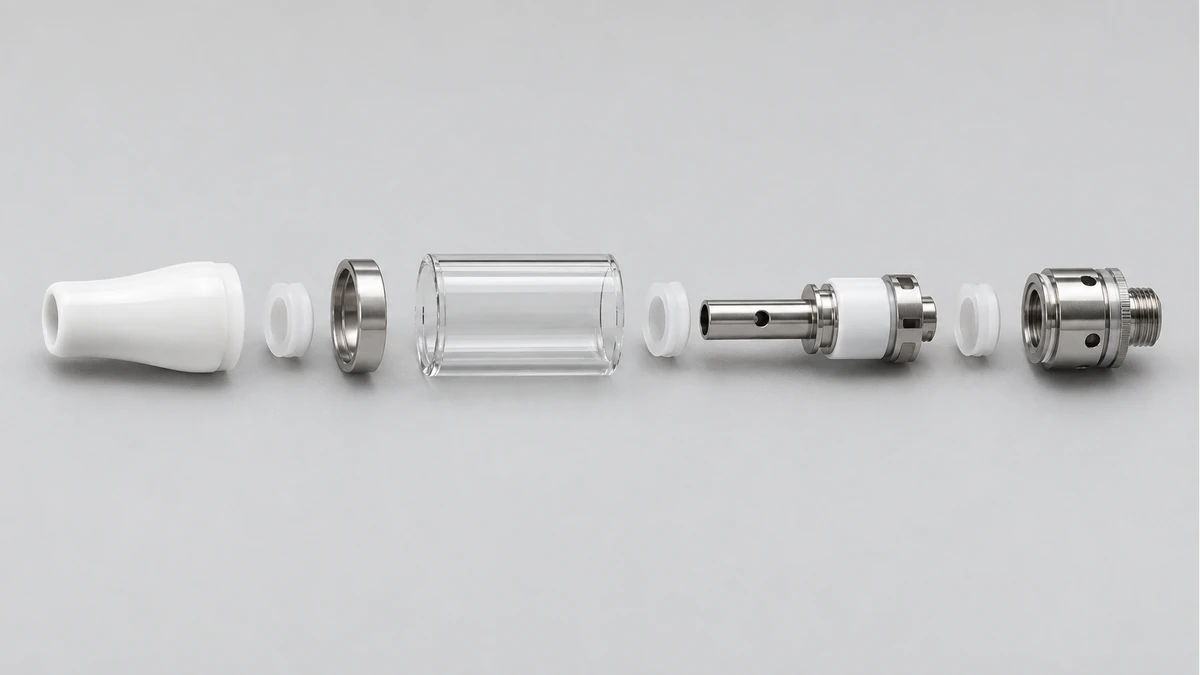
The reservoir is the hollow chamber that holds the oil before it reaches the heating element. On most empty 510 cartridges, this is a ring-shaped cavity surrounding a center air tube, rather than a single open well. The shape of that ring — its width, its depth, whether it tapers near the base — determines how oil behaves as the cartridge is used and as it sits in storage.
Reservoir geometry is one of the areas where nicotine tanks and cannabinoid-oil cartridges diverge the most, even when the outer shell looks similar. Nicotine e-liquids are thin and flow easily, so their tanks are often built with wider wicking channels and different airflow assumptions. Cannabinoid oils tend to be more viscous, and cartridges designed for them typically have narrower reservoir gaps and slower-draining geometry to keep the oil in contact with the wicking element rather than pooling away from it. Using hardware built for one oil type with a formulation it wasn’t engineered around is a frequent source of the leaking and uneven-draw complaints people describe online.
🧵2.1 Nominal Capacity vs. Usable Geometry
Cartridge listings usually advertise a nominal capacity — half a gram, one gram, and so on — based on the reservoir’s total volume. In practice, the usable volume is almost always a little less than that number. Some space near the mouthpiece and center tube is reserved for airflow and to prevent oil from being drawn in liquid form into the airpath. Manufacturing tolerances also mean that two cartridges labeled the same capacity can hold measurably different amounts.
This gap between nominal and usable geometry matters most for people comparing empty hardware across brands. A “half gram” cart from one manufacturer and a “half gram” cart from another are not guaranteed to be interchangeable in real-world fill volume, even if the labels match. Readers specifically evaluating half-gram formats will find more detail on this size class in our half-gram cart hardware guide.
🌬️3. The Center Air Tube and Intake Apertures
Running through the middle of the reservoir is the center air tube, a hollow channel that carries air from the base of the cartridge up to the mouthpiece. This tube is what keeps the airpath separate from the oil reservoir — without it, there would be no clean route for vapor to travel without picking up unvaporized liquid along the way.
Along the lower portion of the cartridge, small intake apertures allow air to enter the tube from outside. Their number, size, and placement affect airflow resistance, which is part of why two cartridges with identical outer dimensions can feel noticeably different to draw from. Some designs use a single larger intake slot; others use several smaller holes spaced around the base. Neither approach is inherently better — it’s a design tradeoff between airflow volume and how tightly the intake can be sealed against oil seepage.
Because the center tube sits in direct proximity to the reservoir, its material and fit tolerances matter. A loosely fitted tube, or one made from a material that reacts with certain oil formulations over time, can become a slow leak path. This is one of the less visible reasons a cartridge that looked fine when empty starts weeping oil around the base after it’s been filled and stored for a while.
🔥4. The Ceramic Core or Porous Wicking Element
At the bottom of the reservoir, oil needs a way to travel from the chamber to the heating coil. Most modern cartridges use a ceramic core or another porous wicking element for this job — a material dense enough to hold its shape under heat but porous enough to let oil migrate through it by capillary action.
The wicking element’s porosity has to be matched to the viscosity of the oil it’s meant to carry. A core designed around a thinner formulation may not draw a thicker oil efficiently, leading to dry hits or scorching at the coil, while a core built for thick oil may oversaturate with a thin liquid and leak. This is the technical heart of why “empty 510 thread cartridge” isn’t a single universal category — the ceramic core inside determines what the cartridge was actually engineered to carry, even though it’s invisible from the outside.
People who post on forums asking why a certain empty cartridge “leaks no matter what” are often unknowingly running into this mismatch rather than a manufacturing defect. It’s an oil-and-hardware pairing question, not just a hardware quality question.
🔍4.1 Material Compatibility Is a Real Question, Not a Formality
Beyond the ceramic core itself, the surrounding materials — o-rings, gaskets, the tube, and any metal contacts near the reservoir — are chosen with certain oil chemistries in mind. Some polymers and rubber compounds can soften, swell, or degrade when exposed to solvents or terpenes over extended contact. This isn’t a claim about any specific product being unsafe; it’s simply why manufacturers publish material compatibility notes and why generic, unbranded empty carts sold without documentation are harder to evaluate. When a listing gives no information about the seal material or the core composition, there’s no way to reason about how it will hold up over time with a given oil formulation.
👄5. Mouthpiece Closure and Its Role in Storage
The mouthpiece does double duty: it’s the point of inhalation, and its fit against the cartridge body is part of the sealing system that keeps oil from evaporating or leaking during storage. A mouthpiece that seats loosely, or one with a worn o-ring, can let air exchange happen at the top of the cartridge even when the base connection is fine.
Some cartridges use a friction-fit mouthpiece that simply presses into place; others use a mouthpiece that’s more firmly integrated into a single molded top piece. The friction-fit style is more common in refillable designs because it allows the cartridge to be opened for filling, but it also means that repeated removal can wear the seal down faster than a fixed top would. If you’re specifically looking at refillable formats, our refillable vape cartridge guide covers how these mouthpiece and seal designs differ from single-use style hardware.
👁️6. Visual Inspection: What to Actually Look For
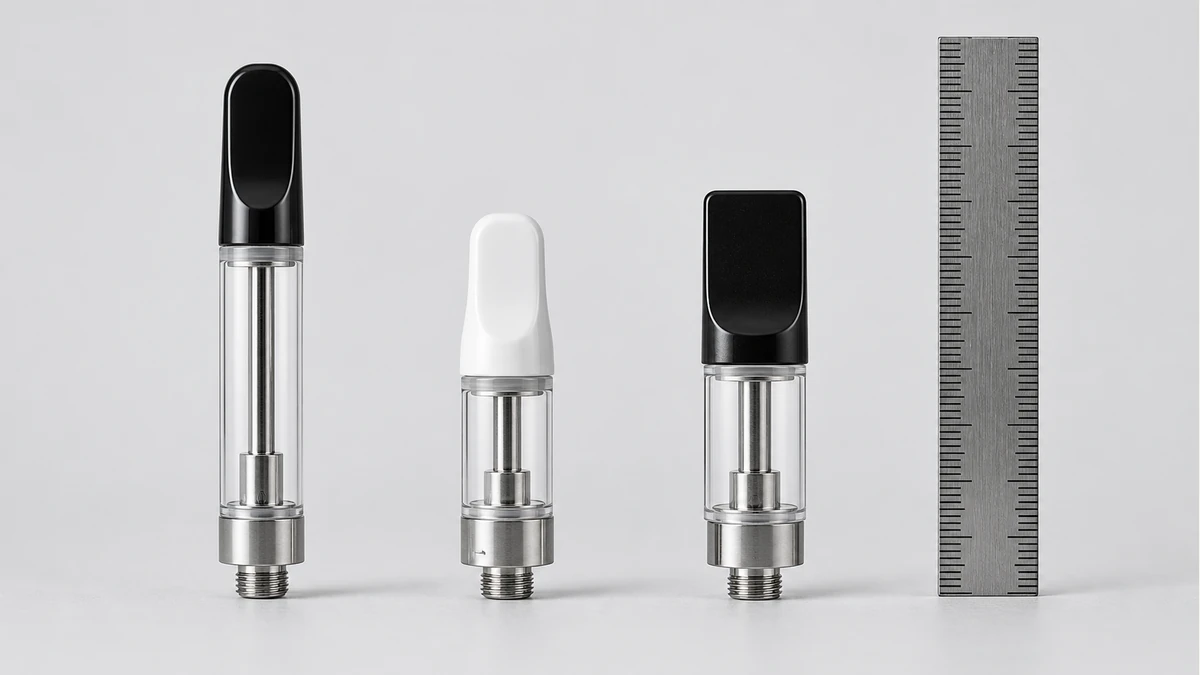
Since so much of a cartridge’s compatibility lives in details that aren’t printed on the packaging, a careful visual check of empty hardware is worth the time. A few things worth examining before assuming a cartridge is ready to use:
- Thread condition — look for stripped or cross-threaded screw patterns from prior handling, which can create a poor battery connection even if the pin itself is fine.
- Center pin height and spring — a pin that sits flush or doesn’t depress slightly under light pressure may not maintain contact once the battery is attached.
- Reservoir clarity — cloudy, scratched, or discolored plastic (on cartridges with a plastic reservoir) can make it hard to gauge fill level later and may indicate the material has already been exposed to something that affected it.
- Core color and texture — a ceramic core that looks uneven, cracked, or has visible residue from a prior fill (on cartridges marketed as new) is worth questioning.
- Mouthpiece seating — it should sit flush without wobble and should not separate with light finger pressure.
- Base seal — check for any oily residue around the threads, which can indicate a returned or previously used unit being resold as empty.
None of this requires special tools, just a slower look than a quick glance under package lighting at a shop counter or a rushed unboxing from an online order.
📦7. Storage Considerations for Empty Hardware
Even before any oil is involved, how empty cartridges are stored affects their condition. Ceramic cores and porous wicking elements can absorb ambient moisture or odors if left unpackaged in a humid environment, which may affect how they perform later. Keeping empty cartridges in their original packaging, in a cool and dry location away from direct sunlight, helps preserve the wicking material and keeps o-rings and gaskets from drying out prematurely.
Temperature swings are also worth minding. Repeated heating and cooling cycles — leaving hardware in a hot car, for instance — can stress plastic reservoirs and seals over time, sometimes leading to hairline warping that isn’t visible until the cartridge is filled and pressure inside the reservoir highlights a weak seam.
🧩8. Why Cartridge and Oil Formulation Are Engineered as a Pair
The recurring theme across the reservoir, the wicking core, the seals, and the airflow design is that none of these components exist in isolation. A cartridge manufacturer designing hardware for a specific oil viscosity, terpene content range, or cannabinoid concentration makes dozens of small decisions — core porosity, intake aperture size, seal material — around that target formulation. Swapping in an oil the hardware wasn’t designed around doesn’t necessarily cause an immediate failure, but it removes the margin the engineering was built with, and that margin is often what separates a cartridge that performs consistently from one that leaks, clogs, or burns unevenly.
This is also why generic marketplace listings that describe a cartridge only by capacity and thread type leave out the information that actually predicts performance. Two “1 gram, 510 thread” cartridges can be built around completely different assumptions about what will go inside them. When quality and specifications are uncertain, as many Reddit threads about marketplace hardware note, the safest approach is to look for documentation about core material, seal composition, and intended oil type rather than relying on capacity and thread size alone.

🔧9. When Hardware Fails: Recognizing Wear vs. Mismatch
People often search for a new empty 510 thread cartridge because an existing one stopped working, and it helps to distinguish between two different failure patterns. Wear-related failure tends to show up gradually — a weaker draw over days or weeks, a core that darkens unevenly, or a mouthpiece seal that loosens with repeated use. Mismatch-related failure tends to show up quickly and consistently — leaking within the first day, a core that never seems to wick properly, or a burnt taste that appears almost immediately regardless of how carefully the cartridge was used.
Recognizing which pattern you’re seeing is more useful than assuming every issue is a defect. A wear pattern usually just means the hardware reached the end of its practical service life. A mismatch pattern is more often a sign that the cartridge’s internal geometry wasn’t suited to the oil it was paired with, and that swapping to hardware built with that oil type in mind — rather than simply buying an identical replacement — is likely to solve the recurring problem.
Understanding an empty cartridge this way — as a small system of interdependent parts rather than a single generic container — makes it much easier to evaluate what you’re buying before you commit oil to it. The thread tells you what it screws onto. Everything else, from the core to the seals to the reservoir shape, tells you what it was actually built to hold.