Search Reddit for “broke my bong” and you’ll find the same confusion over and over. Someone snaps a piece off their setup and isn’t sure if they lost the bowl, the slide, or the downstem. Someone else asks if a cracked joint means the whole piece is trash. A surprising number of people admit they’ve measured a joint by holding a lighter next to it instead of using calipers. None of this is a knock on anyone — glass water pipes have a lot of small, similarly shaped parts, and manufacturers don’t always label them the same way.
Before replacing anything, it helps to know exactly what broke and what its physical fit requirements are. This guide walks through the terminology, the difference between fixed and removable parts, and how to check compatibility without guessing.
🧱 1. Fixed Body vs. Removable Parts
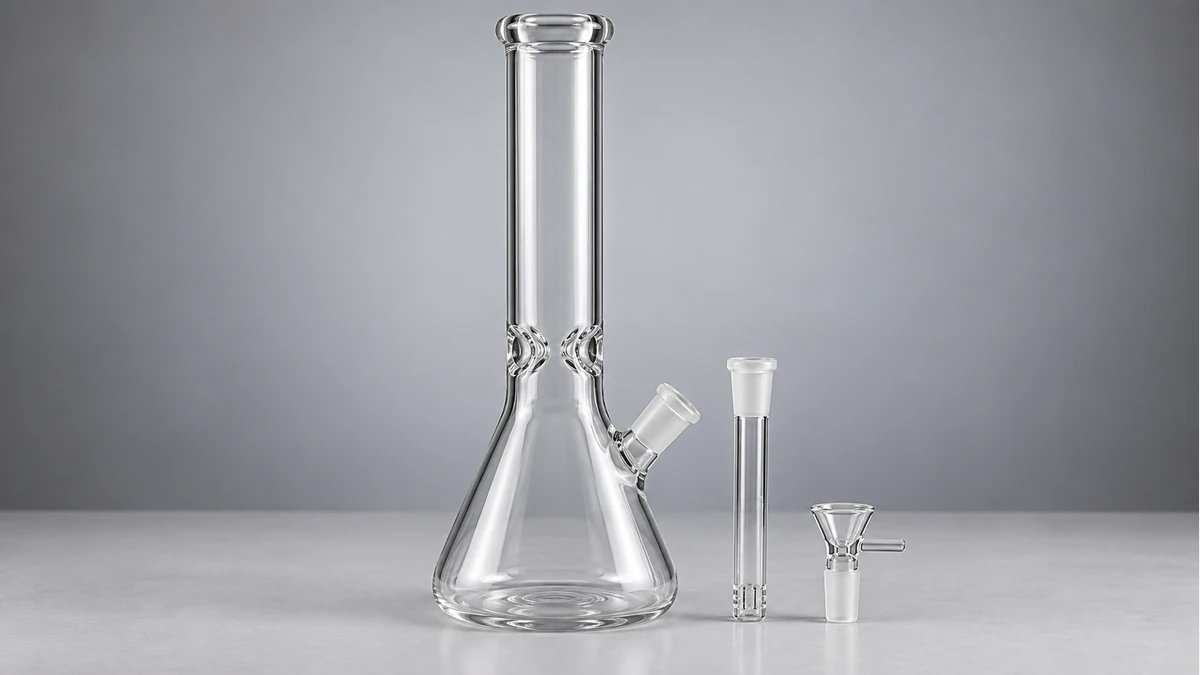
A bong is really two categories of glass working together: the fixed body and the removable accessories. The fixed body is the main tube, base, and any permanently attached features like a fixed downstem or built-in percolator. This part is blown as one piece and can’t be swapped out — if it cracks, the whole unit is generally considered compromised, since there’s no way to isolate the damage from the water-holding chamber.
Everything else — the bowl, the slide, a removable downstem, an ash catcher, or a mouthpiece attachment — is designed to be pulled out, cleaned separately, and replaced independently. This is the distinction that trips people up most on forums: they’ll say “my bong broke” when what actually happened is a small removable piece cracked, and the body itself is fine.
Some bongs are built specifically with modularity in mind, using multiple joints so different sections can be separated and replaced. If you’re not sure which category your piece falls into, this guide to bongs designed to come apart walks through how multi-section designs are typically joined and what that means for replacing individual pieces.
🥣 2. Bowl and Slide: The Most Confused Pair
“Bowl” and “slide” get used interchangeably online, but they’re not identical. The bowl is the cup-shaped piece where dry material sits and is packed. The slide is the full piece that includes the bowl at one end and a stem that inserts into the joint — essentially, the bowl is a feature of the slide, not a separate object in most designs.
Some slides are labeled with a “bowl piece” name because the bowl portion is the visible, functional part users interact with directly, while the stem portion just sits inside the joint. When someone says they need a replacement bowl, they usually mean the whole slide unit, unless they specifically have a two-piece screen or removable bowl insert system.
Material matters here too. Glass slides are the most common, but metal bowls exist as an alternative for durability reasons. If you’re deciding between materials or trying to understand how a metal option compares dimensionally to a glass one, this guide to metal bong bowls covers how those pieces are typically sized and fitted.
🌀 3. Downstem and Diffuser: What’s Underneath the Joint
The downstem is the tube that runs from the joint down into the water reservoir. Its job is to carry smoke below the waterline so it bubbles up through the liquid. A diffuser refers to the perforated or slitted end of the downstem — the part with small holes or notches that breaks up the airflow into smaller bubbles as it passes through the water.
Not every downstem has a diffused tip; some are a simple open tube. When people ask whether their “diffuser” broke, they’re usually referring to the bottom few centimeters of the downstem snapping off, which is a common failure point because that section is thin and exposed to bumps against the base of the bong.
Downstems come in fixed and removable versions. A fixed downstem is fused to the body and can’t be replaced without affecting the whole piece. A removable downstem simply rests in the joint and slides out, which is the version most people are dealing with when they’re shopping for a replacement.
🔌 4. Adapters, Ash Catchers, and Mouthpiece Accessories
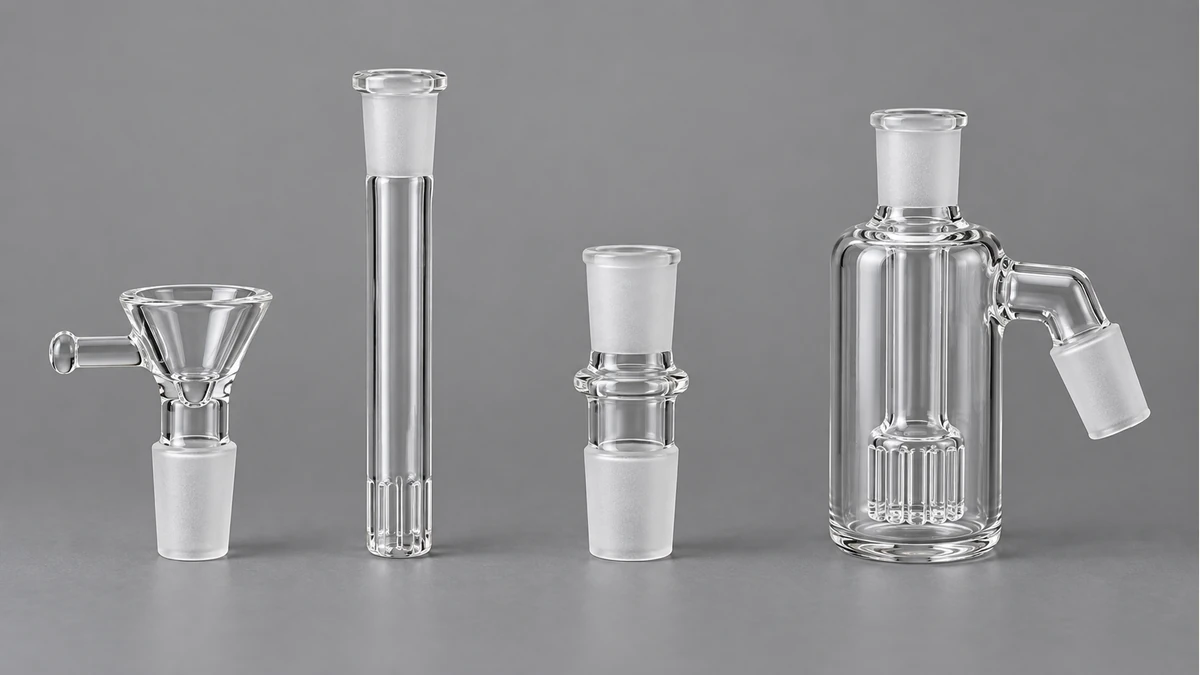
An adapter is a small connector piece used when two joints don’t share the same size or angle — for example, fitting a smaller slide into a larger joint, or changing a joint’s angle from 45 to 90 degrees. Adapters don’t hold water or diffuse smoke; they exist purely to bridge a size or angle mismatch between two other components.
An ash catcher is a separate attachment that sits between the bowl/slide and the main joint. It has its own small water chamber and downstem, designed to catch ash and debris before it reaches the main bong. Ash catchers are common on both bongs and dab rigs, and the joint-sizing logic is similar across both, which is worth knowing if you ever switch a piece between the two. A broader look at how these attachments fit into a full setup is covered in this dab rig parts guide, since rigs and bongs often share compatible ash catcher and adapter sizing conventions.
Mouthpiece accessories — like a removable mouthpiece tip — are less common but do exist on some designs, mainly to make cleaning the very top of the tube easier or to allow a splash guard to be swapped in.
🔗 5. Grommet Joints vs. Ground-Glass Joints
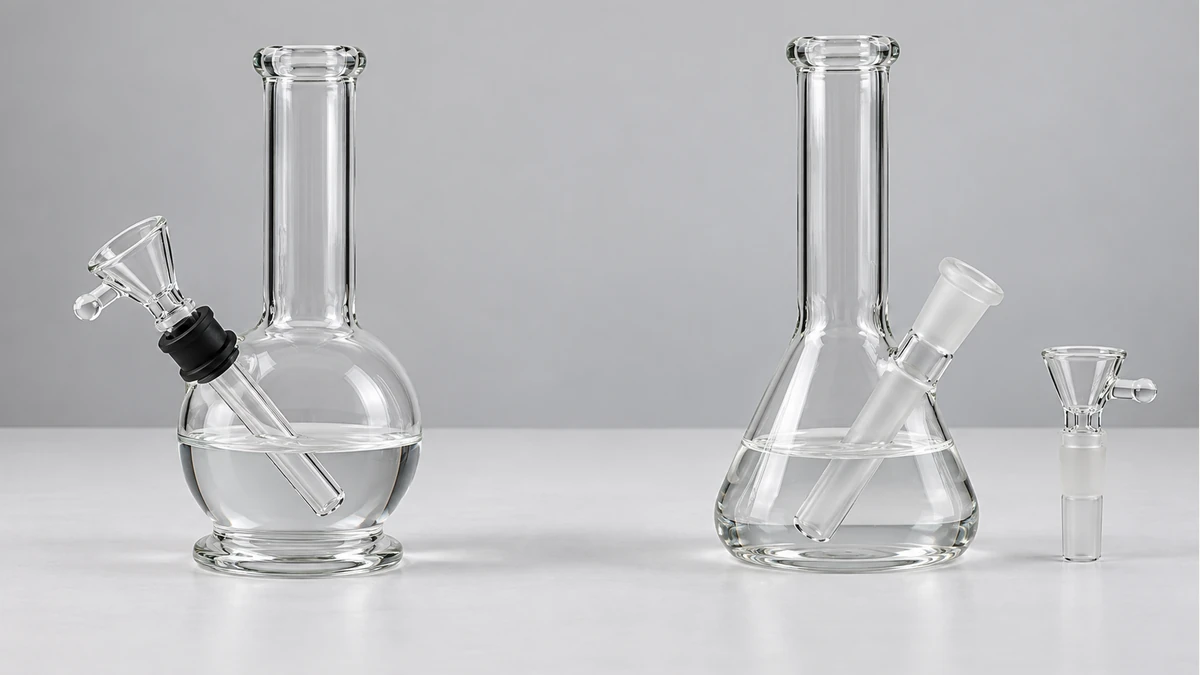
Older or budget bongs sometimes use a grommet joint, where a rubber or silicone ring creates the seal between the downstem and the body, rather than the glass surfaces touching directly. Grommet joints are more forgiving of slight size mismatches because the rubber compresses to fill small gaps, but the grommet itself wears out over time and can crack or lose elasticity.
Ground-glass joints, which are far more common on mid-range and higher-end pieces, rely on two frosted glass surfaces meeting directly to create an airtight seal. There’s no rubber involved. This is why ground-glass joint sizing tends to matter more precisely — a slide that’s even slightly off in diameter either won’t seat properly or will sit loose enough to leak air, since there’s no flexible material to compensate.
Knowing which joint type you have changes what “replacement” even means. A grommet issue might just need a new grommet rather than a whole new downstem, while a ground-glass fit issue usually does mean sourcing a correctly sized glass part.
🧩 6. Joint Gender and Nominal Diameter
Every joint has a gender: male or female. A male joint is the tapered piece that inserts into another component. A female joint is the recessed opening that receives it. On a bong, the main joint on the body is typically female, meaning the downstem or slide’s male end inserts into it. Matching gender correctly is the first compatibility check — a male piece can’t connect to another male piece, and the same goes for two female ends.
Beyond gender, joints are described by a nominal diameter, commonly referenced in millimeters — figures like 10mm, 14mm, or 18mm come up frequently in forum discussions. It’s worth understanding that “nominal” is a general size category, not a guarantee of an exact universal fit across every brand. Manufacturing tolerances mean two pieces labeled with the same nominal size can still fit slightly differently depending on who made them. This is exactly why measuring your actual piece, rather than assuming from a label, is the more reliable approach — something covered in more detail further down.
📐 7. Insertion Depth, Angle, and Clearance
Diameter and gender aren’t the only things that determine whether a replacement part will actually work. Insertion depth — how far the male joint slides into the female one — affects both the seal quality and whether the downstem’s diffused tip sits at the right depth in the water. Too shallow, and the seal may be weak. Too deep, and the piece might bottom out against an internal ledge before it’s fully seated.
Angle is another factor people overlook. Joints are commonly cut at 0 degrees (straight up), 45 degrees, or 90 degrees. A slide meant for a 45-degree joint won’t sit correctly in a 90-degree opening, even if the diameter and gender match perfectly, because the bowl would end up pointing the wrong direction relative to the tube.
Clearance matters for percolated bongs especially. A downstem that’s too long can hit internal percolator arms or the base of the tube, while one that’s too short might not reach below the waterline at all. If your bong has internal percolation, it’s worth checking the internal geometry before assuming a downstem of a given generic length will work.
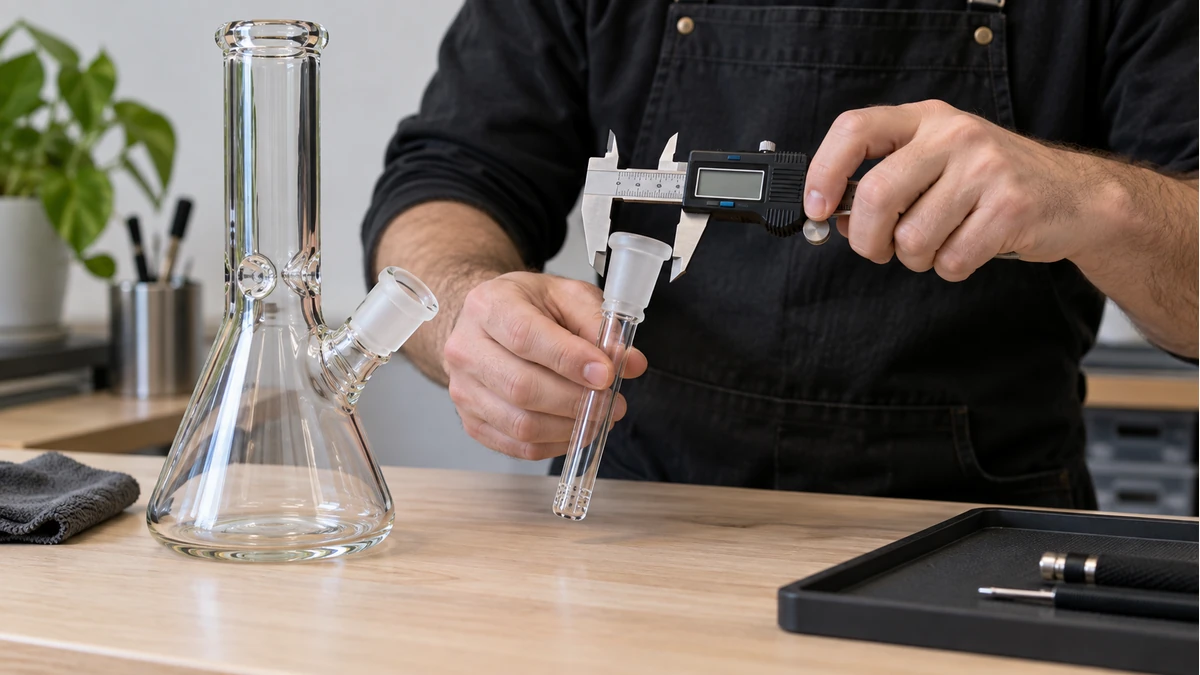
📏 8. Measuring with Calipers, Not a Lighter
Using a lighter, pen, or finger as a rough size reference is common on forums, but it’s not a reliable substitute for an actual measurement. These objects vary in diameter themselves, and “close enough” judged by eye often isn’t close enough for a ground-glass seal, where fractions of a millimeter can be the difference between airtight and leaking.
A basic set of digital or dial calipers gives a far more accurate read. To measure a joint:
- For a male joint, measure the outer diameter at the widest point of the ground-glass section, not including any lip or flare.
- For a female joint, measure the inner diameter of the opening at the same section.
- Note the angle by comparing the joint’s cut against a straight edge, or by checking if it looks flush at 0, angled at 45, or perpendicular at 90 degrees.
- Measure the total length of the piece if insertion depth or percolator clearance is a concern.
Recording these numbers before searching for a replacement saves a lot of back-and-forth guessing, and it’s a more dependable method than relying on brand names or nominal size labels alone.
⚠️ 9. When a Crack Means the Body Should Not Be Used
Not every crack is the same, and this is a common point of confusion in online discussions. A crack on a removable piece — a chip on the bowl’s rim, a hairline fracture on a downstem — usually just means replacing that individual part. A crack on the fixed body, however, is a different situation entirely.
Because the main body holds water and is subjected to temperature changes from smoke passing through it, any crack in that glass creates a structural weak point. Cracks can also spread over time with normal handling, heating, or cleaning, particularly near stress points like the base or joint. A body with a visible crack, even a small one, is generally not something that can be reliably patched or reinforced back to its original condition.
If you’re unsure whether damage is on a removable part or the fixed body, go back to the distinction from the first section: anything that lifts out on its own is replaceable, and anything that’s fused into the main tube is not. When in doubt about a crack’s location or severity, it’s reasonable to set the piece aside and inspect it more closely in good lighting before continuing to use it.
Identifying the actual broken part — rather than assuming the whole piece needs replacing — comes down to a few habits: understanding which sections are fixed versus removable, checking joint gender and angle before diameter, and measuring with calipers instead of eyeballing it. Once you know exactly what you’re looking at, finding a compatible replacement becomes a much more straightforward process.