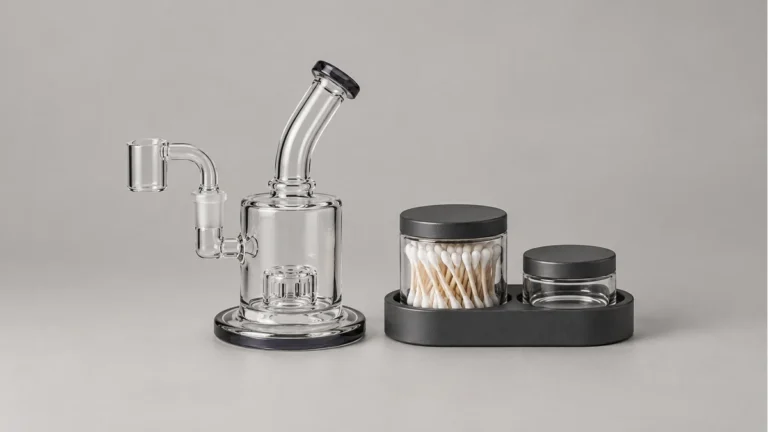
🔩 1. What Is a Vape Battery 510?

A vape battery 510 is a rechargeable, battery-powered device that supplies regulated electrical current to an oil cartridge via a standardized threaded connection. The “510” designation refers to a threading specification — 10 threads at 0.5mm pitch — that has become the universal connection standard across the cannabis oil cartridge industry.
Because the standard is universal, a 510 thread vape battery from one manufacturer will physically connect to and power cartridges from virtually any other brand. This interoperability is the primary reason the 510 format has dominated the oil cartridge segment for over a decade.
- 🔗 Universal threading — 10 threads at 0.5mm pitch; fits virtually all oil cartridges
- 🔋 Rechargeable lithium-ion cell — typically 280–1000 mAh depending on form factor
- ⚡ Variable voltage output — typically 2.4V–4.2V, controlling heat delivered to the cartridge coil
- 🔌 USB-C charging — standard on quality designs in 2026
- 📏 Compact body — pen-style, palm-style, concealed, or object-disguise form factors
📌 The 510 battery vape does not generate vapor itself. The heating element (atomizer coil) is inside the cartridge. The battery’s role is to deliver consistent, controlled electrical energy to that coil — which then heats the oil to its vaporization temperature. Voltage is the primary control variable: higher voltage delivers more energy to the coil, producing more heat and more vapor per draw.
Readers can explore AOVAPE’s complete 510 thread battery lineup, the vape cartridge range, and the CBD vape pen collection for hardware options across this format.
⚡ 2. How a 510 Thread Battery Actually Works

Understanding the hardware requires understanding what happens between button press and vapor delivery. The 510 thread battery vape is not a passive connector — it is an active power management device built around a lithium-ion cell and a control circuit.
🔋 2.1 The Battery Cell
The cell is a lithium-ion unit rated in milliampere-hours (mAh). This rating describes how much charge the cell stores — and by extension, how long it can power a cartridge coil before needing to recharge. Capacity directly affects session count per charge:
| Capacity | Typical Session Count | Best For |
|---|---|---|
| 280–350 mAh | 80–120 puffs | Slim pen-style, occasional use |
| 400–550 mAh | 150–200 puffs | Daily moderate use, balanced size |
| 600–1000 mAh | 250–400+ puffs | Heavy use, all-day sessions, travel |
A larger cell requires a physically larger device body. This is the fundamental tradeoff between discreet vape battery 510 designs (smaller cell, more compact) and high-capacity models (larger cell, longer runtime).
⚙️ 2.2 The Control Circuit
Between the cell and the 510 threading sits a circuit board that manages voltage output, activation logic, and safety functions. This circuit is responsible for:
- 🎛️ Voltage regulation — maintaining consistent output at the selected voltage level regardless of cell charge state
- 🔁 Activation detection — either reading button input or detecting airflow through a pressure sensor (draw activation)
- 🛡️ Safety cutoffs — short-circuit protection, overcharge/over-discharge protection, overheat detection, and timed auto-shutoff
- 💡 Status indication — LED or display feedback on voltage level, battery state, and activation confirmation
💡 The quality of this circuit determines how consistently the battery delivers its rated voltage to the cartridge coil under real-world conditions. A poorly regulated circuit produces inconsistent draws even when the voltage setting does not change — a common quality differentiator between budget and mid-range 510 vape batteries.
🔗 2.3 The 510 Connection
The 510 threading itself is the physical interface between battery and cartridge. A quality 510 connection uses a spring-loaded center pin that maintains consistent electrical contact even with slight variations in cartridge thread depth. A worn, corroded, or fixed center pin causes intermittent connection failures — the most common hardware failure mode in this product category.
📌 Regular cleaning of the 510 threading with a dry cotton swab prevents oil residue buildup that degrades connection quality over time. This simple maintenance step extends the functional life of any rechargeable vape battery 510 significantly.
🌡️ 3. Voltage and Its Effect on Oil Vaporization

Voltage is the primary performance variable in any vape pen battery 510. Because the heating element is inside the cartridge rather than the battery, the battery controls heat delivery indirectly — by regulating how much electrical energy it sends to the coil. More voltage = more current through the coil resistance = more heat generated = more vapor per draw.
The relationship between voltage and vapor quality is not linear. Different oil types, coil resistances, and cartridge designs perform best at different voltage levels:
| Voltage Range | Vapor Character | Best Oil Type |
|---|---|---|
| 2.4–2.8V | Light, cool, highly aromatic | Live resin, high-terpene full-spectrum, CBD |
| 2.8–3.2V | Balanced flavor and vapor density | Standard distillate, most everyday cartridges |
| 3.2–3.8V | Denser vapor, stronger extraction | Thick distillate, high-viscosity oil |
| 3.8–4.2V | Maximum vapor density, warmer draw | RSO, very thick concentrate oils |
💡 The practical takeaway: lower voltage preserves terpene complexity and produces smoother, more flavorful vapor. Higher voltage produces denser, more potent output at the cost of some aromatic nuance — and risks burning thinner oils if set too high for the cartridge type.
🎛️ 3.1 Fixed Presets vs. Variable Voltage
Most 510 vape batteries offer one of three voltage control designs:
- 🟢 Fixed single voltage — simplest design; one output level; no adjustment. Reliable for users who always use the same cartridge type.
- 🟡 3-preset variable voltage — cycles through Low / Mid / High via button presses. The most common design in the mid-range vape battery 510 category. Covers most everyday use cases. AOVAPE’s Law, MAW, and B1 are examples of this design.
- 🔴 Continuous variable voltage — adjustable in fine increments (typically 0.1V steps) across the full range. Best for users who run multiple cartridge types at different viscosities. AOVAPE’s Vertex and Pro 45S offer multi-level voltage control in this direction.
📌 Always start at the lowest voltage setting and increase gradually when trying a new cartridge. This protects the coil, prevents burnt hits, and helps identify the optimal setting for each specific oil.
🗂️ 4. Types of 510 Vape Batteries by Form Factor
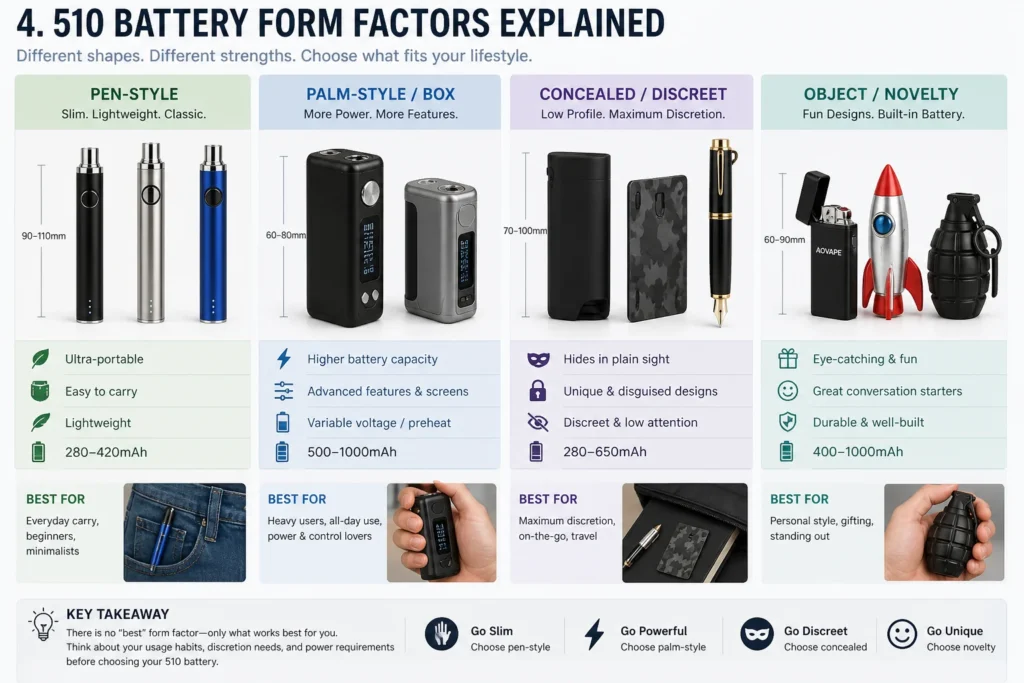
One of the most important distinctions in the vape battery 510 category is form factor. Body shape, size, and design architecture are not purely cosmetic — they reflect meaningful decisions about cell capacity, heating path, activation method, and intended use context.
✏️ 4.1 Pen-Style (Slim / Cylindrical)
The classic vape pen battery 510 format. Slim, cylindrical, and pocket-friendly. This form factor prioritizes portability over raw capacity — the slim profile limits how large a cell can be housed inside. Pen-style designs are the most widely sold format in the 510 category and serve as the entry point for most new cartridge users.
- 📏 Most portable and minimal format — disappears in a shirt pocket
- ⚙️ Typically simple controls — one button or draw-activated
- 🔋 Smaller cell capacity — 280–450 mAh typical
- 💰 Generally the most affordable tier in the 510 battery market
AOVAPE’s B1, V1, and MAW represent this format — reliable threading, compact build, and straightforward operation for daily cartridge use.
🧱 4.2 Box Mod / Palm-Style
Wider, flat-bodied designs that sit naturally in the palm. The increased volume compared to pen-style allows for larger cell capacity (typically 500–1000 mAh), more sophisticated circuit electronics, and optional display integration. These designs trade some portability for extended runtime and more feature-rich performance.
- 🔋 Higher capacity — 500–1000 mAh; all-day use without recharging
- 🖥️ Often includes LED display or OLED screen for voltage and battery status
- 🎛️ More likely to feature fine-increment variable voltage control
- 📦 Less minimal than pen-style — slightly larger pocket footprint
AOVAPE’s Pro 45S and Vertex represent this direction — multi-voltage output, preheating function, and a solid build suited to daily heavy use.
🕵️ 4.3 Concealed / Discreet Designs
Devices with a housing that fully encloses the cartridge inside the device body, hiding it from view. Unlike standard pen-style designs where the cartridge sits exposed above the battery, a discreet vape battery 510 keeps the entire cart concealed — providing both a lower visual profile and physical protection for the cartridge from light exposure and impact.
- 🫙 Cartridge sits fully inside the device body — not visible externally
- 🌞 Protects oil from UV light degradation — improves oil longevity
- 💨 Often paired with auto-draw (buttonless) activation for maximum stealth
- 🧲 Many designs use magnetic cartridge loading for fast, silent swaps
AOVAPE’s Law and cRoll are examples of low-profile concealed designs within the AOVAPE 510 lineup. For a broader look at the discreet category, the full 510 thread battery collection includes options across concealment levels.
🌈 4.4 Color Variants and Aesthetic Options
The functional design of a cute vape battery 510 is identical to its standard counterpart — the same threading, the same voltage system, the same charging interface. Color variants and finish options allow users to personalize their daily carry device without sacrificing performance.
- ⬛ Black — most common; neutral and professional
- 🔵 Blue — popular everyday carry finish
- 🔴 Red — bold but still compact
- 🟡 Gold — premium aesthetic
- 🟣 Purple — popular choice for expressive daily carry
AOVAPE’s cRoll and Valen are available in multiple color finishes while maintaining the same performance specifications across variants.
🔌 5. Charging: USB-C and Best Practices
Charging design is a hardware detail that significantly affects daily convenience and long-term battery health. In 2026, vape battery 510 USB C charging is the standard for quality-positioned products — and for practical reasons that extend beyond convenience.
⚡ 5.1 USB-C vs. Legacy Charging Methods

| Charging Type | Typical Charge Time | Cable Availability | Durability |
|---|---|---|---|
| USB-C | 60–90 minutes | Universal — same as phones/laptops | High — rated for 10,000+ insertions |
| Micro-USB | 90–120 minutes | Widely available but becoming obsolete | Moderate |
| Screw-in adapter | 60–120 minutes | Proprietary — easily lost | Low — threads wear with repeated use |
A vape battery 510 charger using a screw-in adapter (which threads onto the 510 connection itself) is still found on older budget designs. These function adequately but require carrying a proprietary cable and wear down the 510 threading with repeated use. USB-C eliminates both problems.
🛡️ 5.2 Charging Best Practices
Proper charging habits extend the usable lifespan of any rechargeable vape battery 510 significantly:
- ⛔ Do not charge overnight — sustained overcharging degrades lithium-ion cells; disconnect once full
- ⛔ Do not fully discharge — recharge at approximately 20% remaining to avoid deep discharge stress on the cell
- 🔍 Inspect before charging — check for physical damage, corrosion, or deformation before connecting power
- ✅ Use the correct cable — USB-C ports require USB-C connectors; forcing the wrong connector permanently damages the port
- 🌡️ Charge at room temperature — avoid charging in hot cars or in direct sunlight; heat accelerates cell degradation
📐 6. Activation Methods: Button vs. Auto-Draw
Activation method is a design variable that affects both daily user experience and stealth. The two standard approaches in the 510 battery vape category each have distinct hardware implications:
| Activation Type | How It Works | Best For | Stealth Level |
|---|---|---|---|
| Button-activated | Hold button while inhaling to fire | Precise session control; experienced users | Moderate — audible click |
| Auto-draw (draw-activated) | Inhalation triggers airflow sensor to fire | Beginners; discreet use; public settings | High — completely silent |
| Dual activation | Supports both button and auto-draw modes | Versatile daily carry; adapts to any context | High when in auto-draw mode |
💡 Auto-draw activation is driven by a pressure sensor inside the device body that detects the slight negative pressure created when the user inhales. There is no moving mechanical part — it is entirely electronic. The practical advantages for a discreet 510 thread battery are clear: no visible button operation, no audible clicks, and a more natural draw behavior that mimics a cigarette or disposable vape.
🛒 7. Sourcing and Where to Buy a Vape Battery 510
The vape battery 510 for sale market in 2026 spans a wide range of retail and wholesale channels. Understanding the options helps both individual buyers and wholesale/OEM purchasers make better sourcing decisions.
- 🌐 Online retailers like AOVAPE — Best selection across all price tiers. Full spec comparison. Buy vape battery 510 at wholesale pricing with MOQ-flexible ordering. Discreet packaging and shipping. Vape battery 510 free shipping available on qualifying orders. Browse the full 510 thread battery catalog.
- 🏪 Local vape shops — Good for handling devices in person before purchasing. Staff advice on compatibility. Limited wholesale pricing.
- 💊 Cannabis dispensaries — Convenient when purchasing alongside cartridges. Selection is limited but products are typically vetted.
- 🖥️ Online marketplaces — 510 vape battery Amazon and eBay listings offer wide variety including budget options. Verify seller credentials and return policies carefully.
For wholesale and OEM buyers building a brand discreet 510 battery or a private-label 510 battery line, AOVAPE offers full OEM/ODM services — logo printing, custom color matching, packaging design, heating element customization, and MOQ-flexible production. Explore the Shatterizer manufacturing case study for a documented example of development and repeat production.
🏭 8. Hardware Design Considerations for OEM and Wholesale
From a product development and wholesale sourcing perspective, the vape battery 510 category presents clear opportunities alongside important technical constraints. The most important design decision at the OEM level is system-level matching: the battery circuit, voltage range, activation system, and connection hardware must be engineered as a matched unit. A circuit designed for a fixed 3.7V output cannot simply be reconfigured to offer 0.1V-increment variable voltage without redesigning the control board.
Common OEM design variables include:
- ⚡ Voltage output range and adjustment system — fixed, 3-preset, or continuous variable
- 🔋 Cell capacity selection — balanced against target device dimensions and form factor
- 💨 Activation system — button, auto-draw, or dual activation with pressure sensor sensitivity tuning
- 🔌 Charging interface — USB-C standard for quality market positioning
- 🧲 Connection system — standard 510 threading vs. magnetic adapter for concealed designs
- 🎨 Exterior shell material and finish options — anodized aluminum, ABS, zinc alloy, leather wrap
- 💡 Display / indicator design — LED pips, OLED screen, or no display (stealth)
- 🛡️ Safety circuit specification — overcharge, over-discharge, short-circuit, overheat, auto-shutoff
Brands and wholesale buyers looking to develop a custom 510 thread battery line can explore AOVAPE’s OEM/ODM program or browse the full 510 battery catalog as a reference for form factor and specification decisions.
🛡️ 9. Safety Design and Quality Indicators
Safety and reliability design in the vape battery 510 category is important because these devices involve active battery management and precision voltage delivery — two systems where poor engineering creates real failure risks during daily use.
Quality indicators to evaluate in any 510 vape battery:
- ⚡ Short-circuit protection — prevents current surge if the cartridge coil shorts
- 🔋 Overcharge protection — cuts off charging current when the cell reaches full capacity
- 🔋 Over-discharge protection — prevents cell voltage from dropping below safe minimum
- 🌡️ Overheat cutoff — shuts down output if the device body temperature exceeds safe limits
- ⏱️ Timed auto-shutoff — prevents extended unattended firing (typically 8–15 seconds per draw)
- 🔒 Child-lock / travel lock — 5-click power on/off prevents accidental activation in pockets or bags
📌 The auto-shutoff timer is an often-overlooked quality signal. Budget 510 batteries sometimes lack this protection or implement it inconsistently. A battery that allows continuous firing beyond 15 seconds risks overheating the cartridge coil and degrading oil quality — or in worst cases, damaging the device. AOVAPE’s Pro 45S and Vertex include full safety circuit implementations across these parameters.
📊 10. Practical Evaluation Checklist
| Evaluation Area | Why It Matters | What to Check |
|---|---|---|
| Voltage range | Determines compatibility with different oil types | Fixed / 3-preset / continuous variable; min-max range |
| Cell capacity | Determines sessions per charge | mAh rating relative to form factor and use pattern |
| Activation method | Affects daily convenience and stealth | Button / auto-draw / dual activation |
| Charging interface | Daily convenience and cable ecosystem | USB-C preferred; screw-in adapter is older-tier |
| Connection hardware | Affects reliability over repeated cart changes | Spring-loaded center pin; threading quality |
| Safety circuit | Protects cell, coil, and user | Short-circuit, overcharge, overheat, auto-shutoff |
| Form factor | Determines portability and stealth profile | Pen / palm / concealed / object-disguise |
✅ This checklist applies whether evaluating a vape battery 510 for personal use, retail selection, or OEM sourcing. The fundamentals of voltage system, connection quality, and safety design are consistent across all contexts.
❓ FAQ: Vape Battery 510
What is a vape battery 510?
A vape battery 510 is a rechargeable, battery-powered device built around the 510-thread connection standard — 10 threads at 0.5mm pitch — that powers oil cartridges containing CBD, THC distillate, live resin, or similar cannabis concentrates. The battery delivers controlled electrical current to the cartridge’s internal coil, which converts that energy into heat and vaporizes the oil.
What does the “510” in 510 thread battery mean?
The “510” refers to the threading specification: 10 threads at 0.5mm pitch. This threading dimension became the dominant industry standard in the vaping industry because it was widely adopted by early cartridge manufacturers, creating a universal connection that works across virtually all brands.
What is the best voltage for a vape battery 510?
For most standard distillate cartridges, 2.8–3.2V is a practical starting point. For live resin or high-terpene oils, lower voltage (2.4–2.8V) preserves terpene complexity. For thick, high-viscosity oils, higher voltage (3.4–4.0V) is needed to heat the material properly. Always start at the lowest setting and increase gradually with any new cartridge.
How long does a 510 vape battery last on a charge?
A 500 mAh rechargeable vape battery 510 typically delivers 150–200 puffs — enough for most moderate users to get through a full day on a single charge. Long-term cell life across months depends heavily on charging habits: avoid overnight charging and avoid draining the cell fully before recharging.
What is the difference between a vape pen battery 510 and a standard vape pen?
Functionally, these terms often describe the same device. A “510 battery” refers specifically to the power unit with universal 510-thread connection. A “vape pen” is a general term that typically describes a 510 battery in slim, pen-style form factor. The two terms are used interchangeably throughout the industry, though “510 battery” is the more technically precise designation.
Can I use a 510 thread battery with CBD cartridges?
Yes. A 510 thread vape battery works with all standard 510-thread cartridges including CBD, Delta 8, Delta 9, THCa, HHC, and full-spectrum oil. For CBD specifically, lower voltage settings (2.4–3.0V) are recommended to preserve cannabinoids and terpenes for the cleanest, most flavorful experience. AOVAPE’s CBD vape pen range is purpose-designed for oil-format cartridge use.
What safety features should a quality 510 vape battery have?
Quality hardware includes short-circuit protection, overcharge and over-discharge protection, overheat cutoff, timed auto-shutoff (8–15 seconds per draw), and a power lock function (typically 5-click activation/deactivation) to prevent accidental firing in pockets or bags.
Where can I buy a vape battery 510?
AOVAPE carries a full range of 510 thread batteries across all form factors and price tiers — pen-style, palm-style, concealed, and color variants — with wholesale pricing, discreet shipping, and OEM customization available. Local vape shops, cannabis dispensaries, and online marketplaces are also options depending on location and purchasing volume.
📌 Final Thoughts
The vape battery 510 is a broader category than its name suggests. It encompasses slim pen-style designs and high-capacity palm-style mods, concealed discreet devices and object-disguise stealth batteries, entry-level fixed-voltage units and precision variable-voltage systems with OLED displays — each optimized for different use contexts, oil types, and user priorities.
What unifies them is the core principle: a regulated lithium-ion power system delivering controlled voltage through a universal 510-thread connection to an oil cartridge coil, converting electrical energy into heat and ultimately into vapor. The voltage system, connection quality, activation method, and safety circuit are where real differentiation happens — and they are the most important factors to evaluate when choosing, sourcing, or designing a 510 thread vape battery.
For broader supporting context, readers can review the AOVAPE homepage, the full 510 battery product range, the complete vaporizer catalog, the OEM/ODM program, the blog archive, and the contact page.