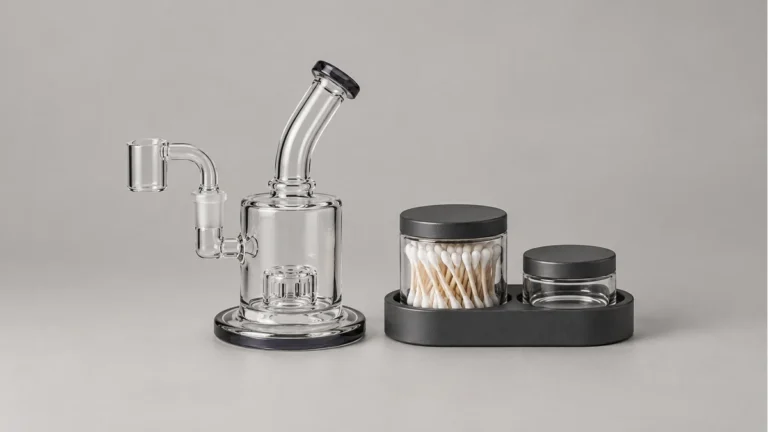
A brand development lead unboxes a cartridge sample from a new supplier, and it looks flawless: even glass, a crisp metal finish, a mouthpiece that clicks into place with a satisfying snap. Three weeks later, the first production lot arrives, and something is off. The draw feels tighter on some units, looser on others. A handful of carts weep oil around the mouthpiece within days. The supplier insists nothing changed. Technically, they may be right — the coil, the glass, the packaging all look the same on paper. But “the same on paper” is exactly the problem, because the paper never specified enough to catch the change.
This is the gap that separates a good-looking sample from a hardware partner you can actually reorder from. Cartridge hardware is a small, dense object with a lot of interacting tolerances, and most of what determines consistency is invisible in a photo or a spec sheet summary. Brands qualifying vape cartridge manufacturers need to get past the sample and into the details that actually govern repeatability: what materials are disclosed, how dimensions are controlled, how the unit seals, how it behaves with the buyer’s own oil, when it gets capped, and how changes are tracked once production starts.
🔍 1. What cartridge specifications should actually cover
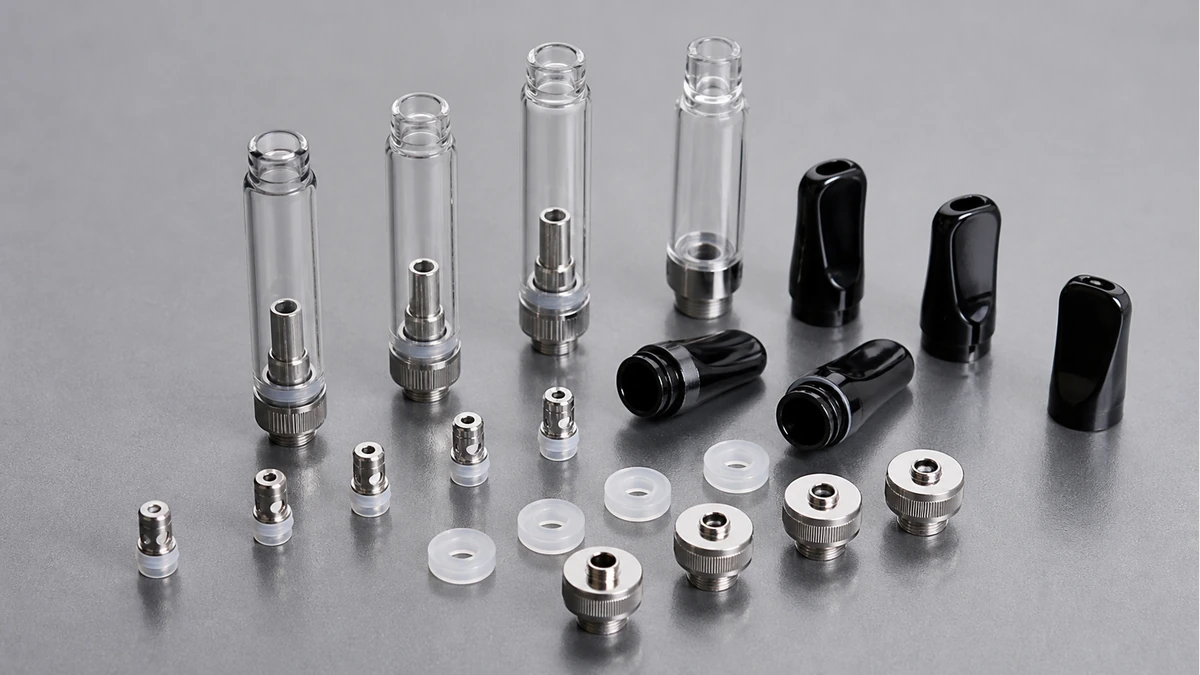
A spec sheet that lists “glass tank, ceramic coil, 510 thread” is a marketing summary, not a specification. It tells a buyer almost nothing about how the cartridge will behave once it is filled, transported, and used. A specification worth qualifying a manufacturer on needs to name the actual materials in contact with the oil and the vapor path, not just the category of part.
🧩 1.1 Material disclosure that matters
At minimum, a manufacturer should be willing to disclose:
- The alloy used in the connector pin and threading, and whether it is plated (and with what)
- The coil material — ceramic, cotton-wrapped, or another wicking medium — and the wire type underneath it
- Whether the tank body is glass, and if so, borosilicate or another formulation; or whether it’s a plastic or resin body, and which polymer
- The material and durometer of any O-rings or gaskets used in the seal
- Whether the mouthpiece is glass, metal, plastic, or a composite, and how it’s finished
None of this is exotic information. A manufacturer that has genuine control over its own process can produce this list without hesitation, because they already track it internally for their own quality control. Hesitation, vagueness, or a refusal to name specific materials — beyond reasonable confidentiality around proprietary formulations — is itself informative. It usually means the manufacturer is sourcing components from multiple sub-suppliers without tight incoming inspection, which is exactly the condition that produces lot-to-lot drift.
Buyers who want a clearer mental model of what’s actually inside a cartridge, and how the parts relate to each other, will find it useful to work through a cartridge anatomy breakdown before writing a spec request, since it’s much easier to ask precise questions once you know what each component does.
🧩 2. Dimensional control: where tolerance breaks a supply chain
Material disclosure tells you what the cartridge is made of. Dimensional control tells you whether every unit in a production run is actually the same shape. This is where most quiet failures originate, because a cartridge that is 0.1mm off on a bore diameter or thread pitch can still look correct and still thread onto a battery — it just won’t seal, draw, or heat the same way as a unit that’s in spec.
The dimensions that matter most in practice are the ones that govern fit and flow, not the ones that are easiest to measure with calipers on a finished sample:
- Thread pitch and depth on the 510 connector, which determines how consistently the cartridge seats against a battery
- Bore diameter and airflow channel size, which governs draw resistance
- Wall thickness of the tank, particularly on glass, where inconsistency affects both fill volume and fracture risk
- Chamber depth around the coil, which affects how much oil sits against the wick at rest
A single sample cannot demonstrate dimensional control — it can only demonstrate that one unit was built correctly. What a buyer actually needs is evidence of the manufacturer’s tolerance range and how they hold it across a run: incoming inspection records on machined components, in-process sampling during assembly, and a stated tolerance band rather than a single target number with no stated variance. If a manufacturer can’t answer “what’s the tolerance on this dimension, and how often do you check it,” they likely aren’t controlling it — they’re hoping the machine that made the last batch is still calibrated the same way.
⚙️ 3. Seal and closure design: the part nobody photographs
The seal is the least visually interesting part of a cartridge and one of the most consequential. Leaking, weeping, and inconsistent draw resistance almost always trace back to how the cartridge closes, not to the coil or the glass in isolation.
🧩 3.1 What actually holds a seal together
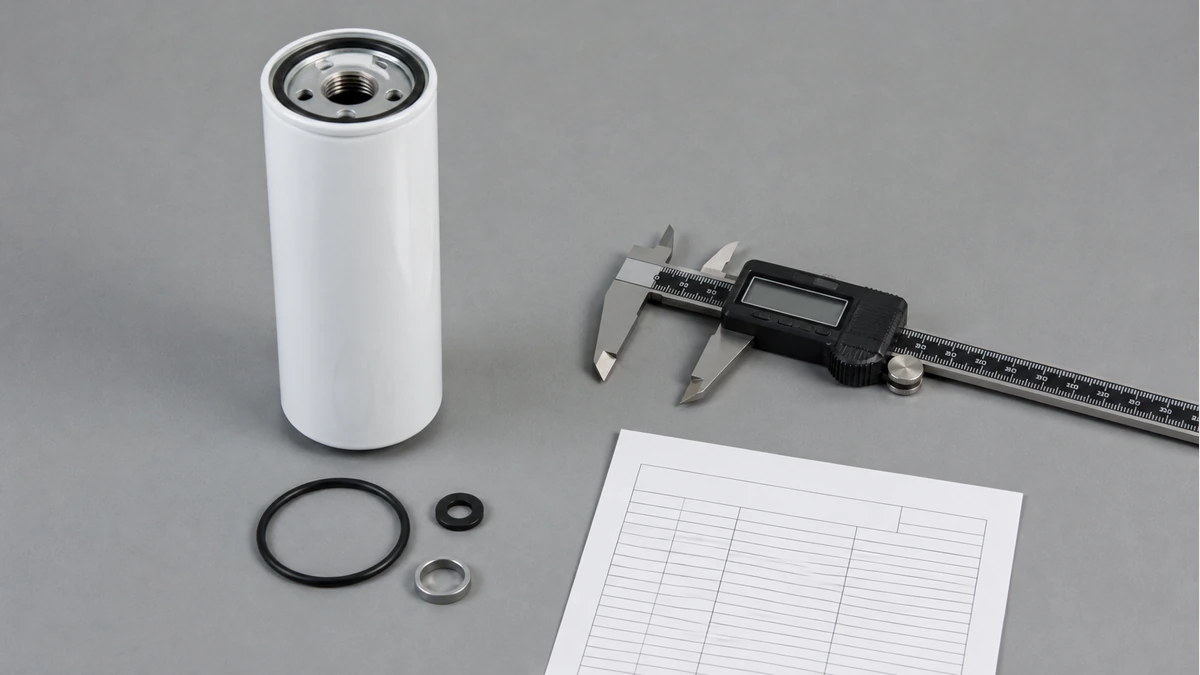
Closure design involves several interacting decisions: how much an O-ring compresses when the cap is seated, whether the cap-to-tank joint relies on compression alone or also on adhesive or ultrasonic welding, and how much clearance exists between the coil housing and the tank wall. A manufacturer that has engineered this properly can explain the sealing mechanism in specific terms — which surfaces are doing the sealing work, and what happens to that seal under mild pressure changes like altitude shifts during air freight.
A manufacturer that hasn’t thought about this in detail will usually describe the seal in vague, reassuring language — “it’s leak-proof” — without being able to say why. That’s a reasonable prompt for a follow-up question, not a reason to walk away immediately, but it’s worth pressing on before committing to a production order. Reviewing how the coil, wick, and seal interact at a component level, as covered in the vape cartridge anatomy reference, makes it easier to ask the closure question in terms the manufacturer’s engineers will actually engage with.
🧼 4. Why hardware has to be evaluated with the buyer’s own oil
This is the point where a lot of otherwise-careful qualification processes fall apart. A cartridge can pass every material and dimensional check and still perform badly once it’s filled — because oil is not a neutral substance from the hardware’s point of view. Viscosity, terpene content, and any cutting agents in the formulation all interact with wicking speed, coil saturation, and the seal itself in ways that differ from oil to oil.
A cartridge tested only with the manufacturer’s own reference oil — often a lighter, more standardized formulation used for internal QC — tells a buyer almost nothing about how it will behave with their specific product. Thicker, terpene-rich oil wicks more slowly and can saturate a cotton coil unevenly, leading to dry hits in some units and flooding in others. Certain formulations can also interact with plastic or gasket materials over time in ways that a short internal test wouldn’t reveal.
The only reliable way to evaluate this is to test the hardware with the actual oil and the actual filling process the buyer intends to use in production — same fill temperature, same fill speed, same degassing approach if one is used. That means sending representative oil (or a close analog, where regulation prevents shipping the real formulation) to the manufacturer for trial fills, or having the manufacturer ship unfilled hardware for the buyer to fill and test under their own process. Either way, a sample filled with someone else’s reference oil under someone else’s process is not a meaningful test of how the hardware will behave in the buyer’s supply chain.
📏 5. Capping window and why timing belongs in the spec
Capping window refers to the time between when a cartridge is filled and when it’s sealed with its final cap or mouthpiece. It sounds like a minor process detail, but it has real downstream effects. Oil left open to air for too long before capping can begin to lose volatile terpenes or pick up moisture, depending on the formulation and the filling environment. Cap too soon after filling, before any intended degassing has finished, and pressure can build inside a sealed cartridge, pushing oil out around the seal during shipping or once the buyer’s customer starts using it.
A manufacturer with a controlled process will have a defined capping window — a stated range of time between fill and cap, tied to their filling equipment and environment — rather than capping “as soon as convenient” on the line. Buyers should ask directly what that window is and whether it’s monitored, because it’s rarely mentioned unless asked, and it’s one of the more common quiet causes of inconsistent draw and minor leaking that gets misattributed to the coil or the glass.
🔄 6. What a golden sample should actually lock
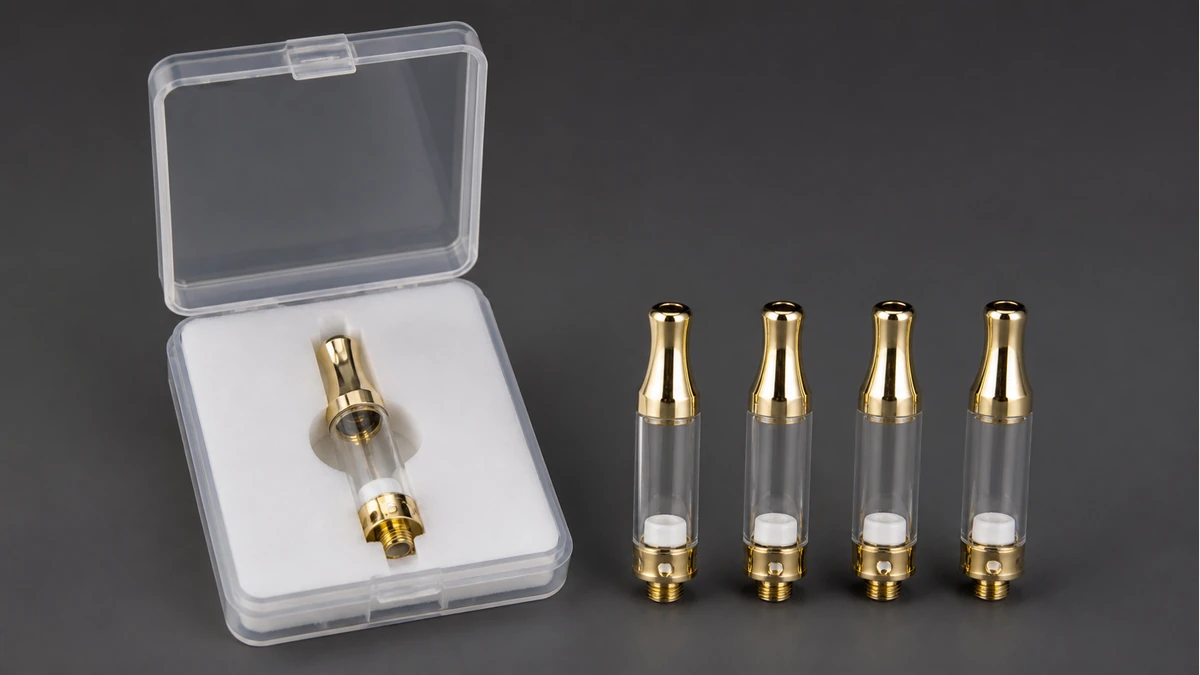
Once material, dimensional, seal, and oil-compatibility questions have been worked through, the natural next step is a golden sample — a reference unit both sides agree represents the production standard. The mistake many buyers make is treating the golden sample as a shape and color reference only. A golden sample that only locks appearance protects almost nothing, because appearance is the easiest thing for a manufacturer to hold constant even as internal components change.
A golden sample worth the name should lock, and have documented against it:
- The specific materials and sub-supplier components used, matched to the disclosure discussed earlier
- The dimensional tolerances measured on that unit, not just its nominal size
- The draw resistance and airflow characteristics, ideally measured rather than judged by feel
- The sealing performance under the buyer’s own oil, confirmed through the trial fill process
- The capping window and fill process used to produce it
This is also where working with a manufacturer under an OEM/ODM arrangement tends to pay off, because it gives the buyer more direct visibility into — and influence over — which components and processes get locked into the golden sample, rather than qualifying a generic catalog item after the fact.
🧰 7. Traceability and change notification protect the next order
The golden sample protects the first order. What protects the fifth order, placed a year later, is traceability and a change notification agreement. Component suppliers change. Raw material lots vary. A manufacturer might switch O-ring suppliers, adjust a coil wire gauge, or move to a new glass vendor without considering it a meaningful change — because from their side, the finished cartridge still looks and functions the same.
Lot traceability means every production run is tied to records of which component lots and material batches went into it, so that if a problem shows up in the field, it can be traced back to a specific cause rather than a vague “batch issue.” A change notification protocol means the manufacturer agrees, in writing, to inform the buyer before making any change to a material, component supplier, or process step that was part of the golden sample specification — not after the fact, and not only when the manufacturer judges the change to be significant.
This single agreement is often the difference between a manufacturer relationship that survives multiple reorders and one that quietly degrades. Without it, a buyer only discovers a change when a customer complains, and by then several thousand units may already be in the field.
📦 8. Frequently asked questions
Is a single sample enough to approve a manufacturer?
No. A single sample can confirm that one unit was built to spec. It can’t demonstrate tolerance control across a production run, which is where most consistency problems originate.
Should hardware testing use the manufacturer’s oil or the buyer’s oil?
The buyer’s own oil and filling process, or as close an analog as regulation allows. Reference oil used for internal QC often behaves differently from a terpene-rich production formulation.
What’s the fastest way to tell if a manufacturer has real dimensional control?
Ask for a stated tolerance range on the key dimensions — thread pitch, bore diameter, wall thickness — and how often they’re sampled. A manufacturer without real control will only be able to give a single target number.
✅ 9. The takeaway
A polished sample says a manufacturer can build one good cartridge. Everything that determines whether they can build ten thousand identical ones lives in the parts of the process that don’t show up in a photo: named materials, held tolerances, an engineered seal, oil-matched testing, a controlled capping window, and a traceability agreement that survives beyond the first order. Brands that push for these details before committing to production spend a little more time up front and considerably less time troubleshooting field complaints later.
📚 10. Sources and Reader Questions Reviewed
- FDA: Vaporizers, E-Cigarettes, and other ENDS
- Reddit discussion 1fj97so (reader-language research only)
- Reddit discussion ce0v4v (reader-language research only)
- Reddit discussion scw1iq (reader-language research only)
- Reddit discussion ph7vr4 (reader-language research only)
- Reddit discussion ckhl9z (reader-language research only)