🔍 1. Two Rigs, One Listing, Same Photo, Different Fit
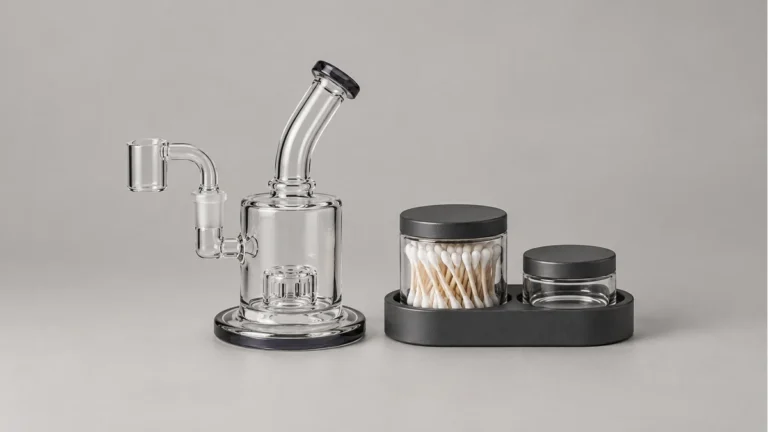
A distributor recently pulled two dab rigs out of the same sample carton. Same catalog listing, same 16:9 hero shot, same case dimensions on the packing slip. One banger dropped into its joint with a clean, snug quarter-turn. The other wobbled, sat a few millimeters proud, and needed a grip of silicone tape before it would hold vacuum. Nothing on the product page had changed. What had changed was somewhere upstream, in a batch of glass that never got checked against the reference sample before it left the workshop.
This is the recurring problem in wholesale dab rigs sourcing: catalog photography and spec sheets describe an ideal unit, but the units that actually ship are blown, cut, and joined by hand or semi-automated process, batch after batch. A buyer who treats the first sample as representative of everything downstream is setting up their own return-rate problem. The fix isn’t exotic — it’s specifying the right details up front, testing samples the way end users actually use the product, matching accessories deliberately instead of by assumption, and keeping packaging and inspection records tight enough to trace where a break happened. None of this is complicated, but skipping any one step is exactly how a shipment full of “identical” rigs turns into a shelf full of returns.
🧩 2. Glass and Joint Details Worth Specifying Before You Order
Most communication problems between buyers and glass suppliers come down to vague language. “Thick glass” and “sturdy base” mean nothing on a purchase order. The details that actually predict field performance are narrower and more mechanical.
🧩 2.1 Joint size and gender, stated explicitly
Dab rig joints commonly come in 10mm, 14mm, and 18mm, in male or female orientation, and that pairing has to be locked down for every SKU in an assortment — not assumed to be consistent across a supplier’s catalog. A buyer building a mixed case of rigs for different price tiers should confirm joint size and gender per model, in writing, and should ask whether the quoted bangers or accessory attachments are matched to that exact joint spec rather than a “compatible with most rigs” description that turns out to be approximate.
Fit tolerance matters as much as the nominal size. A joint that’s cut a half-size loose will leak air and won’t hold a banger under normal handling; one cut tight will crack under thermal stress faster than a properly ground joint. Ask the supplier directly whether joints are ground and fire-polished, and whether there’s a tolerance range they hold to — not because the answer alone guarantees performance, but because a supplier who can’t answer clearly is one where fit variation between production runs is more likely.
🧩 2.2 Glass thickness and where it’s measured
“Thickness” as a spec is only useful if you know where on the piece it’s being measured. A base can be thick while the neck near the joint — the part that takes the most torque from swapping bangers and carb caps — is thin. When a supplier quotes a thickness figure, ask whether it refers to the base, the joint area, or an average across the piece. If they can’t specify, treat the number as marketing shorthand rather than a spec you can rely on for a wholesale order.
🧩 2.3 Percolator and diffusion type, described precisely
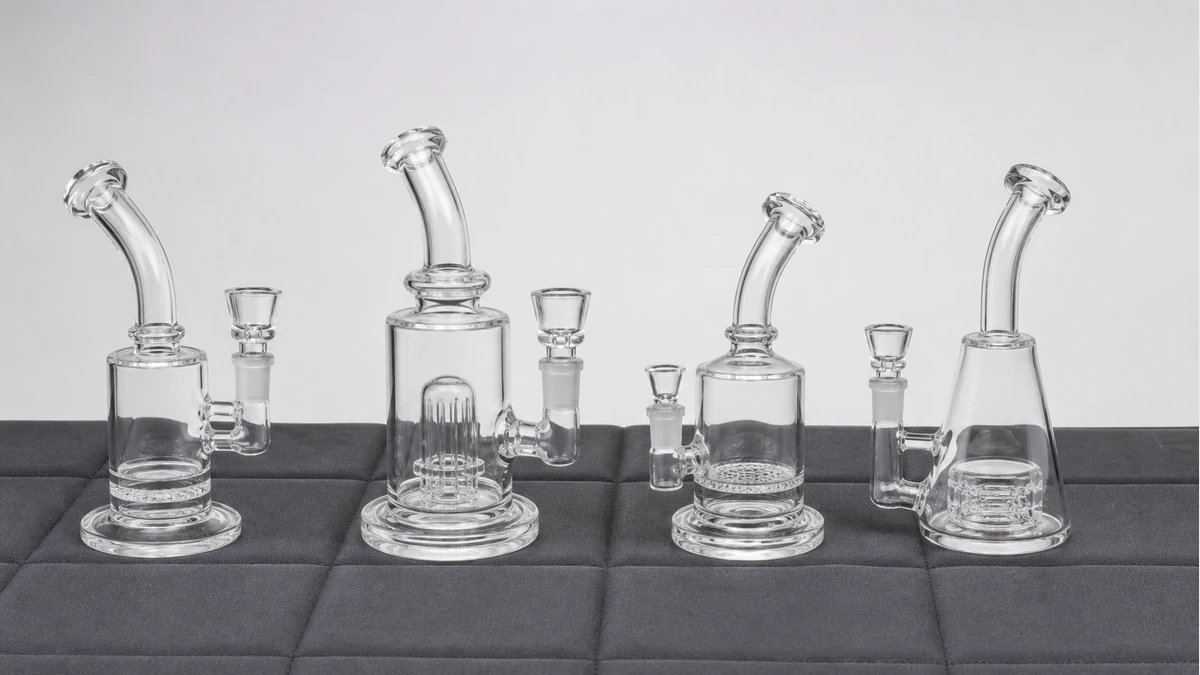
Percolator type affects both drag and breakage risk, since more intricate percolators generally mean more fused joints and thinner internal glass that can crack from thermal shock or a hard knock in transit. Rather than accepting a generic “smooth percolation” description, ask what percolator style is used (showerhead, tree, honeycomb, or a simple downstem) and how many fused points it introduces. For assortments going to buyers who resell at different price points, this also helps you position SKUs correctly — a straightforward downstem rig is a different product, and a different risk profile, than a rig with a multi-chamber percolator.
| Spec detail | Why it matters for wholesale ordering |
|---|---|
| Joint size and gender per SKU | Determines accessory compatibility across the whole assortment, not just one sample |
| Joint grinding and polish | Predicts fit consistency and long-term seal quality between production batches |
| Thickness measurement location | Prevents a base-only thickness figure from masking a thin, breakage-prone neck |
| Percolator style and fused-joint count | Correlates with drag, cleaning difficulty, and shipping breakage risk |
⚙️ 3. Why a Function Video Tells a Different Story Than a Physical Sample
Suppliers commonly send a short video showing a rig being loaded, heated, and pulled through — draw sounds clean, percolator bubbles evenly, everything looks smooth. That video is real, but it’s a single unit filmed under ideal conditions, usually the best example the workshop has on hand. Buyers researching this category online frequently run into the same complaint pattern: a rig looked flawless on video, then arrived with a joint that didn’t seat right or a base that sat unevenly on a flat surface. The gap isn’t necessarily dishonesty — it’s that video demonstrates one unit’s function, not the tolerance range across a production run.
A physical sample answers different questions than a video can. Video shows draw and percolation working. A physical sample in your own hands shows joint fit against your own banger, base stability on a flat surface, wall thickness by feel and by held-up-to-light inspection, and whether the piece sits level when a banger and carb cap are attached. These are the checks a video literally cannot perform, because they depend on comparing the glass to a reference object — your own hardware — rather than to itself.
A workable sample-evaluation sequence for a wholesale buyer looks like this:
- Request a physical sample of the exact SKU, not a “representative similar model.”
- Test joint fit with the banger or accessory you intend to bundle, not the supplier’s own accessory.
- Set the rig on a flat, hard surface and check for rocking or an uneven base before and after attaching a banger.
- Hold the neck and joint area up to light to check for thin spots, bubbles, or uneven wall thickness.
- Photograph and log the sample’s joint fit and base stability as your reference standard for incoming inspection on the full order.
That last step matters more than it looks. Without a documented reference sample, “does this match what we ordered” becomes a subjective judgment call every time a new shipment arrives. With one, it’s a direct comparison.
🧼 4. Matching Bangers and Accessories to the Assortment, Not the Other Way Around
Accessory mismatch is one of the most common — and most avoidable — sources of end-user complaints in this category. A banger sized for an 18mm joint dropped into a 14mm rig will sit loose, leak heat unevenly, and eventually get blamed on the rig rather than the mismatch. Buyers assembling private-label kits or mixed assortments need to treat accessory matching as its own step, not an assumption that follows automatically from a shared product category.
The safest approach is to source bangers, carb caps, and dab tools against the confirmed joint size and gender of each specific rig SKU, rather than against a generic “universal” listing. When an assortment includes multiple rig sizes, each with different joint specs, that means maintaining a matching table internally — which accessory pairs with which rig — so warehouse staff or private-label finishing teams aren’t guessing at pack-out time. For buyers building starter kits rather than single rigs, working through a resource like the dab rig kit guide before finalizing an assortment can help clarify which components actually need to be paired versus which can be sourced as flexible add-ons.
It’s also worth deciding, per SKU, whether the accessory is meant to be a functional match or a cosmetic one. A banger that fits the joint correctly but is disproportionately large or small for the rig’s visual scale will still work, but it looks like an afterthought on a retail shelf. For private-label programs sourced through OEM/ODM arrangements, this is usually the point to specify accessory proportions alongside function, since both affect how a finished kit photographs and how it’s perceived at the point of sale.
📏 5. Packaging, Cushioning, and Incoming-Inspection Records That Actually Reduce Breakage
Breakage in transit is the cost center that eats margin quietly, one cracked joint or shattered base at a time, and it’s rarely traced back to a specific cause because most buyers don’t keep the records that would let them. The pattern shows up repeatedly in buyer discussions of this category: a shipment arrives with a handful of units broken, the loss gets absorbed or written off, and the next order repeats the same failure rate because nothing changed upstream.
🧩 5.1 What to specify in packaging before ordering
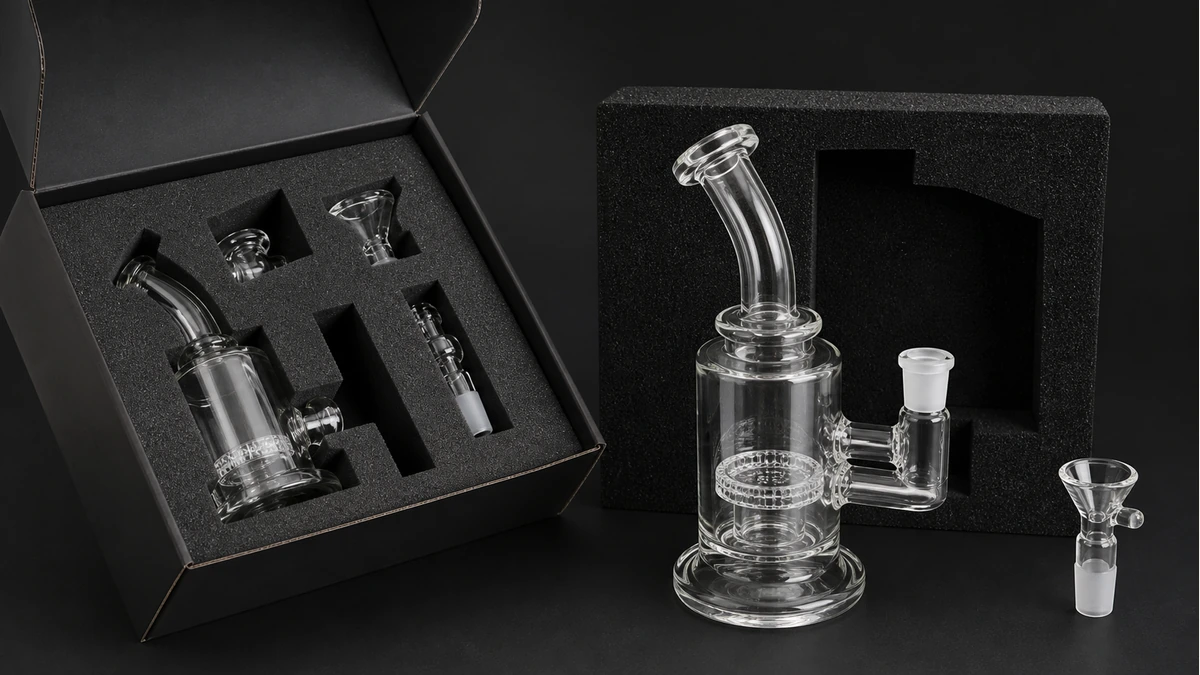
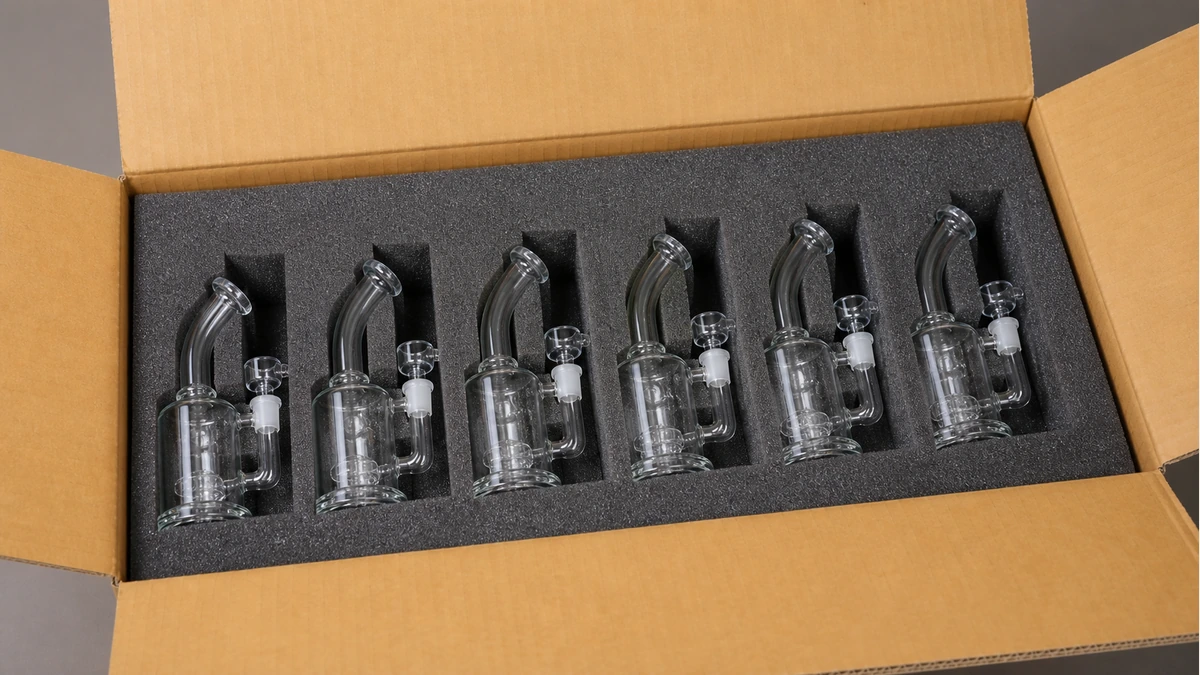
Individual cushioning around the base and neck, not just a shared outer box divider, is the baseline for any glass item shipping internationally. Ask the supplier directly how each unit is individually protected — foam sleeve, molded insert, or wrap — and whether the joint area gets separate protection from the base, since those are typically the two most breakage-prone points. If the rig ships with a banger or other glass accessory pre-attached rather than separately boxed, that’s worth flagging as a risk in itself, since attached accessories concentrate stress at the joint during handling.
🧩 5.2 Building an incoming-inspection record that’s actually useful
A useful incoming-inspection record doesn’t need to be elaborate, but it does need to be consistent across shipments so patterns are visible over time. For each shipment, a simple log noting the count received, the count broken on arrival, the location of each break (joint, base, neck, percolator), and photos of the damaged units gives a buyer something to actually act on — whether that’s renegotiating packaging with the supplier, switching to a different cushioning method, or identifying that one specific SKU with a more delicate percolator design is driving most of the loss. Without that breakdown, a buyer can only report “some units broke,” which gives a supplier nothing to fix.
Comparing each shipment’s inspection log against the documented reference sample from the earlier sampling stage also closes the loop: it turns “this batch felt different” into a specific, describable difference — joint gender, wall thickness, base diameter — that can be raised directly with the supplier instead of argued about in general terms.
🔄 6. Frequently Asked Questions
Do all wholesale dab rigs in one supplier’s catalog use the same joint size?
Not necessarily. Joint size and gender can vary by SKU even within one supplier’s range, so each model needs to be confirmed individually rather than assumed from a single catalog-wide spec.
Is a function video enough to approve an order without a physical sample?
A video can confirm that one unit draws and percolates as intended, but it can’t show joint fit against your own accessories or base stability on a flat surface — both of which require a physical sample in hand.
Should bangers be sourced from the same supplier as the rig?
Not automatically. What matters is that the banger’s joint size and gender match the specific rig SKU, whether it’s sourced from the rig supplier or separately.
What’s the fastest way to reduce recurring breakage across shipments?
Keep a consistent incoming-inspection record — count, break location, and photos per shipment — so patterns become visible and specific enough to raise with the supplier.
🧰 7. The Short Version
Wholesale dab rig sourcing rewards specificity over trust in a catalog photo. Nail down joint size, gender, and grinding per SKU; treat a physical sample as the only reliable check on fit and stability; match accessories to each rig’s actual joint spec rather than a generic listing; and keep packaging and inspection records detailed enough to trace a break back to its cause. None of that guarantees a zero-defect shipment, but it turns breakage and mismatch from a recurring mystery into a problem you can actually see, measure, and fix at the source.
📚 8. Sources and Reader Questions Reviewed
- U.S. CPSC: Business Guidance
- Reddit discussion 1oluj9h (reader-language research only)
- Reddit discussion 1s5zyts (reader-language research only)
- Reddit discussion 1t4688b (reader-language research only)
- Reddit discussion 1mr3mja (reader-language research only)
- Reddit discussion 148lkvm (reader-language research only)