🛠️ 1. What a Rolling Tray Actually Describes
A rolling tray is a shallow, rigid platform with a raised perimeter designed to keep loose material and small tools inside a defined boundary while someone works at a table or on their lap. The category covers a wide range of sizes and materials, but the underlying job is the same in every version: contain particles that would otherwise scatter, and give flat objects like papers or grinders a stable surface. Understanding the tray starts with separating two things that are often confused — the flat base, which does the supporting, and the raised edge, which does the containing.
🔍 1.1 The Base and Raised Lip
Most trays are built from a single formed piece, whether that’s stamped metal, molded plastic, poured resin, or CNC-cut wood. The base is nearly always flat, since any curvature would make small items roll or slide unpredictably. The lip is where the real engineering decisions happen. A lip that rises straight up at a sharp angle behaves differently from one that curves outward, and that difference shows up the moment something spills toward the edge rather than staying centered.
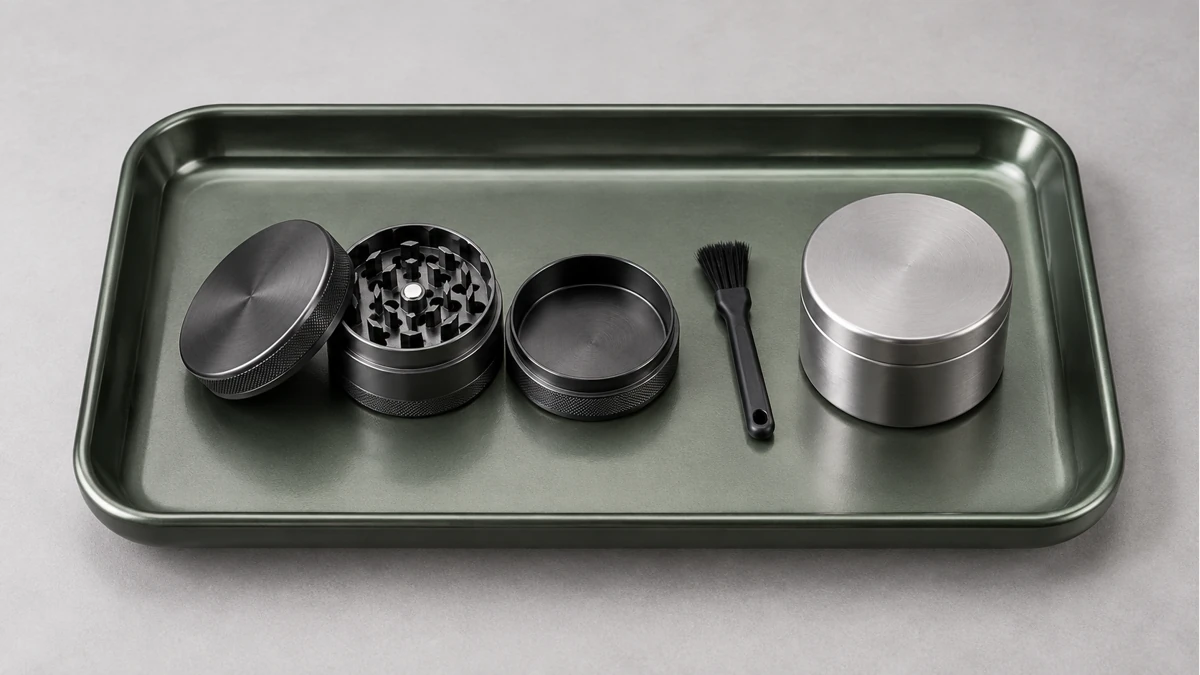
A common real-world scenario illustrates why this geometry matters: a tray loaded with finely ground material gets bumped, tips, or is picked up at an angle, and the outcome depends entirely on how the base-to-lip transition is shaped. A tray with a generous, gradually curved edge tends to redirect material back toward the center as it shifts. A tray with a low, flat-topped rim offers far less resistance, and contents can slide straight over it. This is the physical question worth understanding before anything else about a tray’s design.
📏 2. Edge Height and Containment
Edge height is the single most functional variable in tray design, and it’s also the one that varies most between models. Some trays use a low rim of a few millimeters, intended mainly to stop items from rolling off a flat surface. Others use a much taller wall, sometimes exceeding an inch, intended to hold a working pile of loosely packed material during an extended session. Neither approach is universally “correct” — they solve different problems.
🧩 2.1 Why Edge Height Varies Between Designs
A shallow-lipped tray is usually built for portability and low weight, since a tall wall adds material and bulk. A deep-lipped tray sacrifices some portability in exchange for a much larger safety margin against spills, particularly when the tray gets tilted, lifted, or set down unevenly. Manufacturers make this tradeoff deliberately, and it’s reflected in how a tray is marketed — travel-oriented designs skew shallow, while stationary or workstation-style trays skew deep.
⚙️ 2.2 What Happens When Edge Height Is Insufficient
The failure mode of a low-edge tray is straightforward physics: once the angle of tilt exceeds the height of the rim relative to the pile of material, contents cross the boundary and fall. This is why trays intended to hold loose ground material during active handling are built taller than trays meant only to hold a rolled item and a lighter or grinder. If a tray is being knocked or lifted frequently, edge height should be evaluated against that use pattern rather than against overall tray size, since a wide tray with a short lip can spill just as easily as a small one.
📐 3. Corner Geometry and Spill Behavior
Corners are a secondary but meaningful detail. A tray’s corners are either rounded, in which case the wall curves continuously into the adjacent side, or squared, in which case two straight walls meet at close to a right angle. This choice affects both cleaning and containment.
📐 3.1 Rounded Corners
Rounded corners eliminate tight interior angles where fine material can pack in and resist removal. They also tend to redirect material along the curve rather than letting it settle in a dead zone, which keeps more of the tray’s interior usable during active handling.
🧼 3.2 Squared Corners
Squared corners are more common on trays built for structured layouts — dividing a surface into compartments, or matching a rectangular storage case. The tradeoff is that a squared interior corner is harder to fully clear with a straight edge like a card or brush, since the tool has to change direction rather than sweep continuously. Neither corner style is inherently better; the choice usually follows from whether the tray is designed around free-form use or a fixed internal layout.
🎨 4. Surface Finish, Material, and Static
Surface finish determines how material behaves once it’s inside the tray, independent of edge height or corner shape. This is where material choice has the largest practical effect.
🛠️ 4.1 Metal Surfaces
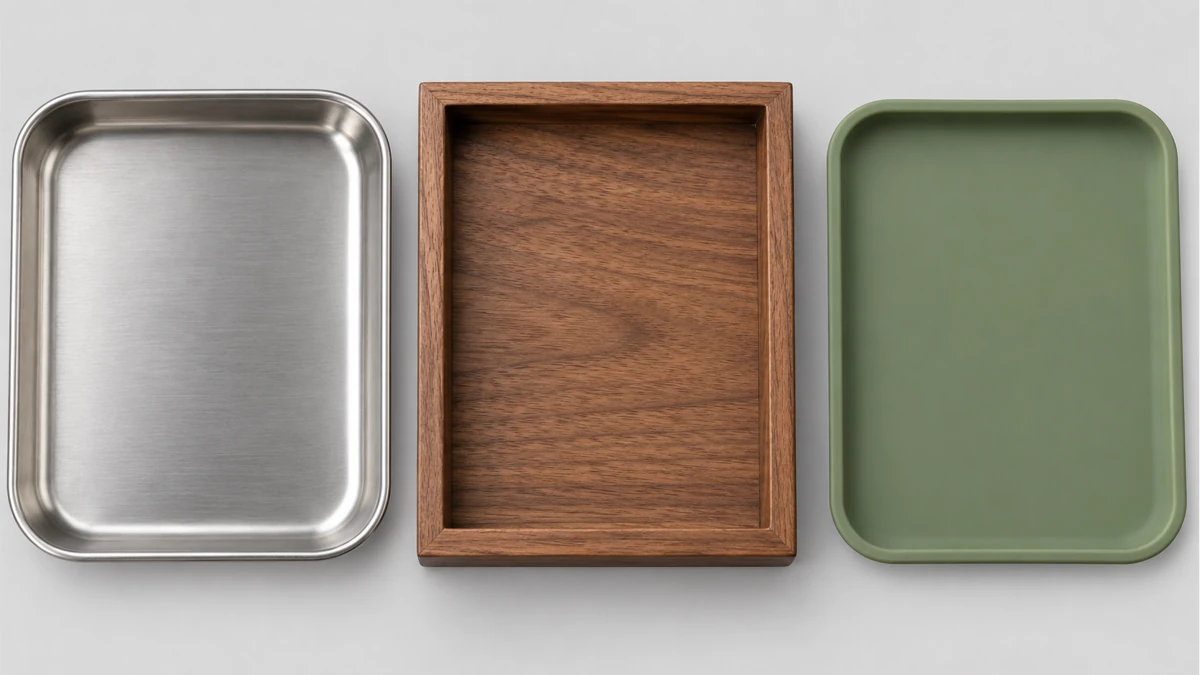
Metal trays, typically aluminum or coated steel, are common because the material is rigid, resists denting under normal handling, and can be finished smooth or textured depending on the manufacturing process. A smooth metal finish lets fine particles slide easily, which helps with gathering material toward the center but can also make it easier for particles to slide over a low edge. A textured or matte metal finish adds slight resistance, which can reduce unwanted movement at the cost of being marginally harder to sweep completely clean.
💨 4.2 Wood and Resin Surfaces
Wood trays, often finished with a sealant or lacquer, tend to have more surface texture than metal even when sanded smooth, since the grain remains slightly present under the finish. This texture can catch very fine particles in a way that a sealed resin or acrylic surface generally does not, since cast resin surfaces are typically uniform and non-porous unless intentionally textured. Custom and one-off trays — including hobbyist or small-batch designs made with printing or casting processes — usually fall into this resin or hard-plastic category, and their surface behavior depends entirely on how the mold or print layer lines were finished afterward.
🔗 4.3 Static and Material Interaction
Static buildup is a documented behavior of dry, finely divided plant material on hard surfaces, and it’s more noticeable on some materials than others. Plastics and resins, particularly in low-humidity conditions, are more prone to generating a static charge through friction than metal, which conducts and dissipates charge more readily. On a tray with strong static behavior, fine particles can cling to the surface or to a grinder rather than settling flat, which affects how easily material can be swept or poured out. This is a material property, not a defect, and it varies with ambient humidity as much as with the tray itself.
🧰 5. Tool Zones and Layout
Beyond the basic base-and-lip structure, many trays include internal layout features meant to organize small tools and materials rather than just contain them.
📏 5.1 Divided Compartments
Some trays use molded or etched divisions to separate the tray into distinct zones — a central working area plus one or more smaller recessed sections along an edge. These recessed sections are typically shallower than the main tray floor and are sized for small flat items rather than loose material, since a narrow compartment does little to contain anything that isn’t already a discrete object.
🧭 5.2 Rolling Zone Versus Storage Zone
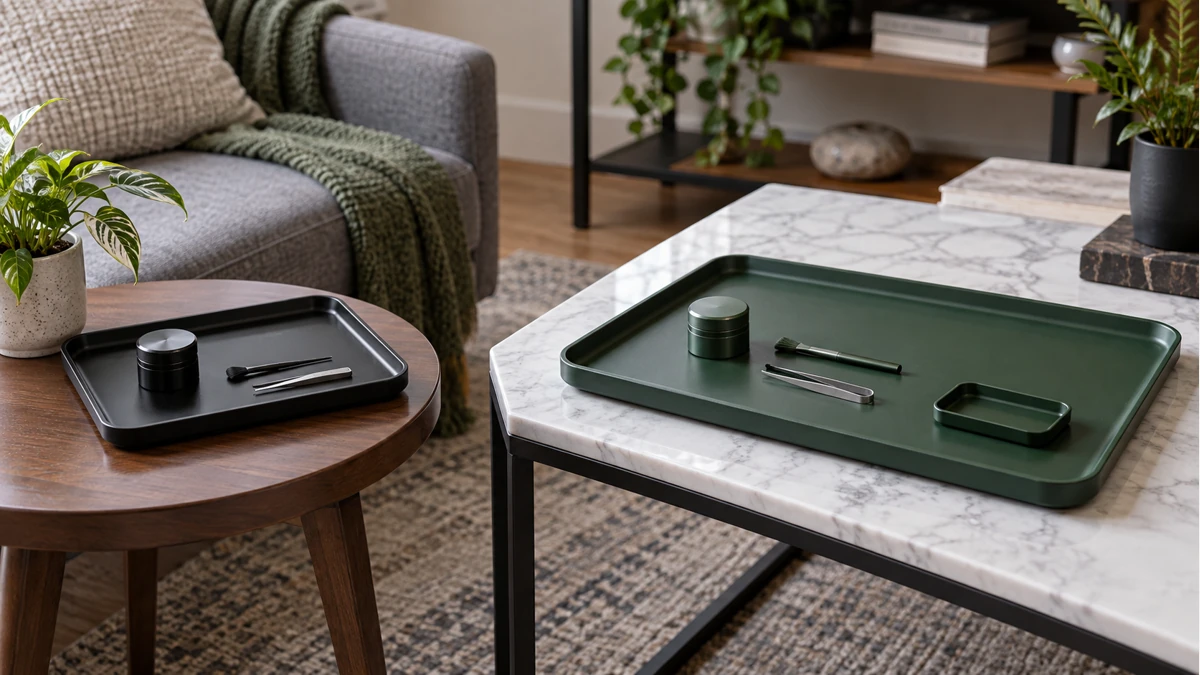
Even on trays without formal dividers, users tend to functionally separate the surface into a rolling or working zone near the center and a storage or staging zone nearer the edge. This isn’t a manufactured feature so much as a consequence of tray shape: the center is the flattest and most stable area, farthest from the edge where a bump is most likely to cause a spill, which makes it the natural place for active handling. Tray layouts that already reflect this — for instance, a slightly recessed or textured center panel — are building on that same physical logic rather than introducing a new one.
🧭 7. Choose Geometry Around the Actual Workspace
Tray size is useful only when it matches the surface beneath it and the objects placed on it. A wide tray on a narrow table overhangs and becomes easier to tip. A very small tray may force tools across the central working area. Measure the available footprint first, then reserve a clear zone for preparation and a separate zone for objects that can roll.
📦 7.1 Storage Features Need Cleanable Transitions
Built-in recesses can organize a grinder, papers, or small tools, but deep sharp corners also collect fine material and cleaning residue. Rounded transitions are easier to brush or wipe. Removable inserts simplify cleaning only when they seat securely and do not create a lip that catches material during transfer.
🧲 7.2 Material Changes Daily Handling
Thin steel is rigid and easy to wipe but can be noisy and may interact with magnetic accessories. Wood feels warmer and can be durable, yet unfinished grain holds residue. Resin permits molded shapes but should be checked for flatness and surface defects. Silicone mats resist sliding and cushion glass accessories, although flexible edges provide less containment when the mat is lifted.
The simplest test is mechanical: set the empty tray on its normal surface, press each corner, and confirm that it does not rock. Then place the usual tools without loading material and make sure none can roll across the main area. A stable, cleanable layout is more useful than decorative complexity.
✅ 8. A Useful Tray Is Easy to Reset
After use, every item should have an obvious place and the working surface should be accessible for cleaning. If fixed decorations or deep compartments prevent a complete wipe, the layout creates more maintenance than organization. A tray succeeds when it contains small material, keeps tools stable, and returns to a clean state without complicated disassembly.
Inspect the underside as well as the working face. A bent base, loose insert, or trapped debris can make an otherwise wide tray rock on the table.
🧽 6. Cleanup and Maintenance
Cleaning method should match the surface material, since the wrong approach can damage a finish or drive residue into a texture rather than removing it.
⚖️ 6.1 Residue Removal by Material
Metal and sealed resin surfaces generally tolerate wiping with a slightly damp cloth without damage, since neither surface is porous under normal conditions. Wood surfaces need more care, since excess moisture can lift a sealant layer over repeated cleanings or cause the underlying wood to swell slightly at the grain. For all materials, a dry brush or soft card is usually enough for routine clearing of loose particles, reserving any damp cleaning for buildup that dry methods can’t remove.
🌡️ 6.2 Storage Between Uses
How a tray is stored affects both its surface and its edge integrity over time. Stacking heavy objects on top of a tray can deform a thin metal lip or crack a rigid resin edge, since the raised rim is usually the thinnest structural point on the piece. Trays with a fitted lid or sleeve protect the surface finish from scratching during storage, which matters most for glossy or printed finishes where a scratch is both a functional and visual change to the surface.
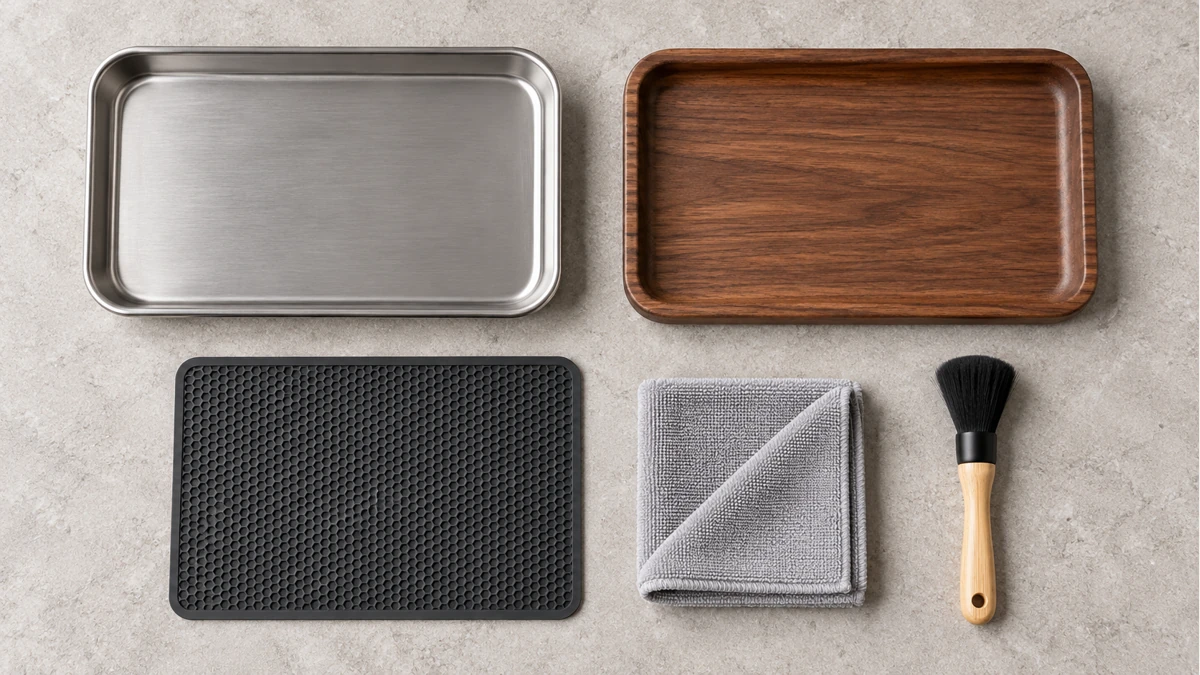
Taken together, the physical identity of a rolling tray comes down to four measurable things: edge height relative to how the tray will be tilted or carried, corner geometry relative to how thoroughly it needs to be cleaned, surface material relative to how it interacts with static and fine particles, and internal layout relative to whether tools need a dedicated zone. When evaluating any specific tray, checking these four points against the actual use pattern — travel versus stationary, loose material versus discrete tools, frequent cleaning versus occasional wipe-down — will tell you more about how it will perform than the tray’s overall size or appearance ever will.