A licensed brand that buys cannabis vape hardware in late November 2026 is looking at two different kinds of public record at once. One is enacted federal law: a revised definition of hemp, already on the books, that applies in stages and includes a 0.4 milligram per-container limit scheduled to take effect on 11 December 2026 unless Congress changes the statute again. The other is not law. It includes a bipartisan Senate bill introduced on 17 November, public statements about what should or should not go into a year-end funding package, a federal hearing on Illinois's own hemp statute that had not produced a public ruling as of this briefing, and company announcements of all-in-one devices now being offered in licensed adult-use markets.
Those items can be placed in the same week of headlines and still answer different questions. A statute, a bill, a senator's stated position, and a press release are not interchangeable sources. This briefing, dated 19 November 2026 (Asia/Shanghai), keeps them separate so a hardware buyer can see what is confirmed in official or other reputable public sources, what is only proposed or asserted, and which visible device features appear in recent licensed-market announcements without treating those announcements as verified market share.
🔎 1. Statute, Bill, and Stated Position Are Not the Same Thing
Three labels are being used in the same conversation, and they do not have the same legal status. A statute is enacted law. The revised hemp definition was added by section 781 of Division B of Public Law 119-37, enacted 12 November 2025. A later funding law, Public Law 119-103, enacted 2 September 2026, limited how much of that amendment applies before 11 December 2026. A bill is a proposal. The Hemp Guardrails Act, introduced on 17 November 2026 by Sens. Tim Sheehy (R-MT) and Amy Klobuchar (D-MN), is in that second category: it has been filed, and it has not become law. A stated position is narrower still. A senator's or representative's comment about a year-end funding bill is evidence of what that official said, not evidence of what Congress has passed.
For a hardware buyer, the practical cut is simple. Inventory and compliance questions that depend on the federal definition of hemp should be checked against the public laws and against official summaries of those laws. Product-roadmap questions that depend on a different federal framework should be labeled as contingent on legislation that has not been enacted. Feature questions that come from a brand's own launch announcement should be labeled as that company's description of a device, not as a surveyed market result.
🧩 1.1 What a Buyer Can Treat as Confirmed on 19 November 2026
As of this date, the following points can be verified in official or other named public sources:
- The 0.4 milligram per-container limit exists in the text of P.L. 119-37, now printed as the prospective text of 7 U.S.C. §1639o.
- P.L. 119-103, §2019, states that until 11 December 2026, the P.L. 119-37 amendments "shall only apply" to products described in paragraphs (1)(C)(ii)(I) and (1)(C)(iv)(I) of the amended hemp definition — the intermediate and final products that contain cannabinoids "not capable of being naturally produced by a Cannabis sativa L. plant."
- The Iowa Department of Health and Human Services states that those naturally-impossible cannabinoids were excluded as of 12:00 a.m. on 12 November 2026, and that "the new 0.4 mg per-container limit and total THC requirements" take effect at 12:00 a.m. on 11 December 2026. The page does not name a time zone.
- The Hemp Guardrails Act is reported as introduced on 17 November 2026. It is not reported as enacted.
- MKX Oil Co.'s 18 November 2026 PR Newswire release describes two all-in-one devices entering New Jersey's adult-use market and lists specific hardware features. Those are company statements.
The following points are not confirmed and are not treated as facts in this briefing: that the Guardrails Act will be attached to a continuing resolution; that any particular year-end vote will succeed or fail; that "U.S. grown, processed, finished, and packaged" language in a proposal is already a ban on imported empty hardware; or that any company's sales-rank wording has been independently verified.
📅 2. The Two Dates Already Written Into Federal Law
P.L. 119-37 originally made the new hemp definition effective 365 days after its 12 November 2025 enactment, which is 12 November 2026. Section 2019 of P.L. 119-103 then split that timetable. Until 11 December 2026, the amendments apply only to the two product descriptions noted above: intermediate and final hemp-derived cannabinoid products that contain cannabinoids not capable of being naturally produced by the plant. The 0.4 milligram per-container exclusion is in a different paragraph, (1)(C)(iv)(III). It is part of the amendment, but it is not in the early-applied set.
That split is also how a state health agency is explaining the law to registrants. Iowa HHS's consumable-hemp FAQ, on an official State of Iowa page, lists two implementation times: 12:00 a.m. on 12 November 2026 for certain cannabinoids that cannot naturally be produced by cannabis, and 12:00 a.m. on 11 December 2026 for the 0.4 milligram per-container limit and total THC requirements. The same FAQ notes that Congress could still change or delay those requirements through additional legislation, and that Iowa cannot extend federal deadlines.
A 13 November 2026 bulletin from the Maryland Cannabis Administration likewise tells licensed dispensaries that the new federal definition "is set to take effect on December 11, 2026," and it restates the greater-than-0.4-milligrams-per-container exclusion. The bulletin is useful as official state guidance to licensees. It is less precise than the public law and the Iowa FAQ about the 12 November carve-out that had already taken effect by the date of this briefing.
One editorial caution belongs here. The House Office of the Law Revision Counsel's classified text of 7 U.S.C. §1639o, in a snapshot current through Public Law 119-142 (10 November 2026), still prints the original "365 days after enactment" effective-date note and does not yet classify the P.L. 119-103 limitation in that note. The delay is in the public-law text itself. A buyer checking only the Code's editorial note could miss the 11 December date.
⚖️ 3. What the 0.4 Milligram Per-Container Limit Actually Says
The figure in circulation is not a loose industry estimate. In the P.L. 119-37 amendment to 7 U.S.C. §1639o, the term "hemp" does not include any final hemp-derived cannabinoid product containing "greater than 0.4 milligrams combined total per container of" (aa) total tetrahydrocannabinols, including tetrahydrocannabinolic acid, and (bb) any other cannabinoids that have similar effects, or are marketed to have similar effects, on humans or animals as a tetrahydrocannabinol, as determined by the Secretary of Health and Human Services.
The same amendment defines "container" as "the innermost wrapping, packaging, or vessel in direct contact with a final hemp-derived cannabinoid product in which the final hemp-derived cannabinoid product is enclosed for retail sale to consumers, such as a jar, bottle, bag, box, packet, can, carton, or cartridge." It excludes bulk shipping containers and outer wrappings that are not essential for final retail delivery or sale to an end consumer.
Two limits follow from that wording, and they matter for hardware buyers even though the statute is not a device-spec sheet. First, the 0.4 milligram threshold is a limit on what remains inside the federal definition of hemp as a final product in its innermost retail package. It is not a statement about battery capacity, coil type, screen features, or whether a device is a 510 cartridge system or an all-in-one. Second, "cartridge" appears in the statutory list of example containers. That is an example of a retail vessel, not a finding that every 510 cartridge on a licensed or unlicensed shelf is or is not hemp.
Iowa HHS also notes that the new federal law changes how THC is measured, requiring total THC, including THCA, rather than only delta-9 THC, and that products which no longer meet the federal definition of hemp "may become subject to federal controlled-substance laws." This briefing does not attempt to classify any particular SKU.
📄 4. The Hemp Guardrails Act Is an Introduced Proposal, Not Law
Marijuana Moment, in an 18 November 2026 report by Tom Angell, states that Sens. Sheehy and Klobuchar introduced the Hemp Guardrails Act on 17 November 2026. Sponsor press materials republished by the Hemp Beverage Alliance present the same introduction as coming from the offices of Senator Sheehy and Senator Klobuchar. As of this briefing, that is the verified status: a filed proposal. It is not an enacted statute.
According to Marijuana Moment and those sponsor materials, the proposal would replace the scheduled tighter limit with a different federal framework. The reporting describes a 1 percent total THC threshold on a dry-weight basis for hemp, with an exception discussed for in-process materials; a category of prohibited cannabinoids described as including delta-8 THC, delta-10 THC, and THC-O-acetate; a 21-year age limit; a bar on raw floral hemp, smokable hemp flower, and hemp pre-rolls in interstate commerce; FDA rulemaking on packaging, labeling, manufacturing, testing, registration, and recalls within 180 days; and a requirement, in the Sheehy office materials, that "consumable hemp products" be "cultivated, processed, finished, and packaged in the United States."
That last clause should be kept in its actual category. It is language from a bill, as described in sponsor materials, about consumable hemp products. It is not, on the sources opened for this briefing, a finished legal ban on importing empty vape hardware. A buyer who treats a proposal's product-origin sentence as an already-effective hardware-import rule is reading a status the public record does not yet support.
This briefing does not predict whether the Guardrails Act, or any similar measure, will be attached to a continuing resolution or other must-pass bill.
🗣️ 5. Year-End Funding Positions Are Statements, Not Outcomes
The same Marijuana Moment report, and a same-day recap in The Hype Magazine, records a public split over using a year-end funding bill as the vehicle for any change. Sen. Ted Budd (R-NC), in a 17 November social-media post quoted by Marijuana Moment, said he "will not support any year-end package that extends, delays, or builds a regulatory framework around products that fuel addiction, endanger our children, and weaken our workforce." Sen. Pete Ricketts (R-NE), in an 18 November post, said he "won't support any legislation that allows these drugs to continue hurting our kids and communities."
Other officials and groups, in the same report, described a different preferred path. Rep. James Comer (R-KY), chair of the House Oversight and Government Reform Committee, is quoted as saying the best opportunity is "a bill that is going to pass," and that "the only bill that I think that absolutely, positively has to pass is going to be another continuing resolution." Marijuana Moment also reports that the U.S. Hemp Roundtable said it looked forward to working for inclusion of the Guardrails Act's provisions "in the next spending bill or continuing resolution that will keep the government open for business."
Those are verifiable statements of position, dated 17–18 November 2026 in the reporting. They are not votes, and they are not a forecast. A hardware buyer can record them as the present public alignment and still have no confirmed legislative outcome.
🏛️ 6. The Illinois Hearing Is on the Calendar; No Public Ruling Was Found
A separate state statute, the Illinois Hemp Act, is being challenged in federal court in Chicago. The case is Illinois Healthy Alternatives Association et al. v. Raoul et al., No. 1:26-cv-13799, in the U.S. District Court for the Northern District of Illinois, Eastern Division, before Judge Martha M. Pacold.
A minute entry filed 9 November 2026 sets "oral argument on the pending emergency motion for a temporary restraining order and preliminary injunction" for 19 November 2026 at 2:00 p.m. in Courtroom 2325, with 20 minutes for each side. The entry does not print a time zone; the court sits in Chicago. That 2:00 p.m. sitting is 04:00 on 20 November in Asia/Shanghai. As of this briefing, dated the morning of 19 November 2026 in Asia/Shanghai, that argument had not yet been held, and no public ruling on the emergency motion was found in the docket documents retrieved for this article. None is inferred.
What does exist is a limited party agreement, not a court order. A 6 November 2026 joint status report states that the state defendants agreed not to take Hemp Act enforcement action against the hemp-company plaintiffs, including the association's members, through 19 November 2026, subject to agreed terms and a members list. The agreement posted by ILHAA says it "will remain in effect until 5 p.m. on November 19, 2026," and it is written as applying to the named plaintiffs, including association members as defined in the letter. The same letter states that the state will otherwise continue to defend and enforce the Hemp Act. That is not a statewide pause, and it is not a judicial stay.
Hardware news in the same window is easier to over-read than the statutes are. A press release can tell a buyer that a licensed brand has put a particular all-in-one format on dispensary shelves, and it can list the features the company wants a reader to notice. It cannot, by itself, establish national share, fill quality, or whether those features will become a default specification.
On 18 November 2026 at 07:05 ET, MKX Oil Co. issued a PR Newswire release announcing its entry into New Jersey's adult-use cannabis market. The company says it was established in Detroit in 2017 and that products are now available in dispensaries across the state. The release describes two all-in-one devices filled with New Jersey-grown and extracted cannabis oil:
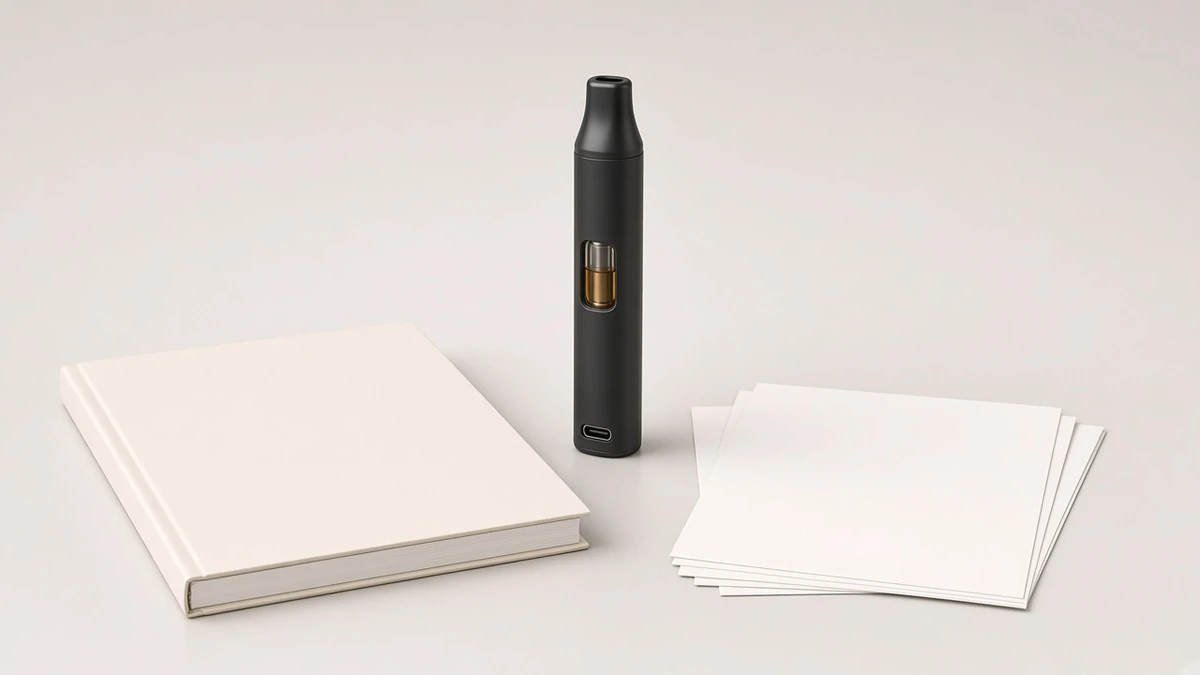
- The MKX 2G AiO, a 2-gram disposable listed in six strains, with company-listed features of anti-clog technology, preheat capability, a battery indicator, and a blinker timer light.
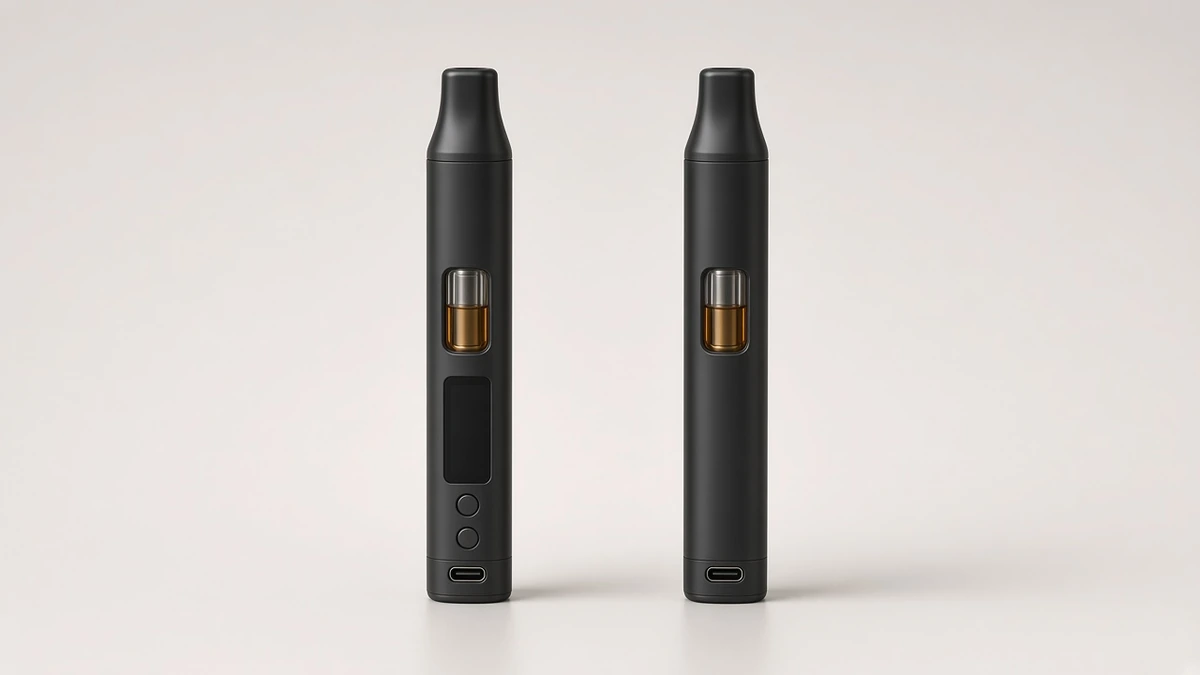
- The Geeked 3G by MKX, a 3-gram device listed in twelve zodiac-based strains, with company-listed features of a mesh coil system, a 3D curved screen, variable voltage, a pre-heat function, a battery-life indicator, and built-in puff and blinker counters.
Those feature words are useful as a snapshot of what one licensed-market launch is putting on the specification sheet: preheat, a battery indicator, and, on the larger device, variable voltage, a screen, and puff or blinker counters. They are the company's descriptions. This briefing does not repeat unverified ranking language from the same release, and it does not treat the listed features as laboratory results.
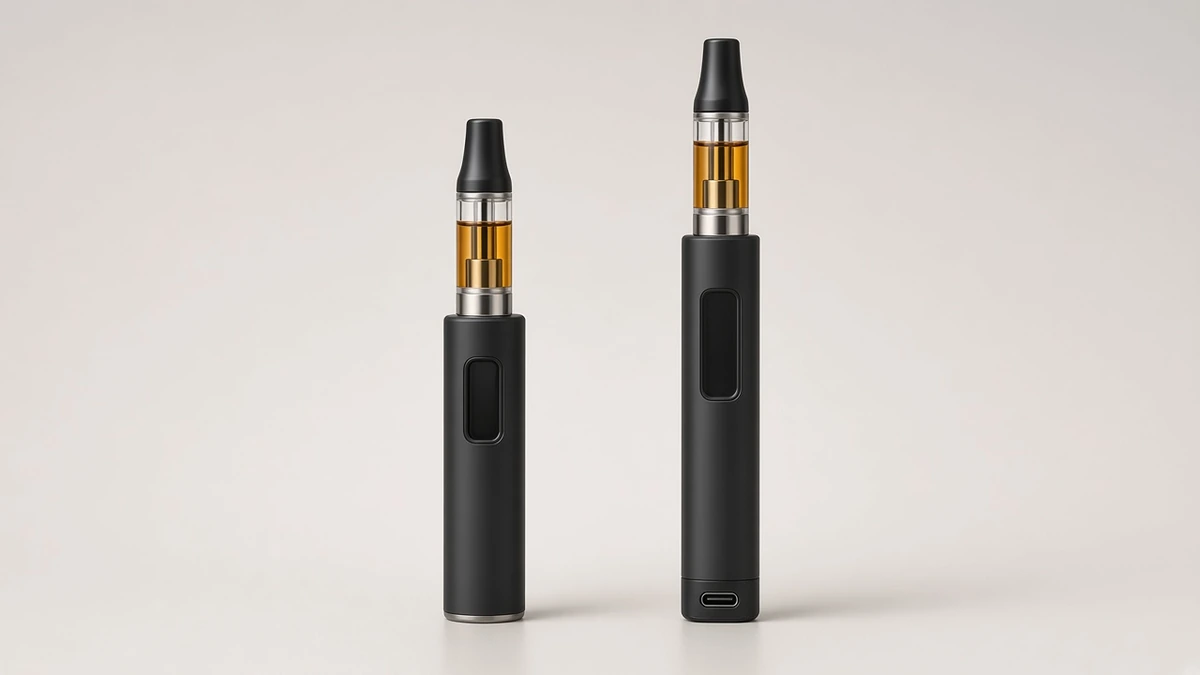
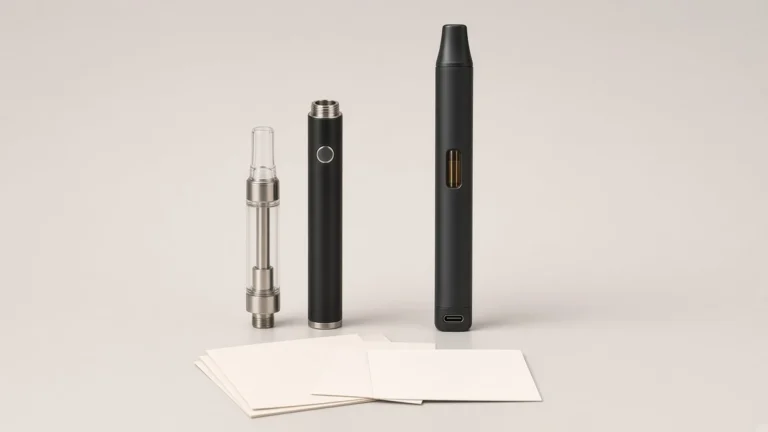
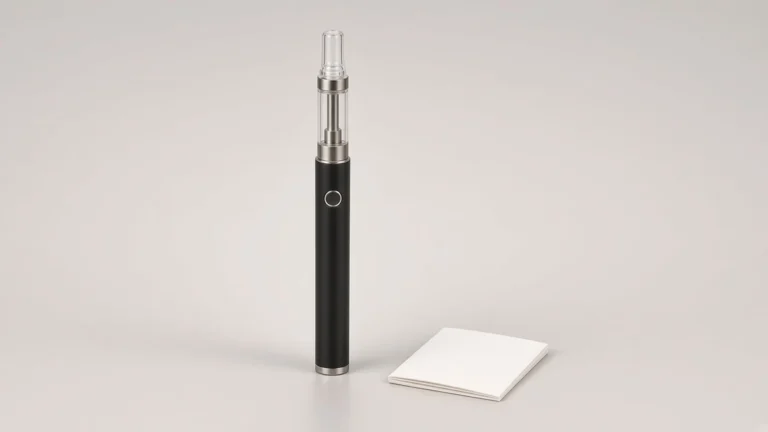
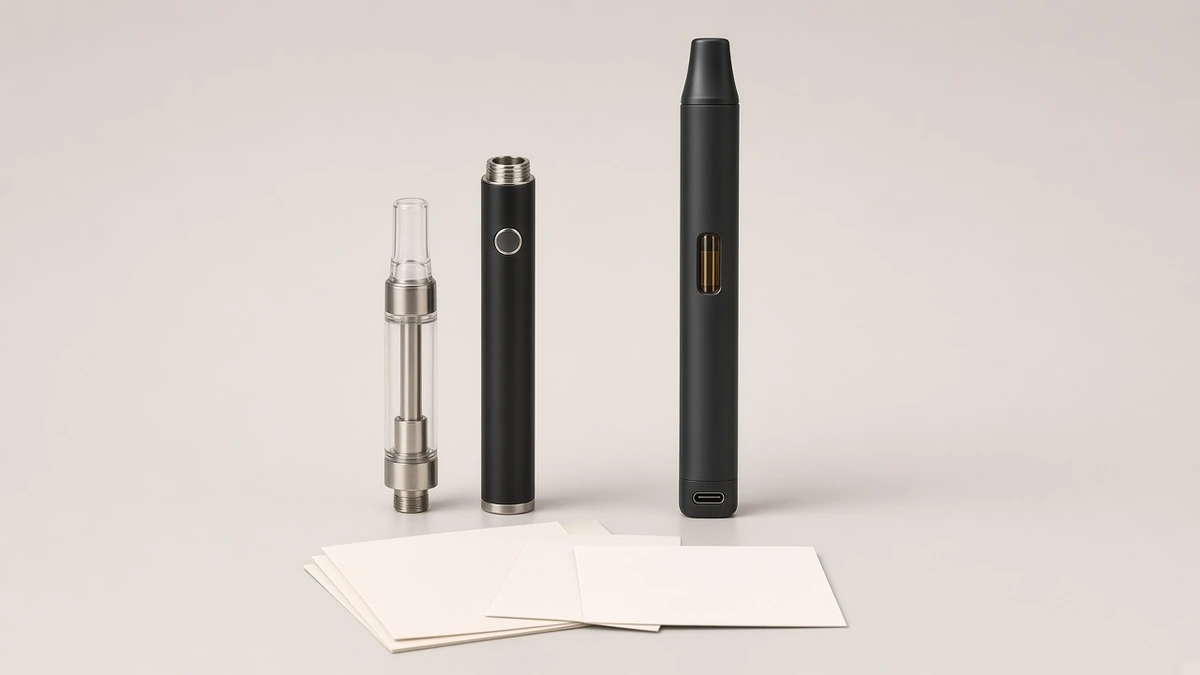
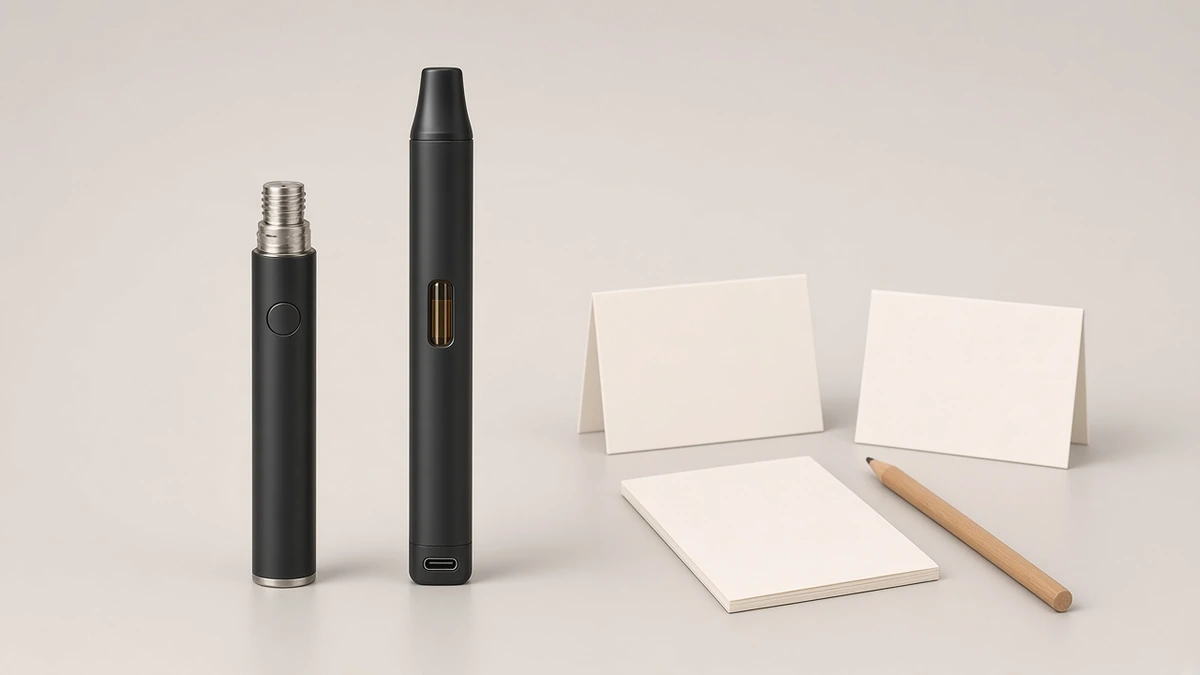
A 7 November 2026 trade article in Cannabis Professional had already described all-in-one devices — oil and battery in one unit, without a separate cartridge-and-battery pairing — as a prominent licensed-market format, and it collected other 2026 examples of visible feature combinations: a rechargeable 2-gram all-in-one with a digital dose screen; preheat; USB-C charging; and multiple heat settings. Those examples are cited here the same way as the MKX list: as reported, company-described features, not as a sales ranking and not as an AOVAPE test. The format distinction itself, including the difference between a 510 cartridge system and an all-in-one, is the subject of a separate identification guide.
One calendar fact is also public and narrowly relevant. The official MJBizCon site lists the 2026 conference as 1–4 December at the Las Vegas Convention Center, about a week before the 11 December federal date. This briefing records those official dates only. It does not invent exhibitor or hardware announcements from the show.
✅ 8. What to Check Before Treating a Claim as Confirmed
A buyer who has to brief a product or compliance team can keep the late-November public record on a short list. The point is not to forecast Congress. It is to stop a statute, a bill, a quotation, and a press release from collapsing into one sentence.
- The current federal timetable. Confirm the two dates against P.L. 119-37, P.L. 119-103 §2019, and an official explanation such as the Iowa HHS FAQ. Record that the 0.4 milligram per-container limit is scheduled for 11 December 2026 unless Congress amends the law again.
- What the 0.4 milligram figure actually measures. It is a combined-total limit per innermost retail container, including THCA and certain other cannabinoids as the statute describes them. It is not a hardware rating.
- The status of any "replacement framework." If a supplier, broker, or news summary mentions the Hemp Guardrails Act, ask whether the citation is to an introduced bill or to enacted law. As of 19 November 2026, the sources opened for this briefing show only the former.
- Origin clauses in proposals. If a document cites U.S. cultivation, processing, finishing, or packaging requirements, record the exact defined product category and whether the text is enacted. Do not treat consumable-product language in a bill as a completed rule on empty hardware imports unless a primary source says that.
- State cases and side agreements. If Illinois or another state statute is in litigation, separate a noticed hearing date from a ruling, and separate a party non-enforcement agreement from a court order, including who is covered and when the agreement ends.
- Licensed-market hardware announcements. Copy company-listed features — preheat, voltage control, indicators, screens, charge ports, stated fill weight — onto a specification line, and ask the supplier to confirm them on the exact version. Leave ranking claims and unsourced share figures off that line.
- Platform identity. Confirm whether the SKU is a 510 cartridge system, a proprietary pod, or an all-in-one, because those formats do not leave the same parts in service when the oil is gone.
❓ 8.1 Short Answers a Brief Can Reuse
Is the 0.4 milligram per-container limit already the law? The limit is in enacted federal law, in P.L. 119-37's amendment to the hemp definition. Under P.L. 119-103, it is scheduled to apply on 11 December 2026, not as part of the narrower set of provisions that applied from 12 November 2026.
Did the entire new hemp definition already take effect on 12 November 2026? No. Official sources describe a split. Iowa HHS states that certain cannabinoids that cannot naturally be produced by cannabis were excluded as of 12:00 a.m. on 12 November 2026. The 0.4 milligram per-container limit and total THC requirements are stated as taking effect at 12:00 a.m. on 11 December 2026.
Is the Hemp Guardrails Act the current federal rule? No. As of 19 November 2026, public reporting and sponsor materials describe it as a bill introduced on 17 November 2026. It has not been cited here as enacted law.
Does a "U.S. grown, processed, and packaged" sentence in that bill already ban imported empty hardware? Not on the sources opened for this briefing. The sponsor materials describe a requirement for consumable hemp products in a proposal that is not law. That is not the same thing as a finished hardware-import prohibition.
Have Senators Budd and Ricketts blocked a funding bill? They have stated that they will oppose a year-end funding bill that keeps hemp THC products legal, as reported on 18 November 2026. A stated position is not the same thing as a completed vote or a change in the statute.
Has a federal judge ruled on the Illinois Hemp Act challenge? Not in any public ruling found for this briefing. Argument was set for 19 November 2026 at 2:00 p.m. in Chicago. A limited party agreement, not a court order, was described as running until 5 p.m. that day for the named plaintiffs.
Do recent all-in-one launches prove which features now dominate the licensed market? No. They show which feature combinations a company is announcing — including preheat, indicators, screens, and variable voltage. They do not, by themselves, verify share, ranking, or performance.