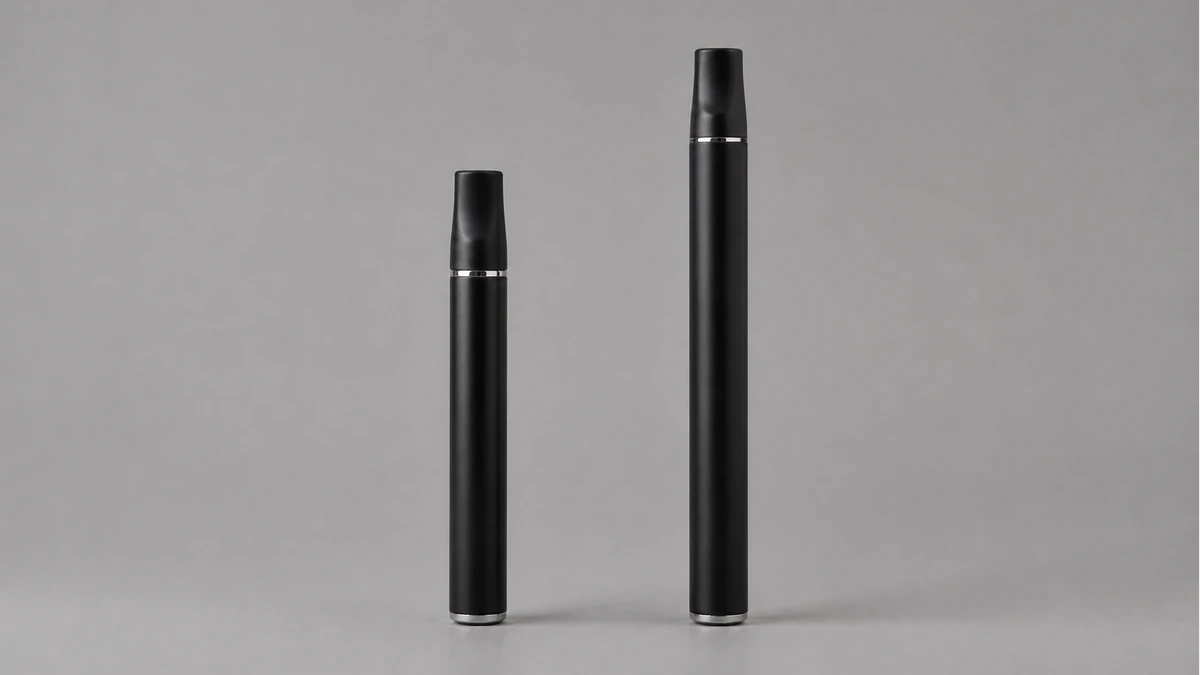
Set two vape pens side by side—one a standard-length pen, the other a stubby, compact model barely longer than a tube of lip balm—and the size difference looks like pure convenience. Smaller means it disappears into a jacket pocket and feels less conspicuous next to keys and a phone. But pick both up and turn them over, and the differences start multiplying: fewer buttons, a squatter grip, a cartridge that sits closer to your fingers, a charging port crammed into less real estate. None of that is accidental.
🔍 1. What “Compact” Actually Means in a Vape Pen
“Compact” gets used loosely in vape marketing, so it helps to separate the term into what it’s actually describing: overall length, diameter, or weight. A pen can be short but thick, long but slim, or genuinely small in every dimension. True compactness—the kind that changes how a pen behaves in daily use—usually means a reduction across all three at once, not just a shorter silhouette in a listing photo.
That distinction matters because a pen that’s merely short but retains a wide diameter can still house a reasonably sized battery and a stable control board, since diameter is where a lot of internal volume actually lives. A pen that’s been narrowed in every direction has nowhere to hide the components that make a device predictable to use.
Diameter reduction tends to be the more consequential change. Shrinking the barrel by even a couple of millimeters can force redesigns of the battery cell, the airway, and the button assembly simultaneously, since all three typically share the same cross-section of the tube. Length reduction is comparatively gentler on internal design, which is part of why some of the most usable small pens are shorter rather than thinner.
🧭 2. The Control Tradeoff: Fewer Buttons, Fewer Compromises?
Standard-length pens often have room for a dedicated power button, sometimes a separate button for adjusting heat or airflow, and occasionally a small display. Compact bodies frequently consolidate all of that into a single button, or remove buttons entirely in favor of draw-activation.
Draw-activated compact pens are appealing on paper: no button to accidentally hold down in a pocket, no interface to learn, nothing to misclick. But removing the button also removes the ability to lock the device, which matters more on a small pen than on a larger one, because a compact body is more likely to get tossed loosely into a bag or coat pocket rather than carried in a dedicated case. A pen without a lock and without a recessed activation point has more opportunity to fire against fabric or other objects it’s stored next to.
Single-button compact pens split the difference, but that one button usually has to handle several jobs—power on/off, and sometimes heat-setting cycling—through click patterns like double-taps or hold sequences. That’s a reasonable compromise, but it means the learning curve for a compact pen can be slightly steeper than for a larger pen with dedicated controls, even though the compact pen looks simpler at a glance. Buyers switching from a full-size device to a small one should expect a short adjustment period rather than assuming smaller automatically means easier.
⚙️ 3. Battery Capacity and the Physics of a Shorter Tube
This is the tradeoff most buyers already anticipate, but it’s worth being specific about why it happens rather than treating it as a vague rule of thumb. Battery cells are physical objects with fixed volume; a shorter or narrower tube has less internal space to fit one, full stop. There’s no clever engineering trick that fully escapes this—only ways to manage the consequences.
🧩 3.1 Why Shorter Doesn’t Always Mean Lighter
One counterintuitive result is that a compact pen isn’t always meaningfully lighter than a standard one, because manufacturers sometimes compensate for reduced battery volume by using a denser cell chemistry or a metal housing instead of plastic, both of which add weight back in a smaller package. Weight alone is therefore an unreliable proxy for battery size—buyers comparing two pens by heft in the hand may be comparing housing material as much as capacity.
The more reliable comparison is checking whether the listing specifies battery capacity directly, and understanding what that number means in context rather than assuming a bigger-sounding figure automatically translates into a specific number of uses, since that depends on variables a spec sheet doesn’t capture. For a deeper look at how battery specifications translate into real-world differences, the vape pen battery guide breaks down what the numbers on a spec sheet actually represent.
Buyers who want predictable capacity regardless of body size sometimes look toward devices built around a removable cell, since it sidesteps the compact-body tradeoff entirely by letting the housing stay small while the battery itself is swapped rather than shrunk to fit. That approach, covered in more detail in this overview of vapes with a detachable battery, is one of the few ways to keep a slim profile without inheriting the capacity compromises that come with a sealed, undersized internal cell.
🧩 4. Heat Spacing and Thermal Crowding
Less obvious than battery capacity, but just as consequential, is what happens to heat management when the internal layout gets compressed. In a standard pen, the heating element, the battery, and the control board typically have some physical separation, with a bit of open space or insulating material between them. In a compact pen, that spacing shrinks along with everything else.
Tighter spacing means heat generated near the cartridge or atomizer has less distance to travel before it reaches the battery compartment and the electronics. Reputable compact designs account for this with better insulating materials or smarter thermal cutoffs, but it’s a genuine design challenge rather than a solved problem, and it’s one reason compact pens vary more in perceived warmth during use than their full-size counterparts do.
This is also part of why compact pens more often specify lower or narrower heat-setting ranges than full-size devices with the same general market positioning. It isn’t necessarily a limitation imposed for its own sake—it can be a deliberate response to the reduced thermal buffer inside a smaller tube.
🛠️ 5. Cartridge Exposure and Protection
Cartridge protection is one of the more practical, everyday consequences of a compact body, and it’s the one most buyers actually notice within the first week of ownership. On a standard-length pen, the cartridge or chamber is often set back from the very top of the device, sometimes with a threaded collar or a slightly recessed mouth end that gives it a bit of a buffer against bumps.
Compact pens frequently can’t afford that buffer, because giving up even a few millimeters of length to protect the cartridge works directly against the goal of staying short. The result is a cartridge that sits closer to flush with the top edge of the device, more exposed to knocks if the pen is dropped, tossed in a bag with keys, or set down mouth-first on a hard surface.
This matters more for glass or rigid-chamber cartridges than for more flexible housings, so buyers who know they’re rough on gear—dropping devices, carrying them loose in pockets—may want to weigh cartridge exposure as heavily as overall size when comparing compact models. It’s a detail that rarely appears prominently in marketing copy but shows up quickly in daily handling.
📐 6. Grip, Balance, and Daily Handling
A shorter, narrower pen changes hand mechanics more than people expect before they try one. Standard-length pens usually give the hand two points of contact—fingers wrapped around the body and a thumb resting near a button—with enough length that the device feels stable even with a loose grip.
Balance is the other factor. Because the battery is usually the heaviest single component, and compact designs sometimes shift battery placement to make room for other internals, a small pen’s weight distribution can feel different from a standard pen’s even at a similar overall weight. Some buyers describe compact pens as feeling “top-heavy” or “bottom-heavy” for this reason, and it’s worth handling a device in person, or checking detailed unboxing footage, before assuming size alone will make it comfortable.
🧼 7. Charging Considerations in a Smaller Footprint
Charging ports and charging speed both get squeezed by compact design, and buyers rarely think about this until they’re standing at an unfamiliar outlet. A smaller internal battery generally needs less time to fill from empty than a larger one, all else equal, which sounds like an advantage—but “all else equal” is doing a lot of work in that sentence, since compact pens sometimes pair smaller batteries with lower charging currents to manage heat during charging, offsetting some of that theoretical speed benefit.
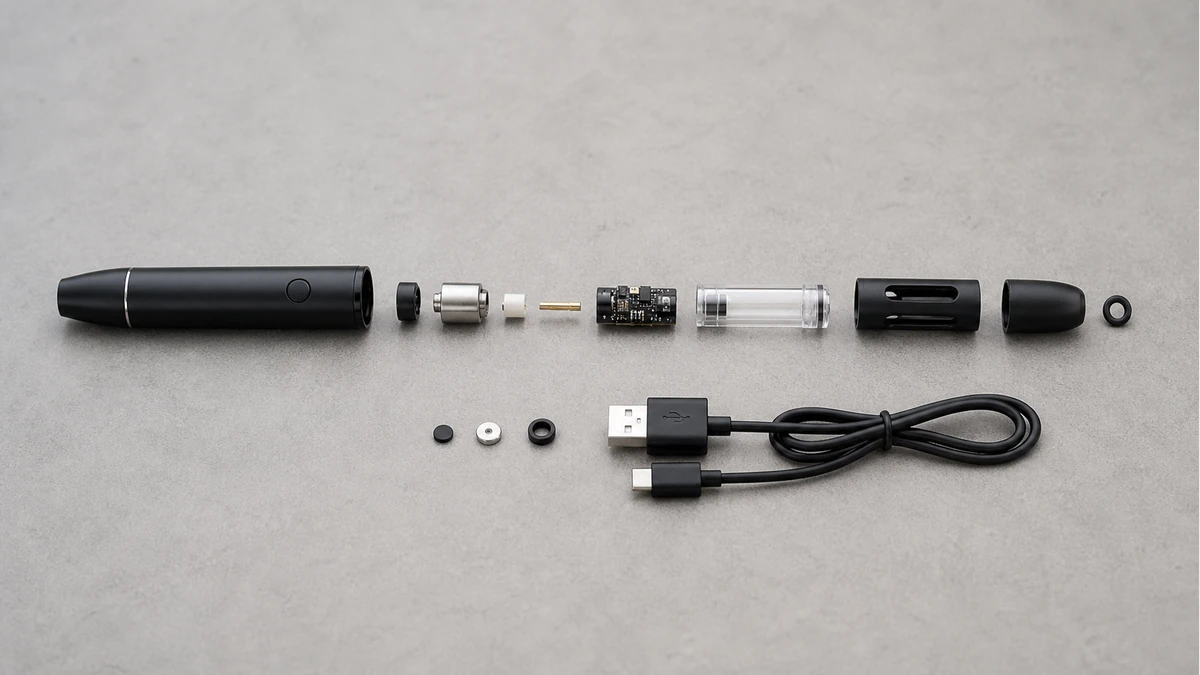
Port placement is a smaller but real annoyance: a compact pen has less surface area to work with, so the charging port sometimes ends up positioned in a spot that’s awkward to access one-handed, or close enough to the battery compartment that charging generates a bit more warmth in a confined space than it would in a longer body with more separation between components. None of this is disqualifying, but it’s worth checking port placement and charging cable type in product photos rather than assuming a small pen charges exactly like a larger one, just faster.
🔌 8. What to Compare Besides Overall Length
Length is the easiest spec to compare and the least informative one on its own. A more useful comparison process looks something like this:
- Check diameter, not just length—diameter reduction affects battery, controls, and grip more than length reduction does.
- Look for stated battery capacity rather than relying on weight or overall size as a proxy.
- Note whether the cartridge or chamber has any recessed protection at the mouth end.
- Confirm whether the device has a lock feature, especially for draw-activated compact models.
- Check the charging port type and its position on the body.
- If consistent battery capacity matters more than absolute size, compare against models built around a detachable battery instead of a sealed compact cell.
Working through these points in order gives a much clearer picture of day-to-day usability than length alone, and it surfaces the tradeoffs described above before they become a surprise after purchase.
📦 9. Compact vs. Standard: A Quick Side-by-Side
| Factor | Compact Pen | Standard-Length Pen |
|---|---|---|
| Battery capacity | Typically smaller, constrained by tube volume | More internal volume available for the cell |
| Controls | Often single-button or draw-activated | More often has dedicated buttons, sometimes a display |
| Heat spacing | Tighter, less buffer between components | More separation between heat source and electronics |
| Cartridge protection | Cartridge often sits closer to the top edge | More likely to have a recessed or collared mouth end |
| Grip and balance | Varies more by hand size; can feel top- or bottom-heavy | Generally more stable across hand sizes |
| Pocketability | Genuinely discreet, minimal print | Noticeable in tighter pockets |
For buyers researching the category further, the general vape pens overview covers how these body-style differences map onto the broader range of pen formats currently available.
❓ 10. Frequently Asked Questions
Does a smaller vape pen always mean a smaller battery?
Not always in a strict linear sense, but there’s a physical relationship between tube volume and cell size, so meaningfully compact pens generally do work with less battery volume than standard-length ones—the exception being models built around a detachable battery, where the cell isn’t constrained by the housing size.
Are compact pens more likely to overheat?
They aren’t inherently unsafe, but the reduced spacing between heat-generating components and the rest of the internals is a real design constraint, which is why heat settings and insulating materials matter more in compact models than they do in larger-bodied pens.
Why do some small pens skip a lock feature?
Draw-activated designs are common in compact bodies partly because they simplify the control layout, but that also means there’s often no way to lock the device, which is worth weighing against how the pen will typically be carried.
Is a narrower pen always more compact than a shorter one?
Not necessarily. Diameter and length affect internal design differently, and a narrow pen can require more internal compromises than a shorter one of similar volume, even if it doesn’t look smaller in a photo.
🔍 11. The Bottom Line
A compact vape pen isn’t a smaller version of a standard pen with nothing lost in translation—it’s a different set of engineering decisions, made under tighter internal constraints, that happen to produce a shorter or narrower tube as the visible result. None of the tradeoffs described here make compact pens a poor choice; they simply mean buyers should evaluate diameter, battery specifics, cartridge protection, and control layout with the same attention they’d give to length, rather than treating size as the only variable that matters.