🔍 1. Do Dabs Actually Produce a Noticeable Smell?
You clear a banger at 9 p.m., open a window out of habit, and by 9:15 the room smells like nothing in particular. Then at midnight you walk past the shelf where the rig sits and catch a faint, sweetish, faintly burnt smell that wasn’t there an hour before. That’s the contradiction most people run into when they ask whether dabs smell: the honest answer is yes, but not in one consistent way, and not for the reason most people assume.
A dab does produce a smell, and in the first few seconds after concentrate hits a hot surface, that smell can be sharp and immediate — vaporized terpenes and any residual solvents in the concentrate hitting the air all at once. But that smell doesn’t behave like smoke. It doesn’t cling to fibers and hair the way combusted plant matter does, and it clears from open air faster than most people expect based on smoking experience. What lingers instead is what’s left behind on the hardware: the film inside the nail, the residue coating the glass, the water sitting in the rig, and the dab tool left out on a tray. That residue is a slower, quieter, and ultimately longer-lasting source of odor than the hit itself, and it’s usually what people mean when they say a rig “smells” days after it was last used.
So the room-odor question really splits into two separate questions: does the moment of dabbing smell, and does the equipment smell afterward. Both are true, but they’re driven by different chemistry, they fade at different speeds, and they call for different habits if odor control actually matters in a shared space.
🧭 2. Why Fresh Vapor Smells Different From Cooled Residue
The smell that hits you the instant a dab vaporizes is dominated by terpenes — the aromatic compounds that give concentrate its characteristic scent profile, whether that’s piney, fruity, fuel-like, or something more herbal. At high heat, those terpenes flash into the air quickly and in a relatively low concentration per breath, which is part of why the smell can feel strong for a few seconds and then noticeably fade within a minute or two, especially with any airflow in the room. A window cracked before the torch even comes out does more to shorten that window of noticeability than anything done after the fact.
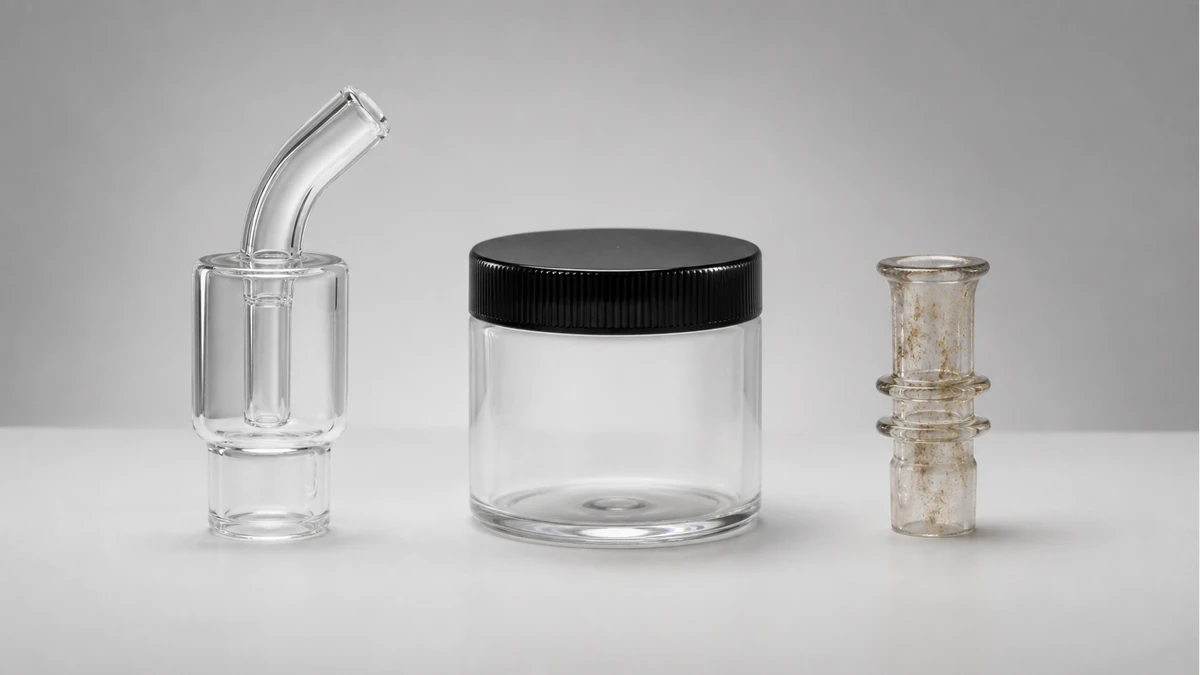
What happens on the nail or banger surface afterward is a different story. Not everything on a hot surface fully vaporizes and clears — some residue is left behind as the surface cools, a thin, often faintly amber or brown film that’s a mix of unvaporized concentrate, plant lipids, and byproducts from repeated heating cycles. That film doesn’t smell the way fresh vapor smells. It tends to read as heavier and more scorched, sometimes slightly acrid, because it’s been through partial combustion rather than a clean vaporization pass, and because it’s had time to oxidize sitting exposed to air between sessions.
That mismatch is the core reason fresh-hit smell and residue smell don’t match, and it explains why someone can walk into a room an hour after a session and register an odor that feels entirely different from what was in the air during the hit itself. The vapor is gone. What remains is byproduct sitting on glass, and byproduct smell behaves more like old smoke residue than like the terpene profile that made the concentrate smell good in the first place.
⚙️ 3. Which Hardware Surfaces Hold Odor the Longest
Not every part of a dab setup holds smell equally. Some surfaces clear almost as soon as they cool. Others accumulate residue session after session until they become a standing odor source independent of whether the rig is actively in use.
🧩 3.1 The Nail, Banger, and Quartz Surface
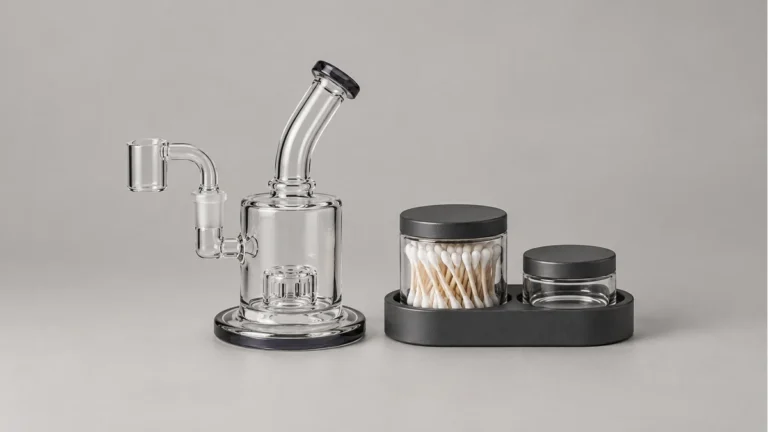
The banger or nail is where concentrate makes direct contact with heat, so it’s also where residue builds fastest. A quartz banger wiped clean after each dab — while it’s still warm, before residue has a chance to fully cool and harden — stays close to odorless between sessions. A banger used repeatedly without cleaning develops visible buildup, and that buildup keeps releasing faint odor even when the rig isn’t in use, particularly in a warm room. Some people wipe the banger after every single dab; others let it go three or four sessions before reaching for a swab. The tradeoff is straightforward — more frequent cleaning means less buildup and less odor, but it also means handling a hot quartz surface more often, so most people settle into a rhythm that balances convenience against how much residue smell they’re willing to tolerate between sessions. Either way, this is the single most controllable odor source in the whole setup, since it’s also the easiest surface to reach with a cotton swab or a dab-specific cleaning solution.
🧩 3.2 Rig Water and the Chamber
Water in the base of a rig filters some of what passes through it, and over multiple sessions it accumulates dissolved residue along with whatever was on the downstem. Water changed after every session or two stays close to neutral. Water left sitting for days, especially in a rig used often, develops a stagnant, slightly sour smell that has more to do with standing water than with the concentrate itself — but it reads to most people as “the rig smells,” because it’s coming from the same object.
🧩 3.3 Dab Tools, Containers, and Silicone Jars
The dab tool goes back into its case or sits on a tray between uses, still coated in a thin layer of concentrate. Silicone containers used to hold concentrate absorb odor into the material itself over time, which is one reason experienced users dedicate one container to one strain or product rather than rotating fresh concentrate through a jar already saturated with old scent. None of these items smells strong on its own, but a tray holding a used tool, an open jar, and an uncleaned dab tool together creates a small, concentrated odor zone — often what people are actually smelling when they say “the whole area smells,” even with the rig itself sitting clean.
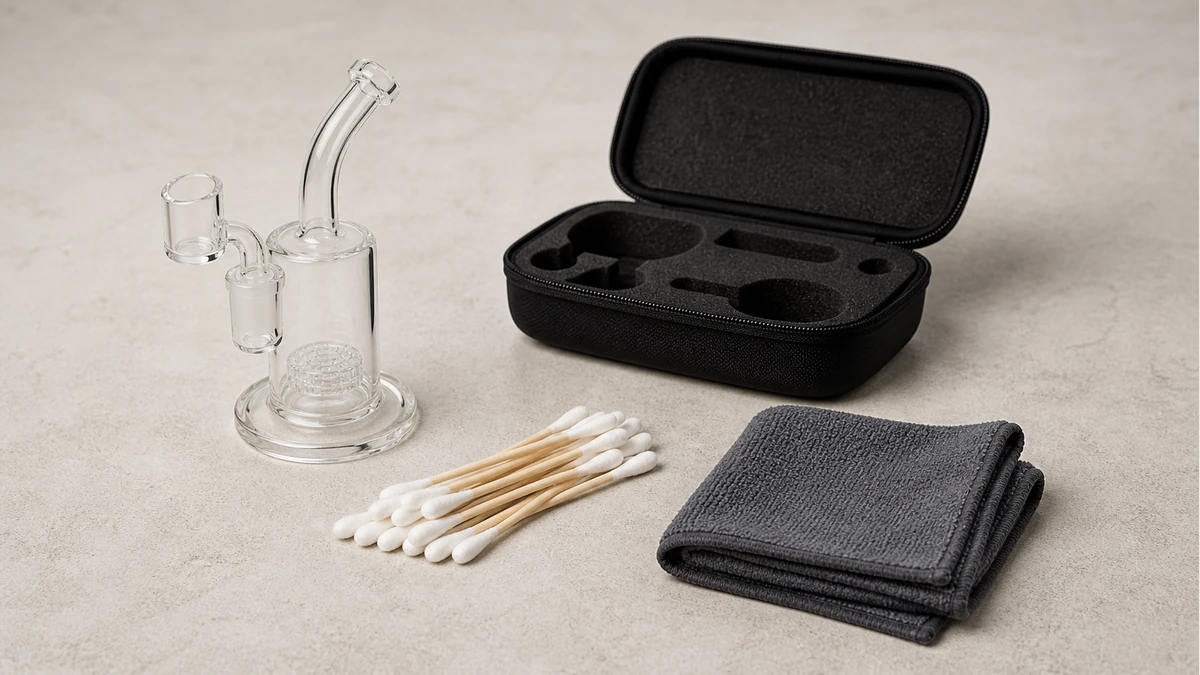
🧩 4. Storage and Fabric — Where Smell Lingers After the Session
Once the session ends, the story shifts from hardware to environment. Three things determine how long smell hangs around a space: airflow, what surfaces are nearby, and whether anything’s been left uncleaned or uncovered.
Fabric is the most persistent odor holder in almost any room. Curtains, upholstery, and clothing absorb airborne terpene compounds the same way they absorb cooking smells, and they release that odor slowly over hours rather than clearing in minutes the way open air does. A rig used in a room with heavy soft furnishings and no ventilation leaves a more noticeable trace than the same session in a room with hard surfaces and a cracked window, even though the actual amount of vapor produced was identical.
Storage containers behave the opposite way — sealed correctly, they trap odor rather than release it, which is useful for concentrate that hasn’t been touched yet but becomes a problem the moment the seal gets broken repeatedly or left open. An open container left on a shelf continues to release scent into the room at a low, steady rate, distinct from anything related to the rig or the dabbing itself. This is a common point of confusion in odor troubleshooting: people focus on the rig, the torch, the technique, when the actual ongoing source is a container left open in a drawer with no airflow.
For anyone dealing with odor in a space they can’t fully ventilate, the practical fixes tend to be mundane rather than clever. An air purifier with an activated-carbon stage does more than an air freshener, since it removes compounds rather than masking them, and simply increasing airflow — a fan pointed toward an open window rather than just a cracked one — moves vapor out of a room faster than passive diffusion ever will.
None of this is a controlled variable the way a lab setting would be. Room size, ventilation, humidity, and how often a space gets cleaned all shift how noticeable and how long-lasting any given smell will be, which is why two people describing “the same” session often report very different odor experiences.
🛠️ 5. When a Stronger Smell Signals Cleaning or Leakage, Not Just the Session
There’s a meaningful difference between the ordinary, short-lived smell of a normal dab and a smell that’s noticeably stronger, more chemical, or more persistent than usual. When that shift happens, it’s worth treating it as a signal rather than background noise.
A butane torch that smells like fuel beyond the moment it’s lit usually points to a small leak at the valve or fill point, not to anything related to the concentrate. That’s worth addressing directly rather than working around, given it involves a pressurized fuel source.
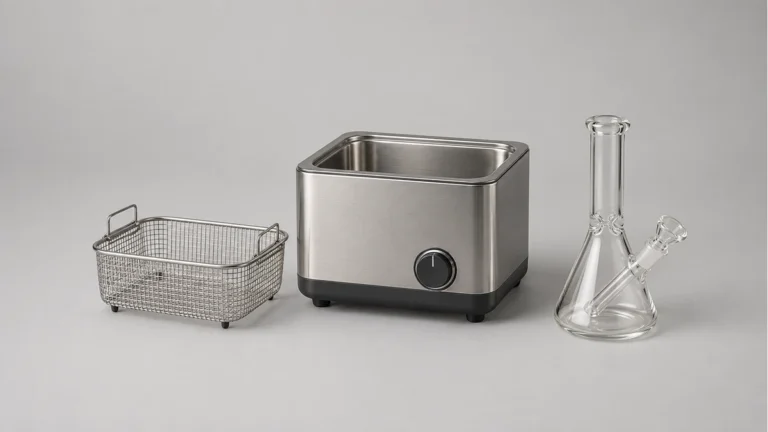
A rig that smells noticeably worse than it did a few weeks earlier, with no change in the concentrate being used, is very often a buildup problem rather than a new odor source. Resin accumulating in the downstem, water that hasn’t been changed in a while, and a banger that’s gone several sessions without cleaning all compound on top of each other, and the resulting smell is disproportionate to any single session. This is the point where cleaning stops being optional maintenance and starts being the actual explanation for the smell — a topic covered in more depth in this guide to cleaning a dab rig without breaking or damaging it, which walks through getting residue out of glass and joints without cracking anything in the process.
A sudden, sharp, chemical smell that doesn’t resemble the usual terpene profile at all — something closer to burning plastic or an off-gassing odor — isn’t a normal variation and shouldn’t be treated as one. That kind of smell points to a hardware problem, a damaged part, or in some cases a concentrate quality issue, and the right response is to stop and inspect the equipment rather than continue the session.
📐 6. How Dab Smell Compares to Carts and Dry Herb
People who move between formats — concentrate, cartridge vapes, and dry herb — often expect the smell profile to be roughly similar, and it usually isn’t. Cartridge vapor tends to be lighter and clears faster in open air, though it carries its own odor questions around cart residue and battery contacts worth understanding on their own terms; those differences are laid out in this look at whether carts smell. Dry herb vaporization sits somewhere in between, with a smell closer to gently baked plant material than to either concentrate vapor or smoke, and it comes with its own chamber and screen maintenance questions covered in this piece on dry herb vaporizer smell.
What all three formats share is the same underlying pattern: the active moment of use isn’t the main long-term odor source. The equipment left uncleaned afterward is. Anyone comparing formats purely on “which one smells worse” is usually really comparing how consistently each user cleans their own hardware.
🧼 7. FAQ
Does dab smell go away faster than smoke?
Yes, in open air with any ventilation. Vapor disperses more quickly than combustion smoke, though it can still linger in fabric and enclosed spaces.
Why does my rig smell even when I haven’t used it in days?
Standing water, uncleaned residue in the banger, and a used dab tool left nearby are the most common sources. Check those before assuming anything else is wrong.
Is a stronger-than-usual smell always a sign of a problem?
Not always, but a sharp increase without a change in concentrate or routine is worth investigating — usually buildup, sometimes a fuel or hardware issue.
Does cleaning the banger actually reduce odor between sessions?
Yes. Residue on the hot surface is one of the most direct, controllable odor sources in the entire setup.
Does the type of concentrate change how much odor lingers?
To some degree — the same variation in terpene profile that changes flavor also changes how strong the initial smell is. But the residue and storage factors described above matter more for how long odor sticks around after the session ends.
Dab smell isn’t one fixed thing — it’s the fresh terpene burst of the hit itself, the heavier residue smell left on hardware afterward, and whatever a room’s fabric and airflow decide to hold onto in between. Track which of those three you’re actually smelling before assuming the worst, and most of what reads as a mystery odor turns out to have a straightforward, fixable source sitting in plain sight on the tray.