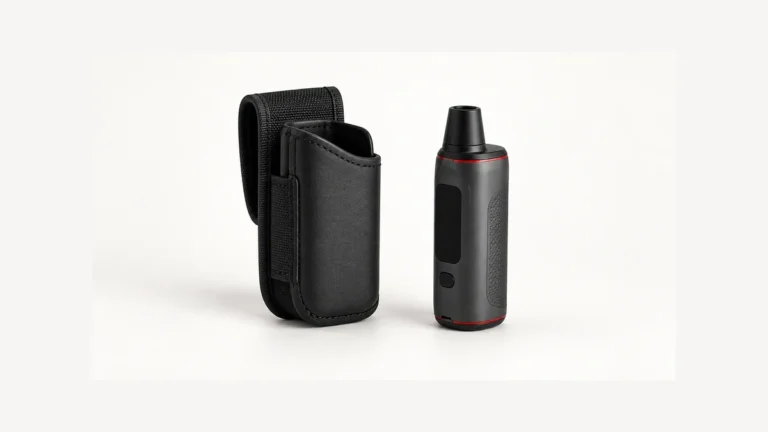
A logo can make a vape device recognizable. It cannot make the device reliable, easy to reorder, or suitable for a particular market.
Strong vape branding starts before color selection. It translates a commercial position into decisions a designer, engineer, packaging supplier, quality team, and sales team can all follow. When those decisions are disconnected, the result may look consistent in a rendering but fall apart across samples, production batches, packaging, and retail listings.
This guide explains how adult-market brand owners and wholesale buyers can build that system, from the first positioning brief through sample approval and repeat production.
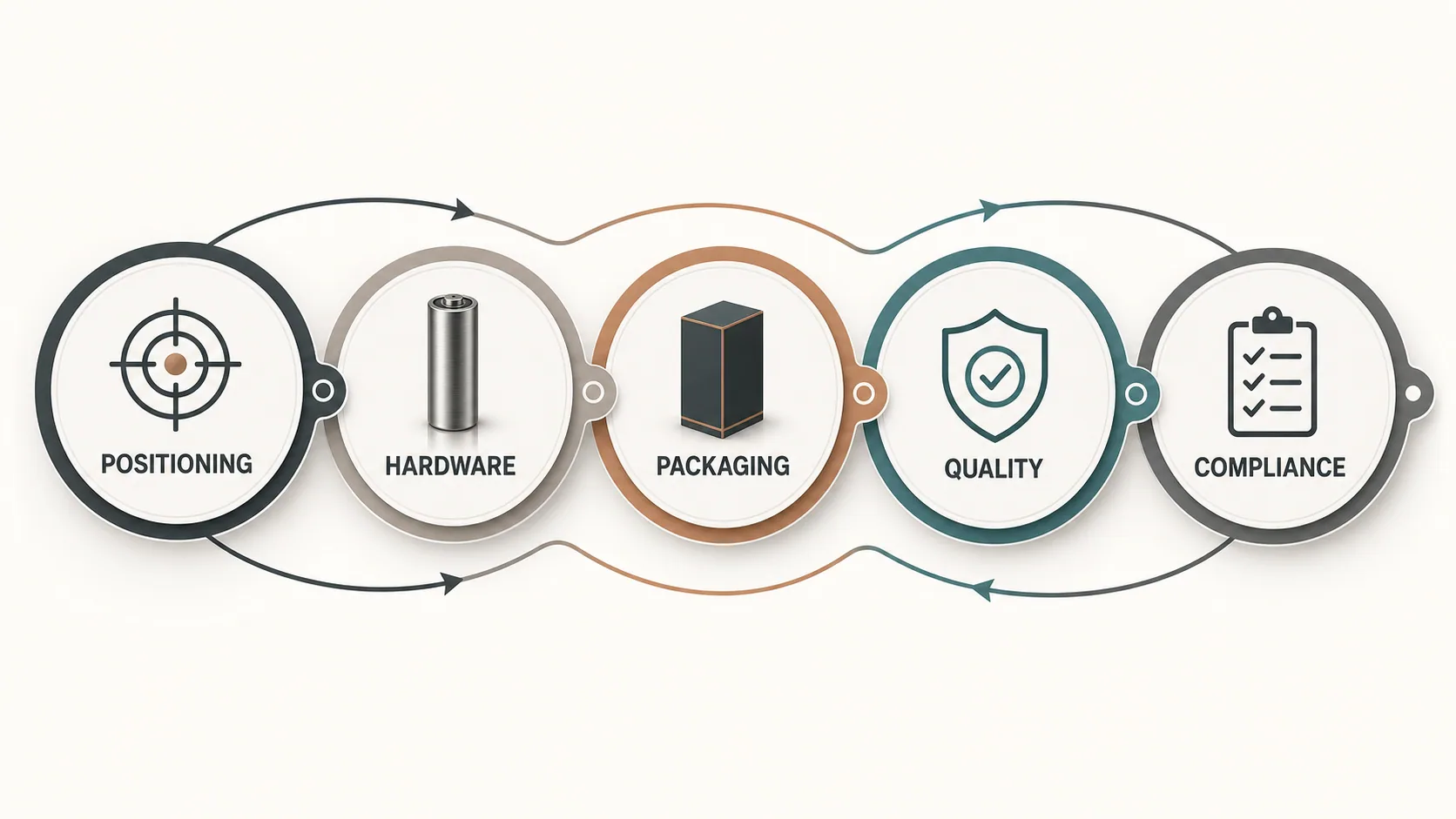
🧭 At a glance: the 5-part branding system
🎯 Positioning
Customer, use case, channel
⚙️ Hardware
Format, features, finish
🎨 Packaging
Identity, hierarchy, artwork
✅ Quality
Samples, limits, control
🛡️ Compliance
Market rules and review
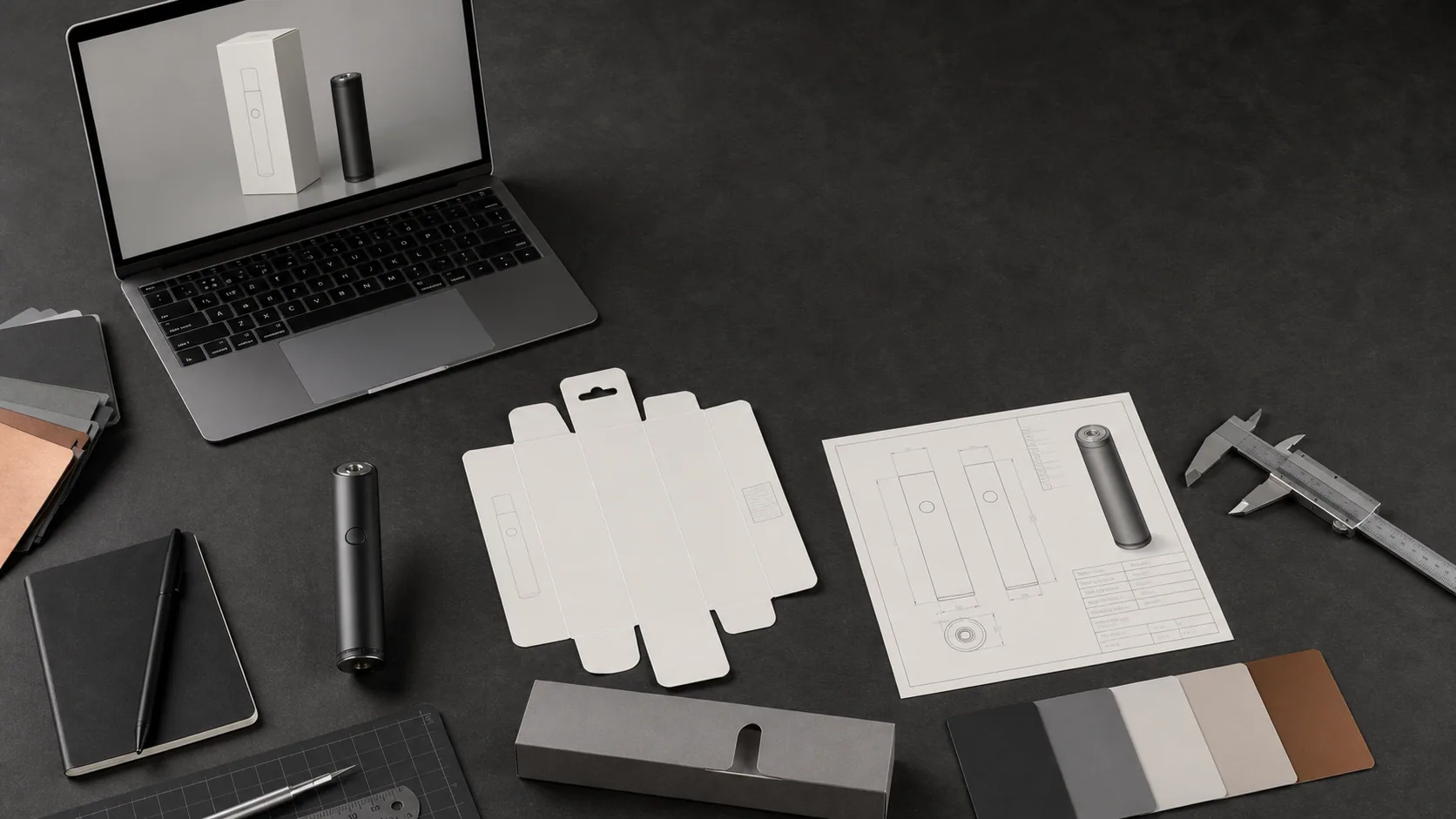
01 🎯 Start with the customer and use case
The first decision is not the logo. It is the customer you are building for and the job the product needs to perform.
A compact 510-thread battery for an occasional cartridge user requires different priorities from a device intended for a high-volume dispensary program. A wholesale line designed for smoke shops may need clear shelf navigation across several SKUs, while a brand selling one flagship device may invest more heavily in a distinctive enclosure, finish, and unboxing experience.
A useful positioning brief should answer five questions:
- Who is the adult customer? Define the market, channel, experience level, and purchasing context.
- What problem does the product solve? Examples include cartridge protection, simple voltage selection, discreet storage, easier cleaning, or a consistent wholesale assortment.
- What should the brand be known for? Choose one or two defensible attributes, not a list of generic adjectives.
- What price and channel constraints apply? Packaging, finish, accessories, margins, and order quantities all depend on the route to market.
- Which requirements cannot change? Identify target-market rules, compatibility, dimensions, charging interface, documentation, and testing needs before design begins.
A statement such as “premium, innovative, and reliable” is not a specification. “A compact variable-voltage 510 battery for licensed dispensary counters, with protected cartridge storage and a finish that resists visible handling marks” gives the product team something it can evaluate.
02 🧩 Choose private label, OEM, or ODM
Manufacturers do not always use the terms private label, OEM, and ODM in exactly the same way. Before comparing quotations, define the work included rather than relying on the label alone.
| Development route | Typical scope | Best fit | Main trade-off |
|---|---|---|---|
| Private label | Existing device with approved logo, color, and packaging options | Testing a channel or launching a small product family quickly | Limited physical differentiation |
| OEM customization | Existing platform with defined cosmetic, packaging, firmware, accessory, or component choices | Brands that need a distinct configuration without a new device architecture | Scope and ownership must be documented carefully |
| ODM development | New industrial design, tooling, structure, electronics, or performance requirements | Established teams building a differentiated flagship product | More validation, investment, tooling, and development time |
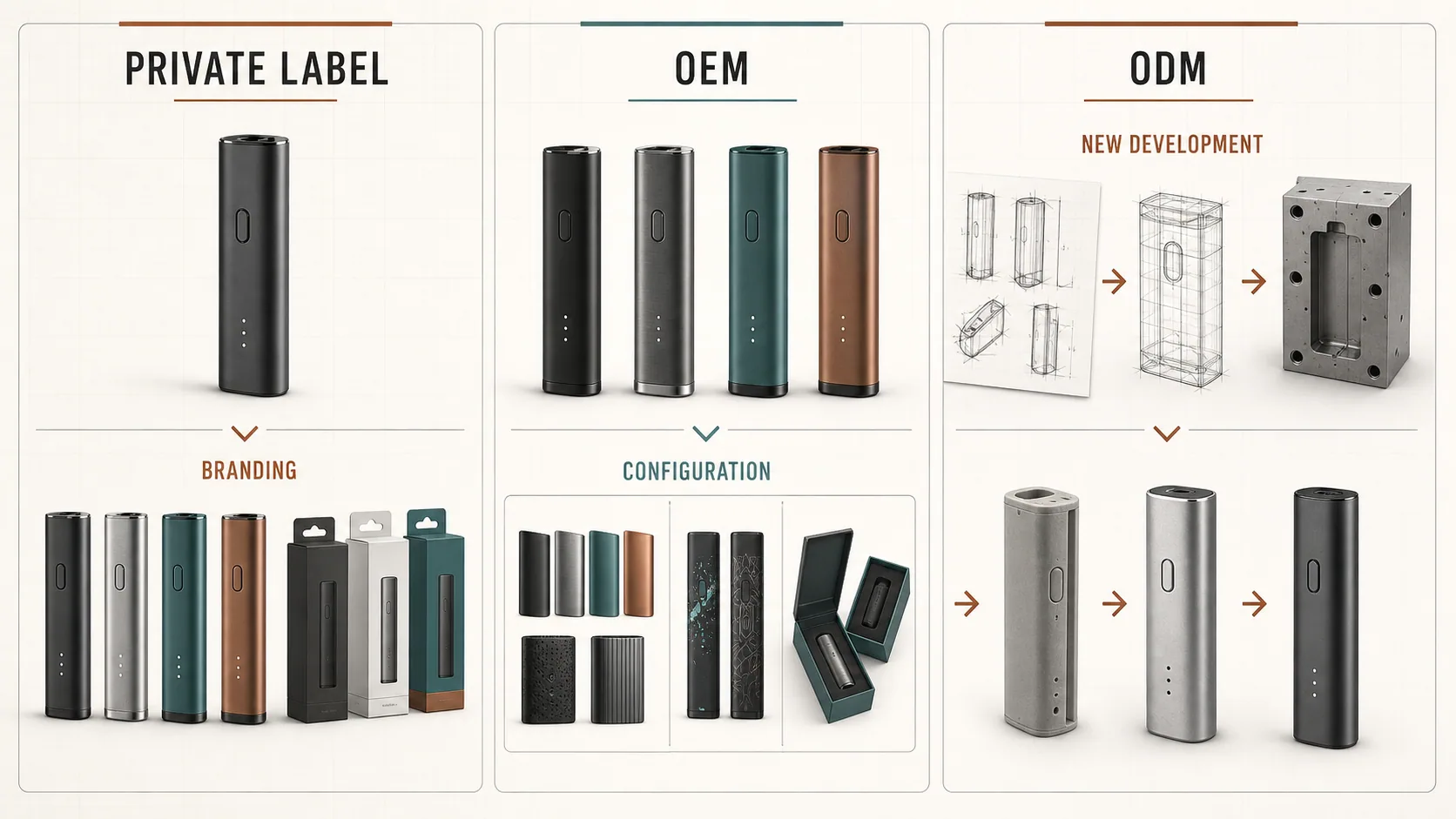
AOVAPE publicly describes separate OEM and ODM processes, including design confirmation, sampling, tooling, bulk production, and packaging support. Buyers should still confirm the exact scope, intellectual-property terms, sample stages, testing responsibilities, and change-control process in the project agreement.
For a new brand, the sensible route is often to validate positioning on an existing hardware platform before funding a unique enclosure or electronics platform. That is not a universal rule. A brand whose value depends on a patented mechanism, unusual ergonomics, or a tightly controlled performance profile may need custom development from the start.
03 ⚙️ Turn the brand idea into a hardware specification
The visual identity must work with the physical product. A thin laser mark, a full-color UV print, an anodized metal finish, and a rubberized coating create different costs, tolerances, wear patterns, and production risks.
Build the hardware brief around measurable decisions:
- Device category: 510-thread battery, cartridge hardware, wax pen, dry-herb vaporizer, or another defined platform.
- Form factor: overall dimensions, cartridge exposure, pocketability, grip, button placement, and display visibility.
- Performance: battery capacity, voltage range, activation method, preheat behavior, charging interface, and protection functions.
- Compatibility: cartridge diameter, thread engagement, resistance range, oil-viscosity assumptions, and accessory fit.
- Materials and finish: substrate, coating, color standard, gloss level, texture, abrasion expectations, and cleaning compatibility.
- Brand application: logo location, maximum print area, print method, color tolerance, and orientation.
- Pack-out: device, cable, adapters, instructions, protective insert, retail box, master carton, and traceability labels.
If the project uses an existing product, start with a confirmed technical data sheet and an undecorated sample. The AOVAPE 510-thread battery range, for example, contains several physical formats. Branding decisions should follow the selected platform’s real print area, materials, controls, and packaging dimensions rather than a generic mockup.
04 🎨 Build a visual system for a product family
A single attractive device is not yet a scalable brand. The system must remain understandable when the range expands.
Define rules for product names, color roles, finish levels, packaging hierarchy, icons, specifications, warnings, barcodes, and batch information. A customer should be able to distinguish a cartridge battery from a wax device, or an entry model from a flagship model, without relearning the brand on every box.
Use a controlled master artwork package containing:
- Vector logos and minimum-size rules.
- Color values for print, screen, coating, and molded materials.
- Approved typefaces and fallback fonts.
- Product naming and model-number conventions.
- Packaging front, back, side, insert, and master-carton layouts.
- Approved icons and prohibited claims.
- Revision number, owner, approval date, and market version.
This is where packaging and product engineering need to meet. A box can be visually correct but still fail because the insert allows movement, the cable changes position during transit, the barcode is difficult to scan, or the warning panel was added after every other element had been locked.
AOVAPE’s existing guide to custom vape packaging outlines common packaging formats and artwork inputs. Treat that page as a starting point, then obtain market-specific legal review before approving production artwork.
05 🛡️ Put compliance at the start of the design process
Vape-product classification and promotion rules depend on the product, intended use, contents, claims, sales channel, and jurisdiction. A hardware supplier’s component certificate does not automatically make a finished branded product lawful for sale or advertising.
For the United States, the FDA regulates advertising and promotion requirements for covered tobacco products and restricts unauthorized modified-risk descriptors. Its current advertising and promotion guidance should be reviewed with qualified counsel for the specific product and campaign.
For Canada, the Vaping Products Promotion Regulations information sheet explains that promotion visible or audible to young persons is prohibited and that permitted advertising may require a health warning. Requirements can also vary by province or territory.
Use a market approval checklist before final artwork:
- Confirm the product classification and responsible legal entity.
- Confirm required warnings, languages, placement, size, and attribution.
- Remove youth-oriented imagery, themes, naming, and channels.
- Remove health, cessation, “safe,” “light,” or reduced-risk claims unless specifically authorized.
- Confirm electrical, battery, transport, recycling, and labeling documentation required for the market and shipment method.
- Maintain a market-specific artwork version rather than overwriting one global file.
This article is a product-development framework, not legal advice. Regulations change, and the applicable rules must be confirmed for each destination before production and promotion.
06 ✅ Use a golden sample as the approval standard
Digital renderings are useful for direction. They cannot confirm coating texture, print sharpness, button feel, cartridge fit, color under retail lighting, packaging movement, or how the finish behaves after repeated handling.
Approve a physical “golden sample” and record the criteria that make it acceptable. The approval package can include:
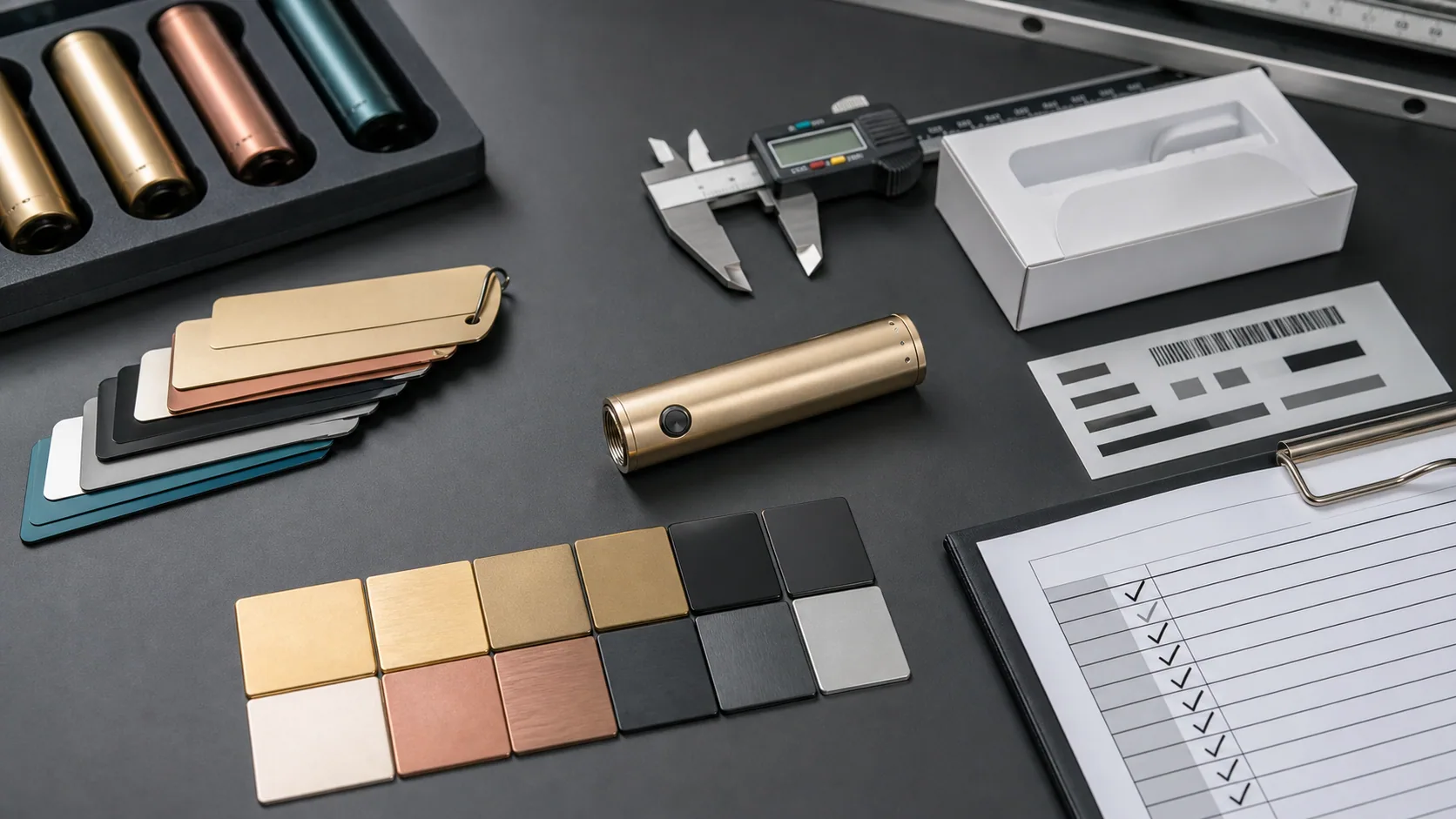
- Signed device and packaging samples.
- Approved color standard and tolerance.
- Logo position, size, orientation, and adhesion requirements.
- Functional test plan and pass/fail limits.
- Cosmetic defect definitions and inspection level.
- Packaging drop, fit, barcode, and carton-mark checks.
- Firmware version and change history where applicable.
- Lot, date-code, and traceability format.
Any change after approval should be documented. A substituted coating, battery cell, adhesive, insert material, cable, or print method may affect performance or customer perception even when the product name remains the same.
07 📋 Build a supplier brief that is hard to misunderstand
A strong request for quotation is concise, but it is not vague. Give each supplier the same inputs so you can compare like with like.
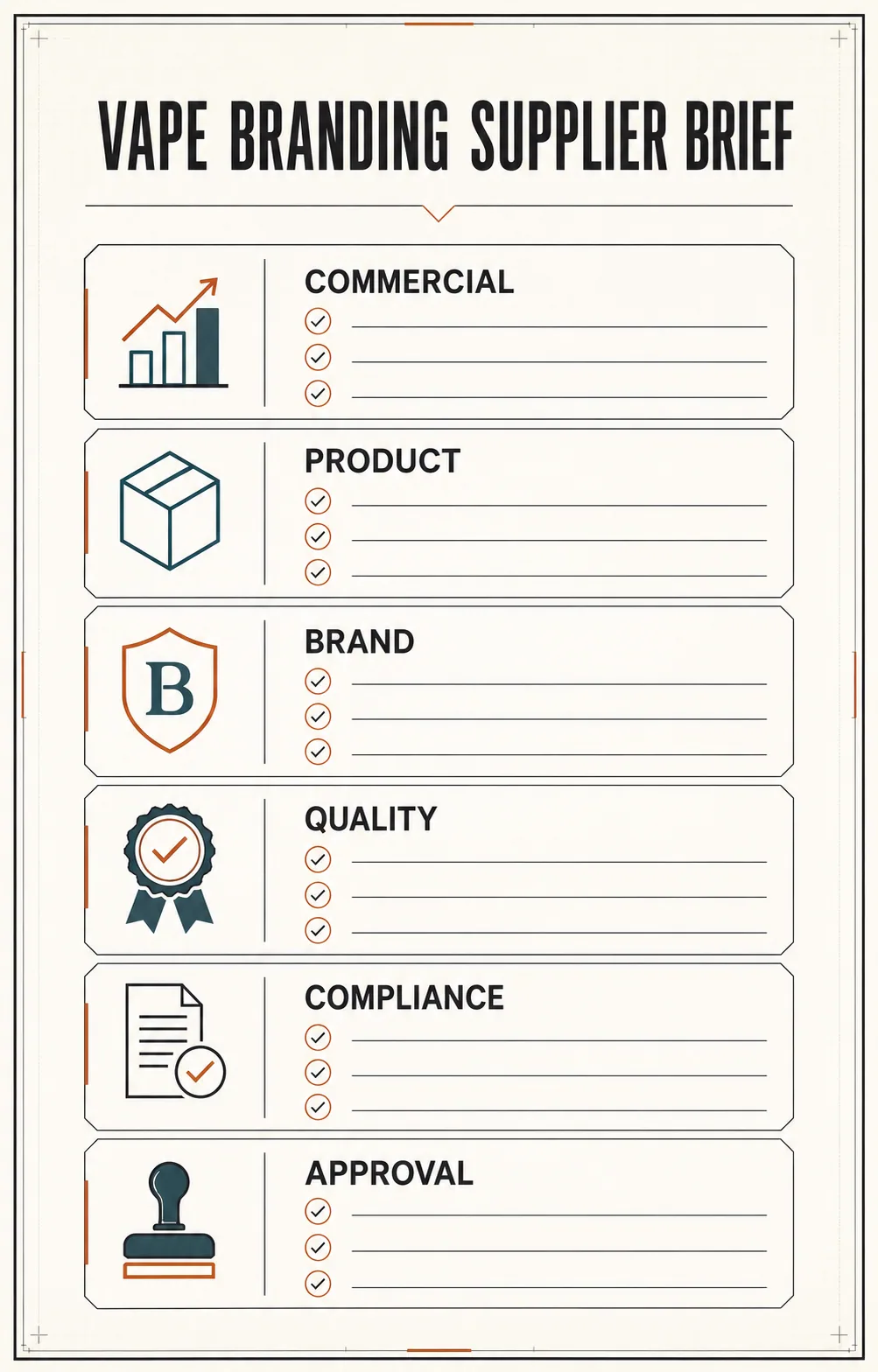
| Brief section | Information to provide |
|---|---|
| Commercial | Target market, channel, launch window, forecast, target cost, and Incoterm |
| Product | Category, reference platform, required features, compatibility, accessories, and exclusions |
| Brand | Logo files, color standards, finish, naming, artwork ownership, and packaging hierarchy |
| Quality | Inspection plan, functional tests, cosmetic limits, traceability, and change-control expectations |
| Compliance | Destination, required documents, approved claims, warnings, languages, and responsible reviewer |
| Approval | Rendering, prototype, engineering sample, decorated sample, packaging sample, and golden-sample stages |
Ask the supplier to identify assumptions and exceptions in writing. If a requested finish, voltage profile, packaging material, test, or certification is unavailable, it should appear as a deviation before sampling, not after mass production.
08 🤝 How AOVAPE supports a vape branding project
AOVAPE’s public OEM/ODM service page describes in-house design, packaging support, sampling, tooling, manufacturing, and delivery stages for 510-thread batteries, wax pens, dry-herb vaporizers, and oil-pen hardware.
Before requesting a quote, decide whether you need an existing platform with branding, a configured OEM product, or a new ODM development. Then send a structured brief covering the market, user, device, performance, visual identity, packaging, documentation, and approval plan.
That preparation shortens the clarification loop and makes the first sample more useful. It also gives both teams a shared standard for evaluating changes and repeat orders.
09 ❓ Frequently asked questions about vape branding
Q1 · Is vape branding just a logo and custom box?
No. Those are visible outputs of a larger system. Effective vape branding also covers positioning, hardware selection, finish, interface, compatibility, product naming, quality standards, documentation, and the experience customers receive across multiple batches.
Q2 · Should a new vape brand start with OEM or ODM?
Use the route that matches the required product change and your ability to validate it. An existing platform with controlled branding can test a market with fewer engineering variables. ODM is more appropriate when the brand depends on a distinct structure, mechanism, performance profile, or protected design.
Q3 · What files should I send for a custom vape project?
Send vector logo files, color references, a product brief, required specifications, packaging content, destination-market requirements, forecast, target timeline, and reference images with notes explaining what you do and do not want. Final production artwork should have revision control and named approvers.
Q4 · How can a brand reduce inconsistency between production batches?
Approve a physical golden sample, define measurable cosmetic and functional limits, require lot traceability, and document change control. Do not approve only from a digital rendering, and do not allow material or component substitutions without written review.
10 🚀 Build the specification before the campaign
The most useful vape branding work happens before the first campaign image is produced. Define the adult customer, market, product job, hardware requirements, quality standard, visual system, and compliance constraints first. The logo and packaging can then express a product promise the supply chain is capable of keeping.
If you are preparing a private-label, OEM, or ODM hardware project, review AOVAPE’s OEM/ODM capabilities and send the project team a structured brief for feasibility review.