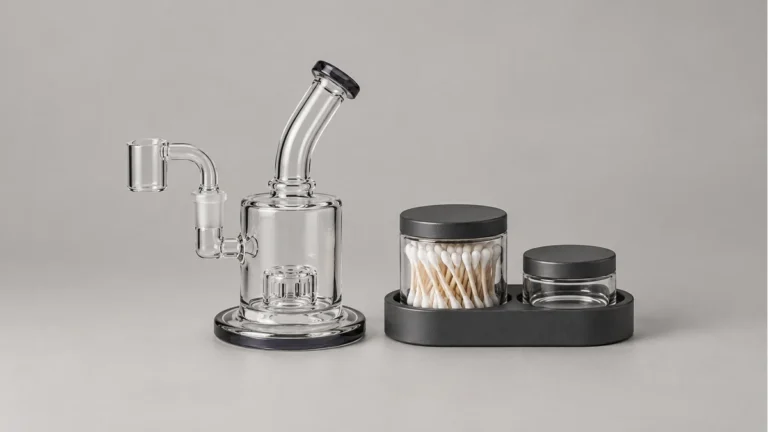
The term weed vaporizer pen refers to a compact, portable device designed to vaporize cannabis material — whether that is dry herb flower, oil concentrate, or wax — without burning it. Unlike smoking, which relies on combustion and a direct flame, a weed vaporizer pen uses a controlled heating system to convert cannabinoids and terpenes into inhalable vapor at a lower, more precise temperature.
The category has expanded significantly over the past decade. What once described a single product type now covers a wide range of hardware formats, heating systems, material compatibility profiles, and electronic control designs. Two devices both described as “weed vaporizer pens” can behave very differently depending on whether they are built for oil cartridges, dry herb, or concentrate — and whether they use conduction, convection, or hybrid heating.
This article explains the weed vaporizer pen from a neutral hardware perspective: how vaporization works, how different heating methods affect performance, what material types each device format supports, how temperature control shapes the experience, and what distinguishes quality hardware from lower-tier designs.
For broader category context, readers can also review AOVAPE’s full portable vaporizer collection, the dry herb vaporizer range, and related technical articles on the AOVAPE blog.
🌿 1. What Is a Weed Vaporizer Pen?
🔍 A weed vaporizer pen is a handheld, battery-powered device that heats cannabis material to a temperature range that produces vapor — typically between 140°C and 220°C (285°F–428°F) — without reaching the combustion point that produces smoke. No flame is involved. The heating is controlled electronically, which allows for more precise temperature management than any open-flame method.

- 🌡️ Heats cannabis below combustion point — vapor, not smoke
- 🔋 Battery-powered with rechargeable lithium-ion cell
- 🧩 Compatible with oil cartridges, dry herb, or concentrate depending on format
- 📏 Compact, pen-style or pocket-sized body for portability
- 🔌 Modern designs typically include USB-C charging
The key distinction from smoking is temperature. When cannabis is combusted — burned with a flame — the material reaches temperatures around 538°C (1000°F). At that level, plant matter breaks down into smoke, and many of the aromatic and active compounds (terpenes, cannabinoids) are destroyed in the process. Vaporization, by contrast, heats material to the point where these compounds convert to vapor without incinerating the surrounding plant matter.
📌 In other words, a weed vaporizer pen is not simply a smaller pipe or a stylized cigarette. It is a fundamentally different heating system built around precision temperature control.
🔬 2. How Vaporization Actually Works
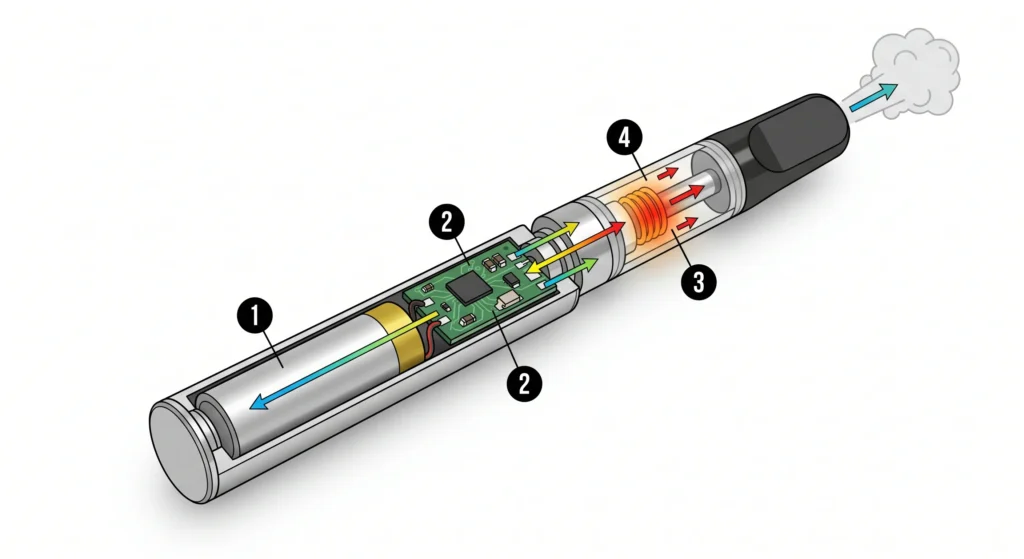
Understanding the hardware requires understanding the underlying process. Vaporization is not one single event — it is a temperature-dependent sequence in which different compounds leave the cannabis material at different points along the heat curve.
🌡️ 2.1 The Vaporization Temperature Range
Cannabis contains hundreds of compounds. Different cannabinoids and terpenes have different boiling points. This means that heating to different temperatures produces meaningfully different vapor composition profiles:
- Lower temperatures (140–170°C / 285–338°F) — tend to activate lighter terpenes and produce cooler, more aromatic vapor
- Mid-range temperatures (170–195°C / 338–383°F) — the most commonly used zone for balanced cannabinoid activation and vapor density
- Higher temperatures (195–220°C / 383–428°F) — produce denser, warmer vapor with stronger extraction, but can degrade delicate terpene profiles
- Above 230°C (446°F) — combustion risk increases significantly; material begins to burn rather than vaporize
This temperature sensitivity is one of the main reasons hardware design matters so much in the weed vaporizer pen category. A device that overshoots its target temperature — or cannot hold a consistent temperature under load — will produce a fundamentally different (and usually worse) experience than one with precise, stable thermal control.
⚡ 2.2 From Battery to Vapor: The Internal Sequence
At a hardware level, the process works as follows: the battery cell delivers electrical current to the heating element when the device is activated — either by pressing a button or, in draw-activated designs, by detecting inhalation through an airflow sensor. The heating element converts that electrical energy into thermal energy. The cannabis material — whether oil in a cartridge, dry herb in a chamber, or concentrate on a coil — is exposed to that heat. Compounds that have reached their vaporization temperature convert from liquid or solid to vapor. The vapor travels through the device’s airflow path and out through the mouthpiece.
💡 The performance of every step in this sequence — from cell discharge consistency to heating element material to airflow path geometry — contributes to the overall quality of the vapor delivered.
🔥 3. Heating Methods: Conduction, Convection, and Hybrid

The heating method is the single most impactful design variable in any weed vaporizer pen. It determines how heat reaches the cannabis material, how evenly that heat is distributed, and how the device behaves during a session.
3.1 Conduction Heating
In a conduction vaporizer, the cannabis material is in direct physical contact with the heated surface — typically the walls of a ceramic or metal chamber, or a coil element. Heat transfers from the surface into the material through direct contact.
Advantages of conduction:
- ⚡ Fast heat-up times — typically 15–30 seconds
- 💰 Simpler design — generally lower cost to manufacture and purchase
- 🔋 More energy-efficient — less battery demand per session
- 👍 Easy to use — widely found in entry-level and mid-range weed vaporizer pens
Limitations of conduction:
- 🌡️ Uneven heat distribution — material touching the chamber walls heats faster than material in the center
- 🔁 Continued heating between draws — the chamber stays hot even when not actively inhaling
- ⚠️ Higher combustion risk if temperature is set too high or the session runs long without stirring
📌 Conduction is the dominant heating method in weed vaporizer pens designed for oil cartridges, as the oil-and-coil format inherently relies on direct contact heating. AOVAPE’s vape cartridge range and 510 thread batteries are built around this system.
3.2 Convection Heating
In a convection vaporizer, the heating element never directly contacts the cannabis material. Instead, it heats incoming air, and that hot air flows through the herb chamber, transferring heat indirectly and more evenly across the entire material load.
Advantages of convection:
- 🌬️ Even heat distribution — all material heats simultaneously, reducing waste
- 🫁 Cleaner, smoother vapor — lower risk of combustion at the same temperature settings
- ⏹️ Heat stops when airflow stops — material does not continue cooking between draws
- 🎯 Better terpene preservation at lower temperature settings
Limitations of convection:
- ⏱️ Slower heat-up times — typically 30–60 seconds
- 💵 More complex design — generally higher cost
- 📏 Tends to result in larger device bodies to accommodate the airflow system
- 🌫️ First draws may produce lighter vapor while the airflow path reaches temperature
3.3 Hybrid Heating
Hybrid designs combine both approaches: a heating element contacts or surrounds the chamber (conduction component) while simultaneously heating the airflow passing through the material (convection component). This delivers faster heat-up than pure convection with more even extraction than pure conduction.
Hybrid heating is increasingly common in mid-to-premium portable weed vaporizer pen designs. AOVAPE’s Uranus Marijuana Vaporizer and VGO Weed Vaporizer represent this direction in the dry herb vaporizer category.
| Heating Method | Heat-Up Speed | Vapor Evenness | Cost Range | Best For |
|---|---|---|---|---|
| Conduction | Fast (15–30 sec) | Moderate | Entry to mid | Oil pens, quick sessions |
| Convection | Slower (30–60 sec) | High | Mid to premium | Dry herb, flavor-focused use |
| Hybrid | Medium (20–45 sec) | High | Mid to premium | Balanced everyday use |
🧩 4. Types of Weed Vaporizer Pens by Material

One of the most important distinctions in the weed vaporizer pen category is what material the device is designed to vaporize. Hardware built for oil cartridges is fundamentally different from hardware built for dry herb flower or wax concentrates. Using the wrong device for the wrong material type produces poor results — and in some cases can damage the device.
🛢️ 4.1 Oil Cartridge Vape Pens
Oil cartridge pens — the most widely sold category — are built around the 510-thread connection standard. The battery body connects to a pre-filled oil cartridge containing cannabis oil, live resin, distillate, CBD oil, or similar liquid concentrates. The cartridge contains its own heating element (the atomizer coil), which is powered by the battery.
These devices use conduction heating by design: the coil element is in direct contact with the oil. Temperature control is managed through the battery’s voltage output. Higher voltage = more heat delivered to the coil = more vapor per draw.
Key hardware characteristics:
- 🔩 510 thread or proprietary pod connection
- ⚡ Variable voltage control (typically 2.4V–4.0V)
- 🛢️ Works with pre-filled or refillable oil cartridges
- 🔋 Compact battery body; separate from cartridge
Readers can explore AOVAPE’s 510 thread battery lineup, vape cartridges, and CBD vape pens for oil-format hardware options.
🌿 4.2 Dry Herb Vaporizer Pens
Dry herb weed vaporizer pens are designed to vaporize ground cannabis flower directly, without extracting it into oil first. The herb is loaded into a built-in chamber, the device heats the chamber (via conduction, convection, or hybrid), and the user inhales the resulting vapor.
This category requires the most careful temperature management because dry plant material is most sensitive to over-heating and uneven heat distribution. Proper grinding of the herb before loading is important for maximizing surface area exposure and extraction efficiency.
Key hardware characteristics:
- 🌿 Built-in herb chamber — not compatible with cartridges
- 🌡️ Precise temperature control, often with digital display
- 🔋 Typically larger battery capacity to sustain longer sessions
- 🧹 Requires more regular cleaning than oil pen formats
AOVAPE’s dry herb vaporizer collection includes devices across different form factors and heating profiles, including the Uranus, VGO, NIU Pro, TRIO, and Malpen weed vape pen.
🍯 4.3 Wax / Concentrate Pens (Dab Pens)
Wax pens — also called dab pens or concentrate pens — are designed for cannabis concentrates: wax, shatter, budder, crumble, and similar semi-solid or solid extraction products. These devices use a coil-and-atomizer system in which concentrate is loaded directly onto a heated coil (typically ceramic or quartz).
Wax pens use conduction heating exclusively. The concentrate melts directly on contact with the heated coil and vaporizes rapidly. These devices require more frequent coil replacement than other weed vaporizer pen types.
Key hardware characteristics:
- 🍯 Open coil or chamber for loading concentrate directly
- ⚡ High-output heating — coils reach target temperature quickly
- 🔩 Ceramic or quartz coil options — each affects flavor profile differently
- 🔄 Coil/atomizer is a consumable component requiring periodic replacement
AOVAPE’s dab pen and wax pen range includes the Cylindra Wax Vaporizer and Vertidip Wax Pen for concentrate-format hardware.
🌡️ 5. Temperature Control and Its Effect on Vapor

Temperature is the most important variable in the weed vaporizer pen experience. Unlike smoking — where the combustion temperature is uncontrolled — vaporization allows for deliberate temperature management, which directly affects vapor character, terpene profile, potency, and session duration.
| Temperature Range | Vapor Character | Best For |
|---|---|---|
| 140–170°C (285–338°F) | Light, aromatic, cooler vapor | Terpene-forward sessions, flavor-focused use |
| 170–185°C (338–365°F) | Balanced flavor and vapor density | Everyday use, general sessions |
| 185–200°C (365–392°F) | Denser vapor, stronger extraction | Experienced users, higher potency preference |
| 200–220°C (392–428°F) | Very dense vapor, warm, robust | Maximum extraction, end-of-bowl sessions |
| Above 230°C (446°F) | Combustion risk — smoke, not vapor | Not recommended |
For oil cartridge pens that use voltage rather than direct temperature settings, the voltage-to-temperature relationship is indirect — it depends on the cartridge’s coil resistance. This is why matching voltage to oil viscosity and cartridge type produces significantly better results than using a single default setting for all cartridges.
💡 The practical takeaway: lower temperatures preserve more terpene complexity and produce smoother, more flavorful vapor. Higher temperatures produce more potent and denser output but at the cost of some aromatic nuance.
📐 6. Form Factors: What the Body Design Tells You
The physical form of a weed vaporizer pen reflects meaningful decisions about the hardware inside. Body shape, size, and material are not purely cosmetic — they constrain and enable specific internal configurations.
🖊️ Pen-Style (Slim / Cylindrical)
The classic weed vaporizer pen format. Slim, cylindrical, and easy to carry. Pen-style devices almost universally use conduction heating because it requires less internal volume than convection systems. Battery capacity is limited by the slim profile. Typical examples include most CBD vape pen and 510 battery designs.
- 📏 Most portable and pocket-friendly format
- ⚙️ Usually simpler controls — one button or draw-activated
- 🔋 Smaller battery capacity — more frequent charging required
- 🛢️ Typically for oil cartridges or concentrate; not ideal for dry herb
🧱 Box / Mod Style
Larger, rectangular body. More internal volume allows for larger battery capacity, more sophisticated electronics, digital display integration, and in some cases a full convection heating system. Common in premium dry herb portable vaporizer designs such as the Uranus and VGO.
- 🔋 Higher battery capacity — longer sessions between charges
- 🖥️ Often includes digital display and precise temperature control
- 🌬️ Can accommodate convection or hybrid heating systems
- 📦 Less minimal than pen-style — trades portability for performance
🔒 Enclosed / Concealed Designs
Devices with a housing that fully wraps the cartridge or chamber, hiding it from view. Provides physical protection for the cartridge and a more discreet visual profile. The Malpen weed vape pen is a good example of this form factor in the dry herb segment.
- 🎯 Discreet appearance — does not visibly resemble a vaping device
- 🛡️ Better physical protection for fragile cartridge or chamber components
- 🧩 Usually optimized for a specific cartridge or chamber size
🏭 7. Hardware Design Considerations for OEM and Wholesale
From a product development and hardware sourcing perspective, the weed vaporizer pen category presents both clear opportunities and important technical constraints.
The most important design decision at the OEM level is material type alignment: the battery body, heating system, airflow path, and chamber or connection type must be engineered as a matched system. A dry herb chamber designed for conduction heating cannot simply be swapped into a device body designed around a convection airflow path. The heating method defines the hardware architecture.
Common OEM design variables include:
- Heating method selection — conduction, convection, or hybrid
- Material compatibility — oil only, dry herb only, or multi-material
- Temperature control system — fixed presets, variable dial, or digital precision control
- Battery capacity and cell selection — balanced against target device dimensions
- Chamber material — ceramic, stainless steel, glass, or composite
- Airflow path design — affects draw resistance and vapor cooling
- Charging interface — USB-C standard for quality positioning
- Exterior shell material and finish options for brand differentiation
Brands and wholesale buyers looking to develop a custom weed vaporizer pen line can explore AOVAPE’s OEM/ODM program or browse the full vaporizer catalog as a starting reference for format and specification decisions.
🛡️ 8. Safety Design and Quality Indicators
Safety and reliability design in weed vaporizer pens is particularly important because these devices involve both battery management and precision heating — two systems where poor engineering creates real failure risks.
Quality indicators to evaluate include:
- Short-circuit protection on the battery circuit
- Overcharge and over-discharge protection for the lithium-ion cell
- Overheat protection on the heating element
- Timed auto-shutoff to prevent extended unattended firing
- Chamber material safety — food-grade ceramic, borosilicate glass, or medical-grade stainless steel in the vapor path
- Airflow path material — avoid plastic components in the heated vapor zone
📌 Chamber and vapor path material is an often-overlooked quality signal. In a dry herb vaporizer pen, the vapor passes through the chamber and mouthpiece before reaching the user. Quality hardware uses ceramic, glass, or stainless steel throughout the heated vapor path. AOVAPE’s NIU Pro and TRIO dry herb vaporizer are examples of designs that prioritize vapor path material quality in the heated zone.
📊 9. Practical Evaluation Checklist
| Evaluation Area | Why It Matters | What to Check |
|---|---|---|
| Material compatibility | Determines what can be vaporized | Oil / dry herb / concentrate — or multi-material |
| Heating method | Affects vapor quality and session behavior | Conduction / convection / hybrid |
| Temperature control | Shapes vapor character and compound activation | Fixed presets vs variable vs digital precision |
| Battery capacity | Determines sessions per charge | mAh rating relative to body size |
| Vapor path materials | Affects vapor purity and flavor | Ceramic / glass / stainless steel in heated zones |
| Safety protections | Supports reliable long-term operation | Overcharge, short-circuit, overheat, auto-shutoff |
| Charging interface | Daily convenience | USB-C preferred; Micro-USB is older-tier |
✅ This checklist applies whether evaluating a device for personal use, retail selection, or OEM sourcing. The fundamentals of heating system, material compatibility, and safety design are the same across all contexts.
❓ FAQ: Weed Vaporizer Pen
What is a weed vaporizer pen?
A weed vaporizer pen is a compact, battery-powered device that heats cannabis material — oil, dry herb, or concentrate — to a temperature that produces inhalable vapor without combustion. No flame is involved.
What is the difference between conduction and convection in a weed vape pen?
Conduction heats the material through direct contact with a heated surface. Convection heats the material by passing hot air through it without direct contact. Conduction is faster and simpler; convection is more even and generally better for flavor and efficiency. Many modern devices use a hybrid of both.
Can a weed vaporizer pen be used for both dry herb and oil?
Not typically. Most weed vaporizer pens are designed for one material type. Oil cartridge pens use a 510-thread connection and are not compatible with dry herb chambers. Dedicated dry herb vaporizers have a built-in chamber that is not designed for liquid oil. Some multi-material devices exist, but they involve specific design trade-offs.
What temperature should I use for a weed vaporizer pen?
For most users, the 170–195°C (338–383°F) range is a practical starting point. Lower temperatures (140–170°C) produce lighter, more aromatic vapor. Higher temperatures (195–220°C) produce denser, more potent vapor. Above 230°C, combustion becomes a risk.
What is the vapor path and why does it matter?
The vapor path is the route vapor travels from the heating element to the mouthpiece. The materials used in this path — ceramic, glass, stainless steel, or plastic — affect vapor flavor and purity. Quality devices use inert, heat-stable materials throughout the vapor path.
What safety features should a quality weed vaporizer pen have?
Quality hardware includes short-circuit protection, overcharge and over-discharge protection, overheat cutoff, and a timed auto-shutoff. For dry herb devices, the chamber and vapor path should use food-grade or medical-grade materials throughout the heated zone.
📌 Final Thoughts
The weed vaporizer pen is a broader category than its name suggests. It encompasses oil cartridge batteries, dry herb portable vaporizers, concentrate pens, and hybrid designs — each built around different heating systems, material compatibility profiles, and use cases. What unifies them is the core principle: controlled heat delivery below the combustion threshold, producing vapor rather than smoke.
Understanding heating methods, material compatibility, temperature control design, and vapor path quality explains not only how these devices work — but why two products described with the same category name can deliver fundamentally different experiences. The hardware architecture behind the heating element is where real differentiation happens, and it is the most important thing to evaluate when sourcing, selecting, or designing a weed vaporizer pen.
For broader supporting context, readers can also review the AOVAPE homepage, the full vaporizer product range, the OEM/ODM program, the blog archive, and the contact page.