When a sourcing team asks a factory for a “ceramic heating core,” they usually get exactly what they asked for — and it still doesn’t solve their problem. The oil is still pooling at the base of the tank, the draw is still uneven between the first and fiftieth puff, or a batch that tested fine in the lab starts throwing complaints once it ships to a warmer climate. The material name was never the real specification. Ceramic describes a substrate, not a system.
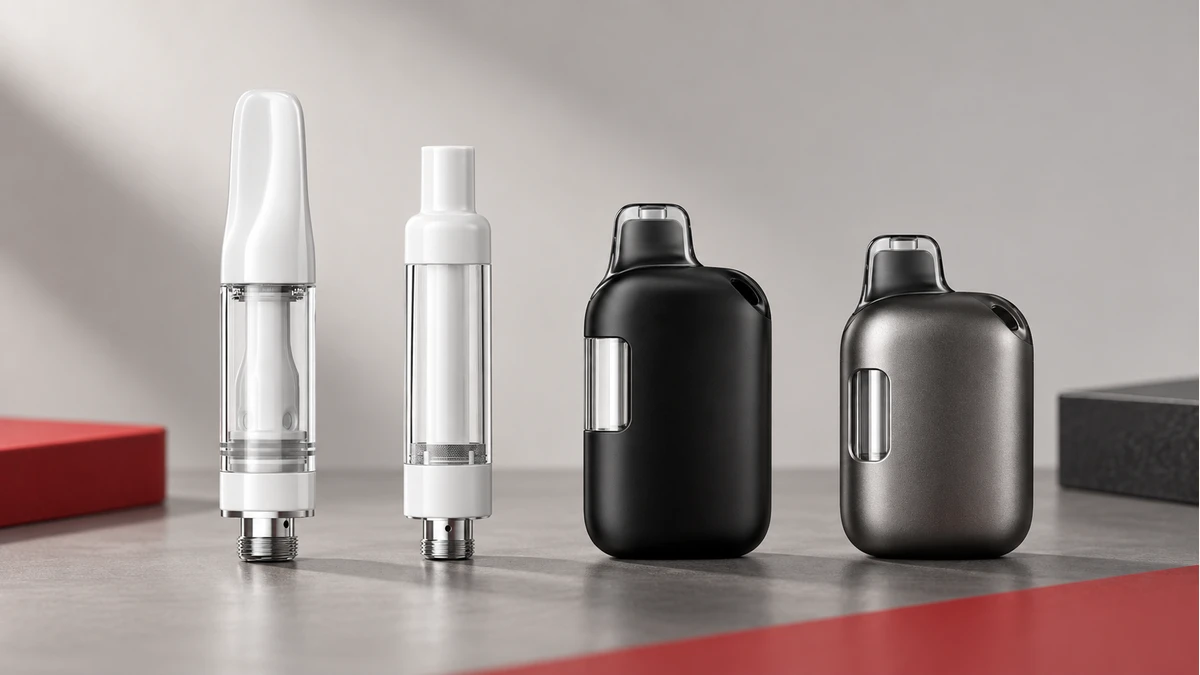
A heating core only performs as well as the formulation it’s asked to vaporize, the pore structure that feeds oil to the heating surface, the wattage curve driving that surface, the airway shaping the draw, and the seals keeping everything where it belongs. Two cartridges built from ostensibly the same ceramic can behave very differently once viscosity, fill volume, and storage orientation are added to the picture. For CBD brands moving into hardware decisions — and for the engineers and sourcing managers who have to translate a marketing brief into a bill of materials — the useful question isn’t “ceramic or not.” It’s which architecture, matched to which oil, under which conditions.
🧭 1. Why “Ceramic” Isn’t a Complete Spec
Every porous ceramic core is defined by more than its material family. Pore size and pore distribution govern how quickly oil migrates from the reservoir to the heating surface. Surface area and geometry determine how much liquid is in contact with heat at any given moment. The heating element embedded in or printed onto the ceramic — its resistance, its placement, its coverage — sets how evenly that surface heats. And all of that interacts with the oil itself: viscosity, terpene and cannabinoid concentration, and how the formulation behaves as it warms or cools.
That interaction is the reason the same core can be praised in one product line and blamed for burnt hits in another. A brand that formulates thinner, terpene-rich oil and a brand running a heavier, higher-concentrate distillate are effectively asking the same ceramic to do two different jobs. Our related piece on matching ceramic core design to oil viscosity goes deeper into how formulation windows should inform core selection during OEM development — it’s worth treating as a companion to the architecture comparison below, not a substitute for it.
🔧 2. Four Heating Core Architectures Brands Are Comparing
🧱 2.1 Conventional Porous Ceramic with an Embedded Element
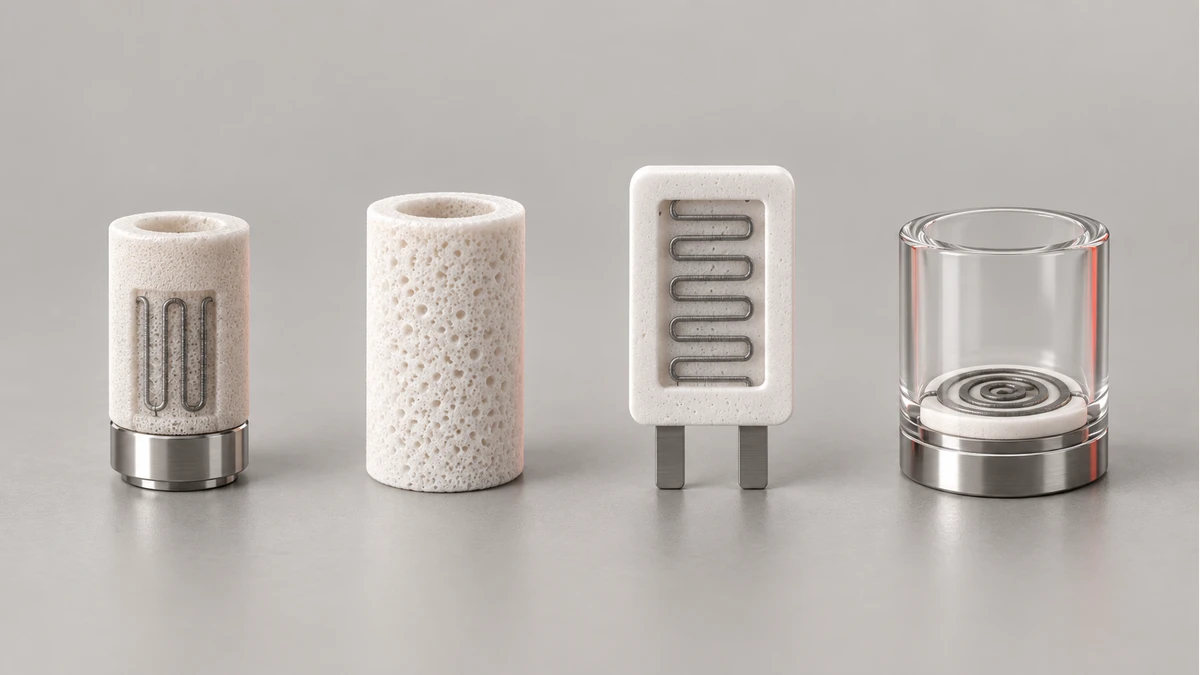
This is the architecture most people picture when they hear “ceramic core”: a porous ceramic body, typically built around a center post or channel, with a resistance wire or printed heating element embedded in or wrapped around the ceramic. Oil wicks through the porous structure to the heated zone, vaporizes, and travels up through the airway.
CCELL’s technology overview describes this general approach — a ceramic substrate paired with an integrated heating element designed to distribute heat across the wicking surface rather than relying on a single hot point. That’s a manufacturer description of intended behavior, not a claim we’ve independently tested, but it’s a reasonable summary of how this architecture is meant to work in principle. See CCELL’s own explanation at ccell.com/technology.
The tradeoff with conventional porous ceramic is that its pore geometry is a compromise. Pores wide enough to feed a thick, high-viscosity oil quickly enough to keep pace with vapor demand may also be prone to weeping or leaking with thinner formulations. Pores tuned for a thin oil can starve a viscous one, especially as temperature drops and viscosity climbs further.
💧 2.2 Optimized High-Porosity Ceramic for Harder-to-Feed Oils
A second category takes the same basic post-and-element layout but re-engineers the ceramic body itself — typically through pore density, pore size distribution, or the forming process — specifically to move more viscous oil to the heating surface without starving it.
CCELL places its EVOMAX platform in this category. The company says it redesigned the walls and pores of the ceramic element to balance oil supply with heating, and it specifically positions the core for harder-to-feed formulations. Those are manufacturer claims, not an independent performance result. A brand still needs to test its own formulation against the finished device. See the CCELL Ceramic-EVOMAX product page.
Optimized high-porosity ceramic tends to be marketed specifically at brands whose formulations run thicker — high-concentrate distillates, or oils with additives that raise viscosity. The manufacturing question worth asking a factory is what, specifically, changed relative to a conventional core: pore size, pore density, forming method, or heating element coverage. “Optimized” without a specific mechanism is a marketing word, not a spec.
📐 2.3 Flat Postless Ceramic
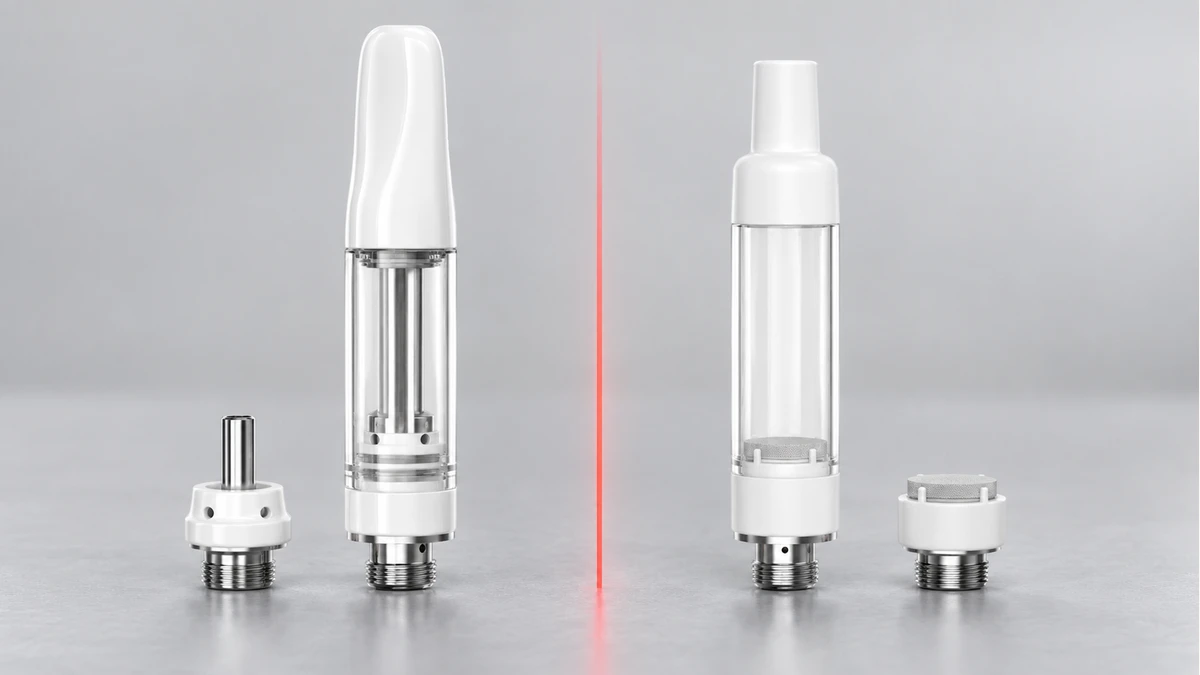
The third architecture removes the traditional center post entirely, replacing it with a flat ceramic heating surface. Eliminating the post changes two things at once: it reclaims interior volume that would otherwise be occupied by the post, which can increase usable fill capacity in a given tank size, and it changes the heating geometry from a wraparound surface to a flat one, which changes how oil contacts and disperses across the element.
iKrusher’s iKONIC FLUX 2.0 is a current example of a flat, postless ceramic approach. iKrusher says the design removes the conventional center post, expands the heating surface, and creates more room around the fill area. Those statements describe the supplier’s design intent; usable capacity, heat distribution, and oil behavior still have to be measured in the complete device. See the iKONIC FLUX 2.0 product page.
🔬 2.4 Glass-Ceramic and Porous-Glass Integrated Structures
The fourth and newest category integrates a heating structure into a glass or glass-ceramic composite rather than a purely ceramic body. The stated goal is generally to combine the thermal stability of ceramic with a more uniform, glass-like optical and structural consistency — in theory allowing tighter control over pore uniformity and reducing part-to-part variation from the forming process.
iKrusher positions iKONIC FLOW in this category, describing an integrated glass-ceramic structure with surround heating and a material path intended for high-viscosity concentrate-style formulations. That is the manufacturer’s description, not an independent finding, so product teams should use it to define test questions rather than treat it as a guarantee. See the iKONIC FLOW product page.
Glass-ceramic and porous-glass structures are the least standardized of the four categories, which cuts both ways for sourcing teams: there’s room for genuine differentiation, but also less of a shared vocabulary across suppliers for comparing one glass-ceramic core to another. Teardown and side-by-side testing matter more here than for the more established architectures.
⚡ 3. The Symptoms That Actually Drive Redesigns
🧯 3.1 Progressive Clogging with Thick Oil
One of the most common complaints is a cartridge that performs fine when new and then degrades over days or weeks of use — draw resistance increases, vapor output drops, and eventually the cartridge stops feeding altogether. With a conventional porous ceramic core, this pattern often points to pore geometry that can’t keep pace with a viscous formulation once the oil closest to the wick has been consumed and the flow path lengthens. It can also point to residue buildup inside the pores from repeated partial heating cycles, or to a core mismatched to the specific viscosity and terpene profile in use. Distinguishing between those causes generally requires teardown of clogged units rather than guessing from field reports alone.
🔥 3.2 Burnt Taste at Supposedly Low Voltage
A second recurring issue is a burnt or scorched taste that shows up even when the device is set to a low voltage or wattage. This is counterintuitive until the pore-and-flow relationship is accounted for: if oil isn’t reaching the heating surface fast enough — because of pore restriction, orientation, or partial clogging — the exposed element can overheat locally even at a nominally low power setting, because there’s less liquid there to absorb and carry away the heat. In other words, burnt taste is often a wicking problem wearing a power-setting disguise, and swapping voltage settings without addressing the underlying flow issue tends not to resolve it.
💦 3.3 Leakage, Capacity, and Refillability Uncertainty
The third cluster of questions is less about performance in use and more about basic product definition: how much oil a given tank actually holds once the core, seals, and airway are accounted for; whether the design is prone to leaking around the core-to-tank interface, especially after temperature cycling or when stored on its side; and whether a given core is genuinely refillable in the brand’s intended filling process, or only nominally so. These aren’t questions ceramic material choice can answer by itself — they’re a function of the seal design, the fill process, and the threaded connection joining the cartridge to its battery, which is covered in more detail in our guide to threaded 510 connections.
📊 4. Architecture Tradeoffs at a Glance
| Architecture | What changes | What to verify | Useful starting question |
|---|---|---|---|
| Conventional porous ceramic + post | Porous ceramic feeds an embedded heating zone around a post or channel | Pore specification, inlet size, heat coverage, and mid-life draw resistance | Has this exact formulation already passed in this exact core? |
| Optimized high-porosity ceramic | Pore and wall geometry are revised to change oil supply | What changed, and can the supplier document the change? | Does the formulation starve a conventional core under cooler conditions? |
| Flat postless ceramic | The center post is removed and the heating surface becomes flatter | Fill clearance, seal geometry, orientation behavior, and usable volume | Does removing the post solve a real package or heating constraint? |
| Glass-ceramic / porous-glass structure | Glass and ceramic functions are integrated into a different material path | Supplier definition, contact surfaces, heat map, and production consistency | What measurable problem does the integrated structure solve? |
🛠️ 5. Building a Validation Plan Before You Commit to a Core
📋 5.1 Define the Formulation Window First
Before comparing cores, define the actual range of formulations the core needs to support: viscosity at room temperature, viscosity range across the expected storage and use temperatures, and cannabinoid/terpene concentration range if the brand offers multiple SKUs on the same hardware platform. A core chosen against a single “typical” sample often fails against the edges of the real production range. This is the same groundwork covered in our OEM-focused piece on matching viscosity to ceramic core design.
🌡️ 5.2 Test Across Cold, Room, and Warm Conditions
Viscosity shifts meaningfully with temperature, and a core that feeds adequately at room temperature can starve in cold conditions or, less intuitively, leak or over-feed in warm ones. Running comparative checks across cold, room, and warm conditions — rather than only the temperature the lab happens to be at — surfaces problems that a single-condition test will miss.
💡 5.3 Draw Resistance and Activation Behavior
Draw resistance and how quickly the core activates and produces vapor should be tracked over the life of the cartridge, not just at first use. A core that starts strong and degrades by mid-use is a different problem than one that’s inconsistent from the first puff, and the two point to different root causes — clogging versus element or power-curve mismatch.
🔒 5.4 Seals, Leakage, and Fill Process
Soak testing and storage-orientation testing — cartridges left upright, inverted, and on their side over time — will expose seal weaknesses that don’t show up in short-term use testing. Leakage is as often a seal and fill-process issue as it is a core issue, which is another reason the threaded connection and o-ring interface deserve attention alongside the ceramic itself; our threaded 510 connection guide covers where that interface tends to fail.
🔍 5.5 Teardown Inspection and Residual Oil
At the end of a test cycle, teardown of used cartridges — checking for oil discoloration, residual unvaporized oil left in the core or reservoir, and any visible degradation of the heating element or ceramic body — gives a clearer picture than output metrics alone. Discoloration or residue patterns often point directly to where in the system (formulation, pore structure, power delivery, or seal) the mismatch is occurring.
🏭 6. Manufacturing Considerations Beyond the Core Itself
How a ceramic body is formed affects more than its raw porosity. Different forming techniques produce different levels of dimensional consistency, wall thickness uniformity, and pore distribution repeatability from unit to unit — which matters as much for quality control at scale as the architecture choice itself. Our overview of ceramic forming techniques for atomizer cores is a useful reference when a factory proposes a specific ceramic body and process, since the forming method has real implications for consistency across a production run, independent of which of the four architectures is in play.
Sourcing teams evaluating a new core should ask suppliers not just which architecture they’re offering, but which forming process produces it, what tolerances they hold on pore structure and wall thickness, and what quality checks are run batch to batch. Those answers say more about expected consistency than the material name does.
📩 7. Talk to AOVAPE About Your Formulation and Validation Needs
Choosing between conventional, optimized-porosity, flat postless, and glass-ceramic cores isn’t a decision that can be made from a spec sheet alone — it depends on your formulation’s viscosity range, your tank geometry, your fill process, and how you intend to validate performance before scaling production. If your team is working through that comparison, AOVAPE’s engineering group can walk through your formulation range and validation requirements directly. Reach out through our contact page to start that conversation.