Bolting a torch onto a rig body raises a practical question before any purchase decision: does the added hardware change how the piece heats, balances, and gets cleaned compared to a standard glass rig paired with a handheld torch, or compared to a plug-in e-rig that skips flame entirely? The honest answer is that a built-in torch rig is still two independent systems sharing one base. Understanding where those systems connect — and where they stay separate — explains most of the fit and stability questions people run into.
🧭 1. 🔥 What “Built-In Torch” Actually Means on a Dab Rig
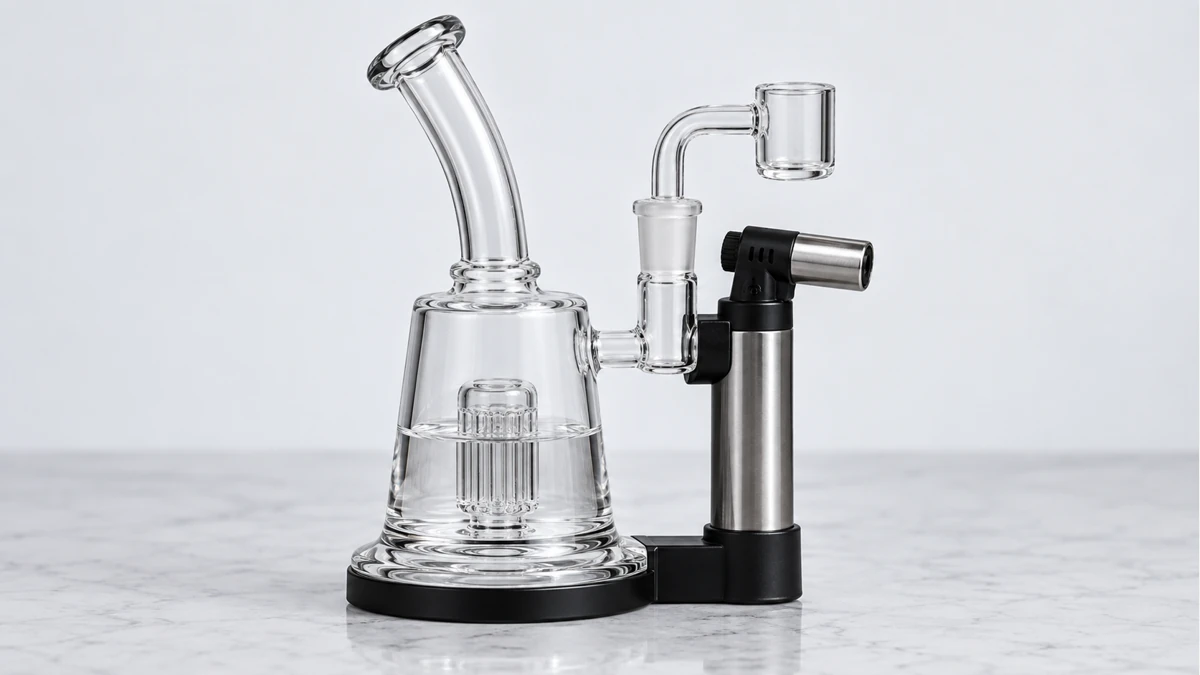
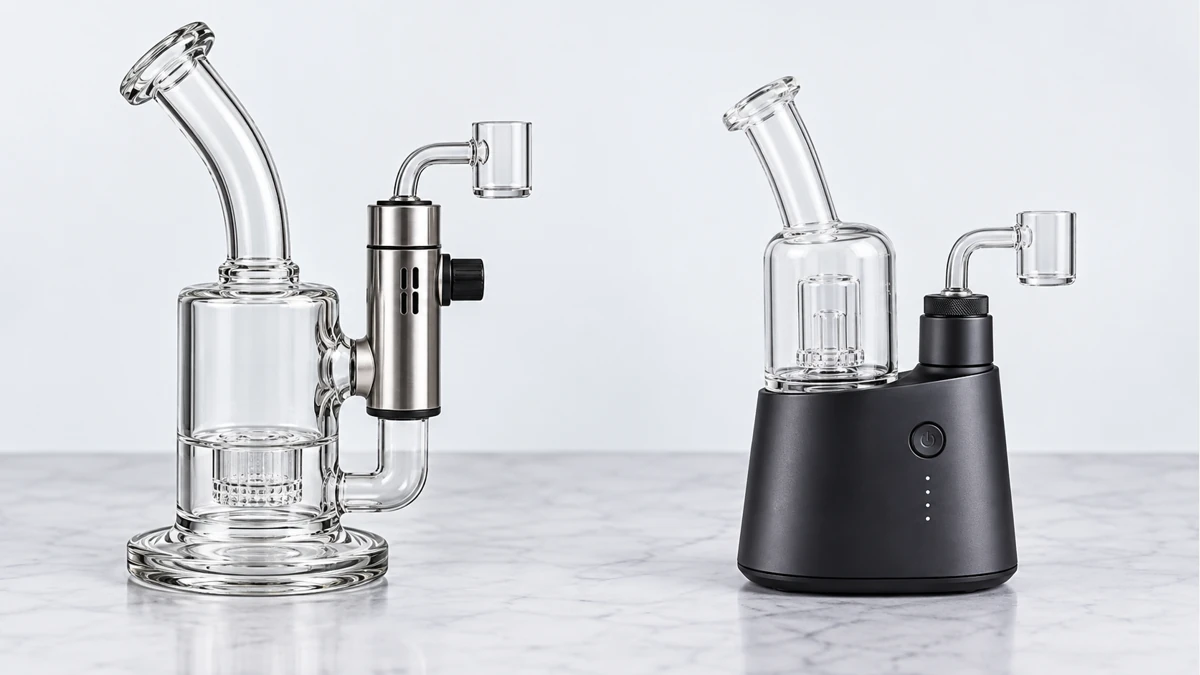
A dab rig with a built-in torch is a water pipe with a torch head mounted or welded onto its base, stem, or a side arm. The water chamber, downstem, and joint function exactly like they would on any glass rig. The torch is a separate combustion unit that happens to share the same stand instead of being a handheld lighter you hold up to the banger yourself.
This matters because the two systems don’t interact chemically or thermally in normal use. The torch heats the banger or nail directly through an open flame path. The water chamber only cools and filters the vapor after the dab is dropped. Nothing about mounting the torch to the base changes how the percolator or downstem behaves.
🔎 1.1 🧱 Two Separate Systems in One Body
Because the torch and the water pipe are structurally joined but functionally independent, a fault in one rarely affects the other. A clogged percolator doesn’t affect flame output. A torch that won’t hold ignition doesn’t affect water filtration once the banger is heated by another method. This separation is the main reason these builds are described as “two systems, one body” rather than a single integrated heating appliance.
The practical benefit is diagnostic. If the piece isn’t producing usable vapor, the cause is almost always isolated to either the glass side (clogged airflow, cracked joint) or the torch side (empty fuel, worn ignition switch), not both at once.
📏 1.2 🔍 How This Differs from an E-Rig or Enail
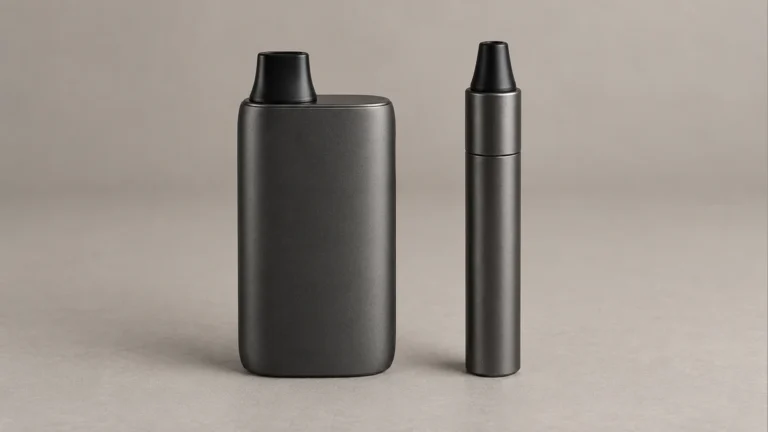
An e-rig or enail setup replaces the open flame with an electric heating coil built into the banger or nail itself, controlled by a temperature dial rather than a fuel valve. A built-in torch rig keeps the open-flame heating method of a traditional glass rig; it only relocates where the torch physically sits. This is the core distinction that separates the three hardware categories people often lump together when comparing glass rigs, torch-integrated rigs, and electronic units.
mapping the parts in a portable dab rig kit
📐 2. 🛠️ The Flame Path: From Torch Head to Banger
The flame path is the physical route the torch’s output travels before it reaches the banger. On most built-in designs, the torch head is fixed at a set angle and distance from the joint, unlike a handheld torch that the user can reposition freely. That fixed geometry is a deliberate trade-off: it removes guesswork about angle, but it also means the banger and joint placement on that specific model are not arbitrary — they’re built around where the torch head points.
Flame path length and angle vary by manufacturer, so no single measurement applies across all built-in torch rigs. What stays consistent across designs is the cause-and-effect relationship: a shorter, more direct flame path heats the banger faster, while an angled or offset path takes longer but can reduce direct flame contact with surrounding glass.
🔎 2.1 ⛽ Fuel Storage and Ignition Controls
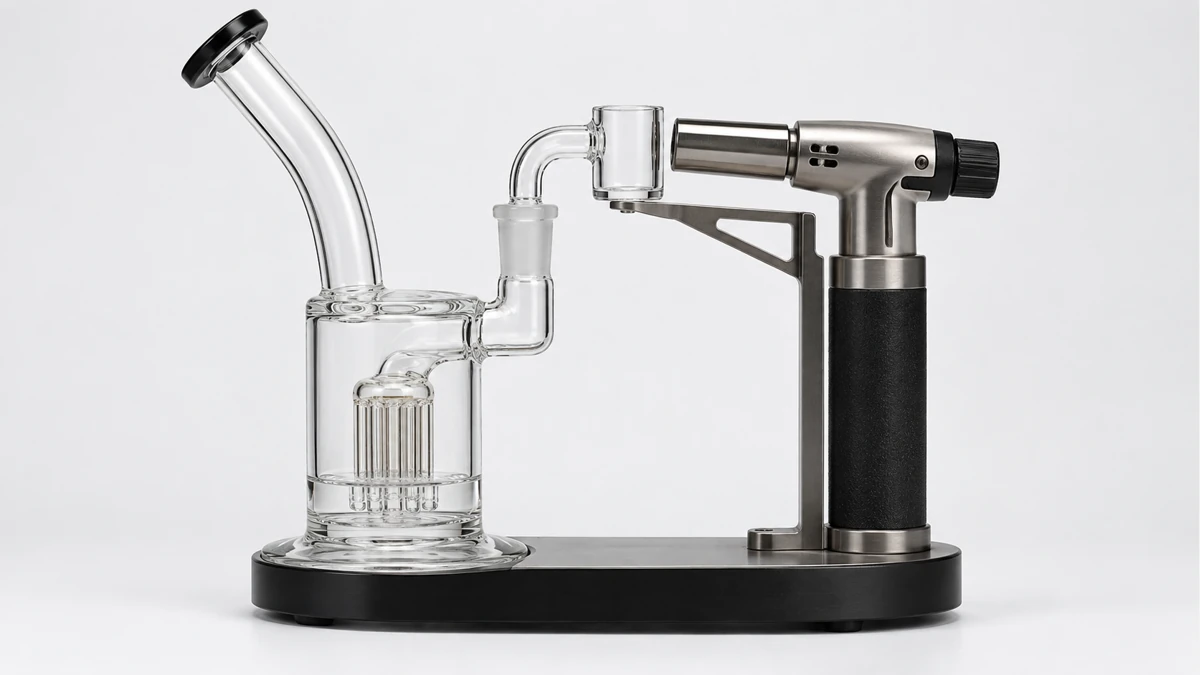
The torch portion needs its own fuel reservoir, typically a butane tank built into the base or stem section, plus an ignition switch or trigger separate from the water pipe’s airflow path. These controls are mechanical and independent from anything related to the glass — turning off the torch does not affect airflow through the downstem, and clearing the airflow does not affect fuel flow to the torch head.
Ignition mechanisms differ by model: some use a spark-wheel striker similar to a standard torch lighter, others use a push-button piezo igniter. Both function the same way conceptually — they create a spark at the torch head to light the released butane — but the physical control layout is not standardized across brands.
📏 2.2 📏 Glass Clearance and Heat Directing
Glass clearance refers to the physical gap between the torch’s flame output and any nearby glass surfaces that aren’t meant to be heated, such as the water chamber wall or a percolator arm. Manufacturers space the torch head away from these surfaces specifically so the flame heats only the banger, not the surrounding glass body. This spacing is confirmed as a design goal across the category, though the exact clearance distance is model-specific and not something to estimate from a listing photo alone.
Heat directing hardware, such as a small shroud or heat shield around the torch head, appears on some models to concentrate flame toward the banger and away from the base. This feature is not universal, so its presence or absence should be checked per product rather than assumed.
🌬️ 3. ⚖️ Stability and Physical Balance Concerns
Adding a torch assembly to a rig’s base shifts its center of gravity compared to a plain glass rig of the same height. This is a straightforward mechanical consequence of mounting extra mass — a fuel tank, ignition housing, and torch head — onto or beside the existing base rather than adding weight evenly.
separating controllers, coils, nails, and heaters
🔎 3.1 🧲 Weight Distribution When the Tank Is Full vs Empty
A full butane tank adds noticeable weight low on the piece, which can actually improve stability by lowering the center of gravity, similar to a wider base on a standard rig. As the tank empties during use, that added low weight decreases, and the balance point can shift slightly. This is a physical consequence of fuel consumption, not a defect, but it’s worth accounting for when placing the piece on an uneven or narrow surface.
Rigs with the torch mounted on a side arm, rather than integrated into the base itself, carry that added weight off-center rather than symmetrically. This layout can make the piece more prone to tipping toward the torch side if bumped, depending on how wide the base is relative to the side-mounted assembly.
📏 3.2 🪑 Base Design and Tip-Over Risk
Base width and shape directly affect tip-over risk, and this relationship holds whether or not a torch is attached. A wider, flatter base resists tipping better than a narrow foot, regardless of where the torch sits. When a torch assembly adds height or off-center mass above that base, the base’s footprint becomes more important to overall stability than it would be on a comparably sized glass-only rig.
🧩 4. 🧽 Refilling, Cleaning, and Maintenance Realities
Maintenance on a built-in torch rig involves two separate routines: cleaning the water pipe as usual, and servicing the torch mechanism, which most glass-only rigs never require. Treating these as one combined task tends to create confusion about what’s actually wrong when the piece isn’t performing well.
🔎 4.1 ⛽ Butane Refill Access Points
Refill valves are typically located at the base or rear of the torch housing, separate from the joint and downstem entirely. Refilling follows the same general principle as any butane torch — purging old fuel and air before refilling slowly to avoid incomplete fills — but the exact valve location and orientation depend on the specific model’s housing design, so checking manufacturer instructions for that particular piece is more reliable than assuming a universal layout.
cleaning powered rig hardware without wetting electronics
📏 4.2 🧴 Cleaning Around a Fixed Torch Housing
Because the torch housing is fixed to the base, it can’t be removed the way a handheld torch can be set aside during cleaning. This means standard rig-cleaning methods, such as soaking or rinsing the water chamber, need to avoid saturating the torch’s ignition and fuel components. Cleaning the glass portion and wiping down the torch housing separately, rather than submerging the whole piece, avoids introducing moisture into mechanical parts that aren’t designed to get wet.
Carbon buildup around the torch head nozzle can also form over repeated use, similar to buildup on any butane torch tip, and typically needs a dry brush or careful wipe rather than liquid cleaner near the ignition switch.
🧼 5. Evaluate the Integrated Layout as Two Systems
A dab rig with a built-in torch places a fuel-and-ignition assembly beside a glass air-and-water path. Housing them together changes handling, but it does not merge their service requirements. The torch still needs its own controls, seals, nozzle clearance, and refill instructions. The rig still needs stable glass joints, an unobstructed air path, and a cleaning routine that keeps liquid away from ignition hardware.
🔎 5.1 Follow the Flame Path to the Heated Surface
Inspect where the nozzle points, what holds the banger or nail, and whether the heated surface can return to the same position without touching glass or the body. The flame path should be deliberate and mechanically constrained by the design. A bent support, loose joint, or shifted nozzle changes that path. Do not compensate for misalignment by holding the glass under sideways force.
📏 5.2 Check Stability With the Moving Parts in Position
An integrated rig may feel stable when cold and empty but become easier to tip when an arm, cap, or heated attachment is moved. Set it on a level nonflammable surface and check the footprint, center of mass, and clearance around controls before operation. Added adapters can move weight outward, multiplying leverage at the joint. The same adapter that fits can still make the assembly unstable.
🧪 5.3 Separate Wet Cleaning From Torch Service
Detach only the glass parts identified as removable. Clean and dry them away from the torch body. Do not soak the ignition assembly, refill valve, control openings, or bonded interfaces. Residue near a joint is a glass-cleaning issue; unreliable ignition, fuel odor, damaged seals, or a loose valve belongs to the torch maker’s service instructions rather than an improvised repair.
🧷 5.4 Do Not Confuse an Integrated Torch With an E-Rig
An e-rig uses an electrical heater, battery or external power, control electronics, and a compatible chamber. A built-in-torch rig uses fuel combustion to heat a separate surface. Both may reduce the number of loose items on a table, but their controls, failure modes, cleaning boundaries, and replacement parts are different. Identify the heat source first; the body shape does not define the system.
🔍 6. 🧩 Compatibility and Hardware Identification
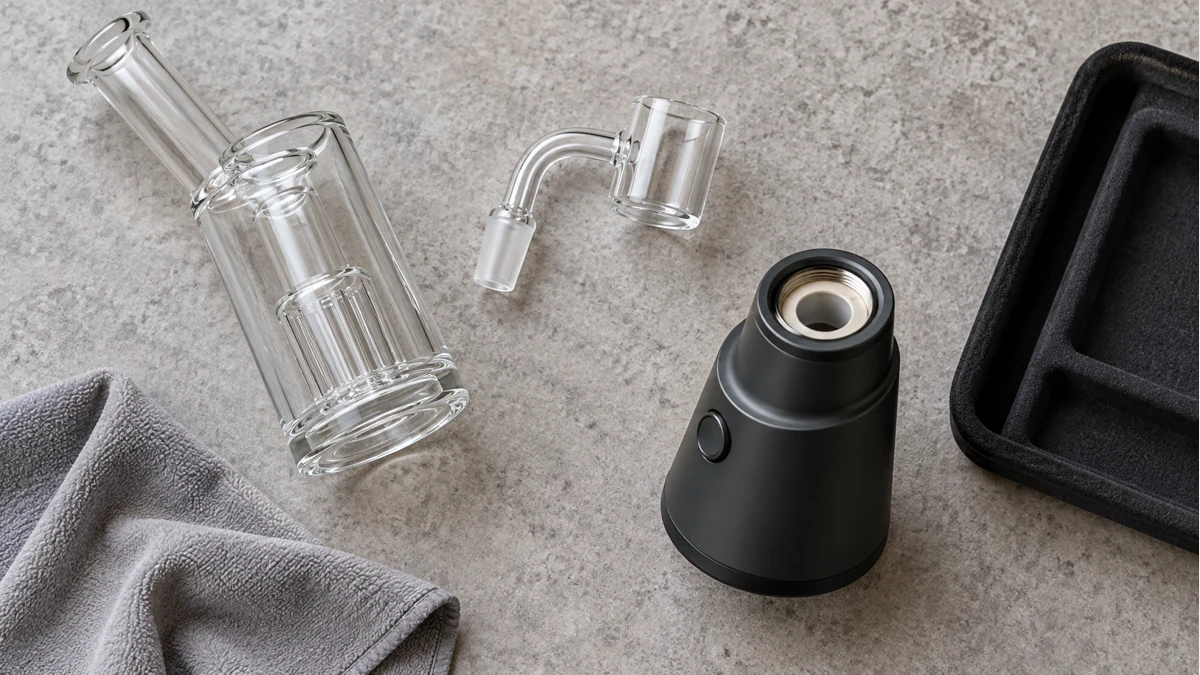
The joint on a built-in torch rig follows the same sizing conventions as any other glass rig — most commonly a female joint sized to fit standard male banger or nail fittings. The presence of a torch doesn’t change joint sizing standards; it only changes what sits next to that joint on the same base.
🔎 6.1 🔩 Joint Size and Banger Fit
Confirming joint size and gender before assuming a banger will fit is standard practice for any rig, and it applies equally here. What’s specific to torch-integrated models is checking that the banger’s angle and height clear the fixed torch head without the two components physically colliding, since the torch’s position isn’t adjustable the way a handheld torch’s angle is.
📏 6.2 🏷️ Reading Listings for Genuine Integration vs Add-On Mounts
Not every product labeled “built-in torch” uses a permanently fixed torch head. Some listings describe a torch that clips or screws onto a mounting bracket, which can be removed, versus a torch head that’s welded or fused into the base glass itself. These are functionally different: a detachable mount can be swapped or replaced if the torch fails, while a fused assembly generally can’t be serviced separately from the rig body. Reading a listing’s description and photos closely for words like “detachable,” “mounted,” or “fused” clarifies which category a specific piece falls into before assuming compatibility with replacement parts.
The practical takeaway for identifying this hardware category: look at the base first. If you see a fuel tank or ignition switch physically joined to the water pipe’s stand, with the joint and downstem otherwise unchanged from a standard rig, you’re looking at a built-in torch design — two independent systems sharing one footprint, not a single heating mechanism. Confirm joint size, check torch mount type (fused versus detachable), and verify base width relative to the added torch mass before assuming a specific model’s stability or serviceability from photos alone.