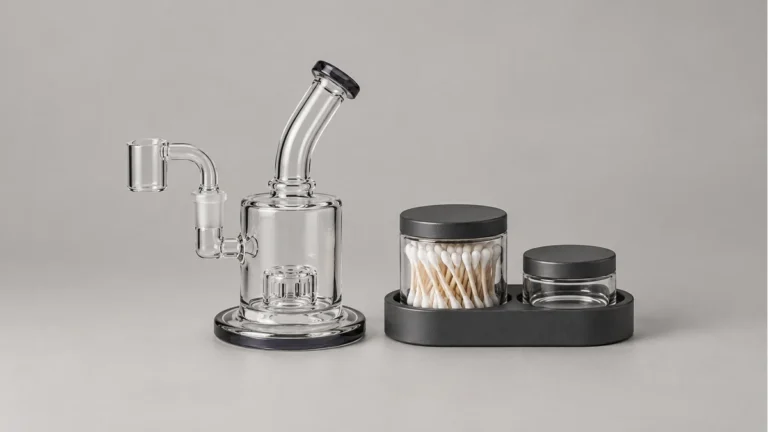
When a piece goes missing or a joint stops holding a seal, most rig owners describe the problem the same way: “the thing that holds the thing broke.” That vagueness isn’t a knowledge gap to be embarrassed about — dab rig terminology is inconsistent across shops, and a single component can be called three different names depending on who’s selling it. The practical fix is learning which parts are permanently fused to the glass and which parts are meant to be swapped, then measuring before buying anything. This guide walks through both.

🧩 1. Fixed Glass Body vs. Replaceable Accessories
Every rig splits into two categories, and confusing them is the single biggest cause of failed replacement purchases. The fixed glass body is one continuous piece — it isn’t sold in sections, and if part of it cracks, the whole body is generally treated as done. The replaceable accessories are separate pieces that connect to the body through a ground-glass joint or friction fit and are designed to be removed, cleaned, swapped, or upgraded independently.
Knowing which category a part belongs to changes how you shop for it. Fixed-body parts are described by shape and function, not by a purchasable SKU, because you’re not buying that part on its own — you’re describing your rig to make sure a replacement accessory will actually fit it. Accessory parts, by contrast, are bought individually, and their fit depends on measurements you take from the joint, not from the rig’s overall style or price point.
🔧 2. Naming the Fixed Body Parts
These parts are blown as one unit. You won’t replace them separately, but naming them correctly matters when you’re asking for help, ordering a compatible accessory, or explaining to a shop what you’re working with.
- Base: the bottom section that sits on a surface and typically holds water. Its width and weight affect stability, and its shape (flat, beaker, or angled) has no bearing on accessory compatibility — only the joint does.
- Chamber: the main body cavity above the base where vapor collects and water filtration occurs before the vapor path narrows toward the neck.
- Neck: the narrowing tube connecting the chamber to the mouthpiece. Its angle (straight or bent) is a design feature, not something you can change without replacing the whole body.
- Mouthpiece: the topmost opening, shaped and sized for a comfortable seal. On some rigs this is a separate opening from the joint; on others the joint and mouthpiece are the same opening turned to face a different direction.
- Joint: the ground-glass connection point where a downstem, adapter, or directly-connected banger attaches. This is the single most important reference point for every accessory purchase, covered in detail in Section 8.
Percolators, if present, are also part of the fixed body. They’re internal diffusion structures, not separate purchasable parts, so “my percolator is clogged” and “my percolator is cracked” are two very different situations — one is a cleaning question, the other affects the whole body.
🌀 3. Downstem and Diffuser — Optional, Not Universal
A downstem is the tube that carries vapor from the joint down into the water in the base. Not every rig uses one — some rigs have the joint positioned to submerge a banger’s lower neck directly, skipping the downstem entirely, which is common on compact and recycler-style pieces. This is where a lot of confusion starts: someone with a downstem-less rig assumes a part is missing when the design simply routes differently.
A diffuser is a feature built into some downstems — slits, holes, or a tree-like end that breaks vapor into smaller bubbles for water contact. It is not a separate purchasable component; it’s a diffusion pattern belonging to a specific downstem. When shopping for a replacement downstem, “diffused” or “non-diffused” is a spec to match, not an add-on to buy separately.
If your rig has a downstem, it has its own joint size and length requirement, both of which must match the body’s joint and the internal depth of the chamber. A downstem that’s too long can hit the base; one that’s too short won’t submerge properly. Both are measurement issues, not defects, and are covered in Section 8.

🔥 4. Banger, Nail, or Enail — Naming the Heating Surface
This is the accessory most often misnamed. “Banger,” “nail,” and “enail” get used interchangeably in casual conversation, but they refer to genuinely different hardware with different fit and function considerations, and mixing them up leads to buying the wrong replacement. A full breakdown of how these differ — including material, heating method, and joint compatibility — is covered in Dab Nail vs. Banger vs. Enail.
For the purposes of naming your parts correctly: this is the component that sits in the joint (either directly or via a downstem/adapter) and forms the heated surface. Its lower neck length, joint size, and angle all need to match your rig’s joint specs — style and brand do not guarantee fit.
❄️ 5. Carb Cap Fit and Function
A carb cap is a separate handheld accessory that rests over the banger’s opening; it is not attached to the rig and is not joint-sized in the same way downstems and bangers are. Its fit depends on the outer diameter and rim shape of the specific banger it’s paired with, not on the rig’s joint size. This trips people up because they assume carb cap sizing follows the same logic as joint gender — it doesn’t.
Directional, bubble, and spinner cap styles all affect airflow differently, and matching one to a banger’s shape is its own sizing question. That’s covered separately in the Carb Cap Guide, since it involves diameter and rim compatibility rather than the joint measurements discussed here.
🧲 6. Reclaim Catchers and Adapters
A reclaim catcher is an optional inline accessory that sits between the joint and the downstem or banger, designed to collect runoff before it reaches the water in the base. It adds two connection points instead of one, which means it introduces two joints that both need to match: one to the rig, one to whatever attaches above it. A reclaim catcher rated for the wrong joint size or gender simply won’t seat at either end.
Adapters exist specifically to bridge mismatches — most commonly gender adapters (male-to-female or female-to-male) and diameter adapters (stepping between two nominal sizes). An adapter is a legitimate way to make a rig compatible with an accessory it wasn’t originally sized for, but each adapter is still a joint on both ends, subject to the same fit rules as everything else. Stacking multiple adapters to force a fit adds height, weight, and leverage stress at the joint, which is worth avoiding where a single correctly-sized part would do the job.

🛠️ 7. Seals, Clips, and Tools
A few smaller components round out the parts list, and they’re easy to overlook until one goes missing.
- Seals (O-rings/gaskets): used on some adapters and enail-style setups to maintain an airtight connection at a joint that isn’t ground glass. These are sized to the fitting they belong to, not to the rig.
- Clips (keck clips): spring clips that hold two joint pieces together under vibration or movement. They’re sized by joint diameter and are a low-cost way to prevent an accessory from sliding loose.
- Tools: dabbers, carving tools, and cleaning implements that interact with accessories but aren’t part of the joint-fit system at all. A full rundown of what each tool does is in the Dab Tools Guide.
📏 8. Joint Gender, Diameter, Angle, Depth, and Fit
This is the section that actually prevents wrong purchases. Every accessory connection comes down to five measurable factors, and a mismatch in any one of them means the part won’t seat correctly — regardless of how good the part itself is.
⚙️ 8.1 Gender
A joint is either male (the tapered piece that inserts) or female (the piece that receives it). The rig’s joint and the accessory’s joint must be opposite genders to connect. A common assumption problem: buyers see two joints that look similar in size and forget to check that they’re opposite genders before ordering.
📐 8.2 Nominal Diameter
Joints are sized by a nominal diameter measurement, and accessories are manufactured to match specific nominal sizes. A downstem, banger, or adapter needs to match the rig’s stated joint diameter — sizes that are close but not identical will not seat with a proper seal, even if they slide in partway.
📏 8.3 Angle
Joints are cut at an angle, most commonly at one of a small number of standard angles. The accessory’s joint angle needs to match the rig’s joint angle so the piece sits level rather than at an awkward tilt that stresses the glass-to-glass contact point.
📥 8.4 Insertion Depth
This is how far the male joint travels into the female joint before it seats. Insertion depth affects how much of the accessory’s lower portion ends up inside the chamber or base — relevant for downstems reaching water, and for bangers or adapters needing clearance from internal structures like percolators.
↔️ 8.5 Clearance and Leverage
Clearance is the space available around and above the joint once an accessory is seated — enough room for a banger’s dish to sit level, enough room for a carb cap to be placed and removed, and enough space that nothing rests against the rig’s neck or base. Leverage refers to how much unsupported weight or torque sits on the joint once everything is assembled; taller or heavier accessories place more strain on the joint connection, which matters most with compact rigs that have shorter necks and less structural buffer around the joint.
🌡️ 8.6 Thermal Boundary and Cold Fit
Every accessory measurement above should be checked while the piece is cold. Fit needs to be confirmed at room temperature — a joint that seats correctly cold is the baseline for a proper connection; a joint that only “sort of” seats cold will not improve once heat is introduced. The thermal boundary refers to where heated components (like a banger) interface with unheated ones (like the joint or a carb cap) — this boundary is a design feature of the parts themselves, not something to test or push during a cold fit check.
📊 9. Part-Function Quick Reference
| Part | Fixed or Replaceable | Primary Function |
|---|---|---|
| Base | Fixed | Holds water; provides stability |
| Chamber | Fixed | Vapor collection and filtration space |
| Neck | Fixed | Routes vapor from chamber to mouthpiece |
| Mouthpiece | Fixed | Opening for drawing vapor |
| Joint | Fixed (connection point) | Attaches all replaceable accessories |
| Downstem/Diffuser | Replaceable | Routes and diffuses vapor into water, if present |
| Banger/Nail/Enail | Replaceable | Heated surface for the concentrate |
| Carb Cap | Replaceable | Regulates airflow over the heated surface |
| Reclaim Catcher | Replaceable | Collects runoff before it reaches the base |
| Adapter | Replaceable | Bridges gender or diameter mismatches |
| Seal/O-ring | Replaceable | Maintains airtight fit on non-ground-glass connections |
| Clip | Replaceable | Secures joint connection against movement |
| Tools | Replaceable | Handling and maintenance of accessories |

✅ 10. Replacement Measurement Checklist
Before buying any accessory, confirm the following against your rig’s existing joint and, where relevant, the piece it needs to pair with:
- Joint gender of the rig (male or female) — the new part must be the opposite gender
- Nominal joint diameter, measured or matched against the existing part, not estimated by eye
- Joint angle, matched so the accessory sits level rather than tilted
- Insertion depth, checked so the accessory reaches its intended position (e.g., a downstem reaching water) without bottoming out early
- Clearance above and around the joint once the accessory is seated, including room for a carb cap if one will be used
- Leverage and unsupported weight the joint will bear once the full accessory is assembled, especially on compact-necked rigs
- Cold fit confirmed at room temperature before any heat is introduced
- If a reclaim catcher or adapter is involved, both of its joint ends checked independently — gender, diameter, and angle on each side
Going through this list takes a few minutes and prevents the most common outcome of guesswork purchases: a part that arrives, doesn’t seat correctly, and gets returned. Compact and proprietary-shaped rigs are the pieces most likely to deviate from what looks “standard,” so treat every rig’s joint as its own measurement rather than assuming consistency across brands or styles.
Naming parts correctly is mostly about separating what’s fused from what’s swappable, then treating every swappable connection as a set of measurements rather than a guess. Once the fixed body is set aside, the replaceable side of the equation — downstem, banger, carb cap, adapters, seals, and tools — comes down to gender, diameter, angle, depth, clearance, leverage, and a cold, level fit.