Reasoning: This is a direct content-editing task within my defined editorial role for AOVAPE — no ambiguity, so I’ll produce the revised draft now.
I’ll fix the broken FAQ sentence, trim repeated distance/angle phrasing that recurs across sections, and add concrete replacement detail to hit the word count while keeping the voice and required links/structure intact.
“`html
🔍 1. The Moment Two Readings Disagree
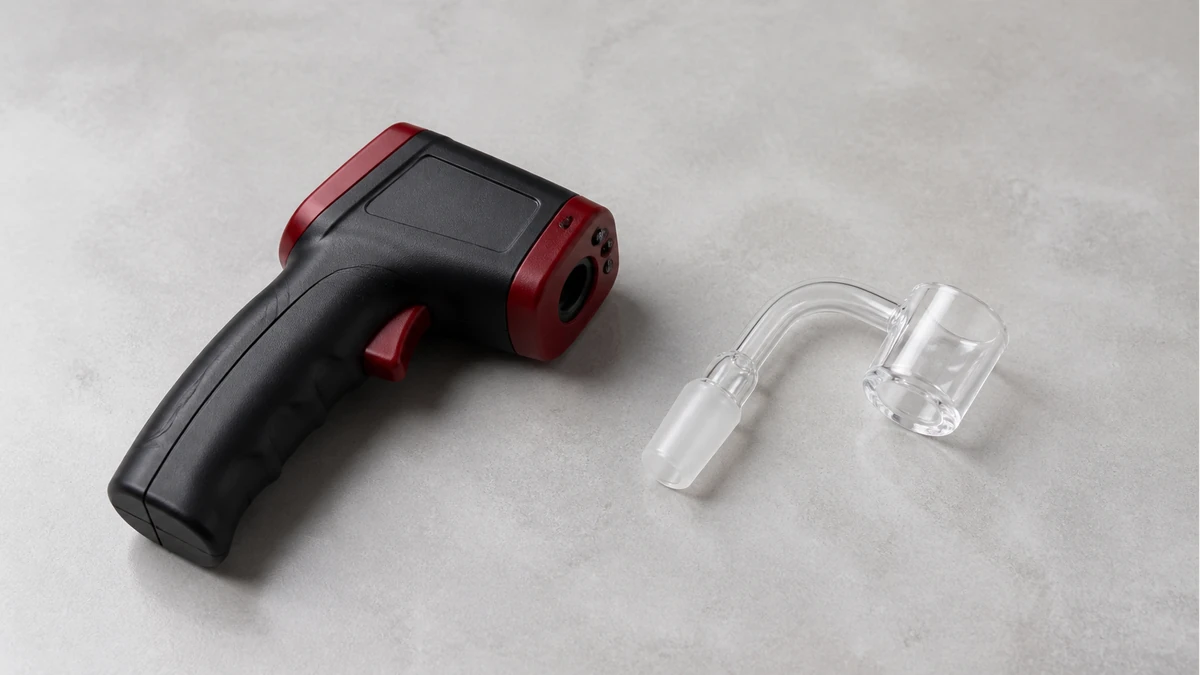
It happens to almost everyone who dabs with any regularity. You heat the banger, wait out the cooldown you’ve learned to trust, and point an infrared thermometer at the quartz. It reads 480°F. You reach for the little digital dab temp reader you bought because the gun felt imprecise, aim it at roughly the same spot, and it reads 410°F. Same banger, same torch, thirty seconds apart, and two devices that are supposedly measuring the same thing are seventy degrees apart.
The instinct is to assume one of the tools is broken. Usually neither is. They are simply not measuring the exact same thing, in the exact same way, from the exact same position. Once you understand what a dab temp reader is actually sampling, and how sensitive that sample is to distance, angle, and the physical state of the quartz, the disagreement stops being mysterious. It becomes a design detail you can work around instead of a malfunction you have to guess at.
This isn’t a guide to hitting a specific number. Nobody supplied a target temperature here, and inventing one would be worse than useless, since the “right” number depends on the banger, the torch, the concentrate, and personal preference in ways no article can settle for you. What this piece can do is explain why the reading itself moves around so much, so that whatever number you eventually settle on is one you can actually reproduce.
🧭 2. What a Dab Temperature Reader Actually Measures
A dab temperature reader, whether it’s a dedicated handheld unit or a general-purpose infrared thermometer repurposed for dabbing, is not touching the quartz. It’s an infrared sensor reading the thermal radiation coming off a surface and converting that radiation into a number. That distinction matters more than most buyers expect.
Infrared sensors are calibrated around an assumption called emissivity: how efficiently a given surface radiates heat compared to a theoretical “perfect” radiator. Quartz, titanium, and ceramic all radiate differently, and the same piece of quartz radiates differently depending on whether it’s clean, coated in reclaim, or freshly torched with a slight haze on the surface. A reader with a fixed emissivity setting tuned for one material will read consistently wrong, in one direction, on a different material.
This is also why a dab temp reader is telling you about the surface of the quartz at the moment of the reading, not the temperature of the concentrate once it hits the banger, and not the temperature a few millimeters below the surface. Quartz cools unevenly as it sits after torching, since the bucket, the sidewall, and the joint all lose heat at different rates depending on mass and airflow. A reading taken at the bottom of the bucket can differ meaningfully from one taken on the sidewall seconds later, even with the torch, rig, and operator completely unchanged. None of this makes the tool useless. It means the number on the screen is a proxy, not a direct measurement of the moment concentrate contacts glass.
⚙️ 3. Why Distance, Angle, and Quartz Condition Change the Number
Three variables account for most of the disagreement people run into between tools, or between two readings taken with the same tool a few seconds apart. None of them are exotic. They’re the kind of thing that’s easy to overlook because the reader doesn’t warn you when you’ve violated its assumptions.
🧩 3.1 Distance and Spot Size
Every infrared thermometer has a distance-to-spot ratio, usually printed somewhere in the manual and almost never read by the person holding the device. It describes how large an area the sensor is actually averaging as you move farther away. Get too close and you risk reading a spot smaller than the banger’s bucket, picking up hot or cool edge effects from the rim or joint. Get too far and the sensor starts averaging in the surrounding air, the rig’s body, or the torch flame’s residual heat, none of which is the number you’re after.
🧩 3.2 Angle and Emissivity
Infrared sensors assume you’re reading a surface roughly perpendicular to the sensor. Tilt the reader off-axis, which happens naturally when you’re trying to aim into a banger at an angle that doesn’t put the torch or your hand in the way, and the effective emissivity the sensor perceives shifts. Curved surfaces make this worse. A banger’s bucket curves away from center, so a reading taken dead-center at a straight angle and one taken from a shallow angle at the rim are sampling geometry the sensor interprets differently, even if the physical temperature at both points were identical.
🧩 3.3 Quartz Surface Condition
Clean, clear quartz has different infrared reflectivity than quartz with a light haze, a film of reclaim, or carbon buildup from repeated dabs. A carbon-coated banger can throw a reading noticeably higher or lower than the same banger cleaned, because the buildup changes how the surface radiates heat rather than how hot it actually is. This is one of the more practical reasons cleaning habits matter beyond hygiene: a dab temp reader calibrated against a clean banger will drift the moment that banger picks up residue, and the drift isn’t something the device can self-correct for.
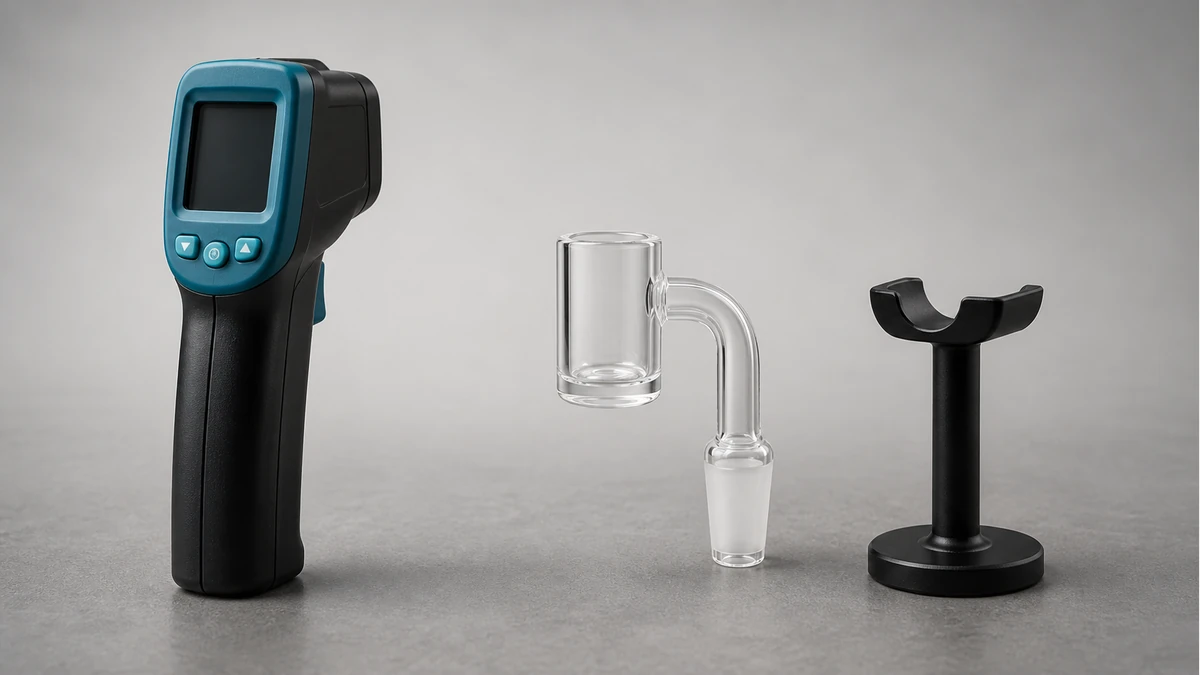
🧩 4. Handheld Infrared Tools vs Stationary Readers
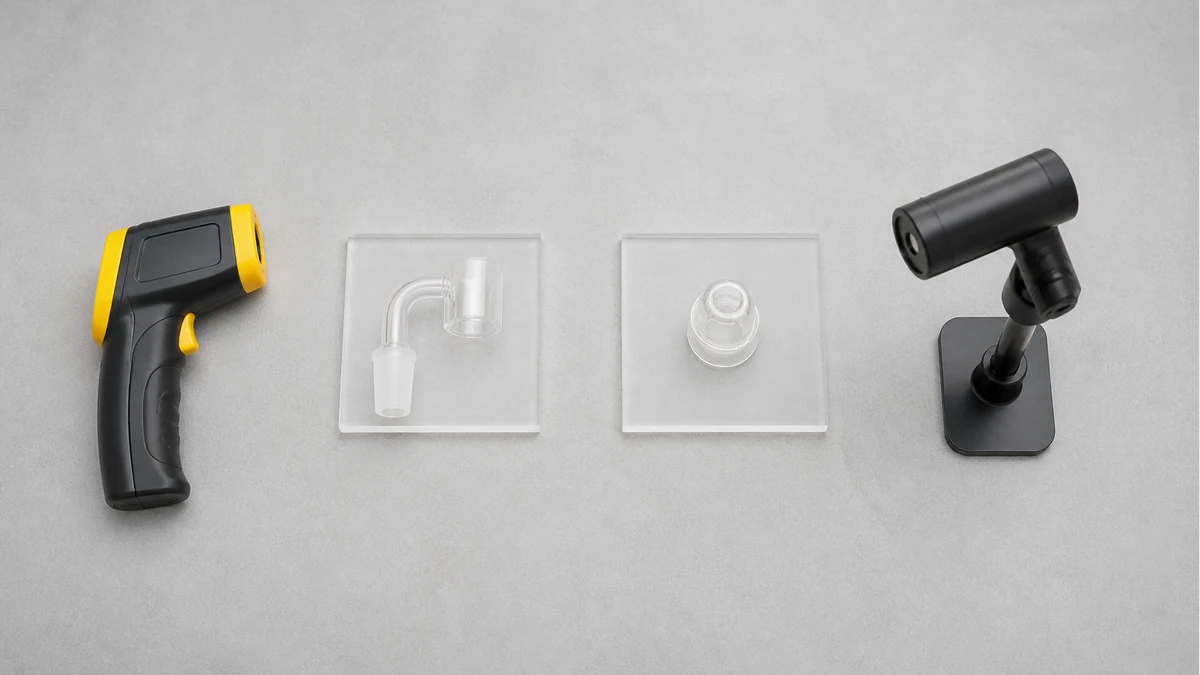
Buyers usually end up choosing between two broad categories: a handheld infrared thermometer, either general-purpose or dab-specific, and a stationary or clip-mounted reader designed to sit near the banger and give a continuous readout. They solve different problems, and the tradeoffs are worth laying out plainly rather than pretending one category is simply better.
| Factor | Handheld Infrared | Stationary/Clip-Mounted |
|---|---|---|
| Positioning consistency | Depends entirely on the user’s hand each time | Fixed distance and angle once mounted |
| Portability | Easy to move between rigs, travel-friendly | Usually tied to one setup |
| Setup effort | None; point and read | Requires mounting and initial positioning |
| Reading during the cooldown window | Single snapshot per aim | Can track the drop continuously if left in place |
| Sensitivity to user technique | High; varies session to session | Low, once correctly mounted |
The handheld’s strength is flexibility. You can carry it between sessions, check different bangers, and use it on the road. Its weakness is exactly what’s discussed above: the reading is only as consistent as the hand holding it, and small variations between checks translate directly into number variation, even when the underlying temperature hasn’t actually moved much.
A stationary or clip-mounted reader removes the hand-to-hand variability once it’s positioned correctly, because it stays fixed session to session. That consistency is valuable if you’re trying to build a repeatable cooldown routine. The tradeoff is that it’s less convenient to move around, and the initial mounting still has to be done thoughtfully, because a stationary reader locked into a bad position will simply be consistently wrong instead of randomly wrong. Neither category eliminates the underlying physics discussed above. They just change how much of the variability is under your control versus left to chance.
For readers weighing this decision against other dab accessories, a side-by-side comparison of dab nails, bangers, and enails is useful context if the temperature reader is one piece of a larger hardware decision rather than a standalone purchase. The choice of nail material in particular interacts directly with the emissivity issue described in Section 2, since titanium and ceramic don’t radiate heat the way quartz does, and a reader tuned for one won’t automatically translate to another.
🛠️ 5. What to Test Before You Trust a Reading
None of the variables above mean a dab temp reader is unreliable. They mean the tool needs to be understood before its number becomes something you act on. A few checks, done once, tell you whether the readings you’re getting are consistent enough to build a routine around.
- Read the same spot twice in a row. Take a reading, wait two or three seconds without moving the torch or the rig, and take it again from the same position. If the number swings noticeably with nothing else changing, the issue is likely technique or environment, not the quartz itself.
- Vary distance deliberately. Take three readings of the same spot at clearly different distances, close, medium, and farther back, and note how much the number shifts. This tells you how forgiving your specific device is, and how careful you need to be about holding a consistent distance every time.
- Check angle sensitivity. Read the same spot straight-on, then from a noticeable angle. If the swing is large, you’ll want to standardize on one angle rather than aiming however is convenient in the moment.
- Compare clean quartz to lightly used quartz. If you have both a freshly cleaned banger and one with some buildup, reading both under otherwise identical conditions shows you how much surface condition alone is moving the number.
- Track the cooldown curve, not a single point. Rather than treating one reading as the moment of truth, take a few readings across the cooldown window and watch the trend. A consistent, gradually falling curve tells you far more about repeatability than any single number does, and a curve that jumps around erratically is usually a sign of inconsistent positioning rather than an actual temperature spike.
Once you’ve run through these, you’ll know whether your reader is giving you a number that moves mainly with the quartz’s actual temperature, or one that moves just as much with your hand position. That distinction is the difference between a tool you can build a repeatable dabbing routine around and one that’s just adding a false sense of precision to a process that’s still fundamentally about feel and timing.
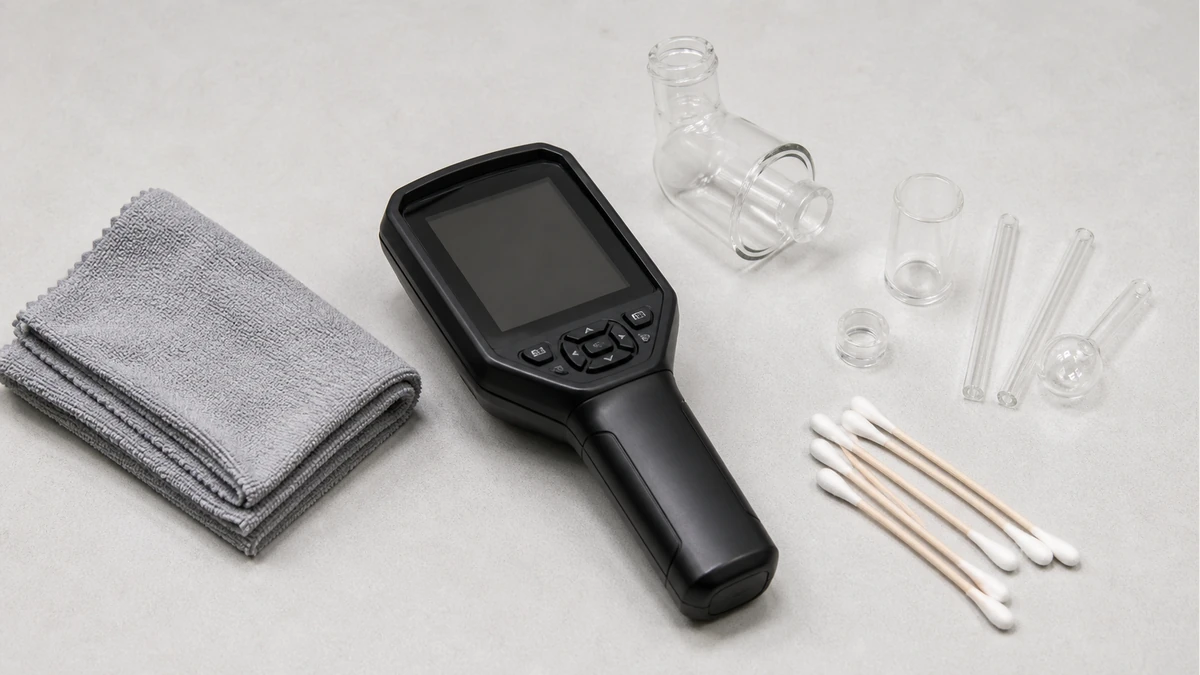
A more complete rundown of how temperature readers fit alongside torches, carb caps, and cleaning tools is covered in the dab tools guide, which is a useful next stop if you’re assembling a full setup rather than buying one accessory at a time. Cleaning tools in particular are worth reading up on before you buy a reader, since as Section 3.3 covers, residue on the quartz is one of the more overlooked sources of reading drift.
📐 6. Frequently Asked Questions
Why do two infrared thermometers give different readings on the same banger?
Differences in emissivity settings, distance-to-spot ratio, and the exact angle and position of each reading can all produce different numbers even when they’re measuring the same physical surface within seconds of each other. Neither reading is necessarily wrong; each is accurate for the exact spot, distance, and angle it sampled.
Does a dirty banger really change the reading that much?
Surface condition changes how quartz radiates infrared energy, so buildup or residue can shift the reading even if the actual temperature underneath is unchanged. Cleaning habits affect more than hygiene in this case.
Is a stationary reader automatically more accurate than a handheld one?
Not automatically. A stationary reader removes hand-to-hand variability once it’s correctly mounted, but a poorly positioned mount will just be consistently wrong instead of randomly wrong. Correct positioning matters in both categories.
Should I trust a single reading or check the whole cooldown?
Tracking a few readings across the cooldown window tells you more about how the banger is actually behaving than any single snapshot, since it shows the trend rather than one point that could be affected by a momentary angle or distance issue.
Can I fix reading inconsistency by switching to a more expensive reader?
A better sensor can narrow the margin of error, but it doesn’t eliminate the underlying physics. Distance, angle, and quartz condition affect every infrared device the same way in principle, so consistent technique matters regardless of price point.
🧼 7. The Short Answer
A dab temp reader isn’t lying to you when it disagrees with another tool, and it isn’t broken when the number shifts between readings taken seconds apart. It’s an infrared sensor doing exactly what infrared sensors do: averaging radiated heat off a small patch of surface, from whatever distance and angle you happened to hold it, off quartz that’s changing condition every time you use it. Understanding that turns a confusing discrepancy into a solvable positioning problem. Standardize your distance, standardize your angle, keep the quartz in a known condition, and check the trend rather than chasing a single perfect number. Do that, and whichever reader you’re using stops being a source of confusion and starts being a tool you can actually calibrate your routine around. For more on how these pieces fit together, the AOVAPE blog covers related hardware topics in more depth.