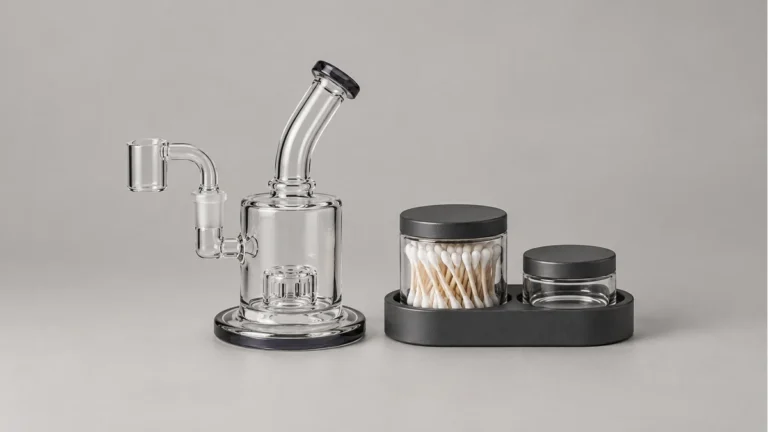
The phrase “double barrel bong” shows up in shop listings and search bars with almost no shared definition behind it. Some buyers mean a piece with two bowls feeding one chamber. Others mean two risers or necks rising off a shared base. Still others are picturing two entirely separate chambers running side by side, or a single chamber split by a dual-percolator layout that just looks doubled from the outside. Before comparing glass, it helps to figure out which of these you’re actually looking at, because the differences affect draw, cleaning, and stability in ways that aren’t obvious from a product photo.
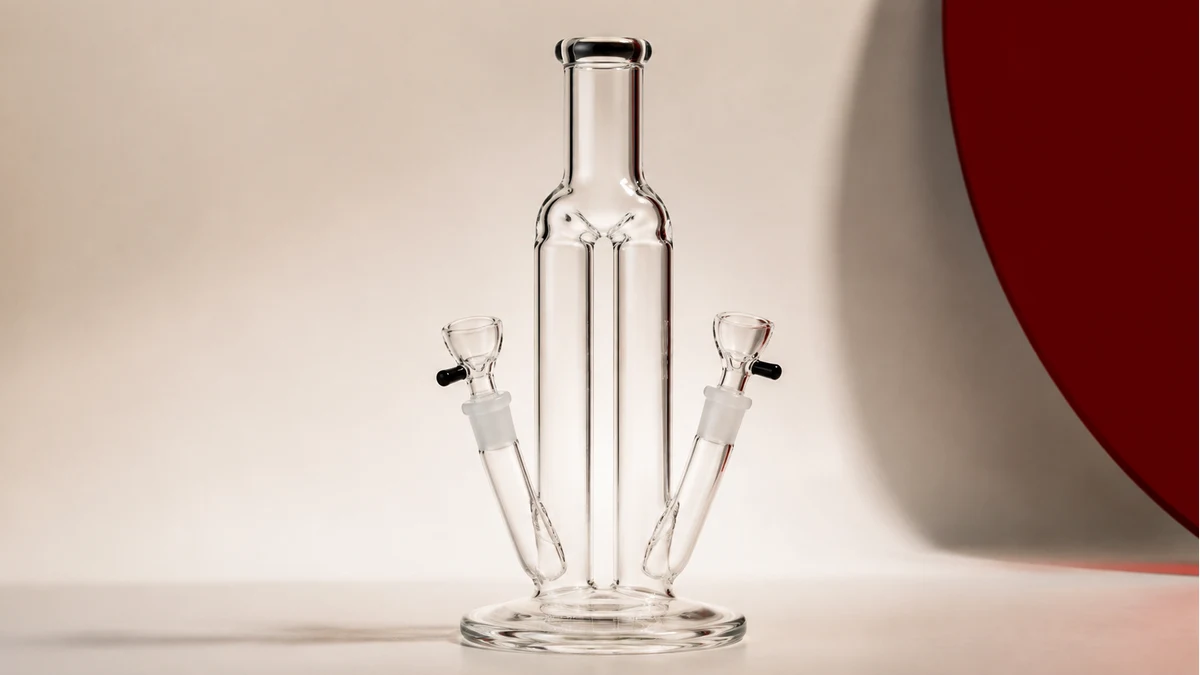
This guide walks through the architecture behind each interpretation, the tradeoffs that come with parallel versus serial airflow, and the questions that keep surfacing in forum threads from people who already own one and are trying to understand why it behaves the way it does.
🔍 1. What “Double Barrel” Actually Describes
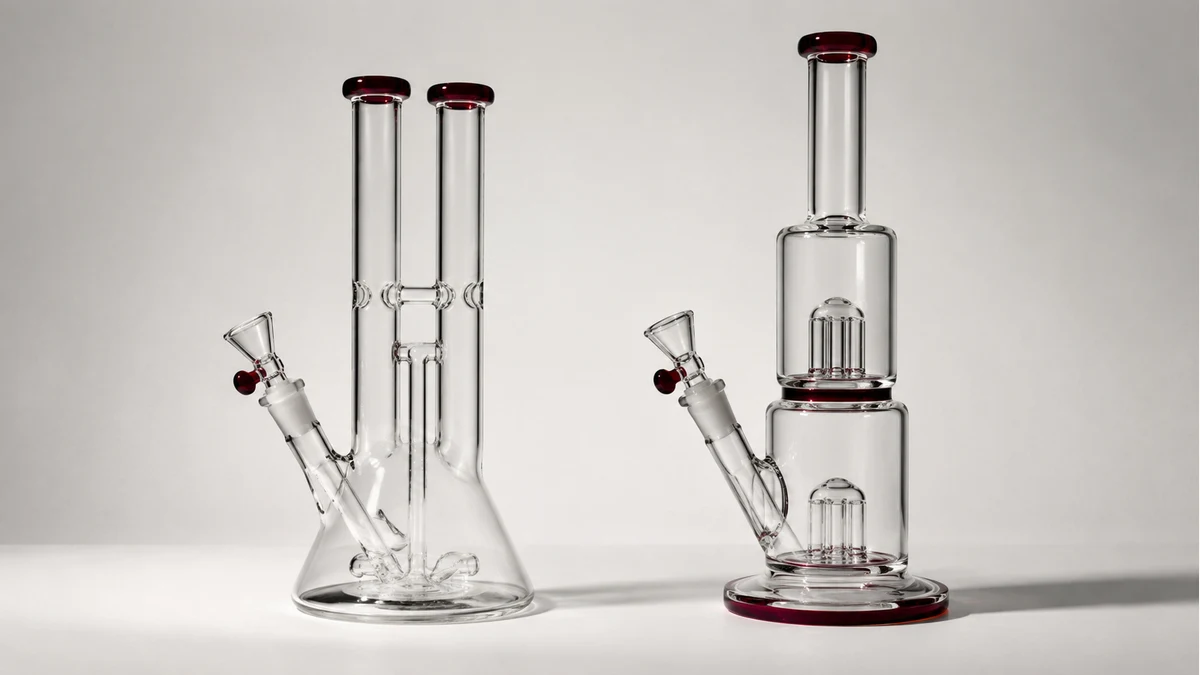
There isn’t a single accepted definition, and that ambiguity is the root of most confusion. Four distinct builds get called “double barrel” depending on the shop or the region.
In this layout, two bowl-and-downstem assemblies feed into a single water chamber. The bowls are usually mounted symmetrically, and airflow from either one passes through the same water and up the same neck. This is the simplest of the four configurations because there’s only one chamber to maintain, even though there are two entry points.
🧬 1.2 Two Risers or Necks
Here, a single chamber splits into two necks near the top, sometimes recombining into one mouthpiece, sometimes staying separate. The “barrels” in this case refer to the tubes themselves rather than the bowls or chambers. Functionally, this is closer to a stylistic or structural choice than an airflow change, since both necks usually draw from the same water below.
🧊 1.3 Parallel Chambers
This is the configuration most people picture when they hear “double barrel”: two independent water chambers, each with its own bowl, sitting side by side and joining somewhere before the mouthpiece. Each chamber holds and filters its own water, and airflow can move through one, the other, or both depending on how the piece is used.
💧 1.4 Dual-Percolator Layout
Some pieces marketed as double barrel actually have one chamber with two percolators stacked or mounted in parallel inside it. The “double” here refers to the diffusion hardware, not to separate airflow paths. This is a meaningfully different build from the parallel-chamber version above, even though marketing language often blurs the two.
Knowing which of these four you’re evaluating changes almost every downstream question about how the piece performs and how it’s maintained. Readers comparing multi-chamber options more broadly may find our 3-chamber bong guide useful for understanding how added chambers behave once you move past two.
❓ 2. Questions People Actually Ask About These Builds
A recurring set of questions shows up across forum threads and comment sections whenever double-barrel pieces come up. They’re worth addressing directly, because the answers depend heavily on which architecture is in play.
🌀 2.1 Do Both Barrels Do the Same Thing?
Not always. In a two-bowl, shared-chamber design, both bowls are functionally identical — they’re just two entry points into the same filtration path. In a true parallel-chamber design, each barrel is a complete, independent path, and the two may not be identical if one chamber has a percolator and the other doesn’t, or if the chambers hold different water volumes. Checking whether the chambers are truly symmetrical is worth doing before assuming they behave the same way.
🌬️ 2.2 Does Having Two Paths Mean More Draw Resistance?
This depends on whether the paths are parallel or serial, which is covered in more detail in Section 3. In short: parallel paths tend to split airflow rather than stack resistance, while serial paths — where air has to pass through both barrels in sequence — add whatever resistance each stage contributes. A piece with two chambers in parallel isn’t automatically harder to pull through than a single-chamber piece; it depends on percolator density and chamber geometry, not the raw chamber count.
💥 2.3 Is There Breakable Glass Inside That Isn’t Visible From Outside?
Yes, and this is one of the more common concerns. Percolators, diffuser slits, and internal risers are often recessed or angled in ways that make them hard to inspect without a flashlight or holding the piece up to light. In dual-percolator or parallel-chamber builds, there can be twice the internal glasswork of a single-chamber piece, which means twice the surface area for hairline cracks or chips to form, particularly around percolator arms and the points where risers join the base.
🧽 2.4 How Hard Is It to Clean Something With Two Chambers?
Harder, generally, and the degree depends on whether the chambers are joined by a wide opening or a narrow one. Two-bowl, shared-chamber designs clean about the same as a single-chamber piece since there’s only one cavity. Parallel-chamber and dual-percolator designs require solution to reach two separate cavities, and if the connecting joint is narrow, agitating cleaning solution into both sides evenly can take real effort. This is one of the most consistently repeated frustrations in owner discussions of these pieces.
⚖️ 2.5 Why Do Some Double-Barrel Pieces Feel Top-Heavy?
Two necks, two bowls, or two percolator stacks add glass mass above the base without necessarily adding base width to compensate. If the footprint wasn’t widened to match the added weight up top, the piece can feel unstable, especially with attachments seated in the joints. This is a base-to-mass ratio problem more than a flaw in the double-barrel concept itself, and it’s addressed further in Section 6.
🔀 3. Parallel Flow Versus Serial Flow
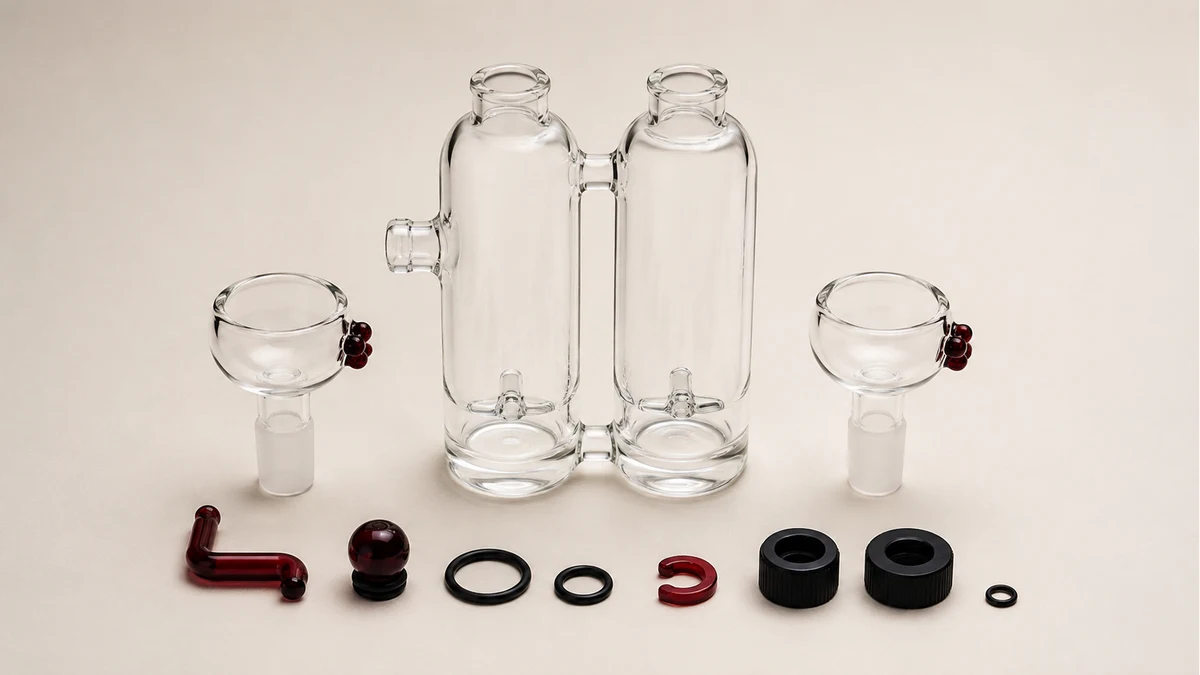
The single biggest factor in how a double-barrel piece pulls is whether the two barrels are arranged in parallel or in series.
↔️ 3.1 Parallel Flow Paths
In a parallel arrangement, air can take either barrel independently, and the two paths reconverge before or at the mouthpiece. This is true of the two-bowl/shared-chamber design and the true parallel-chamber design. Because the air isn’t forced through both paths in sequence, parallel flow doesn’t compound resistance the way serial flow can — it distributes it. The tradeoff is that airflow may be uneven if one bowl or chamber has less resistance than the other, meaning most of the air takes the path of least resistance rather than splitting evenly.
⬆️ 3.2 Serial Flow Paths
A serial arrangement forces air through one barrel, then the other, before reaching the mouthpiece. This shows up less often in true double-barrel marketing but does appear in some hybrid designs where one chamber feeds directly into a second percolated chamber rather than sitting beside it. Serial paths add the resistance of each stage together, so a heavily percolated first chamber feeding into a second percolated chamber will generally pull harder than either stage alone. This is closer in spirit to the stacked-chamber approach covered in the 3-chamber bong guide, where each added chamber compounds rather than splits.
Whether the barrels share one water reservoir or maintain two separate ones changes both performance consistency and maintenance load.
A shared chamber means one water level, one fill point, and one cleaning cavity, regardless of how many bowls feed into it. Separate chambers mean two water levels that need to be checked and maintained independently — overfilling one while underfilling the other is an easy mistake to make, and it can throw off the balance between the two flow paths described in Section 3. Separate chambers also mean double the standing water to dump, refill, and monitor for buildup, which is a maintenance cost that isn’t always obvious from a listing photo.
🕳️ 5. Dead Zones and Airflow Balance
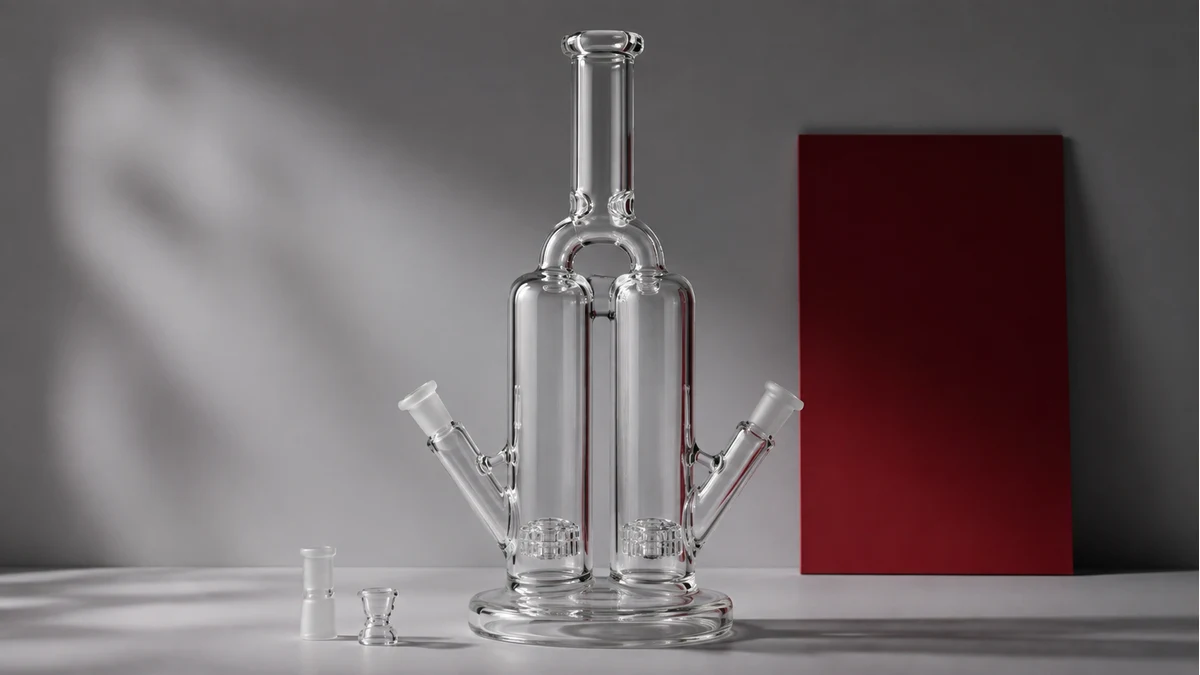
A “dead zone” in this context refers to a section of glass — usually a chamber, riser, or percolator arm — that sees little or no active airflow because air is preferentially routing through the path of least resistance elsewhere. This is more common in parallel-chamber and two-bowl designs than in serial ones, since parallel paths don’t force balanced use the way a single sequential path does. Dead zones aren’t necessarily a defect; they’re a natural consequence of unequal resistance between two paths. But they do mean that a percolator or chamber sitting mostly idle still needs to be cleaned as if it were in full use, since stagnant water and residue collect there regardless of airflow.
🧴 6. Cleaning Access Realities
Cleaning access is one of the most practical differentiators between double-barrel builds, and it’s worth evaluating before purchase rather than after. Two-bowl, shared-chamber pieces clean much like any single-chamber piece — remove the bowls, work solution through one cavity, rinse. Parallel-chamber and dual-percolator pieces require solution to move through two cavities, which usually means blocking one joint while agitating the other, then reversing the process. Some double-barrel designs use removable joints or bases specifically to make this easier, which overlaps with the disassembly approach detailed in the bong that comes apart guide — a relevant reference for anyone deciding whether a fixed or modular double-barrel piece will be easier to live with long-term. Fixed, non-removable double-barrel pieces put more weight on brush length and pipe-cleaner access into narrow percolator slits.
🏛️ 7. Base Stability and Joint Leverage
The stability question raised in Section 2.5 comes down to two factors: base footprint relative to upper glass mass, and how much leverage an attachment exerts on the joints once seated. A wide, flat base spreads the weight of two necks or two chambers effectively; a narrow or rounded base doesn’t. Attachments matter here too — anything seated into a joint, from a bowl to any other removable fitting, adds leverage at the exact point where two barrels already meet and split stress. Because double-barrel joints are frequently smaller or set closer together than on single-chamber pieces, a firmly seated but overly heavy attachment can apply more torque to that junction than the same attachment would on a single, centered joint. This is one reason it’s worth checking joint fit before assuming a replacement bowl or slide will sit the same way it would elsewhere; the bong slide replacement guide covers fit considerations relevant to swapping components on pieces with multiple or closely spaced joints.
📊 8. Architecture Comparison Table
| Configuration | Airflow Path | Water Chamber(s) | Cleaning Access | Typical Tradeoff |
|---|---|---|---|---|
| Two bowls, one chamber | Parallel, single chamber | Shared | Same as single-chamber piece | Simplest to maintain, least structural change |
| Two risers/necks | Parallel or recombining | Shared | Same as single-chamber piece | Mostly aesthetic; airflow largely unchanged |
| Parallel chambers | Independent, split | Separate | Two cavities to clean and monitor | Uneven airflow risk; more upkeep |
| Dual percolator, one chamber | Split within single chamber | Shared | Requires reaching two percolator zones | More internal glass, more breakage points |
🧭 9. Putting the Architecture Ahead of the Label
The label “double barrel” tells you almost nothing about airflow, water volume, cleaning burden, or stability until you know which of the four configurations is in front of you. Two bowls sharing one chamber behaves almost nothing like two fully independent chambers sitting side by side, even though both get called by the same name in listings. Before comparing specific pieces on glass thickness or percolator style, it’s worth confirming whether the “two barrels” refer to entry points, necks, full chambers, or internal diffusers — since that answer determines whether you’re evaluating a maintenance-light piece or one with genuinely doubled upkeep. For anyone weighing a double-barrel piece against a multi-chamber alternative, or deciding whether a modular base will make cleaning more manageable, the linked guides above cover the adjacent architecture decisions that tend to come up in the same buying research.