Judge the connector as carefully as the chamber: it must align without force, remain airtight, support the assembled weight, and still have replacement seals or sections available later.
A bong that comes apart can expose dirty sections, replace one damaged module, or pack into a shorter case. It also puts seals, threads, clamps, or gaskets into a path that a one-piece tube handles with continuous glass.
🧩 1. Modularity moves the weak point into a connector
In a fixed-tube bong, the glass itself is the load path. Water weight, the downstream’s drag when you pull, and the leverage of a percolator all get carried by continuous glass with no seams. That’s mechanically simple: there’s nothing to loosen, nothing to reseat, and no interface where two surfaces have to match up precisely.
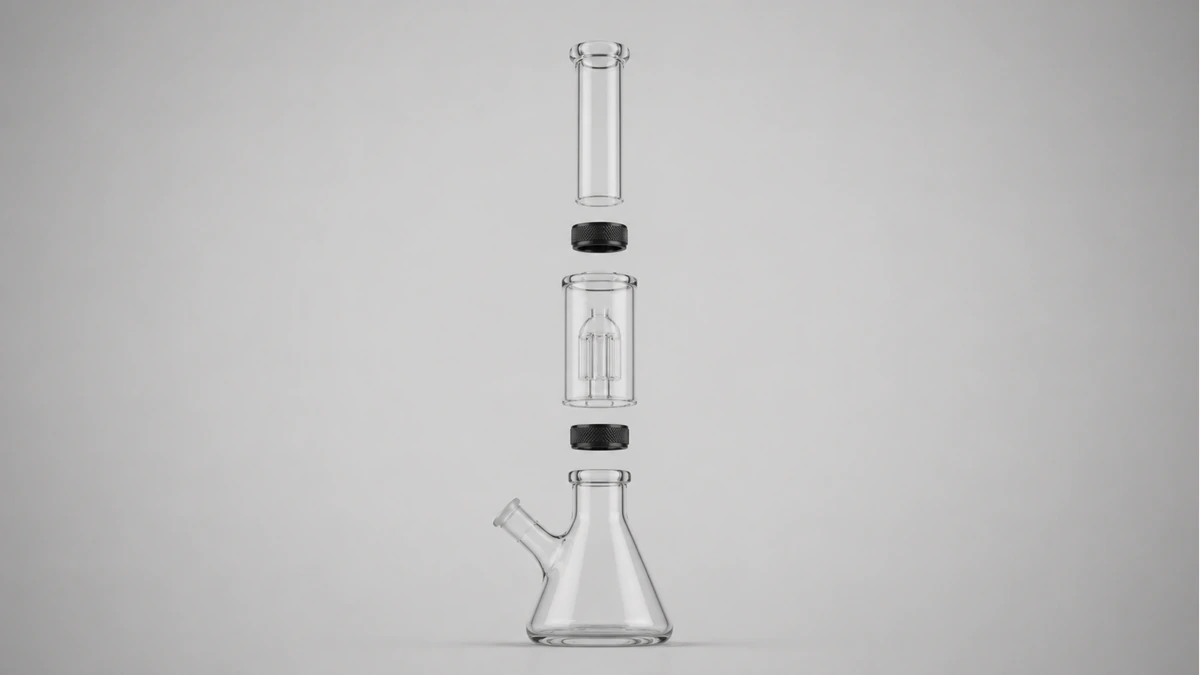
A modular bong replaces part of that continuous glass with a mechanical joint — two separate pieces held together by threads, a compression clamp, an O-ring and sleeve, or magnets set into the glass. Whatever holds the sections together also carries the same water weight and pull force the fixed tube used to handle on its own, except now it’s doing that job through a physical interface instead of through solid glass. Every interface has tolerances, and tolerances loosen with repeated assembly, thermal cycling from hot water or torch heat nearby, and the residue buildup that changes how tightly two surfaces actually meet.
This is why a modular bong’s failure mode looks different from a one-piece bong’s failure mode. A fixed tube tends to fail all at once, from an impact or a stress crack. A modular joint tends to fail gradually — a thread that used to stop with a firm quarter-turn starts spinning further, a clamp that used to click shut needs to be forced, an O-ring that used to seal on the first attempt needs to be reseated two or three times before the connection holds water. None of that is a defect by itself; it’s the ordinary wear pattern of a mechanical joint, and it’s worth checking each connector’s grip and seal the same way you’d check a downstem fit before you commit to a session.
🔗 2. Connection style decides seal and handling
The four common approaches — threaded, clamp, gasket-sleeve, and magnetic — aren’t interchangeable, and each one trades sealing method for a different handling behavior.
Threaded connections cut matching spiral grooves into both glass sections, so they seal through direct glass-to-glass contact along the thread path as you twist them together. That contact is precise when the threads are clean and undamaged, but glass threads are unforgiving: a chip on a single thread ridge, from a drop or from grit trapped during cleaning, can keep the joint from closing fully and leave a leak path that’s hard to see by eye. Threaded joints also transmit torque directly, so overtightening one is a real risk — you’re twisting glass against glass with no give in the system.
Clamp connections use a separate mechanical collar, usually metal, that presses two glass ends together and relies on a gasket sandwiched between them for the actual seal. The clamp itself isn’t sealing anything; it’s applying clamping force so the gasket compresses evenly. That means the seal quality depends on the gasket’s condition as much as the clamp’s tightness, and a warped or hardened gasket can leak even when the clamp feels snug. Clamps are generally easier to inspect than threads, though, because you can see the gasket and check it directly instead of guessing at internal thread wear.
Gasket-sleeve joints slide one glass section into another with an O-ring or rubber sleeve doing the sealing, similar in principle to how a downstem seats into a joint. These tend to be more forgiving of minor size variation than threads, since the rubber compresses to take up small gaps, but the sleeve itself is a wear part — it hardens and loses compression over time, and once it does, no amount of pushing the sections together restores the seal. If you’re already comparing how different attachment styles handle sealing and fit, the same seal principles that apply to dab rig attachments apply directly here, since both rely on a compressible interface rather than rigid glass contact.
Magnetic connections use embedded magnets to hold two sections in alignment, but the magnets aren’t what seals the joint — an O-ring or precision-ground glass surface between the sections does that work, and the magnets just keep the parts from sliding apart or misaligning while that seal does its job. That distinction matters when something goes wrong: if a magnetic joint leaks, the magnets aren’t the problem to troubleshoot, the seal surface is.

🧼 3. Easy access can make real cleaning simpler
The genuine advantage of a bong that comes apart is reach. In a fixed tube, you’re cleaning through one or two narrow openings, working a brush or pipe cleaner blind through bends and around percolator arms you can’t see into. Separate the sections, and each piece opens up on both ends, so you can see and physically reach the interior surface you’re scrubbing instead of working by feel.
That matters most in exactly the spots Reddit threads on modular pieces keep circling back to — the underside of a percolator, the inside curve where a neck bends, the base of a downstem well — areas that collect residue fastest and that a single straight brush can’t reach in a one-piece design. Separating the piece at a joint placed near one of those problem spots turns a difficult clean into a straightforward one; separating it somewhere that doesn’t intersect a hard-to-reach area just adds an extra piece to wash without solving the actual cleaning problem.
The tradeoff is that every connector is itself something that needs cleaning and needs to stay dry when you’re done. Threads, gaskets, and O-rings that stay wet or sit in cleaning solution too long are the parts most likely to degrade, so a modular piece adds a drying step a fixed tube doesn’t need — you’re not just cleaning the glass, you’re making sure the seal components are fully dry and grit-free before you reassemble. A general-purpose glass cleaning kit with brushes sized for different tube diameters handles the reachable sections well; it’s the joint hardware that needs separate attention and a full dry-out before you put the piece back together.
📐 4. Extra sections multiply alignment and stability checks
A one-piece bong only has one geometry to get right: is it sitting flat on its base. A modular bong has that same question plus a second one for every joint — does each section line up straight with the one below it, or is there a slight offset that puts uneven load on the connector.
Misalignment at a joint doesn’t just look off. It concentrates stress at one side of the connection instead of spreading it evenly around the seal, which is exactly the condition that makes a gasket compress unevenly or a thread bind on one side and gap on the other. A joint that’s slightly crooked can hold water for weeks and then start weeping the first time it gets bumped, because the bump finally pushed the misalignment past what the seal could absorb.
More sections also means more total height and more joints stacked between the base and the mouthpiece, which raises the center of gravity and adds points where the piece can flex slightly under a tap or an uneven table. None of that makes a modular bong unstable by default, but it does mean the stability check that matters for a fixed tube — is the base flat and is the piece on a level surface — needs to be paired with a second check on a modular piece: is each joint fully seated and square before you consider it stable enough to leave standing.
📦 5. Replacement parts matter only if they remain available
The other real advantage of a modular design is that a broken section, in principle, doesn’t take the whole piece with it. If the neck cracks on a bong built as one piece, the base is gone too. If the neck cracks on a modular bong, replacing just that section is mechanically possible, because the base was never fused to it in the first place.
Whether that advantage plays out depends entirely on whether a matching replacement section is still made and still sold. A proprietary joint size, a specific thread pitch, or a manufacturer-specific magnet spacing only works with parts from the same maker or the same product line — a modular design doesn’t give you universal compatibility, it just gives you the possibility of compatibility if the right part still exists. This is the same reason Reddit users comparing modular pieces keep coming back to connector standardization before purchase, since a broken section that can’t be replaced leaves you with a piece that’s no better off than a cracked one-piece tube.
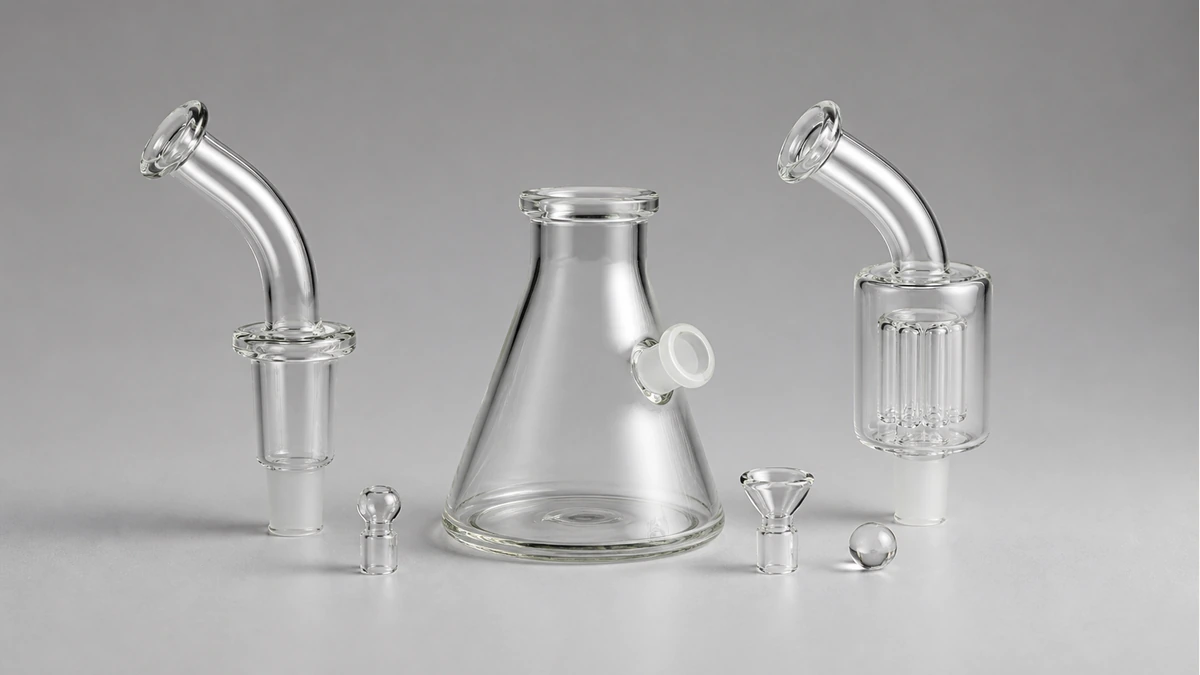
Portable and travel-oriented pieces make this calculation more visible, since they’re built to break down for transport as well as for repair — a portable dab rig that separates into a base and a body is using the same joint logic as a modular bong, just applied for packing size rather than cleaning access. In both cases, the connector standard is the thing worth checking before you buy, not after a section breaks.
🧪 6. Assemble cold and lift from the base
General hardware principle first: any mechanical joint seats more predictably at room temperature. Heating glass unevenly changes its dimensions slightly, and a joint that was cut to fit at room temperature can bind or gap when one side is warmer than the other. Assembling a modular piece before a torch or a hot nail has warmed any part of it keeps the fit consistent with how the joint was actually sized.
Lifting from the base rather than the neck is also general practice, not maker-specific advice — it keeps the load on the section that’s supporting the water weight anyway, instead of putting a shearing or twisting force through a joint that’s only rated to hold static contact, not to carry the weight of the whole assembly hanging from it.
Beyond that, follow the specific instructions for the piece in front of you. Some threaded joints specify a stopping point past finger-tight and warn against forcing further; some clamp systems specify a particular tightening sequence; some gasket sleeves specify how far the sections should slide together before the seal is fully seated. These details vary by manufacturer and joint design, and guessing at them based on a different piece’s instructions is how threads get stripped or gaskets get pinched.

✅ 7. Buy modularity for a specific maintenance or replacement benefit
A bong that comes apart is worth choosing when it solves a specific problem you actually have — a percolator you can’t reach with a straight brush, a piece you need to pack down for travel, or a maker with a track record of stocking replacement sections for their own joint standard. In those cases, the extra connector is doing real work.
It’s a weaker choice when the modularity is incidental — a split placed somewhere that doesn’t intersect a hard-to-clean area, or a proprietary joint from a maker with no visible parts inventory. In that scenario you’ve taken on an extra seal to maintain, an extra alignment check every time you set the piece down, and a replacement part that may or may not exist later, without gaining the access or repairability that justifies the tradeoff in the first place. The connector should be answering a maintenance or replacement question you can name before you buy, not just adding a seam because separable pieces read as more advanced.