How do dry herb vaporizers work? The answer involves more hardware engineering than most users realize — and understanding it explains why two devices both described as “dry herb vaporizers” can produce dramatically different vapor quality, flavor, and efficiency from the same cannabis flower.
This guide explains the complete internal process: how a dry herb vaporizer converts electrical energy into heat, how that heat interacts with cannabis compounds, what the three heating methods actually do differently, and how to use that knowledge to get better results from any device you own. For AOVAPE’s own dry herb vaporizer range, readers can browse the dry herb vaporizer collection, the Uranus, VGO, and the full AOVAPE vaporizer lineup.
⚙️ 1. How Do Dry Herb Vaporizers Work: The Core Process
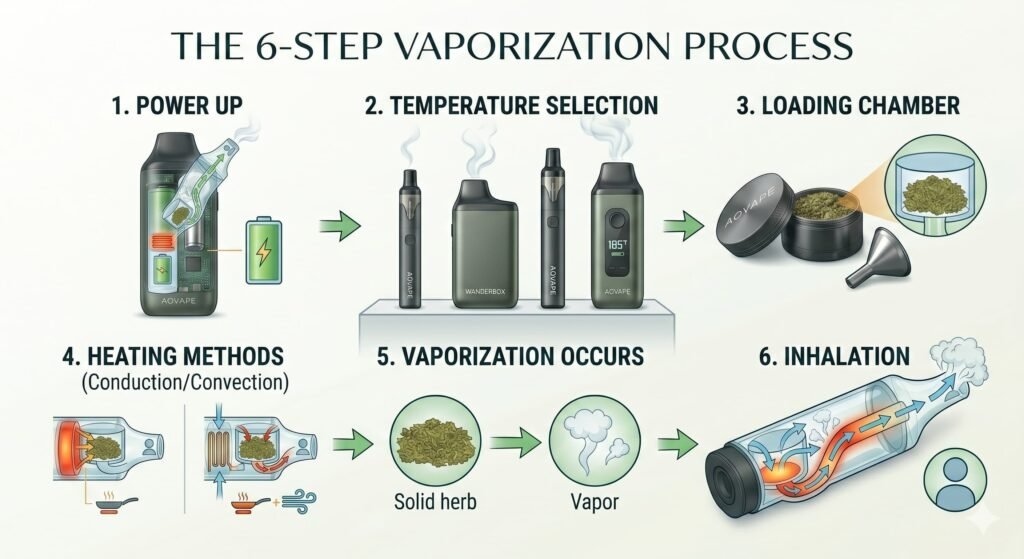
Every dry herb vaporizer — regardless of brand, price, or heating method — operates through the same fundamental sequence:
- 🔋 Battery delivers current to the heating element when the device is activated
- 🌡️ Heating element converts electrical energy to thermal energy — raising temperature to the user’s selected setting
- 🌿 Cannabis flower is exposed to heat — either by direct contact with the heated surface (conduction) or by heated air flowing through the chamber (convection)
- 💨 Cannabinoids and terpenes vaporize — converting from solid/liquid form in the plant matter to a vapor aerosol as they reach their individual boiling points
- 🫁 Vapor travels through the airpath — from the heating chamber through the device body to the mouthpiece
- 😮💨 User inhales vapor through the mouthpiece
📌 Every dry herb vaporizer has a heating chamber where you load your ground flower, a battery or power source, and a mouthpiece. The key difference between models comes down to how they apply heat. That single variable — how heat is applied — is responsible for most of the performance differences between devices.
🔥 2. How Do Dry Herb Vaporizers Work: The Three Heating Methods
The heating method is the most important design decision in any dry herb vaporizer. It determines vapor quality, extraction efficiency, terpene preservation, and session behavior.
🍳 2.1 Conduction Heating
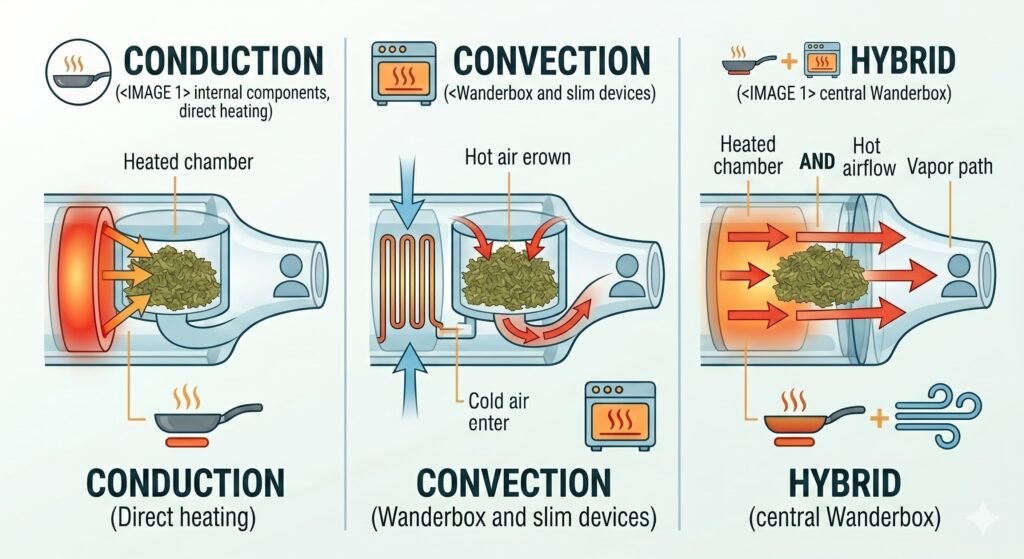
Conduction vaporizers work like a hot pan. The walls of the heating chamber heat up directly, and the herb sitting against those walls absorbs that heat.
In a conduction device, the cannabis flower is loaded directly into a chamber whose walls are heated by the electrical element. Heat transfers from the hot chamber walls into the herb through physical contact — the same principle as cooking food in a pan.
How conduction works step by step:
- The battery powers a resistance heating element wrapped around or built into the chamber walls
- Chamber walls reach target temperature in 15–30 seconds
- Herb in contact with the walls begins vaporizing immediately
- Herb in the center of the chamber receives heat more slowly via conduction through the surrounding material
Conduction advantages:
- ⚡ Fast heat-up — 15–30 seconds to session-ready
- 💰 Simpler design — lower manufacturing cost, lower purchase price
- 🔋 More battery efficient — less energy needed per session
- 👍 Easy to use — load and go, minimal learning curve
Conduction limitations:
- 🌡️ Uneven heating — the herb touching the chamber walls gets hotter than what is in the center, which can lead to some material being wasted or lightly scorched.
- 🔁 Continued heating between draws — the chamber stays hot even when you are not inhaling, continuing to cook the material
- ⚠️ Higher combustion risk if temperature is set too high or herb is packed too tightly
📌 The first few draws from a conduction vaporizer tend to be the most flavorful, with taste dropping off as the session goes on — because the most volatile terpenes vaporize first, and the material sitting against the hot walls is already extracting before you take your first draw.
🌬️ 2.2 Convection Heating
Convection vaporizers pass a stream of hot air through the herb instead of relying on direct contact. This heats the material much more evenly, which means better extraction of active compounds and a cleaner, more consistent flavor throughout the session.
In a convection device, a heating element warms the air before it enters the herb chamber. That hot air flows through the loaded cannabis, transferring heat evenly across the entire material surface. Instead of your material touching the heating element, indirect heating sends hot air into the chamber and coats your material — extracting the desired flavors and properties from your dry herb.
How convection works step by step:
- The heating element heats air before it reaches the herb chamber
- When the user inhales, airflow draws hot air through the heating element and into the chamber
- Hot air flows evenly through the loaded cannabis in all directions simultaneously
- All herb surfaces reach target temperature at approximately the same time
- The herb stops heating the moment airflow stops — preserving the session for the next draw
Convection advantages:
- 🌬️ Even heat distribution — all material extracts simultaneously
- 🍋 Better terpene preservation — consistent heat prevents localized scorching
- ⏹️ Heat stops when airflow stops — material does not continue cooking between draws
- 🎯 More efficient extraction — less wasted material per session
Convection limitations:
- ⏱️ Slower heat-up — 30–60 seconds typically
- 💵 More complex design — higher manufacturing and purchase cost
- 🌫️ First draws may be lighter while the airpath fully warms
⚡ 2.3 Hybrid Heating
Hybrid heating combines both methods for the ultimate vaping experience. You get rapid heat-up (under 30 seconds in current models), smooth potent vapor, superior terpene retention, and minimal waste.
Hybrid designs use a heated chamber (conduction component) that also heats the airflow passing through the material (convection component). The chamber walls start vaporizing the material immediately on heat-up, while simultaneous hot airflow ensures even extraction throughout the load.
Hybrid result:
- ✅ Faster heat-up than pure convection
- ✅ More even extraction than pure conduction
- ✅ Consistent flavor from first draw to last
- ✅ Best overall efficiency and vapor quality at the mid-to-premium price tier
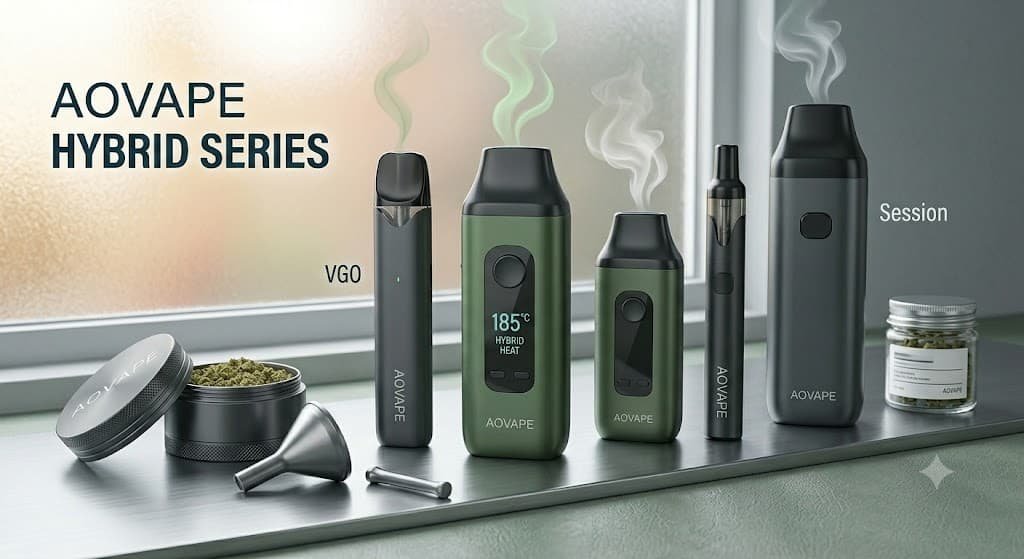
AOVAPE’s Uranus and VGO use hybrid heating for balanced extraction and terpene preservation. The full AOVAPE dry herb vaporizer range covers all three heating methods.
📊 3. Conduction vs. Convection vs. Hybrid: Side-by-Side Comparison
| Feature | Conduction | Convection | Hybrid |
|---|---|---|---|
| Heat-up time | Fast (15–30 sec) | Slower (30–60 sec) | Medium (20–45 sec) |
| Vapor evenness | Moderate | High | High |
| Terpene preservation | Moderate | Best | Very good |
| Battery efficiency | Best | Moderate | Good |
| Combustion risk | Higher at high temps | Lower | Low |
| Price range | Entry to mid | Mid to premium | Mid to premium |
| Best for | Quick sessions, beginners | Flavor-focused, efficiency | Everyday balanced use |
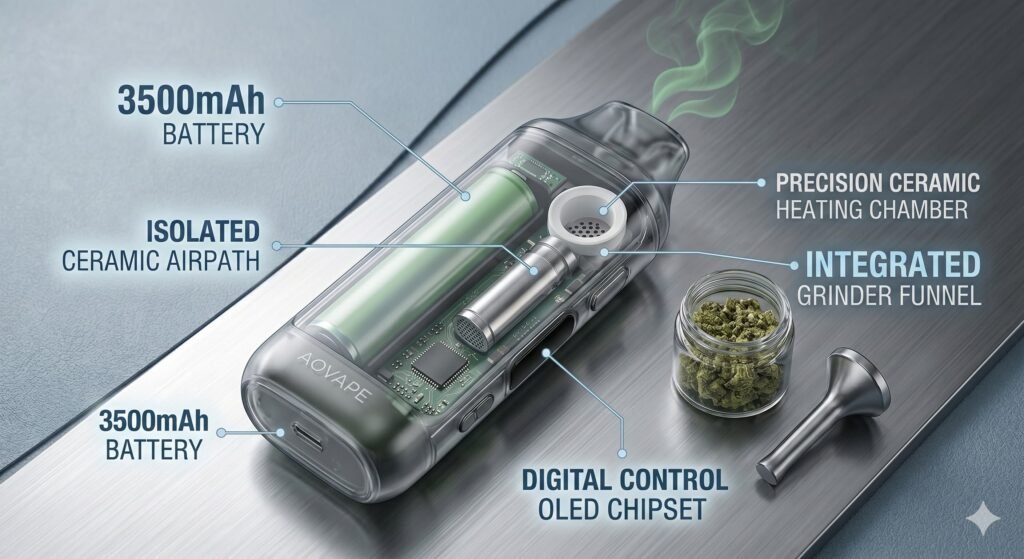
🧱 4. What Is Inside a Dry Herb Vaporizer: The Key Components
Understanding the internal components helps explain why different devices perform differently:
🔋 4.1 Battery and Power System
Most current portable vaporizers deliver between 7 and 18 sessions per charge depending on the device and temperature setting. Some use replaceable batteries that you can swap out when they die, extending the device’s lifespan significantly. Others have sealed internal batteries that charge via USB-C.
Battery capacity ranges from 1,800 mAh in compact pen-style dry herb vapes to 3,500 mAh in full-size session devices. Higher temperature settings drain battery faster — a session at 210°C uses approximately 30%–40% more battery than the same session at 175°C.
🧪 4.2 Heating Chamber
The chamber material directly affects vapor flavor and safety:
| Chamber Material | Flavor | Durability | Heat-Up Speed | Best For |
|---|---|---|---|---|
| Ceramic | 🟢 Cleanest — no added flavor | 🟢 Very durable | 🟡 Medium | Flavor-focused users |
| Stainless steel | 🟡 Neutral — slight metallic note at first | 🟢 Most durable | 🟢 Fast | Heavy daily use, durability priority |
| Glass (lined) | 🟢 Purest vapor path | 🔴 Fragile | 🟡 Medium | Premium flavor sessions at home |
📌 The chamber holds the herbs and is typically made from ceramic, quartz, or stainless steel. Clean airflow ensures purer vapor. Some models use filters to prevent herb particles from entering the mouthpiece. AOVAPE’s dry herb vaporizers — including the NIU Pro and TRIO — prioritize vapor path material quality throughout the heated zone.
💨 4.3 Airflow Path
The airflow path is the channel through which vapor travels from the heating chamber to the mouthpiece. Path length, material, and diameter all affect vapor temperature and flavor by the time it reaches your mouth. Longer paths cool vapor more before inhalation — important for high-temperature sessions where hot vapor can be harsh. Quality devices use ceramic, glass, or stainless steel throughout the vapor path rather than plastic, which can introduce off-flavors at high temperatures.
🖥️ 4.4 Temperature Control System
Temperature control is the feature that separates beginner from advanced dry herb vaporizers:
- 🟢 Fixed presets — 3–4 temperature levels (Low / Med / High / Boost). Simple, easy to use. Entry-level standard.
- 🟡 Digital display with degree control — set exact temperature in 1°C or 5°C increments. Mid-to-premium standard. Most useful for users who want to target specific cannabinoid and terpene boiling points.
- 🔴 App-connected precision — Bluetooth-connected temperature curves and session profiles. Premium tier. Useful for highly experienced users who run temperature-step sessions.
🌡️ 5. Temperature Settings: What Happens at Each Range
Temperature is the user’s primary control variable once the device type is chosen. Here is what happens to cannabis compounds at each range in a dry herb vaporizer:
| Temperature Range | Vapor Character | What Is Activated | Best For |
|---|---|---|---|
| 157°C–175°C (315°F–347°F) | Light, cool, highly aromatic | THC (157°C), light terpenes | Flavor focus, first draws, light effects |
| 175°C–195°C (347°F–383°F) | Balanced vapor and flavor | THC, CBD, CBN, most terpenes | Everyday use — recommended starting range |
| 195°C–220°C (383°F–428°F) | Dense, warm, potent | Full cannabinoid profile including CBG, THCV | Maximum extraction, experienced users |
| Above 230°C (446°F) | Smoke — combustion begins | Compounds destroyed | Not recommended |
💡 Temperature stepping — starting at 165°C–170°C for the first 2–3 draws, increasing to 185°C–190°C for the main session, then finishing at 200°C–210°C — extracts different compound profiles across one bowl and maximizes overall efficiency from each load.
📋 6. How to Use a Dry Herb Vaporizer: Step-by-Step
The core process for using a dry herb vaporizer:
- 🌿 Grind your herb to medium-fine consistency — like table salt. Not powder-fine (restricts airflow) and not chunky (reduces surface area). Even grind is the single most impactful preparation step for both conduction and convection devices.
- ⚡ Power on — 3–5 rapid button clicks on most devices.
- 🌡️ Set temperature — start at 185°C (365°F) if you are new to the device. Adjust after your first session based on vapor density and flavor preference.
- 🌿 Load the chamber — fill full but do not compress. Leave room for airflow. Packing too tightly restricts convection airflow and increases combustion risk in conduction devices.
- ⏱️ Wait for heat-up — 20–60 seconds depending on device and heating method. Most devices signal readiness via vibration or LED color change.
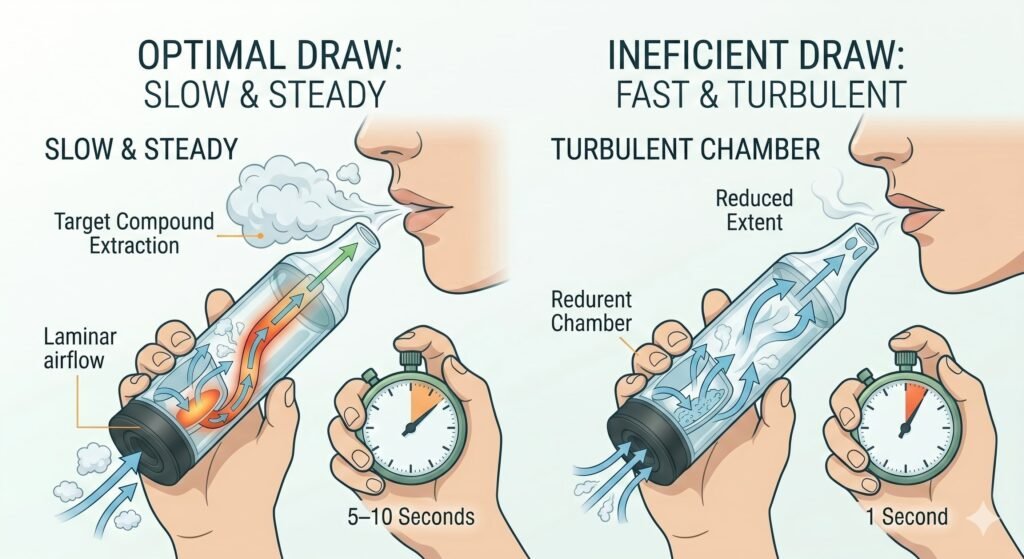
- 💨 Draw slowly for 5–10 seconds — slow, steady inhalation maintains chamber temperature during the draw. Hard fast draws drop chamber temperature and reduce vapor quality.
- ⏳ Wait 20–40 seconds between draws — allows the chamber to return to target temperature and the remaining herb to re-equilibrate heat.
- 🧹 Clean after every 3–5 sessions — brush the chamber while warm to remove residue before it hardens. IPA clean the chamber and mouthpiece weekly.
🗂️ 7. Types of Dry Herb Vaporizers by Form Factor
✏️ Pen-Style
Slim, cylindrical, pocket-sized. Almost always use conduction heating due to the limited internal volume. Best for quick sessions and discreet daily carry. AOVAPE’s Malpen represents this format — compact body, reliable heating, discreet profile.
🧱 Portable Session Vape (Box Style)
Wider, flat-bodied devices. Larger internal volume allows bigger chambers, better convection or hybrid heating systems, and larger batteries (typically 1,800–3,500 mAh). Most current portable models deliver between 7 and 18 sessions per charge. AOVAPE’s Uranus, VGO, NIU Pro, and TRIO fall in this category.
🖥️ Desktop Vaporizer
Plug-in, non-portable devices for home use. Larger heating chambers, more powerful airflow systems, and the ability to use balloon bag or whip delivery systems. Best vapor quality available but not portable.
❓ FAQ: How Do Dry Herb Vaporizers Work
How do dry herb vaporizers work?
Dry herb vaporizers heat ground cannabis flower to between 157°C–220°C (315°F–428°F) using a battery-powered heating element, converting cannabinoids and terpenes into inhalable vapor without combustion. The three heating methods are conduction (direct contact with a hot surface), convection (hot air flowing through the herb), and hybrid (both combined). Vapor travels through an internal airpath to the mouthpiece.
What is the difference between conduction and convection in a dry herb vaporizer?
Conduction heats herb by direct contact with a hot chamber wall — like a frying pan. Fast heat-up, simpler design, lower cost, but can produce uneven extraction. Convection heats herb by passing hot air through it without direct contact — like a convection oven. More even extraction, better terpene preservation, cleaner flavor throughout the session, but slower heat-up and higher cost. Hybrid combines both for a balance of speed and quality.
What temperature should I use for a dry herb vaporizer?
Start at 185°C (365°F) — the balance point where THC, CBD, CBN, and most terpenes are all active. For maximum flavor with lighter effects, use 160°C–175°C. For maximum potency and dense vapor, use 200°C–220°C. Never exceed 230°C — above that point combustion begins and you are producing smoke rather than vapor.
Why does my dry herb vaporizer produce thin vapor?
The three most common causes: temperature is set too low (below 175°C at most devices produces very light vapor), herb is packed too loosely (insufficient herb-to-heat contact), or grind is too coarse (reduced surface area for extraction). Try increasing temperature by 5°C–10°C increments and ensure a consistent medium-fine grind.
How many sessions does a dry herb vaporizer battery last?
Most portable dry herb vaporizers deliver 7–18 sessions per charge depending on battery capacity and temperature setting. Higher temperatures drain battery faster. A device with a 3,000 mAh battery at 185°C typically provides 10–14 sessions per charge. Some models use replaceable batteries (18650 or 21700 format) for indefinite runtime with spare cells.
Do I need to grind herb for a dry herb vaporizer?
Yes — grinding is essential. Ground herb has significantly more surface area than broken flower, allowing heat to reach more material simultaneously. Medium-fine consistency (similar to table salt) is ideal for most devices. Too fine restricts airflow, especially in convection devices. Too coarse reduces extraction efficiency and can cause uneven heating in conduction devices.
What is the best dry herb vaporizer for beginners?
For beginners, a conduction or hybrid device with 3–4 preset temperature levels, USB-C charging, and a ceramic chamber is the most practical starting point. Simple controls, fast heat-up, and reliable daily performance without a steep learning curve. AOVAPE’s dry herb vaporizer range includes options across all experience levels and budgets — from compact pen-style designs to full session vapes with digital temperature control.
📌 Final Thoughts
Understanding how dry herb vaporizers work means understanding the heating method at their core. Conduction is fast and affordable but uneven. Convection is even and flavorful but slower and more expensive. Hybrid combines both for the most balanced everyday performance. Temperature is the user variable that determines which cannabinoids and terpenes are activated — and the 175°C–195°C range is where most users find their everyday sweet spot.
The hardware determines how accurately you can target and hold those temperatures throughout a session. AOVAPE’s complete dry herb vaporizer range covers conduction, convection, and hybrid heating across multiple form factors — from the compact Malpen pen-style to the full-session Uranus and VGO.
👉 Browse AOVAPE’s full dry herb vaporizer range →
📚 References
- Conduction heating definition: direct contact between herb and heated chamber surface — fast heat-up 15–30 seconds, risk of uneven extraction (ScienceInsights.org, March 2026; thekindpen.com, February 2026)
- Convection heating definition: hot air passed through herb without direct contact — even extraction, slower heat-up 30–60 seconds (ScienceInsights.org, March 2026; nectarmedicalvapes.com, June 2025)
- Hybrid heating: combines chamber heating (conduction) with heated airflow (convection) — heat-up under 30 seconds in current models (thekindpen.com, February 2026)
- Session count per charge: 7–18 sessions for most portable dry herb vaporizers at standard temperature settings (ScienceInsights.org, March 2026)
- THC boiling point: 157°C (315°F); CBD: 160°C–180°C; CBN: 185°C; CBG and THCV: 220°C (Steep Hill Labs cannabinoid data; herb.co temperature guide, March 2026)
- Combustion threshold: approximately 230°C (446°F) for cannabis plant material — above this point benzene and carbon monoxide generation confirmed (weedpedia.org, April 2026)
- Grind consistency: medium-fine (table salt consistency) optimal for airflow and surface area in both conduction and convection chambers (thekindpen.com, February 2026; vapefully.com, January 2024)
- Temperature impact on battery: higher temperature settings (210°C vs 175°C) drain battery approximately 30%–40% faster per session (hardware testing reference data, 2025–2026)