Vaporization weed is now the most widely practiced alternative to smoking cannabis globally — and the reason is not just preference. It is physics. When cannabis is combusted with a flame, temperatures reach approximately 900°C (1,652°F) at the tip of a joint, destroying a significant portion of the cannabinoids and terpenes before they can be inhaled. You can look at smoking weed like using a sledgehammer and vaping weed like using a sniper rifle. Vaporization gives you precision. You choose the temperature, target the compounds you want, and preserve the ones you do not want to destroy.
This guide explains the complete science of cannabis vaporization — how it works at a molecular level, what temperature does to different cannabinoids and terpenes, which device type suits which material, and how to apply this knowledge to get consistently better results from every session. For hardware options across every vaporization format, readers can also browse AOVAPE’s dry herb vaporizer range, the 510 thread battery collection, and the full AOVAPE vaporizer lineup.
🔬 1. What Is Weed Vaporization? The Science Explained
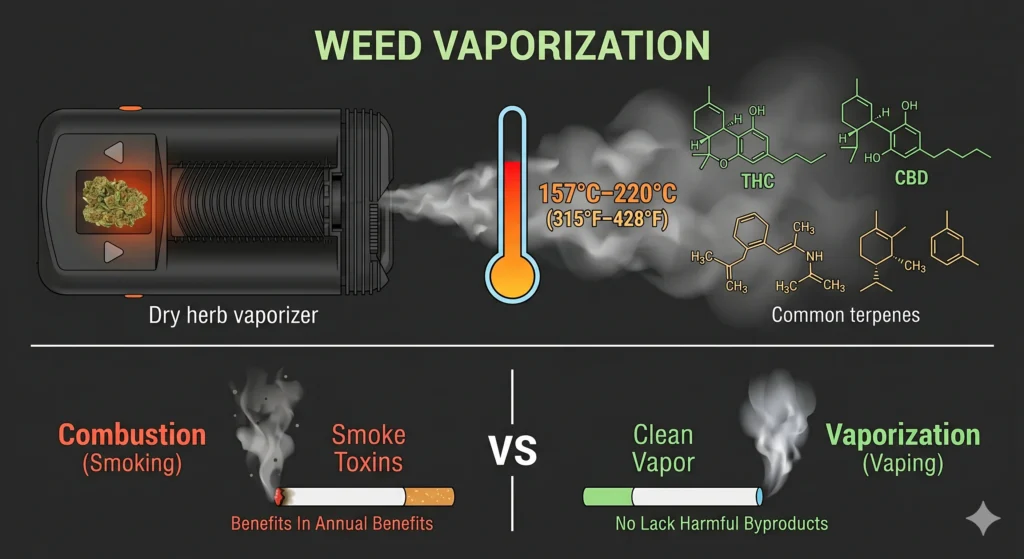
A vaporizer is an electronic device that heats cannabis flower or cannabis extract to a temperature high enough to volatilize cannabinoids and terpenes into an inhalable aerosol, but below the point of full combustion — approximately 230°C (446°F) for plant material. The user inhales vapor rather than smoke.
The distinction matters because combustion and vaporization produce fundamentally different outputs from the same cannabis material:
🔥 Combustion (Smoking)
- Temperature: ~900°C (1,652°F) at the combustion point
- Output: Smoke — a mixture of vapor, tar, carbon monoxide, benzene, and other combustion byproducts
- Cannabinoid delivery: Significant destruction of THC, CBD, and terpenes before inhalation
- Terpene preservation: Minimal — most volatile terpenes are destroyed at combustion temperatures
💨 Vaporization (Vaping)
- Temperature: 157°C–220°C (315°F–428°F) for controlled vaporization
- Output: Vapor — an aerosol of volatilized cannabinoids, terpenes, and carrier compounds
- Cannabinoid delivery: Significantly more efficient — vaporization in the range of 180°C–210°C delivers over 50% of cannabinoids from the flower, while smoking wastes most substances in pyrolysis (Pomahacova et al., Inhalation Toxicology, 2009)
- Terpene preservation: High at lower temperatures — terpenes are volatilized intact rather than combusted
📌 A study by Lanz et al. (2016) showed that the Volcano vaporizer at 210°C releases 95% fewer harmful byproducts than smoke from a joint made with cannabis. The core advantage of weed vaporization is not just flavor or convenience — it is the fundamental difference between controlled volatilization and uncontrolled combustion.
🧪 2. The Boiling Points of Cannabis Compounds: Why Temperature Matters
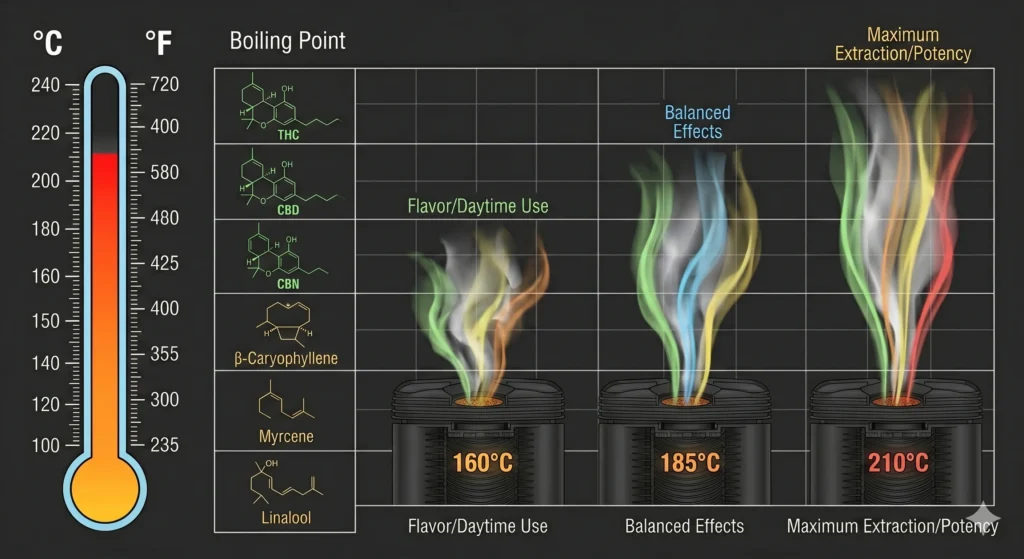
Cannabis contains over 100 identified cannabinoids and more than 200 terpenes. Each compound has its own specific boiling point — the temperature at which it converts from liquid or solid to vapor. This is why temperature control in weed vaporization is not just a preference setting — it determines which compounds you actually inhale.
🌿 2.1 Cannabinoid Boiling Points
| Cannabinoid | Boiling Point | Primary Effect |
|---|---|---|
| THC (Δ9-tetrahydrocannabinol) | 157°C (315°F) | Primary psychoactive compound |
| CBD (cannabidiol) | 160°C–180°C (320°F–356°F) | Non-psychoactive, widely studied |
| CBN (cannabinol) | 185°C (365°F) | Mild sedative properties |
| CBG (cannabigerol) | 220°C (428°F) | Precursor cannabinoid |
| THCV (tetrahydrocannabivarin) | 220°C (428°F) | Appetite suppression, rapid onset |
| CBC (cannabichromene) | 220°C (428°F) | Non-psychoactive minor cannabinoid |
🍋 2.2 Terpene Boiling Points
| Terpene | Boiling Point | Aroma / Associated Effects |
|---|---|---|
| β-Caryophyllene | 130°C (266°F) | Spicy, peppery — anti-inflammatory properties |
| Myrcene | 168°C (334°F) | Earthy, musky — sedative, relaxing |
| Limonene | 176°C (349°F) | Citrus — mood elevation, stress relief |
| α-Pinene | 155°C (311°F) | Pine — alertness, memory retention |
| Linalool | 198°C (388°F) | Floral, lavender — calming, anti-anxiety |
| Terpinolene | 186°C (367°F) | Fresh, floral — uplifting |
📌 Terpenes decompose at a rate directly related to temperature. When terpenes are exposed to high temperature, they decompose at a meaningful rate, resulting in a reduction in the complex natural flavor profile and often a distinct undesirable burned flavor. This is why lower-temperature vaporization sessions preserve significantly more of the aromatic terpene profile than high-temperature sessions — and why the flavor difference between 170°C and 210°C sessions on the same flower can be dramatic.
🌡️ 3. Weed Vaporization Temperature Guide
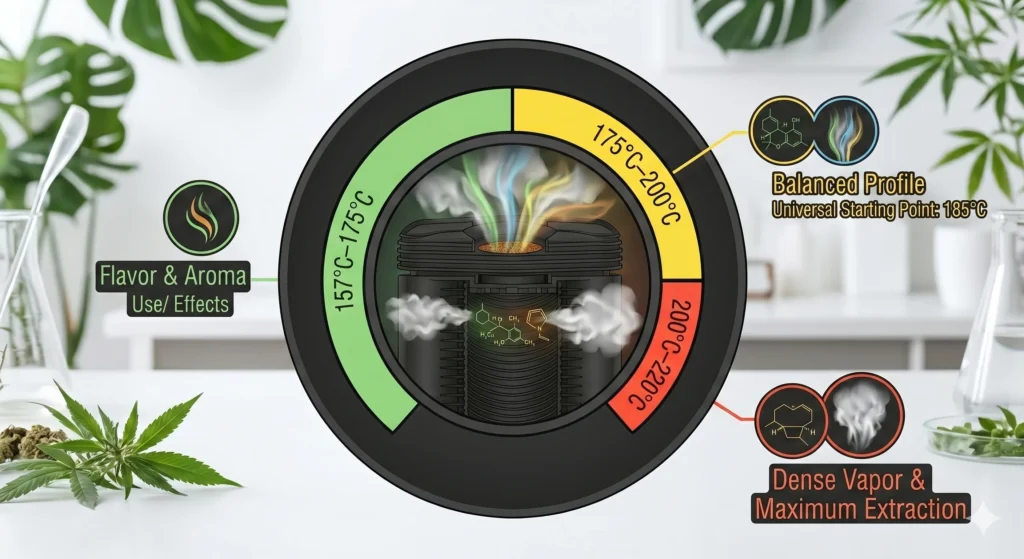
There is no single perfect temperature for a vaporizer, as the optimal experience is a balance between flavor and effective absorption of active ingredients. As a general rule, lower temperatures produce better flavor and smoother vapor, while higher temperatures result in denser vapor and a stronger physical effect.
The practical temperature map for cannabis vaporization:
🟢 Low Temperature: 157°C–175°C (315°F–347°F)
This range is best for those wanting a milder experience with enhanced flavor. THC and terpenes can be released easily at these settings.
- ✅ Maximum terpene preservation — the most flavor-forward sessions
- ✅ Cooler, smoother vapor — least throat irritation
- ✅ THC activates from 157°C — effects present but lighter
- ⚠️ Lower vapor density — draws may feel thin to experienced users
- ⚠️ Higher-boiling cannabinoids (CBN, CBG, THCV) not activated at this range
Best for: First-time vapers, flavor-focused sessions, daytime use where functional clarity is important, high-terpene strains where preserving the aroma profile matters.
🟡 Medium Temperature: 175°C–200°C (347°F–392°F)
Medium temperatures of 185°C–205°C provide a balanced session. Extraction reaches 60%–80% of active ingredients including CBD at 180°C. The vapor is noticeable, the flavor is good, and cannabinoid extraction is most efficient at temperatures between 180°C and 200°C.
- ✅ Best balance of flavor and potency — the everyday sweet spot for most users
- ✅ THC, CBD, CBN, and most terpenes all active in this range
- ✅ Good vapor density — satisfying draws without harshness
- ✅ 185°C considered the universal starting point by most experienced vapers
Best for: Daily use, evening relaxation, medical users seeking broad cannabinoid activation, most users most of the time. The ideal temperature range for the best balance between aroma and potency is typically 185°C–195°C.
🔴 High Temperature: 200°C–220°C (392°F–428°F)
High temperatures produce dense vapor and result in a strong, often physical effect. This range is intended for experienced users who want maximum extraction. At temperatures above 200°C, there is a risk that the vapor becomes harsh and roasted flavors develop.
- ✅ Maximum cannabinoid extraction — CBG, THCV, CBC activated
- ✅ Dense, substantial vapor clouds
- ✅ Strongest physical effects per session
- ⚠️ Terpene degradation increases significantly above 200°C
- ⚠️ Harsher vapor — more throat and lung irritation
- ⚠️ Flavor complexity reduced — more “toasted” than aromatic
Best for: Experienced users seeking maximum extraction, end-of-bowl finishing sessions after starting at lower temperatures, heavy users with high tolerance.
⛔ Above 230°C (446°F) — Combustion Zone
Above 225°C, combustion begins and toxins are generated, including benzene and toluene. Above this threshold, you are no longer vaporizing — you are burning. The output is smoke, not vapor, and the cannabinoids and terpenes are being destroyed in the process rather than preserved.
Complete temperature reference:
| Temperature Range | Vapor Character | Cannabinoid Extraction | Best For |
|---|---|---|---|
| Below 157°C (315°F) | Minimal vapor | None — below THC boiling point | Not recommended |
| 157°C–175°C (315°F–347°F) | Light, aromatic, cool | THC + light terpenes | Flavor focus, light effects |
| 175°C–200°C (347°F–392°F) | Balanced vapor and flavor | THC, CBD, CBN, most terpenes | Everyday use — recommended range |
| 200°C–220°C (392°F–428°F) | Dense, warm, potent | Full cannabinoid profile | Maximum extraction, experienced users |
| Above 230°C (446°F) | Smoke — not vapor | Combustion — compounds destroyed | Not recommended |
🔥 4. Weed Vaporization vs. Smoking: Key Differences
Compared to smoking, vapor contains fewer combustion byproducts — that is the strongest claim you can make. Hardware quality, oil quality, and temperature all matter more than the word “vape” on the box.
Here is the practical comparison:
| Factor | Smoking | Vaporization |
|---|---|---|
| Temperature | ~900°C (combustion) | 157°C–220°C (controlled) |
| Output | Smoke + combustion byproducts | Vapor — cannabinoids and terpenes |
| Cannabinoid efficiency | Low — significant destruction in combustion | High — 50%+ of cannabinoids delivered |
| Terpene preservation | Minimal — destroyed at combustion temps | High at lower temps, moderate at high temps |
| Flavor | Smoke-dominant, harsh | Reflects full terpene profile of the strain |
| Temperature control | None — uncontrolled combustion | Precise — target specific compounds |
| Combustion byproducts | Carbon monoxide, benzene, tar | Significantly reduced at correct temperatures |
⚙️ 5. Types of Weed Vaporizers: Which Format for Which Material
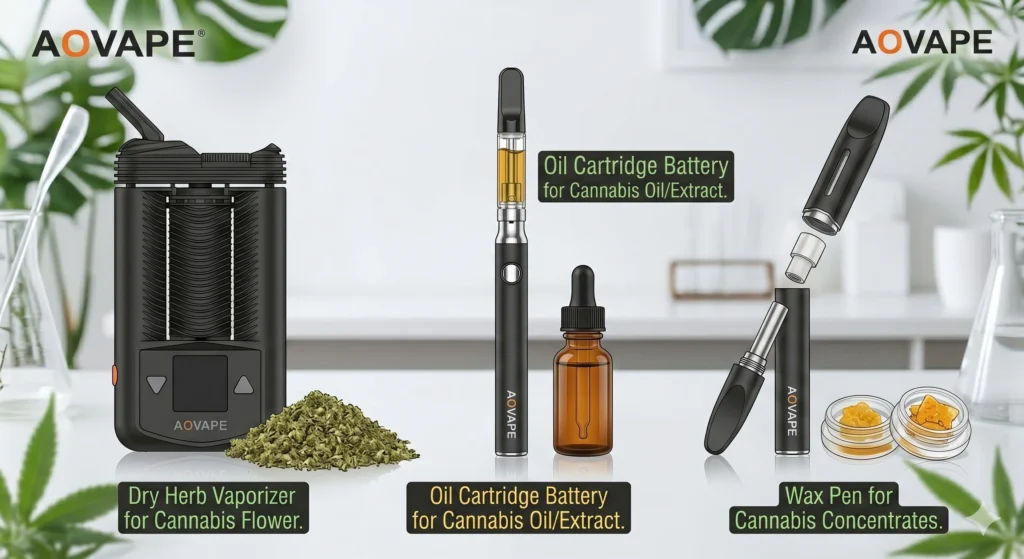
The three main cannabis material formats require different device designs:
🌿 5.1 Dry Herb Vaporizers (For Cannabis Flower)
Dry herb vaporizers heat ground cannabis flower directly in a built-in chamber. They use conduction (direct contact), convection (hot air through the herb), or hybrid heating. Temperature is controlled precisely via digital settings in Celsius or Fahrenheit.
Typical temperature range for flower vaporization: 157°C–227°C (315°F–440°F). Inputs: dry herb flower. Output: vapor — aerosol of cannabinoids, terpenes, and carrier compounds.
AOVAPE’s dry herb vaporizer range includes the Uranus, VGO, NIU Pro, TRIO, and Malpen — covering conduction, convection, and hybrid heating across multiple form factors and price tiers.
🛢️ 5.2 Oil Cartridge Batteries (For Cannabis Oil)
510-thread batteries power pre-filled oil cartridges containing cannabis distillate, live resin, CBD oil, or full-spectrum extract. Temperature is controlled indirectly through voltage output — typically 2.4V–4.2V — rather than direct temperature settings.
For cannabis oil, start with a lower temperature range of 160°C–200°C (320°F–392°F). This allows the oil to vaporize slowly, providing a smooth and flavorful experience that lets you enjoy the unique terpene profiles.
AOVAPE’s full 510 thread battery collection covers every form factor from slim pen-style to variable-voltage precision devices, all with USB-C charging and preheat mode.
🍯 5.3 Wax Pens / Concentrate Devices (For Cannabis Concentrates)
Wax pens use a coil-and-atomizer system to vaporize concentrates — wax, shatter, budder, crumble, live resin, and rosin. Typical operating temperatures are 157°C–232°C (315°F–450°F) depending on concentrate type and user preference.
Lower temperatures, typically around 150°C–230°C (300°F–450°F), preserve terpenes and offer a smoother, more flavorful experience for concentrates.
AOVAPE’s wax pen lineup — including the Cylindra Wax Vaporizer and VertiDip Wax Pen — covers the loaded-coil concentrate format with ceramic heating and variable temperature control.
🔧 6. Heating Methods: Conduction vs. Convection vs. Hybrid
For dry herb vaporization specifically, the heating method is the most significant hardware variable affecting session quality:
| Heating Method | How It Works | Heat-Up Time | Vapor Evenness | Best For |
|---|---|---|---|---|
| Conduction | Herb in direct contact with heated surface | Fast (15–30 sec) | Moderate | Quick sessions, entry to mid-range devices |
| Convection | Hot air flows through herb — no direct contact | Slower (30–60 sec) | High — even extraction | Flavor-focused sessions, full terpene preservation |
| Hybrid | Combines heated chamber + heated airflow | Medium (20–45 sec) | High | Everyday balance — best of both methods |
AOVAPE’s Uranus and VGO use hybrid heating for balanced extraction and terpene preservation. The full dry herb vaporizer range covers all three heating methods across different price points and use cases.
🎯 7. How to Get the Best Results from Weed Vaporization
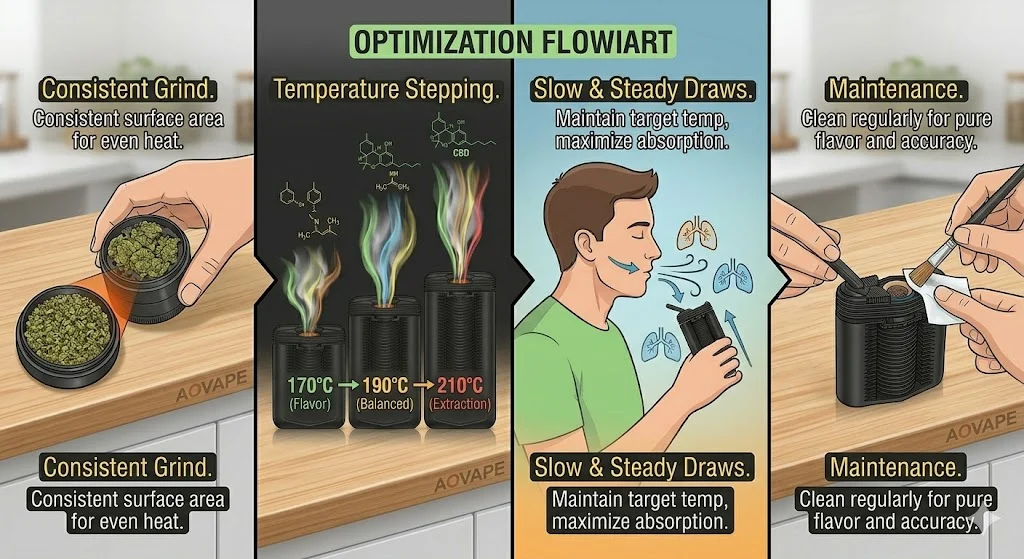
Applying the temperature and compound knowledge above to your actual sessions:
- 🌡️ Start at 185°C and adjust from there. 185°C is considered a universal starting point. Take one draw, assess vapor density and flavor, then adjust up or down by 5°C increments toward your preference.
- 🌿 Grind your herb consistently. For dry herb vaporization, even surface area is critical for consistent heat distribution — especially with conduction devices. A medium-fine grind (not powder) maximizes airflow and extraction efficiency.
- 🔄 Try temperature stepping. Start at 165°C–170°C for the first 2–3 draws to capture the most volatile terpenes and lighter effects. Increase to 185°C–190°C for the middle of the session. Finish at 200°C–210°C for maximum extraction from the remaining material.
- 💨 Draw slowly and steadily. 3–5 second steady inhalations at controlled pace allow the heating element to maintain target temperature throughout the draw. Hard fast draws drop chamber temperature and reduce vapor quality.
- 🔋 Let the device reach target temperature before drawing. Most dry herb vaporizers reach set temperature in 20–60 seconds depending on heating method. Drawing before temperature stabilizes produces cooler, thinner vapor and wastes the first draw.
- 🧹 Clean the chamber after every 3–5 sessions. Residue buildup on chamber walls and screens affects both temperature accuracy and vapor flavor. A dry brush after each session and an IPA clean weekly maintains consistent performance.
❓ FAQ: Vaporization Weed
What is weed vaporization?
Weed vaporization is the process of heating cannabis flower, oil, or concentrate to between 157°C–220°C (315°F–428°F) — converting cannabinoids and terpenes into inhalable vapor without reaching the combustion temperature of approximately 230°C (446°F). The result is vapor rather than smoke, containing the active compounds from the cannabis without the carbon monoxide, benzene, and tar produced by combustion.
What temperature should I vaporize weed at?
The recommended starting point for most users is 185°C (365°F) — the balance point between flavor and potency where THC, CBD, CBN, and most terpenes are all active. For maximum flavor with lighter effects, use 160°C–175°C. For maximum potency and dense vapor, use 200°C–220°C. Never exceed 230°C — above that point, combustion begins.
Is vaporizing weed better than smoking?
From an efficiency standpoint, vaporization delivers significantly more cannabinoids from the same amount of material. Research by Pomahacova et al. (Inhalation Toxicology, 2009) found that vaporization at 180°C–210°C delivers over 50% of cannabinoids from flower, while combustion wastes most substances. Vaporization also eliminates carbon monoxide, benzene, and tar from the output. However, long-term respiratory data on vaporization remains limited and hardware quality significantly affects the output.
What is the difference between conduction and convection vaporization?
Conduction vaporizers heat herb by direct contact with a hot surface — fast heat-up, but less even extraction. Convection vaporizers pass hot air through the herb without direct contact — slower heat-up but more even extraction and better terpene preservation. Hybrid designs combine both approaches for a balance of speed and evenness.
Can I vaporize weed at any temperature?
Below 157°C (315°F), THC does not reach its boiling point and you get minimal to no effect. Between 157°C–220°C is the effective vaporization range. Above 230°C (446°F), combustion begins and you are smoking rather than vaporizing. The usable vaporization window is approximately 73°C wide — and where you sit within that window determines the flavor and effect profile of each session.
Why does vaporized weed taste different from smoked weed?
Vaporized cannabis preserves the terpene profile of the strain at lower temperatures because terpenes are volatilized intact rather than combusted. This means the flavor reflects the actual aromatic compounds in the flower — citrus from limonene, pine from pinene, earth from myrcene. Combustion at 900°C destroys most terpenes before they reach the user, leaving only the harshness of smoke. The flavor difference between low-temperature vaporization and smoking the same material is often described as the difference between tasting the actual strain versus tasting “weed smoke.”
What type of vaporizer is best for weed?
For dry herb flower: a hybrid or convection dry herb vaporizer with precise digital temperature control delivers the best combination of terpene preservation and cannabinoid extraction. AOVAPE’s dry herb vaporizer range covers both formats. For cannabis oil cartridges: a variable voltage 510 thread battery allows you to match voltage to oil type. For concentrates: a wax pen with ceramic heating and variable temperature. Browse the full AOVAPE vaporizer collection for options across all three formats.
📌 Final Thoughts
Understanding weed vaporization means understanding the chemistry behind it. Cannabis contains hundreds of compounds — each with its own boiling point, each contributing differently to the flavor and effect profile of a session. Temperature is the variable that determines which of those compounds you activate and which you preserve or destroy. The 185°C–195°C range is the most reliable starting point for most users because it activates the broadest cannabinoid and terpene profile without crossing into the harshness zone above 200°C.
The hardware you use determines how accurately you can target and hold those temperatures. AOVAPE’s complete lineup covers every vaporization format: dry herb vaporizers with precise temperature control for flower, 510 thread batteries with variable voltage for oil cartridges, and wax pens with ceramic heating for concentrates.
👉 Browse AOVAPE’s full vaporizer collection →
👉 View AOVAPE’s dry herb vaporizer range →
📚 References
- Pomahacova et al. (2009): vaporization at 180°C–210°C delivers over 50% of cannabinoids from cannabis flower; combustion wastes most substances in pyrolysis. Inhalation Toxicology, 2009.
- Lanz et al. (2016): Volcano vaporizer at 210°C releases 95% fewer harmful byproducts than smoke from a cannabis joint. Published cannabis vaporization research.
- THC boiling point: 157°C (315°F); CBD: 160°C–180°C; CBN: 185°C; CBG and THCV: 220°C (herb.co vaporizer temperature guide, March 2026; norddampf.com vaporizer temperature guide, April 2026)
- Key terpene boiling points: β-caryophyllene 130°C, α-pinene 155°C, myrcene 168°C, limonene 176°C, terpinolene 186°C, linalool 198°C (Steep Hill Labs terpene data; ubucha.pl vaporization temperature guide, May 2026)
- Combustion temperature of cannabis at joint tip: approximately 900°C (1,652°F) — standard reference across cannabis chemistry literature
- Combustion threshold for cannabis plant material: approximately 230°C (446°F) — above this point benzene and toluene generation confirmed (weedpedia.org vaporizer reference, April 2026)
- Recommended starting temperature: 185°C considered universal starting point for dry herb vaporization by experienced users and hardware manufacturers (ubucha.pl, May 2026; norddampf.com, April 2026)
- Terpene decomposition: rate directly related to temperature; high-temperature exposure reduces flavor complexity and produces burned flavor (US Patent 10940275 — Cannabis vaporization temperature control)