A common point of confusion shows up whenever someone shops for the smallest complete dab rig they can find: they assume a shorter tube is just a scaled-down version of a full-size rig, with the same performance in a smaller shell. Then the piece arrives, and problems that never came up in bigger glass start appearing. A banger that felt normal on a standard joint suddenly makes the whole rig lean. A percolator that looked identical to a full-size version clears differently and tastes harsher. A neck that seemed fine in photos turns out to be nearly impossible to swab out with a cotton pad. None of this is random. Every one of those outcomes traces back to a specific measurement — chamber volume, joint diameter, base width, or neck taper — that changes disproportionately when a rig is shrunk. Small format glass isn’t just “less rig.” It’s a different set of engineering trade-offs, and understanding them turns a confusing purchase into a predictable one.
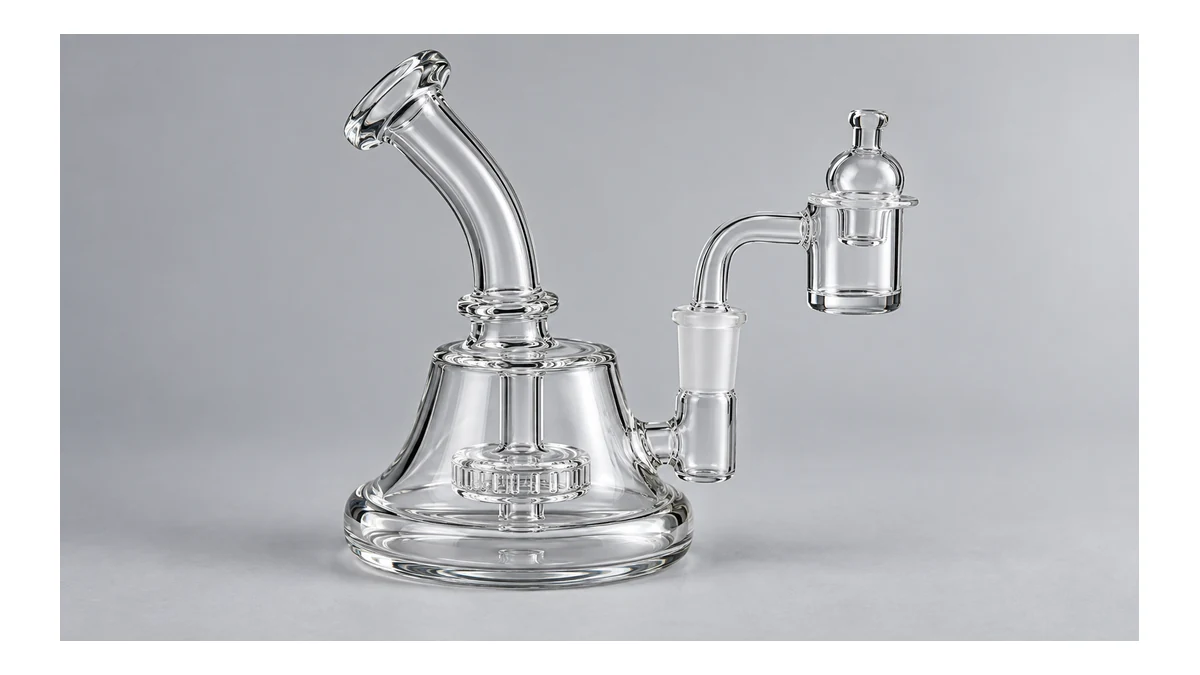
🧭 1. 🌊 Chamber Volume and Percolation Trade-Offs
Chamber volume is the single biggest variable that changes when a rig gets smaller, and it doesn’t scale the way people expect. Cutting a tube’s height and diameter by a third doesn’t reduce internal air volume by a third — because volume is a cubic function of linear dimensions, a modest reduction in size can cut the smoke chamber’s capacity by half or more. That smaller air pocket has direct consequences: less room for vapor to expand and cool before inhalation, less separation between the percolator and the mouthpiece, and less margin for error if a hit is pulled too fast.
🔍 1.1. 💨 Diffusion Loss in Small Chambers
Percolators work by forcing air and vapor through slits, holes, or trees to break the stream into smaller bubbles, which increases surface contact and cools the vapor. In a full-size tube, there’s enough vertical space to stack multiple diffusion points without cramping airflow. In a compact rig, manufacturers often have to choose between a single percolator placed close to the joint or no percolation at all beyond a simple downstem. Either way, the vapor has less distance and less structure to diffuse through, which is why two rigs with visually similar percs can pull noticeably differently once shrunk to mini scale.
🧩 1.2. 🌀 Airflow Path Length
Shorter airflow paths also change draw resistance. A long neck creates more surface area for vapor to lose heat and slow down before reaching the mouth, while a short, wide-open chamber can feel airy but deliver a hotter, faster hit. Neither is inherently wrong, but it explains why people moving from a standard tube to a mini one often describe the pull as “different” even when nothing about the concentrate or heat source changed. The geometry itself is doing the work.
🔍 2. ⚖️ Center of Gravity and Base Geometry
Stability in dab rigs is a function of where the mass sits relative to the base, and small rigs are especially vulnerable to getting this wrong. A full-size rig has enough base diameter and glass thickness low in the piece to counteract the weight of a banger and dome sitting up top. When the whole rig shrinks, the base often shrinks with it, even though the joint hardware — the banger, especially — stays roughly the same size as what’s used on larger pieces.
🧩 2.1. 🧱 Base Diameter vs Tube Height
The ratio between base diameter and total height is the clearest predictor of tip-over risk. A rig that’s tall relative to its base width is carrying its center of gravity higher up, closer to the joint where the heaviest single component — the banger — attaches. Manufacturers who understand this widen the foot of compact rigs disproportionately compared to standard-size pieces, specifically to compensate for the added top-heaviness that comes from full-size joint hardware on a shrunk frame.
🌬️ 2.2. 📐 Joint Angle and Torque
Joint angle changes the direction that weight gets applied. A 90-degree joint pushes banger weight almost straight down into the base, which is mechanically forgiving. A 45-degree or lower angle redirects some of that weight outward, creating a torque arm that a narrow base has to resist. On a full-size rig, that torque is usually small relative to the glass’s overall stability. On a mini rig with a short base radius, the same angled joint can meaningfully increase the chance of tipping, particularly with anything heavier attached.

🧩 3. 🔩 Joint Load and Attachment Stress
Joint load refers to the physical stress placed on the ground-glass connection by whatever is attached to it. This matters more on small rigs because the hardware attached — bangers, carb caps, adapters — is rarely scaled down to match the rig itself. A joint is a fixed connection, and unequal weight distribution across it puts more stress on the glass-to-glass seal and the joint’s structural integrity.
🌬️ 3.1. 🌡️ Banger Weight on Small Joints
Quartz and titanium bangers vary in wall thickness and overall mass, but they’re generally sized for a “standard” range of rigs rather than scaled specifically for mini formats. When a standard-weight banger sits on a mini rig’s joint, that joint is absorbing a proportionally larger share of the rig’s total weight than it would on a bigger piece. Over repeated use, that uneven load can accelerate wear at the joint interface and increase the odds of a chip if the rig is bumped or set down at an angle.
⚙️ 3.2. 🔧 14mm vs 10mm Joint Considerations
Joint diameter is a separate variable from joint load, but the two interact. A 10mm joint has less surface area of ground glass in contact, which means less friction holding the banger in place and a smaller margin before a slight bump becomes a slip. A 14mm joint offers more contact area and generally more forgiving stability, at the cost of being a slightly bulkier fitting on an already compact rig. Neither size is universally better; the right choice depends on how the rest of the rig’s geometry compensates.
| Joint Size | Contact Surface | Stability Tendency | Typical Trade-off |
|---|---|---|---|
| 10mm | Smaller | Less forgiving of bumps | More compact footprint, tighter cleaning access |
| 14mm | Larger | More forgiving of bumps | Slightly bulkier fitting relative to rig size |
🌬️ 4. 🧽 Reclaim Paths and Cleaning Access
Reclaim is the residue that collects inside a rig as vapor cools and condenses on glass surfaces. Where that residue pools, and how easily it can be removed, depends entirely on internal geometry — and small rigs tend to compress that geometry into tighter, less accessible spaces.
⚙️ 4.1. 🕳️ Reclaim Catchers in Compact Builds
Full-size rigs often include a dedicated reclaim catcher: a bulb or pocket positioned to collect condensed residue before it reaches the mouthpiece. In compact rigs, there’s frequently not enough vertical room to fit a catcher without also shrinking the percolator or the joint placement, so many mini rigs skip it entirely. Without a catcher, reclaim tends to settle directly in the neck or around the percolator, which is a harder area to clean.
🧼 4.2. 🧴 Narrow-Neck Cleaning Limits
Cleaning access is a direct function of neck diameter. A wide neck lets a brush, pipe cleaner, or cotton swab reach the percolator and joint area directly. A narrow neck — common on mini rigs designed to look sleek — can make those same tools too wide to fit, forcing reliance on soaking and swirling methods that take longer and reach less thoroughly. This is one of the least visible trade-offs at purchase time, since neck width rarely gets mentioned in product descriptions, but it has an outsized effect on how easy the rig is to maintain over time.

⚙️ 5. 🎒 Travel and Handling Trade-offs
The appeal of a small rig is almost always portability, but portability introduces its own set of hardware compromises that are worth weighing against the size benefit.
🧼 5.1. 🧳 Portability vs Durability
Thinner glass and a smaller footprint make a rig easier to pack, but thickness is also what gives glass its resistance to chips and thermal stress. A mini rig built with the same wall thickness as a full-size piece will be heavier and less pocket-friendly than one built thinner — but the thinner version is also more fragile in transit, particularly around the joint and base where impact stress concentrates. There’s no version of a small rig that maximizes both durability and portability at once; every design is a specific point on that spectrum.
📏 5.2. 🪨 Material Thickness Choices
Borosilicate glass thickness is usually measured in millimeters, and even a one- or two-millimeter difference changes how a rig handles knocks. Rigs marketed specifically for travel often use slightly thicker glass at stress points — the base and joint — while keeping the tube itself thin, which is a deliberate compromise rather than a manufacturing shortcut. Recognizing where that reinforcement is placed, rather than judging thickness by feel alone, is a more reliable way to gauge how well a compact rig will hold up outside a controlled home setup.
🧼 6. 🔍 Reading the Hardware Before You Judge the Size
Size alone doesn’t predict how a small dab rig will perform or how much day-to-day maintenance it will demand. Two rigs with nearly identical height can behave completely differently depending on base width, joint angle, percolator placement, and neck diameter. The practical approach is to treat size as one variable among several, not the deciding factor.
- Check base diameter relative to overall height — a wider foot lowers tip-over risk regardless of how tall the tube is.
- Note the joint angle — a 90-degree joint distributes banger weight more directly downward than an angled one.
- Look for a reclaim catcher or pocket below the percolator, since its absence means residue collects closer to the airflow path.
- Measure or estimate neck width against standard cleaning tools before assuming maintenance will be simple.
- Match joint size (10mm or 14mm) to the hardware already on hand, since mismatched banger weight is a leading cause of joint stress on compact pieces.
None of these details show up clearly in a thumbnail photo or a size listing, which is exactly why they cause so much confusion after purchase. A small rig with a wide base, a direct joint angle, a shallow but present reclaim path, and a neck wide enough for a standard cleaning brush will hold up in daily use far better than one chosen on tube height alone. Reading the hardware first, and treating the overall size as secondary, is the more reliable way to identify a compact rig that actually performs the way a buyer expects.
📏 7. ⚖️ Compact Glass Moves the Balance Point
Small rigs shorten the distance between the joint, chamber, and base. That can make the air path direct, but it also puts more of the assembly’s mass near one side when a long banger, reclaim catcher, or heavy cap is installed. A rig that feels stable when empty may become easy to tip once those parts are attached.
Check stability with the piece cold. Set the complete assembly on a level surface and gently rotate the accessory through the positions it will occupy. The base should stay planted without depending on the water’s weight. A wide footprint, low joint, and short accessory stack usually matter more than the rig’s advertised height.
🧪 7.1. 🧽 Cleaning Access Is Part of Portability
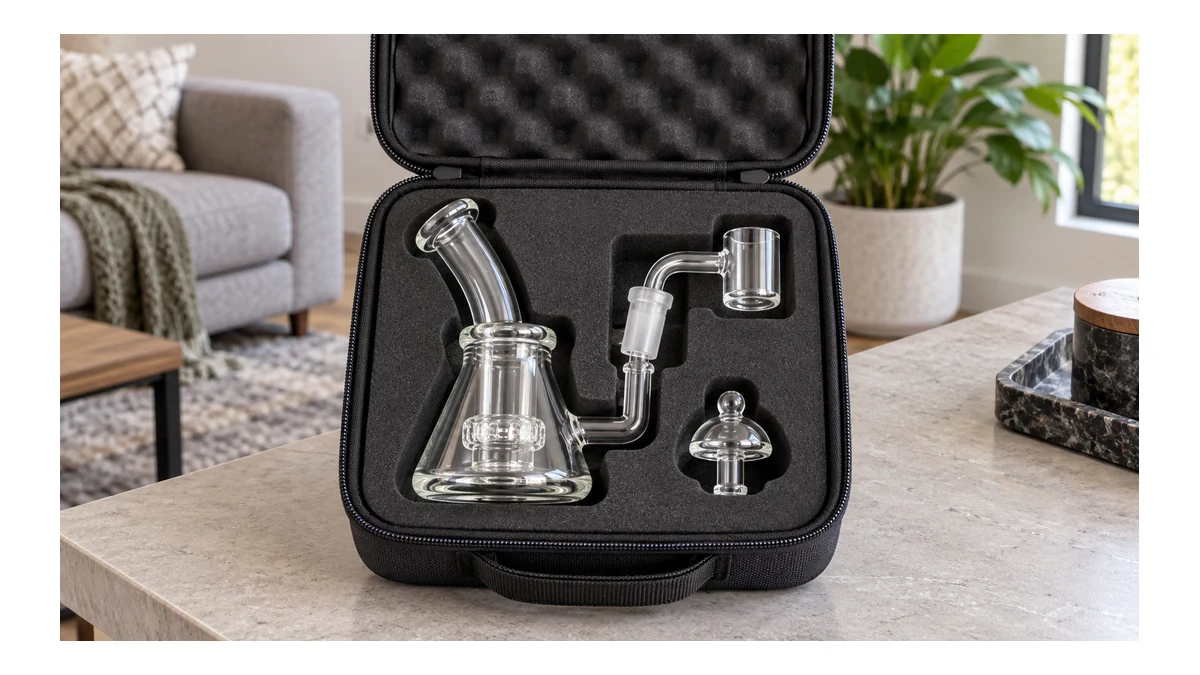
A tiny chamber can be convenient to carry yet awkward to rinse if the neck traps liquid or the joint admits no brush. Before calling a design portable, trace how water, residue, and a cleaning solution can enter and leave. A protective case also needs separate spaces for the cold glass body and the rigid heat parts.