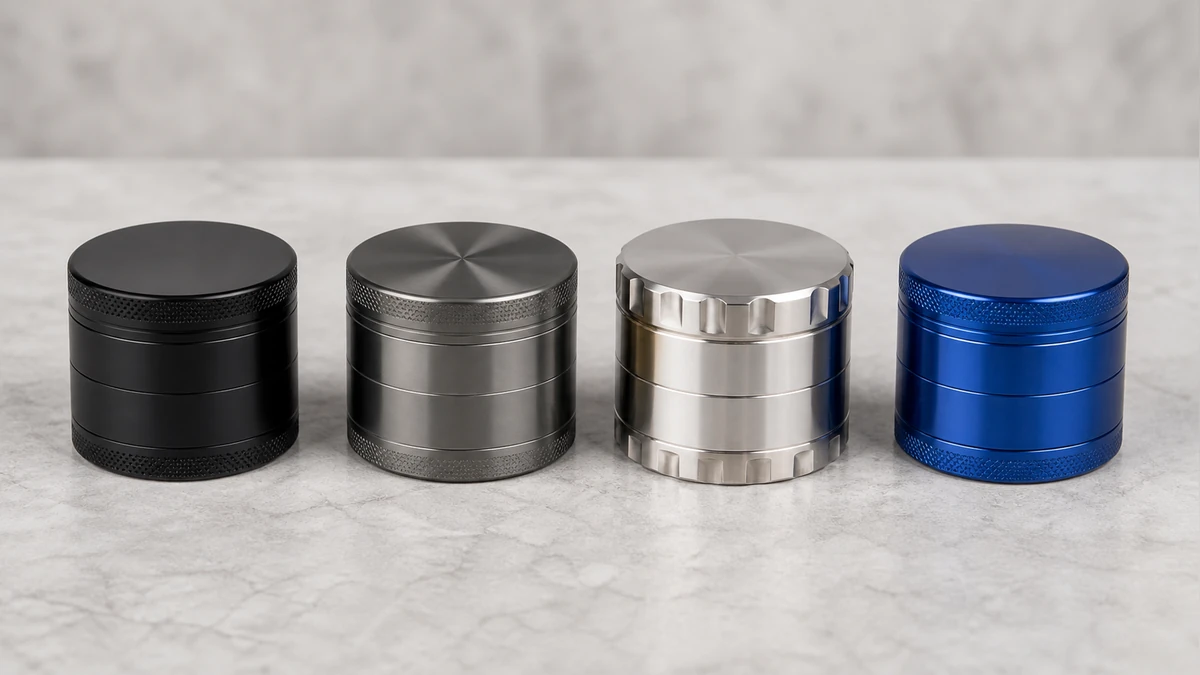
Two herb grinders sit on a sourcing manager’s desk in Shenzhen, both four-piece, both stainless steel, both weighing almost exactly the same in the hand. From three feet away they could be the same product. Up close, the differences start to show: one has a burr-free edge where the lid meets the body, the other has a faint ridge that catches a fingernail. One turns with a smooth, contained resistance; the other has a slight wobble, like the threads were cut a hair off-center. Neither flaw would show up in a spec sheet, and neither would matter for a single unit sold retail. For a wholesale order of several thousand pieces, that ridge is the difference between a reorder and a return pallet.
This is the real work of sampling herb grinders for private label: judging the parts a spec sheet doesn’t capture. Material grade matters, but so does how that material was finished. Tooth geometry matters, but so does whether the cut stays consistent unit to unit. This piece walks through what a buyer, distributor, or brand owner should actually look for when comparing samples, and how to run that comparison so the winner is obvious for reasons that will hold up at scale.
🔍 1. ️⃣ Why Two Similar Samples Age Differently
A grinder’s first thirty seconds in hand tell you almost nothing about its first thirty days of daily use. The metal that feels solid on day one is the same metal that will show wear patterns, coating loss, or thread fatigue by day thirty, and those patterns depend entirely on choices made before the unit ever reached the sample box: what alloy was used, how it was machined, whether the finish was applied evenly, and whether the tolerances were tight enough to survive repeated twisting.
Buyers who only weigh a sample in one hand and call it “heavy duty” are skipping the part of the evaluation that actually predicts field performance. Weight tells you about density and wall thickness. It tells you nothing about burrs, coating adhesion, or how the closure will feel after a hundred open-close cycles. The rest of this guide is about the things that don’t show up when you’re just holding a grinder — the things that separate a sample that photographs well from one that survives a full production run without a spike in complaints.
🧩 2. ️⃣ Material: Stainless Steel Versus Aluminum, and Why Finish Matters More Than the Headline Metal
The material debate usually gets framed as stainless steel versus aluminum, as if picking the metal settles the question. It doesn’t. Both metals can be finished well or finished poorly, and a well-finished aluminum sample will outperform a poorly finished stainless one in daily use, even though “stainless steel” sounds like the safer claim on a spec sheet.
🧩 2.1 ️⃣.1️⃣ What to Check on Stainless Steel Samples
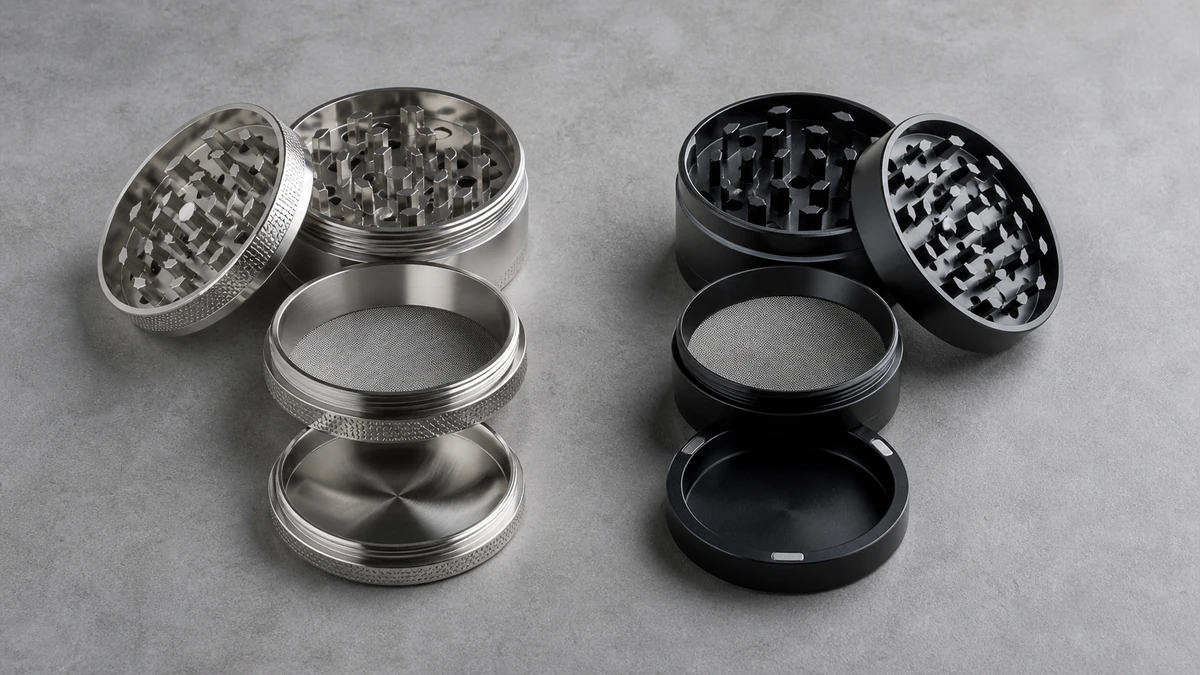
Stainless steel is prized for resisting corrosion and holding up to repeated handling without visibly degrading. But grade alone doesn’t guarantee a clean result — machining quality does. Run a fingertip along every seam: the rim of the lid, the edge of the chamber, the base of the threads. Any place metal was cut or stamped is a place a burr can hide. A well-machined sample feels uniformly smooth; a rushed one has a spot that catches, even faintly. That spot will catch worse after a few hundred uses, and on a bulk order it will show up as a support ticket, not a single scratch.
Also check the surface for consistency under raking light — tilt the sample toward a window and look across the surface rather than straight at it. Polishing marks, tool chatter lines, or uneven brushing patterns are easier to spot at an angle, and they’re a reliable sign of how carefully the finishing pass was done.
🧩 2.2 ️⃣.2️⃣ What to Check on Aluminum Samples
Aluminum grinders are usually lighter and often anodized for color and surface hardness. The question to ask isn’t whether the sample is anodized, but how evenly. Look at high-contact areas — the outer rim, the finger grip, anywhere threads engage — for any thinning or unevenness in the color. A logo area under heavy laser engraving can also stress a thin anodized layer differently than the surrounding surface, so it’s worth examining exactly where your logo will sit, not just the body generally.
Coating wear is the aluminum equivalent of the burr problem on steel: it won’t show on a fresh sample, but it will show after repeated handling, and by the time it shows on a customer’s unit, the batch is already sold. If a supplier can’t explain how the coating is applied and what happens at contact points over time, treat that as a gap worth pressing on before committing to volume.
🌊 3. ️⃣ Teeth and Cut Consistency
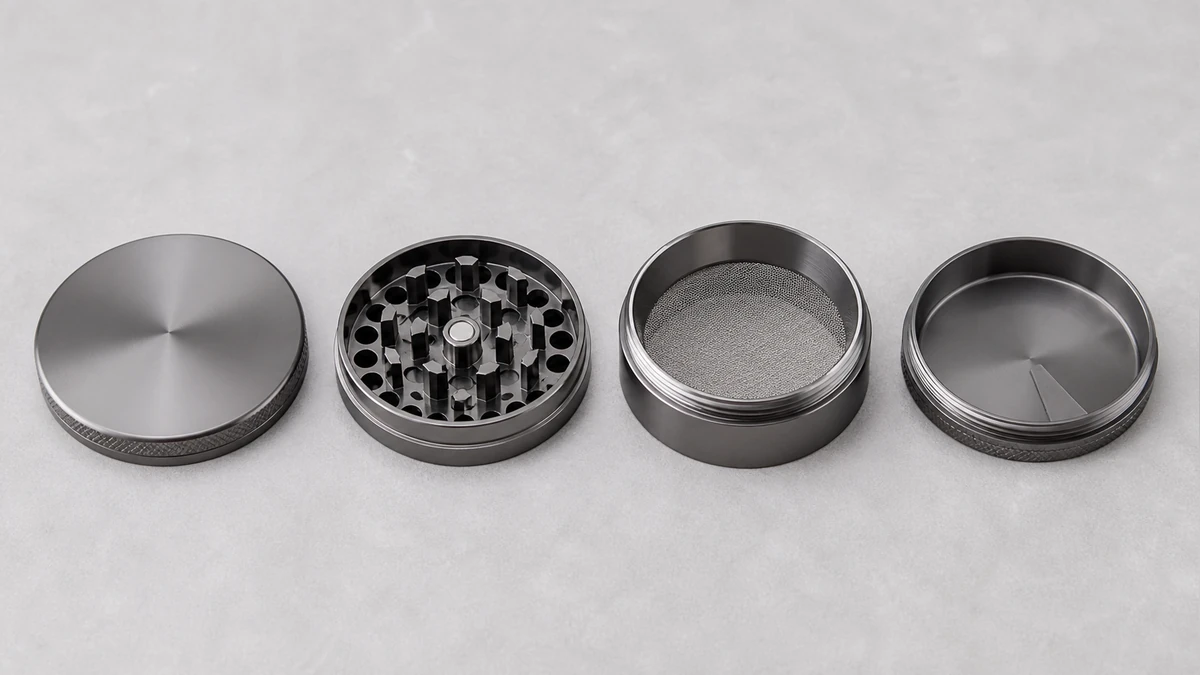
The teeth are the part of a grinder that does the actual job, and they’re also the easiest part to judge on a sample that’s already had a few hundred cycles run through it by a supplier’s QC team — which is exactly why buyers should ask for samples that haven’t been pre-conditioned. Compare tooth alignment across the same chamber: teeth should be evenly spaced, uniformly sharp, and consistent in depth. Uneven teeth don’t just produce an inconsistent cut on that one unit — they’re usually a sign of inconsistent tooling across the whole production run, meaning the unit in your hand may not represent what ships in bulk.
A fair test is a side-by-side pass with the same material through both samples, then a look at the result rather than a stopwatch. Consistency matters more than speed: a grinder that produces a uniform result run after run is a better wholesale bet than one that’s marginally faster but variable. If you’re weighing manual grinders against electric options for a private-label line, the tradeoffs in consistency, batch size, and buyer expectations are covered in more detail in AOVAPE’s guide to electric herb grinders, which is worth reading before finalizing a product mix.
🧼 4. ️⃣ Closure: Threaded, Threadless, and Magnetic Systems
Every grinder closure eventually shows its weak point, and the failure mode depends on the mechanism. Standard threaded closures are the most common because they’re cheap to produce and familiar to end users, but threads can cross-thread if the tolerances are loose, and repeated grit exposure — fine particles working into the threads over time — can make a closure feel gritty or start to bind. That’s a maintenance issue, not necessarily a design flaw, but it’s one a buyer should ask about directly: how tight are the thread tolerances, and what’s the supplier’s experience with cross-threading complaints at volume?
Threadless and magnetic closures are often marketed as solving the threading problem outright, and it’s true they remove cross-threading as a failure mode. But they introduce their own maintenance profile. Magnetic closures depend on consistent magnet strength and precise alignment between the two halves; if that alignment drifts even slightly during production, the lid can feel loose or misaligned even though nothing is technically broken. Threadless friction-fit closures depend on tight, consistent tolerances between the mating surfaces, and any variation in machining will show up as either a closure that’s too loose or one that’s stiff enough to be annoying. Neither system eliminates maintenance considerations — they just trade one set of tradeoffs for another, and a buyer should test the closure open and shut a couple dozen times on the sample, not just once, to see how it holds up.
🔄 5. ️⃣ Screen and Chamber: Where Leftovers Reveal Quality
The middle chamber and screen are where a lot of quiet quality problems live. After grinding, check what’s left behind: a well-machined chamber and a properly sized screen leave minimal residue clinging to the walls or clogging the mesh. A chamber with rough interior machining or a screen with inconsistent hole sizing will trap more material and be harder to clean out completely, which becomes a repeated annoyance for the end user rather than a one-time flaw.
It’s also worth checking the screen itself for any sharp edges around its perimeter or uneven mesh tension — a screen that’s not seated evenly can bow, catch material unevenly, or wear a groove into the surrounding metal over time. None of this needs to be exhaustively tested by the buyer; it just needs to be looked at directly on the physical sample, since these are exactly the kind of details that don’t come through in a photo or a spec sheet.
✅ 6. ️⃣ Cleaning and Maintenance
How a grinder cleans is as much a product decision as how it cuts. Disassemble the sample fully — every piece that’s designed to come apart — and check whether it comes apart cleanly, without excessive force, and whether the internal surfaces are accessible enough to actually clean. A grinder that requires prying at a stuck chamber or fighting a stiff screen isn’t a good candidate for a product line aimed at repeat use, regardless of how good the cut quality is.
This is also where the earlier finish and coating questions circle back. A burr on a steel edge or thin spot in an aluminum coating will wear faster in a piece that’s handled frequently during cleaning, since disassembly and reassembly add extra contact and friction beyond normal grinding use. A sample that looks fine after grinding but shows new scuffing after a few cleaning cycles is telling you something about how it will hold up over a longer ownership period, not just about cleaning specifically.
🧭 7. ️⃣ Logo Application and OEM/ODM Considerations
For brand owners and private-label buyers, the logo isn’t a cosmetic afterthought — it’s applied directly onto the surfaces already under discussion, and it interacts with all of the material and finish questions above. Laser engraving on stainless steel typically sits cleanly on a well-finished surface, but a poorly finished or burr-heavy surface can make engraving look inconsistent even when the artwork file itself is clean. On anodized aluminum, engraving depth needs to be matched to coating thickness, since going too deep can expose the base metal beneath the anodized layer and leave a visible ring around the logo.
These are exactly the kind of production variables that separate a supplier offering true OEM/ODM development from one simply printing a logo onto an existing catalog item. If you’re evaluating private-label options and want to understand what a genuine custom development process should look like — from material selection through logo placement — AOVAPE’s custom development overview lays out what to expect at each stage. And because logo application quality is closely tied to who actually controls production versus who is reselling someone else’s catalog, it’s worth understanding the practical differences covered in AOVAPE’s comparison of distributors and manufacturers before committing to a supplier relationship built around a custom mark.
📚 8. ️⃣ Running a Disciplined Sample Comparison
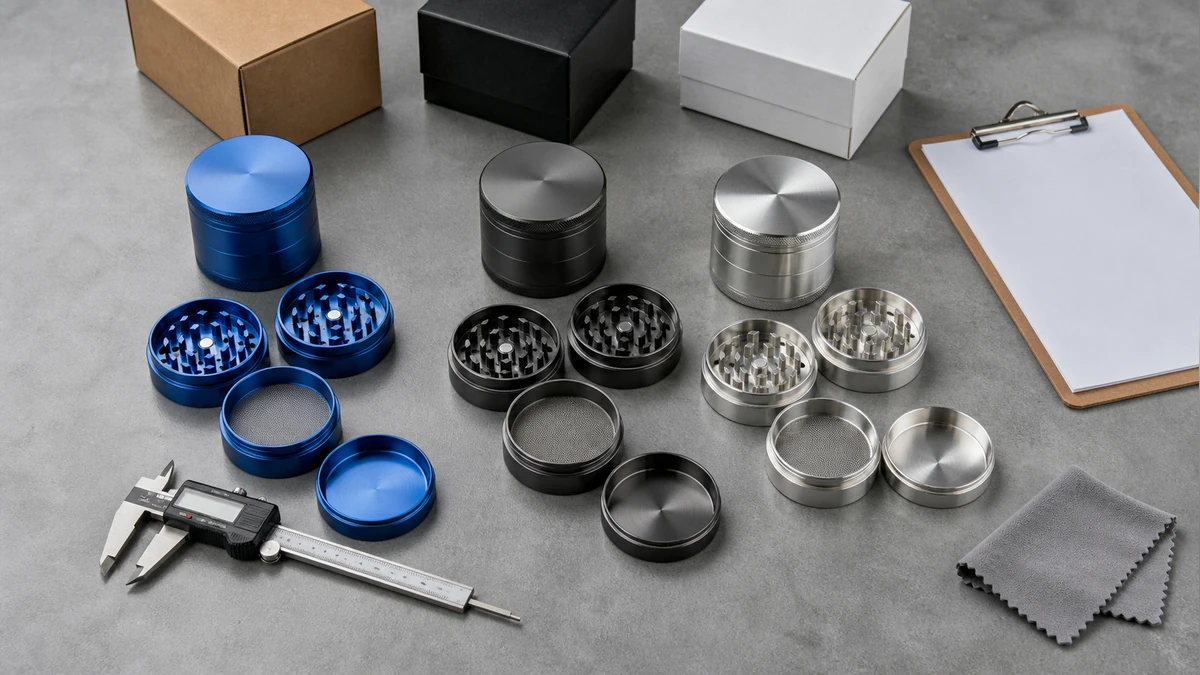
Once you’ve pulled two or three finalist samples, the goal is to compare them on equal footing rather than by feel alone. A simple checklist, worked through side by side, keeps the comparison honest:
- Run a fingertip and raking light across every seam and edge on each sample, looking for burrs or uneven finishing.
- Grind the same material through each sample and compare the resulting texture rather than just the speed.
- Open and close each closure two dozen times and note any change in feel, alignment, or resistance.
- Fully disassemble each sample and check what residue is left in the chamber and screen.
- Clean each sample and inspect for scuffing, coating change, or new wear at contact points.
- Compare logo placement mockups against the actual finish quality at the exact spot the logo will sit.
None of these checks require lab equipment. They require handling the samples the way an end user actually will — repeatedly, with some force, and with attention paid to what changes rather than just what impresses on first contact. A sample that holds up through this process is a much safer bet at production volume than one chosen because it felt heavier or looked shinier under a showroom light.
⚙️ 9. ️⃣ Conclusion
Wholesale herb grinder sourcing rewards buyers who slow down at exactly the point where two samples start to look identical. Material grade sets the baseline, but finish quality, tooth consistency, closure behavior, chamber cleanliness, and logo integration are what actually separate a reliable production run from one that generates returns and reorders for the wrong reasons. A disciplined side-by-side comparison, run on real samples handled the way customers will handle them, is the most reliable filter available before committing to volume — more reliable than weight, price, or a supplier’s own marketing copy.
📚 10. Sources
This article reflects general manufacturing and materials-handling knowledge about metal finishing, anodizing, and mechanical closures, along with standard B2B sampling practice. No specific external studies, certifications, or test data were cited, and none should be inferred; buyers should verify exact specifications, tolerances, and coating processes directly with a supplier before placing a production order.