A banger holder gives loose attachments their own supported places on a desk. The useful choice is between a stand for one piece and a rack with enough space for several complete shapes—not simply a rack with the largest number of holes. Match the support to the joint, leave room for the sideways bucket and check whether the maker permits anything beyond storage of fully cool parts.
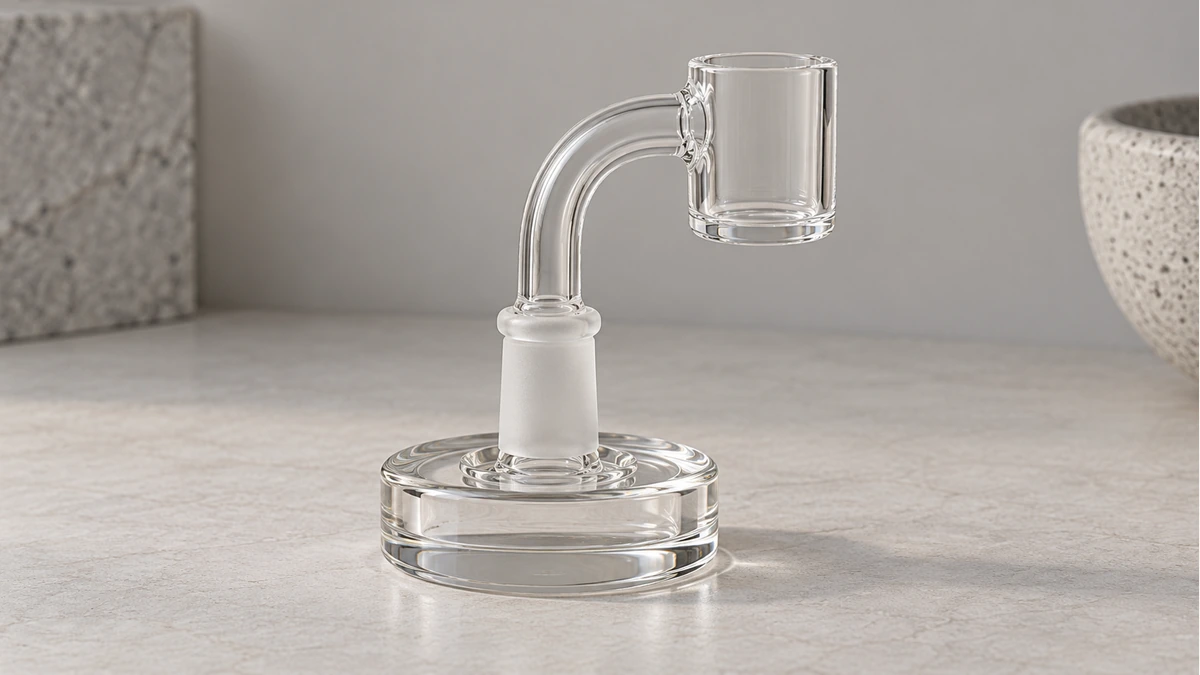
If your spare banger rolls against a cap every time you open a drawer, the problem is easy to recognize. A holder can separate those pieces on a shelf. It cannot keep an overcrowded shelf out of reach of a passing sleeve, and an open stand does not replace a closed transport case. Start with the pieces you actually want within reach and the surface where they will live.
🧩 1. Is It a Banger Holder, Cap Stand or Tool Cup?
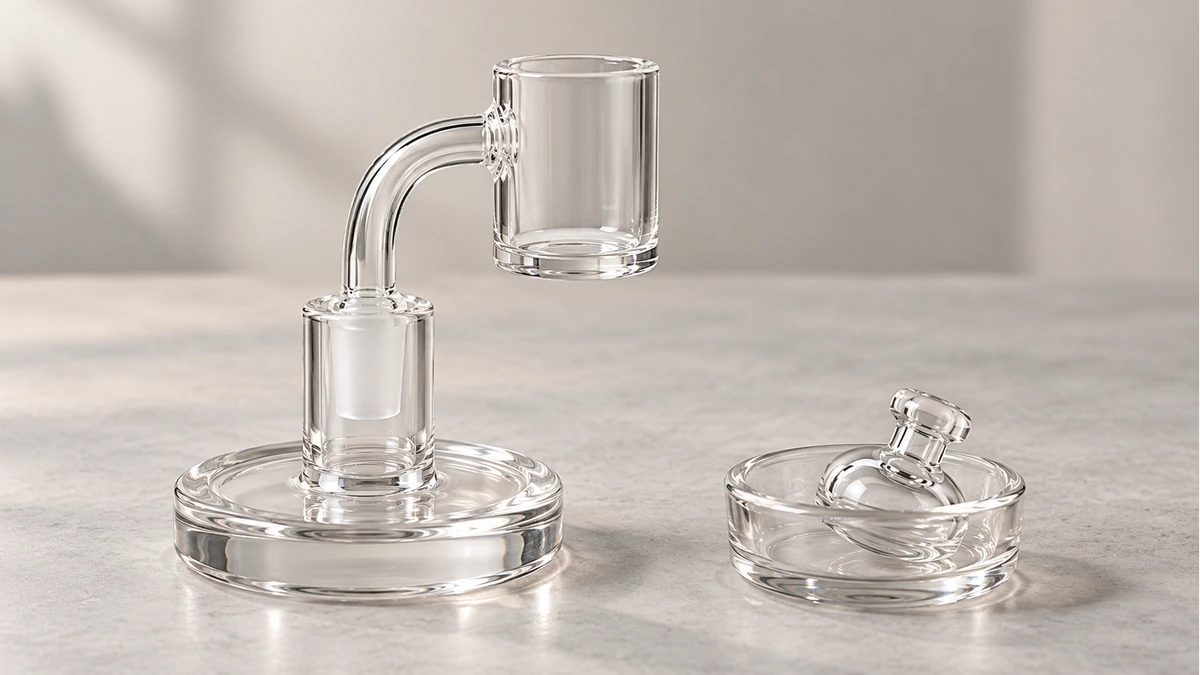
These accessories can look remarkably similar in small photos. A socket that supports a banger’s tapered joint is different from a shallow rest for a carb cap. A cup that holds long dab tools has another job again. The object needs to support the particular part you intend to store, at a place on that part designed to take support.
A Reddit identification discussion illustrates the confusion: the owner thought an included accessory might be a cap, while replies offered several different names. The disagreement does not identify every similar-looking object. Look for the maker’s picture of the intended arrangement and description of the support opening before putting a banger into an unfamiliar accessory.
The dab tool holder guide covers long tools separately. Keeping those categories distinct can also simplify the desk. A scoop resting in its own holder need not share a socket with a glass joint, and a small cap can sit in an appropriate separate dish instead of being balanced on the bucket just to save space.
📏 2. Match the Joint, Then Check the Shape Above It
The bucket’s width and the mating joint’s size describe different parts of the banger. A wide bucket may still have a small joint. Record the connection from the original part information rather than using the outside of the cup as the stand measurement. A stand with a receiving socket also needs the appropriate mating shape; a familiar size number alone does not describe that relationship.
For a concrete example, Roots Glass lists separate stand variants for 10mm, 14mm and 18mm joints. That is a description of its own product options, not evidence that every storage rack accepts the same pieces. Use a listing’s complete fit description, including what actually rests in the opening.
🧩 2.1 Several Hole Sizes Do Not Guarantee Every Position Works
A mixed collection may need different sockets or approved inserts supplied for that holder. Do not pack an oversized hole with whatever happens to be at hand or force a joint into a tight one. The result should not rely on wedging glass hard against an opening. If the maker cannot say which slot supports your connection, leave that position unused until the fit is clear.
Picture two spares with matching joints but different neck lengths. Even if both seat as intended, one bucket may reach over the neighboring slot. Matching the support opening is only the first part of the layout. The shape above it decides whether you can use the adjacent position.
↔️ 3. Count the Spaces Between Buckets, Not Just the Holes
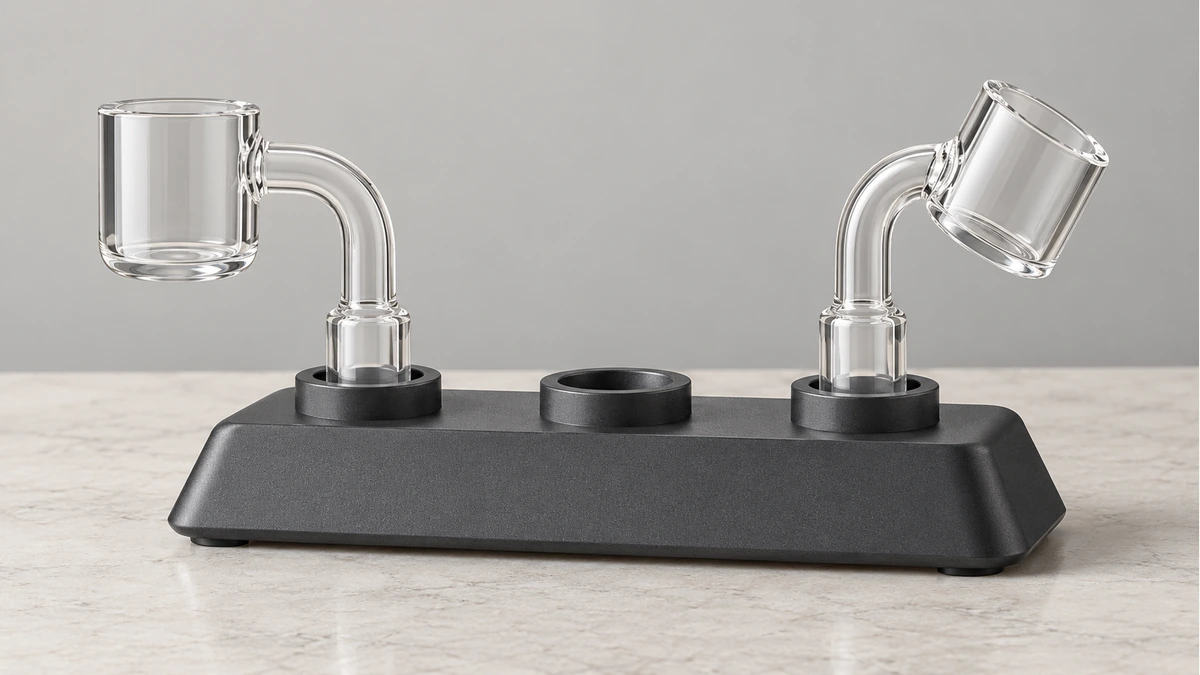
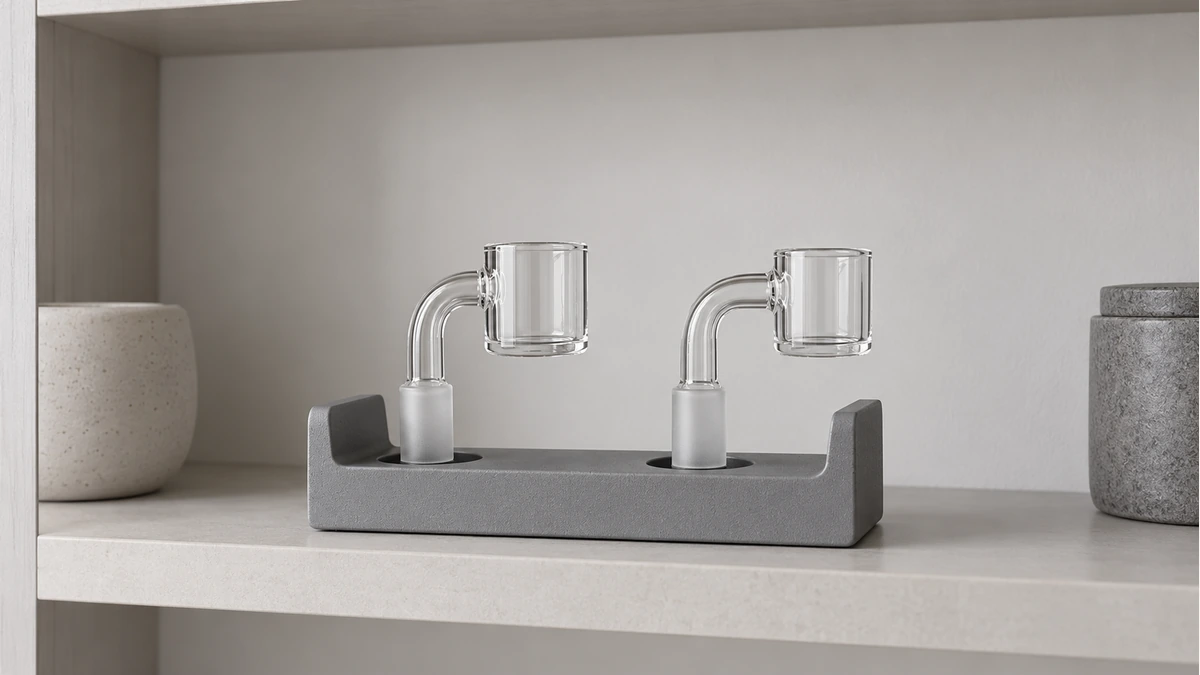
A rack’s slot count is a count of openings. It does not describe the outline of the pieces you own. An elbow points the bucket away from the joint, a broad rim takes up more sideways space and a cap adds another object to reach around. Two bangers can have room at their bases while their buckets touch above the rack.
Before loading the holder, compare its stated spacing and overall footprint with the intact, cool pieces laid separately on a clear surface. Think about the path needed to lift one piece out, not only the pose it occupies while resting. If reaching a rear bucket requires passing a hand between two narrow necks, a smaller display may be more practical than filling every socket.
The community questions are often about exactly this mismatch. A May 2026 discussion asked for storage for six attachments with mixed joint sizes; an older cabinet discussion focused on stand names, tipping and a piece protruding beyond the others. The useful question is how your own shapes occupy the space. There is no universal hole count that answers it for every collection.
📐 4. Give the Base a Suitable Place to Sit
Start with an empty holder on the intended surface. Its whole base should be supported, with room behind and beside it for the bucket shapes you plan to add. Shelf depth matters as well as width: the rack may fit while an elbow projects toward the edge. A tall item behind it can also turn an ordinary reach into an awkward lift over glass.
Look at nearby cables, drawers and doors. A charging lead that is routinely pulled across the desk should not pass through the storage space. A cabinet door should close without touching a bucket. In a home with pets or other people sharing the surface, placing the collection out of that traffic is more useful than assuming a heavier-looking base cannot be knocked.
Do this assessment with the holder empty rather than pushing a loaded rack to test whether it tips. A photograph of a stable-looking arrangement is not a load rating. If a base rocks on the surface or the holder has visible damage, resolve that before adding parts. The dab mat and station guide discusses the surrounding work surface; a mat does not correct a holder that fits badly.
🌡️ 5. Storage of Cool Parts Is Different From a Hot Rest
Here, cool storage means ordinary storage of parts that have fully cooled—not putting attachments in a freezer. A rack can be sold for display or organization without being intended to receive a hot component. Its shape and color tell you nothing dependable about that permission.
The Roots Glass stand page explicitly describes cooling use for its own glass stand. That statement belongs to that product. Do not transfer it to a wooden block, printed polymer rack or another glass stand simply because the openings look similar. Where instructions allow only storage, use the holder for fully cool pieces. Where permitted temperatures or contact conditions matter, get them from the holder’s maker.
🔎 5.1 A Support Should Not Become a Clamp
DWK’s laboratory glassware guidance advises gentle support and avoiding excessive clamp stress. It concerns laboratory equipment, but the distinction between supporting glass and forcing it into place is useful here. Do not turn a tight storage socket into a grip test.
A holder is also not an invitation to move hot equipment simply to make the tabletop look tidy. Arrange the permitted resting space before it is needed, and follow the equipment’s handling instructions. An empty storage hole can remain empty until the component is ready for ordinary storage.
🖐️ 6. A Single Stand and a Rack Change Everyday Reach
A solo stand gives one frequently handled attachment its own place. A rack groups several spares. Neither format is automatically better: a collection displayed together can be convenient to see, while an unused rear row may create more obstacles than useful storage. Keep the item you reach for from requiring a reach across every other piece.
Do not assume a loaded rack or single stand is a carrying handle for the glass. Unless the product’s instructions specifically provide for moving it loaded, remove the cool components into their appropriate protected places before relocating the holder. Lifting a base and lifting a banger are different handling tasks; the socket may provide no retention when the arrangement tilts.
This matters during ordinary cleaning under the rack as much as during a move. Plan where the parts will go before picking up the base. A clear tray beside the workspace can organize that temporary separation, but pieces should still be supported individually rather than piled together. Returning a rack to the shelf should not require improvising a resting place for everything that was in it.
📦 7. A Display Holder Is Not a Travel Case
An open socket keeps a component in an intended resting position. It does not enclose its rim, keep a cap from falling away or stop neighboring items in a bag from hitting the neck. A rack that is satisfactory while stationary can therefore be unsuitable for carrying the same collection.
The dab rig case guide treats transport as a separate task. Cool, clean, intact attachments need appropriate separated protection, including space around the parts that project sideways. Putting a desktop rack inside a larger bag does not automatically supply that protection.
If a holder is part of a purpose-designed case, follow that case’s loading and retention instructions. Check whether it is designed around your actual attachments and whether the lid clears them. Do not close a lid harder because a cap or bucket seems to be just slightly too tall. A fit problem in storage remains a fit problem when the case is shut.
🧼 8. Make the Empty Holder Easy to Clean
Take a simple reference photo once the cool storage arrangement is settled. It can show which joint belongs in each approved opening and which slots you deliberately leave empty for clearance. This is particularly useful when a mixed collection is taken out for shelf cleaning and someone else puts it back. The picture records your arrangement; it does not certify a holder’s capacity or thermal rating.
When adding another piece later, compare its complete outline with the open space rather than copying the previous bucket’s position. A longer neck may occupy a neighbor’s space even though the new joint is the same nominal size. Move the other spare into protected storage if needed. Keeping one position vacant is often a straightforward way to preserve a usable gap without changing the holder or improvising an adapter.
Cleaning the holder starts with removing the stored parts, following their own handling instructions. Then use the method specified for the holder’s material and construction. A procedure for an all-glass accessory does not authorize soaking wood, a painted base or an assembly with unknown inserts and adhesive. If the care information is missing, ask before applying a cleaner.
Pay attention to where used and clean parts are put back. A socket with visible residue is not a clean storage position merely because the banger going into it was just cleaned. Keep the pieces separate while the permitted cleaning and drying are completed. Give caps and other loose accessories their own spaces so they do not migrate into the support openings.
Store spare holders, approved inserts and the relevant part information together. If an insert comes loose or a socket no longer supports the joint as intended, stop using that position rather than adding a makeshift shim. A label on a nearby compartment can identify the intended piece without attaching anything to the banger itself.
The useful endpoint is a desk you can reach into without navigating a dense row of glass. If the next accessory has no clear place, put an infrequently used spare into its protected storage rather than squeezing one more bucket into the gap. The right holder is the one that supports your actual pieces with enough room to handle them.