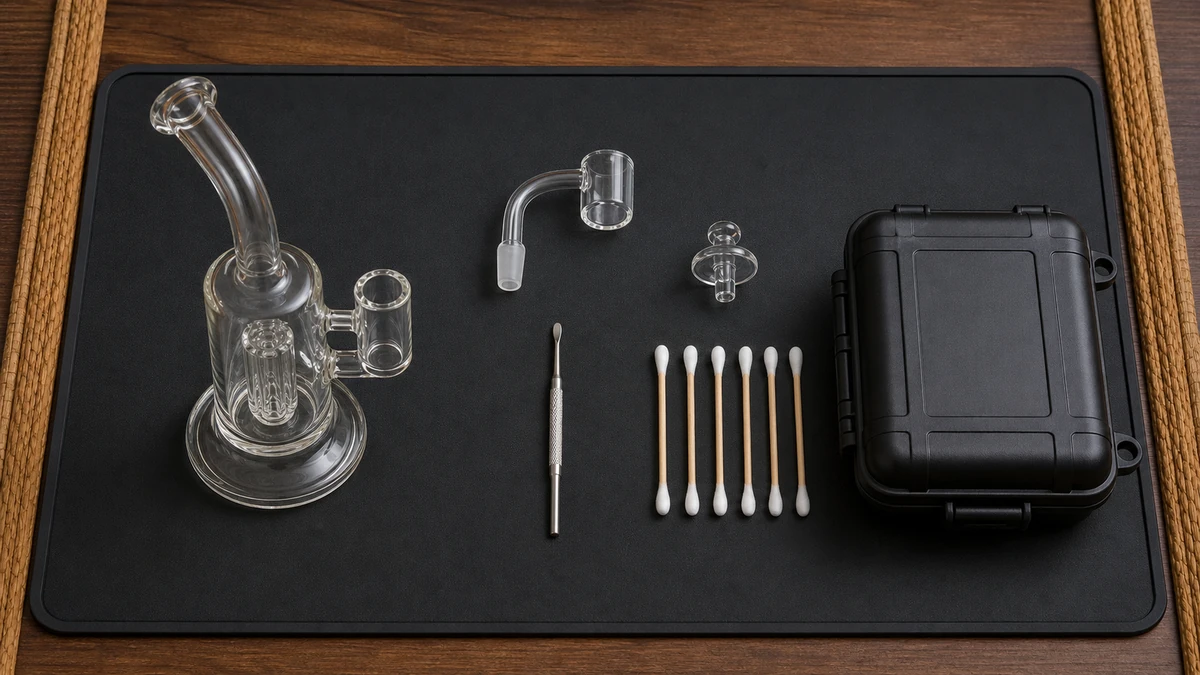
A dab mat station is the flat surface — mat, tray, or small mat-plus-tray combo — where a rig, torch, dabber, and containers sit while someone works. Picture a rig at the center, a torch angled off to one side, a dabber resting where it won’t roll, and a small dish of alcohol wipes within reach. That layout is a dab mat station, and its job is narrow: it catches drips, gives glass a grippy place to stand, and keeps loose tools from scattering across a desk or counter. It is not a substitute for careful handling of hot glass, and it does not turn a wobbly surface into a stable one on its own. Knowing what the mat actually does — and where its job ends — is the difference between a station that reduces mess and one that just adds another surface to clean.
🧭 1. A dab mat station is a work surface, not heatproof insurance
Most dab mats are rated to resist occasional contact with warm glass and to keep spilled concentrate from soaking into wood, laminate, or fabric underneath. That is a meaningful function, but it’s easy to read more into it than the material actually promises. A mat resisting brief contact with a warm nail or banger is not the same as a mat being safe to set a glowing-hot piece on indefinitely, and manufacturers vary widely in what temperatures and contact times their products are actually built for. Reddit threads about station setups return to this gap often: people assume a mat is doing more protective work than it is, then find scorch marks or warping later.
The safer mental model is that the mat manages residue and gives glass something better than a bare tabletop to rest on — it does not replace the judgment calls that come with handling a heated nail or banger. Anyone unfamiliar with how a specific rig’s parts heat and cool should treat the manufacturer’s instructions as the authority on contact and cooldown times, not general habit or what a mat’s marketing implies. A dab mat station reduces the number of things that can go wrong around the rig; it doesn’t eliminate the need for basic care with hot glass.
🧩 2. Separate the hot zone from the handling and cleaning zones
The Reddit thread on essentials lists makes a point worth taking seriously: the instinct to add a holder or dish for every accessory can produce more clutter, not less, if there’s no underlying layout. A station with a torch, a dabber, a rig, a cleaning solution, and a stack of cotton swabs all touching each other is harder to use safely than one with a bit of intentional separation.
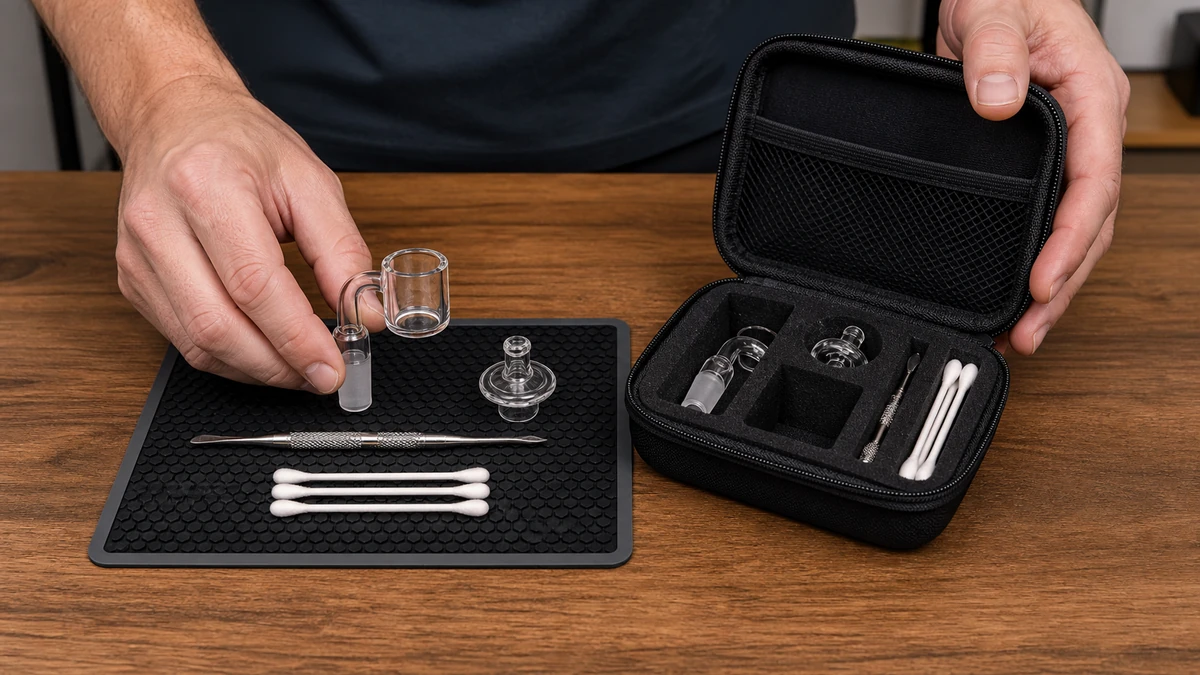
A workable layout usually breaks into three loose zones on the same mat or tray:
🔍 2.1 Hot zone
Where the rig sits and where the torch is used. This area should have the most clearance — nothing flammable, nothing that needs to be reached across an active flame, and enough room that setting the rig down doesn’t require moving other items first.
⚙️ 2.2 Handling zone
Where the dabber, any tool holder, and spare parts like carb caps rest between uses. This is the space someone’s hand moves through most often, so it benefits from being close but not overlapping the hot zone.
🧼 2.3 Cleaning zone
Where wipes, cotton swabs, and any cleaning solution live. Keeping this separate from the hot zone matters because cleaning supplies — especially alcohol-based ones — should never sit close to an active torch.
These zones don’t need dedicated products to exist. A mat can be mentally divided into thirds, or a small tray can mark off the cleaning supplies from everything else. The point isn’t more gear; it’s knowing which part of the mat each item belongs on so the layout stays predictable session after session.
🔍 3. Mat material changes grip, lint, staining, and cleanup
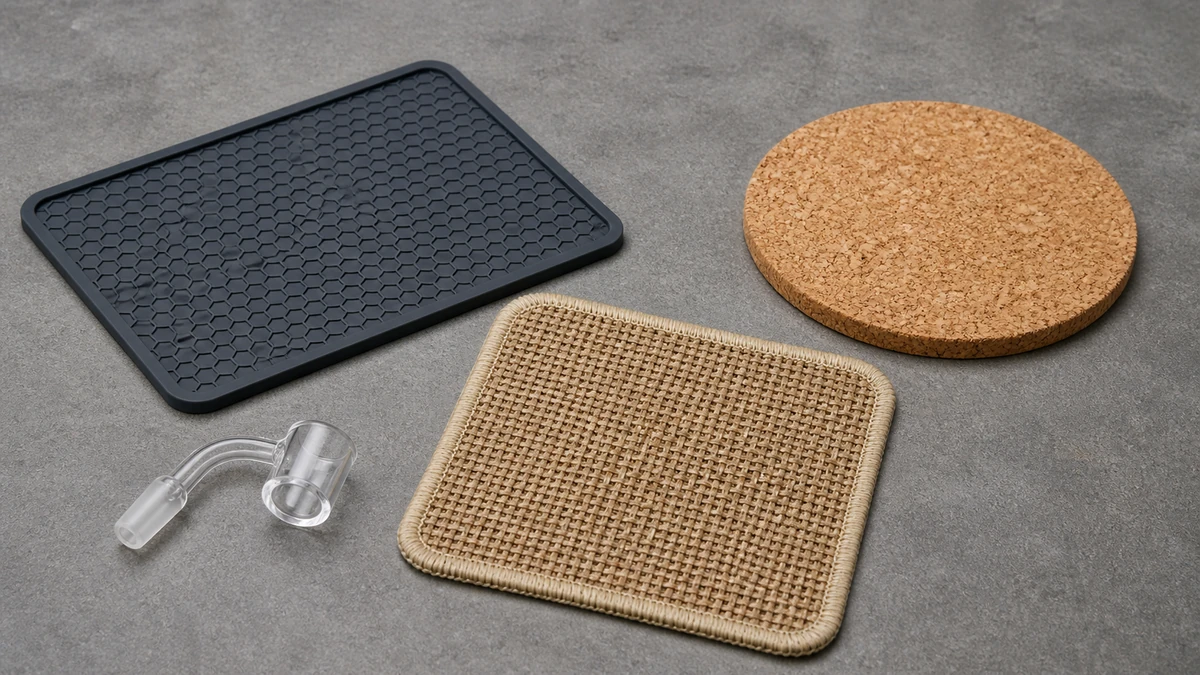
Mat material is not a cosmetic choice — it affects four practical things: how well glass grips the surface, how much lint or fiber transfers onto tacky concentrate, how visible staining becomes over time, and how easy the mat is to wipe down.
Silicone is the material most people default to, and for good reason: it’s naturally grippy, which keeps a rig or dabber from sliding, and it resists staining better than fabric or bare wood. It’s also commonly used to catch stray drips of concentrate and to give tools a place to rest without touching a hard countertop. But silicone isn’t lint-free by nature — dust and fiber from nearby fabric, or from the mat’s own surface texture in some cases, can end up stuck to anything tacky that touches it. A silicone mat with a smooth, non-textured surface tends to pick up less debris than one with a heavily embossed pattern, simply because there’s less surface area for particles to catch on.
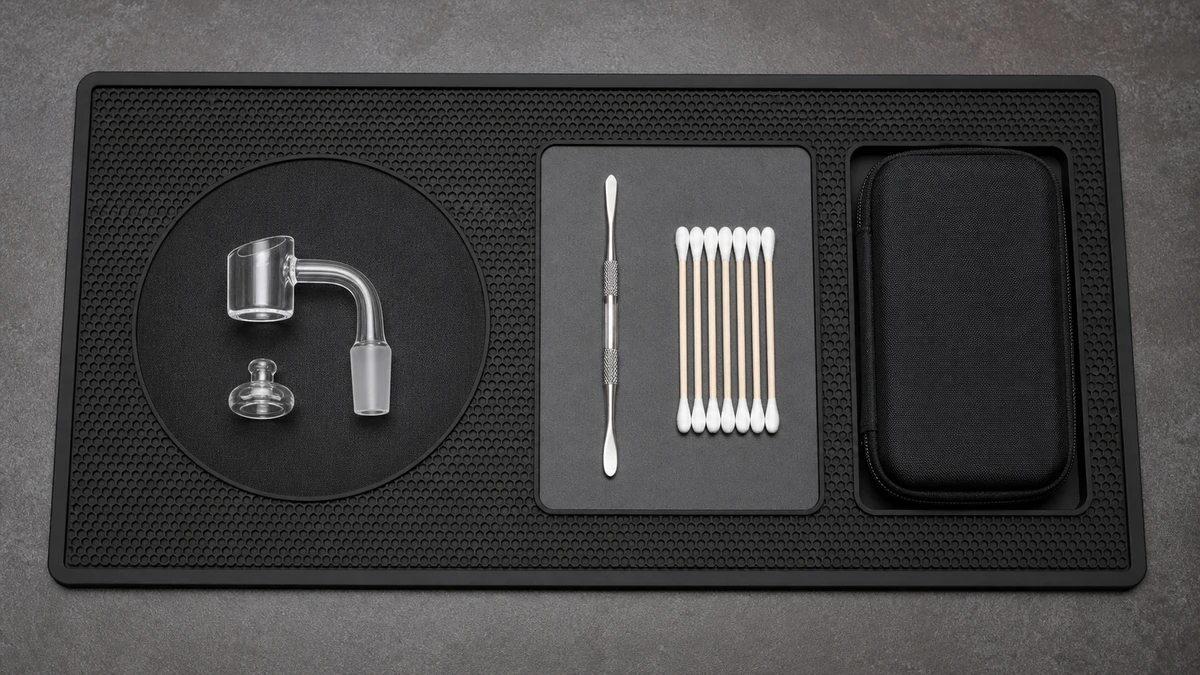
Rubber and silicone blends behave similarly to pure silicone but can vary more in heat tolerance, so checking what a specific product is rated for matters more than assuming all rubber-like mats perform the same. Fabric or felt surfaces, sometimes used under a rig for a softer look, are the ones most likely to show staining and are harder to fully clean once concentrate soaks in. None of these differences make one material universally correct — they just mean the choice should match how the mat will actually be used: heavy daily contact with hot glass calls for something rated for that, while a mat that mostly holds tools and catches the occasional drip has more flexibility.
⚙️ 4. Tool holders should prevent contact without hiding residue
A dedicated tool holder solves a real problem — a dabber left flat on the mat can roll, and its working end often carries leftover concentrate that then transfers to whatever it touches. Elevating the tool tip off the mat surface keeps that residue from spreading and keeps the tool itself from picking up lint or dust between uses. For a closer look at how different holder styles handle that job, the dab tool holder guide walks through the tradeoffs in more detail.
The risk the Reddit thread flagged is real, though: a holder for every single tool can turn a simple mat into a crowded tray where residue collects in seams, hinges, or narrow gaps that are harder to wipe than a flat surface. A holder is worth adding when it solves an actual problem — keeping a hot tool off the mat, or keeping a sharp one from rolling toward an edge — not simply because it exists as an accessory. Choosing the right set of tools in the first place also cuts down on how many holders a station actually needs; the dab tools guide covers what a minimal, functional tool set looks like before adding storage on top of it.
🧼 5. Cable and torch routes need clear space
Stations that use an e-nail, a small light, or any powered accessory add a cable into the mix, and that cable needs a route that doesn’t cross the hot zone or dangle where a hand or sleeve could catch it mid-session. Running the cable along the back edge of the mat or tray, rather than across the front where hands move most, keeps it out of the way without needing a special organizer.
Torch placement deserves the same attention. A butane torch should have a clear path to be picked up, ignited, and set back down without passing over cleaning supplies, cables, or anything the user doesn’t want near an open flame. If the layout requires reaching over one item to get to another, that’s usually a sign the zones from earlier need to be rearranged rather than a sign more accessories are needed. Clear routes are a layout decision, not a product one — they cost nothing beyond thinking through the order of motions a session actually requires.
🛠️ 6. Clean the mat before stickiness becomes the organizing system
A mat that’s cleaned only when it looks obviously dirty tends to reach a point where tackiness itself starts dictating the layout — tools get set in whatever spot happens to already be sticky, because moving them elsewhere means dealing with a residue trail. That’s the opposite of an organized station, and it’s also how lint and dust accumulate fastest, since debris sticks more readily to a residue film than to a clean surface.
Wiping the mat down after a session, before residue has a chance to dry into a harder film, keeps cleanup fast and keeps the surface grippy rather than gummy. The same logic applies to the rig itself — residue that’s allowed to sit and harden is more work to remove later, on the mat or in the glass. The guide to cleaning a dab rig covers rig-specific cleaning in more depth, but the general principle carries over directly to the mat: frequent light cleaning beats occasional deep cleaning, both for time spent and for how well the surface holds up.
✅ 6.1 Build the station with cold parts first
Place the rig, cap, tools, swabs, waste container, and any temperature reader on the surface while everything is cold. Move through the intended sequence and note every point where a hand crosses the torch path, a cable brushes the glass, or a used tool passes over clean supplies. Rearranging those crossings is the real value of a station.
Leave one empty landing area for a part whose condition changes during use. A holder full of accessories is not useful if the active cap or tool has nowhere stable to go.
📦 6.2 Know what the mat cannot do
A silicone mat may catch sticky residue and improve grip, but it is not proof that the desk beneath it can accept a hot torch or banger. Follow the mat maker’s temperature and cleaning limits and use a dedicated stand for hot glass. Replace a warped, torn, or persistently contaminated mat.
🧭 6.3 Leave a clear shutdown path
The station should have an obvious sequence for turning off power, setting down the tool, and letting glass cool without moving other accessories. If shutdown requires reaching across the rig or clearing a crowded holder, simplify the layout before use.
Photograph the finished cold layout once it works. The reference makes it easier to restore clear zones after cleaning and reveals when extra accessories have gradually crowded the safe landing space.
✅ 7. The best station makes the next safe action obvious
A dab mat station succeeds when someone can look at it mid-session and immediately know where the next tool is, where it’s safe to set down something hot, and where the cleaning supplies are if something spills. That clarity comes from consistent zones and restraint on extra accessories, not from having every possible holder or organizer available. The Reddit threads that circle back to “clear zones beat a pile of accessories” are describing exactly this outcome — a mat that reduces decisions instead of adding them.
Getting there doesn’t require rebuilding the setup from scratch. It usually means picking one material suited to how the rig actually gets used, giving the hot zone real clearance, keeping cables and cleaning supplies out of that zone’s path, and wiping the mat down often enough that stickiness never becomes the de facto organizing system. Everything else — specific holders, specific mat shapes, specific tray add-ons — is worth adding only once that basic layout is already working.