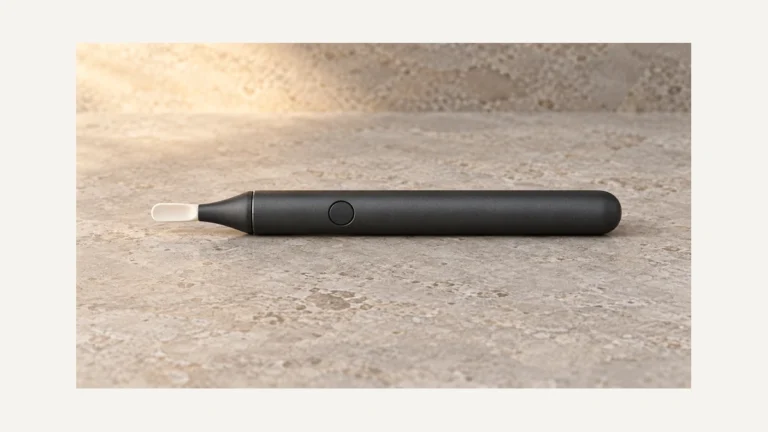
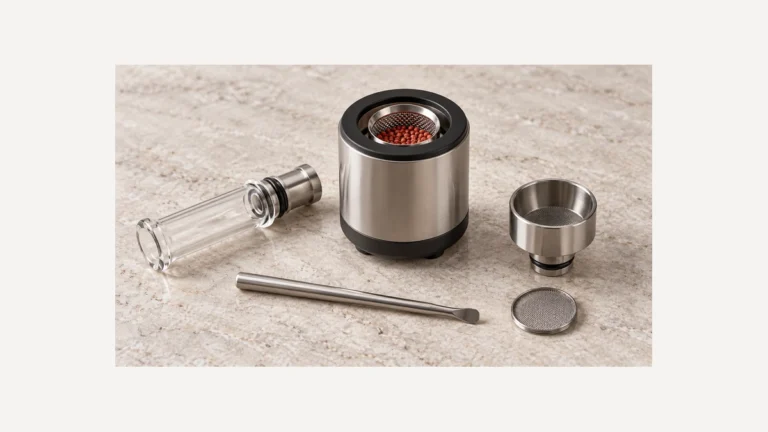
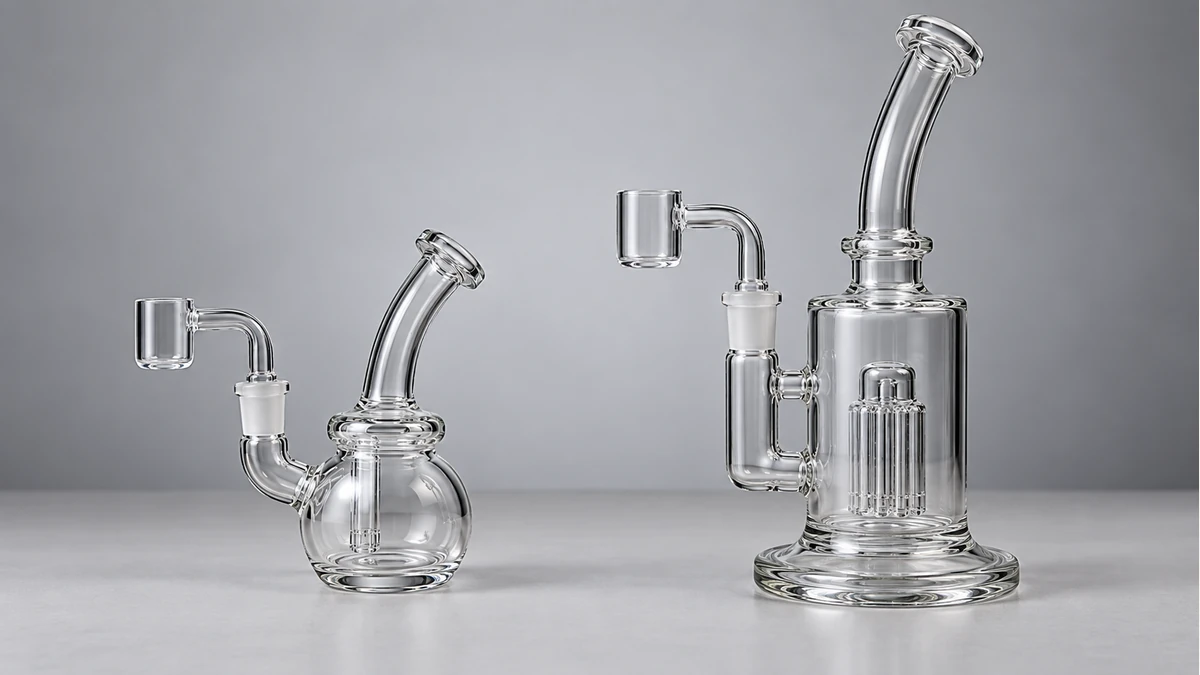
A bubbler for dabs is easiest to understand as a compact glass system rather than a miniature version of every larger water pipe. The joint, chamber, waterline, neck and base all share a small footprint, so changing one feature affects the others. A short chamber may feel direct, yet it can also leave less room for splash control and cleaning tools. A narrow recycler-style path may look elaborate while adding turns where residue collects. The useful comparison therefore begins with the complete air-and-water path, not the number of visible glass features.
That perspective also prevents a common parts mistake. A banger that physically enters a joint can still sit at the wrong angle, crowd the body or shift the center of gravity. Compact glass rewards careful measurement because there is less spare clearance around every connection.
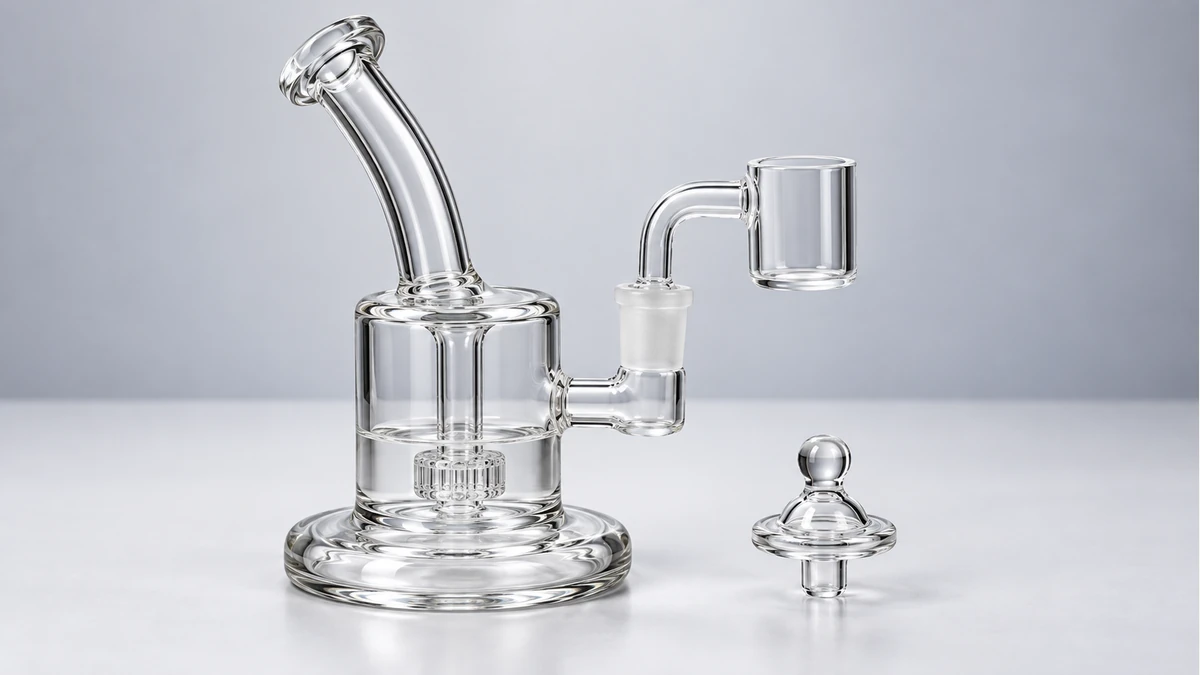
🫧 1. Bubblers vs. Rigs vs. Bongs: Sorting Out the Category
A bubbler for dabs sits in an odd middle space in glass shopping. It looks like a small water pipe, it usually carries a banger instead of a bowl, and it gets marketed under both “mini rig” and “bubbler” labels depending on the shop. That inconsistency is part of why people end up confused about what a piece can actually do before they buy it.
The short version: a bubbler is a compact water pipe built around a fixed or semi-fixed stem, generally with a smaller chamber and a shorter travel path than a dedicated dab rig or a full-size bong. It trades some airflow volume and percolation for portability and a lower price point. That’s not a downgrade so much as a different set of priorities, and it matters most when you’re comparing joint size, water volume, and how much internal glass you’ll need to clean later.
🔬 1.1 Where a Bubbler Sits Between a Dry Rig and a Bigger Bong
A dry rig has no water chamber at all, so airflow resistance and splash aren’t factors, but there’s also no filtration or cooling from water. A full-size bong or rig usually has a larger chamber, sometimes a removable downstem, and often a percolator disc or tree for extra diffusion. A bubbler compresses that middle ground into one fused piece — smaller water volume, tighter neck, and often a fixed stem that can’t be swapped out.
If you’re trying to figure out which category actually fits how you use concentrates, it helps to look at a side-by-side breakdown of how different dab rig styles compare before assuming a bubbler will behave like a scaled-down version of a full rig. The differences in chamber size and joint access change more than just the footprint.
🔗 2. The Banger and Joint Connection
The joint is where most of the confusion actually starts, and it’s also the part of the piece that determines whether a banger or nail will even seat correctly. On a bubbler, the joint is frequently fixed in place rather than a separate ground-glass connection you can swap between accessories, which changes how you think about compatibility.
📏 2.1 Male, Female, and the Diameter Mix-Up
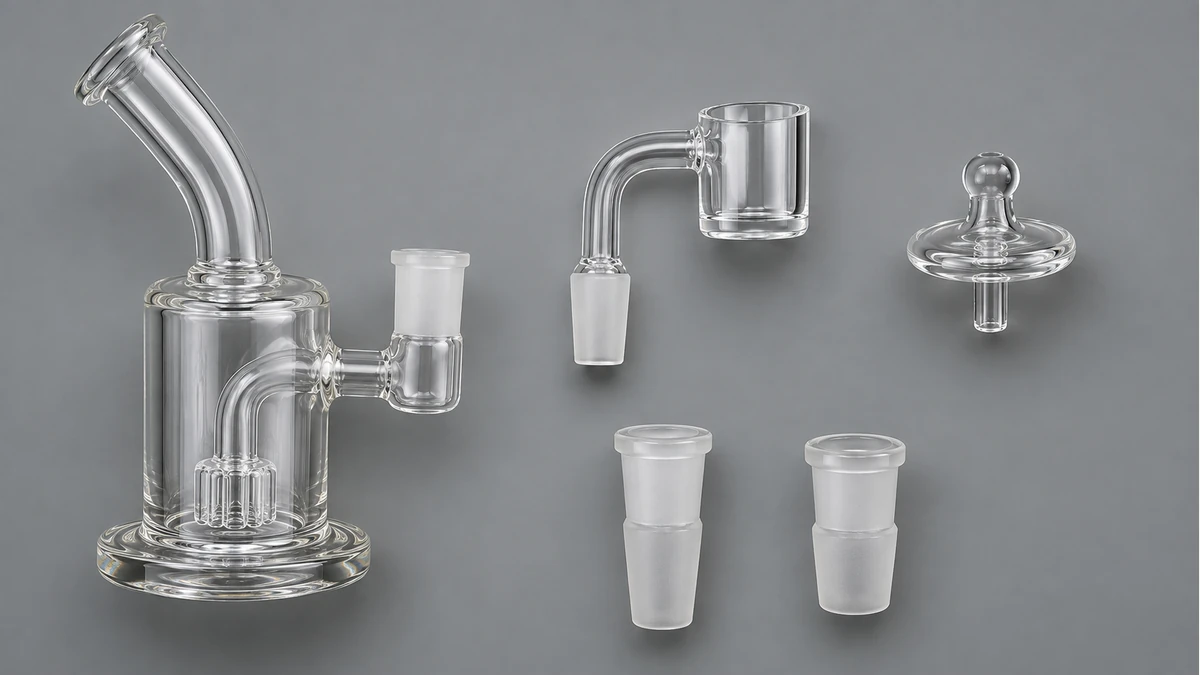
Joints come in male or female orientation, and separately in a diameter — commonly 10mm, 14mm, or 18mm on this style of glass. A female joint on the piece needs a male-fitted banger, and vice versa; mixing up gender is the single most common reason a banger won’t sit flush. Diameter is a separate variable from gender, so a correctly gendered banger in the wrong diameter will still wobble or fail to seal, even though it “fits” in the sense of screwing into place at an angle.
Because bubblers often ship with a small, fixed joint, it’s worth checking both numbers against the banger you already own rather than assuming a smaller-looking piece automatically takes 10mm. A reference like the breakdown of rig parts and joint terminology is useful here if you’re not sure which measurement you’re even looking at on a listing.
🔌 2.2 When You Need an Adapter (and When You Don’t)
An adapter changes either the gender or the diameter of a joint so a banger that wouldn’t otherwise fit can be used. That’s a legitimate fix when you already own a banger in a different size than the piece takes. It’s a different situation from trying to force an ill-fitting connection with tape, rubber grommets, or other household materials — those don’t create a real seal, and inconsistent airflow at the joint is one of the more common complaints traced back to exactly that kind of workaround rather than to the glass itself.
📐 3. Neck Angle and Everyday Handling
Neck angle affects two things: how comfortable the piece is to hold and light at the same time, and how much splash risk there is when water gets agitated. A straight or near-straight neck keeps the banger close to vertical, which some people find easier to torch evenly, but it also puts the joint closer to the water level.
An angled neck moves the banger further from the chamber and usually higher above the waterline, which can reduce how often water gets pulled up during a pull. The tradeoff is a piece that’s a little more awkward to hold one-handed, and sometimes a slightly longer path for vapor to travel before it clears. Neither angle is objectively better; it’s a matter of what feels stable in hand versus what keeps water contained.
💧 4. Waterline and Splash Control
Because bubbler chambers are small, the margin between “enough water to filter” and “too much water to pull through comfortably” is narrower than it is on a bigger piece. Overfilling is the most common cause of splashback reaching the joint or mouthpiece, since there’s less vertical space for water to move before it hits the stem.
Most bubblers have a visible fill line or an implied one based on where the stem’s slits or percolator sit below the water surface. Filling just above that point, rather than filling the chamber generously the way someone might with a larger bong, tends to keep the piece easier to control. It also means checking the water level more often, since even a small amount of evaporation or splash-out changes the ratio faster in a small chamber than in a large one.
🌀 5. Percolators and Airflow Resistance
Not every bubbler has a percolator — plenty rely on a simple diffused downstem with slits or holes cut into the glass. Where a percolator disc, tree, or honeycomb is present, it adds surface area for water contact but also adds airflow resistance, which is more noticeable in a small chamber than a large one because there’s less room for the extra restriction to spread out.
This is one of the tradeoffs worth thinking about before assuming more percolation is automatically better in this form factor. A heavily percolated bubbler can feel noticeably harder to pull through than a simple stemline version, and that resistance is also part of why some percolated designs are harder to clean thoroughly, since water and residue collect in the same tight spaces that create the diffusion in the first place.
🌡️ 6. Chamber Volume and Thermal Separation
Chamber volume is really about two separate jobs: how much vapor accumulates before you clear it, and how much distance and water exist between the hot banger and your mouth. A small chamber fills faster, which some people like for quicker sessions, but it also means less thermal buffering between the joint and the mouthpiece compared to a large rig with a wide, tall chamber.
This is part of why a bubbler isn’t just a smaller version of a full-size rig in terms of feel — the compressed geometry changes how quickly heat and vapor reach the top of the piece, not just how much total volume is available. It’s a design tradeoff tied directly to portability, not a flaw, but it’s worth knowing before assuming a mini piece will behave identically to a full-size one with everything scaled down proportionally.
⚖️ 7. Base Stability and Material Notes
A wide, flat base matters more on a bubbler than people expect, mostly because these pieces are often used one-handed or set down and picked back up frequently. A narrow base combined with a heavy fixed banger and torch nearby is a stability risk that’s easy to overlook when the piece looks compact and lightweight overall.
⚠️ 7.1 Materials People Try — and Why Fit Matters More Than Improvisation
On forums, it’s common to see people describe swapping in mismatched stems, using non-borosilicate glass replacement parts, or fashioning downstems and adapters out of materials never intended for that use. These are anecdotal reports rather than technical guidance, and they generally show up as workarounds for a joint that didn’t fit rather than as a recommended practice. The safer approach is matching joint gender and diameter correctly in the first place — using an actual glass adapter rated for the connection — rather than improvising with materials that weren’t designed for repeated heat cycling near a hot banger.
🧽 8. Reclaim Paths and Cleaning Access
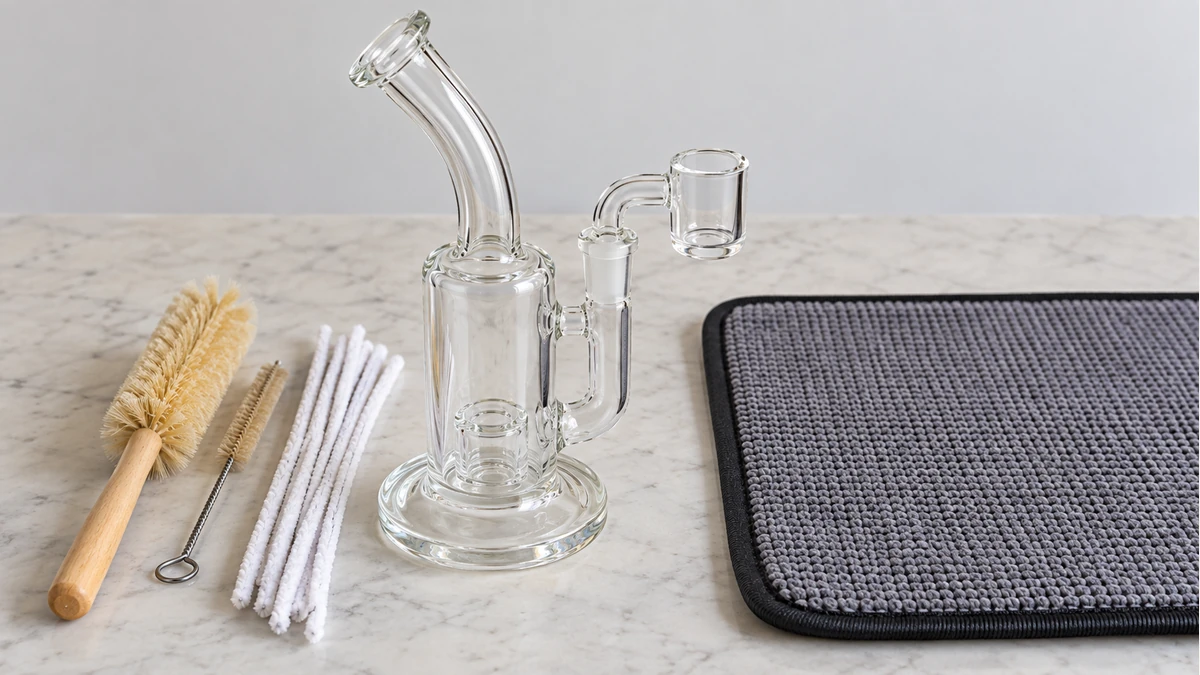
Cleaning is where a bubbler’s compact design becomes a genuine tradeoff rather than just a size preference. Reclaim and residue collect in the same narrow chamber and stem that make the piece portable, and there’s often no removable downstem to pull out and clean separately the way there is on a rig with a ground-glass joint.
🕳️ 8.1 Narrow Passages and Where Residue Hides
Fixed stems, tight percolator slits, and small chamber openings all make it harder to get a brush or pipe cleaner into the exact spot where buildup accumulates. Reddit threads on this topic are full of people describing stubborn clogs specifically in the neck-to-chamber transition or inside percolator holes — again, anecdotal rather than a technical measurement, but a pattern that lines up with the physical reality of a smaller, less accessible internal geometry.
Isopropyl alcohol and coarse salt remain the standard combination for loosening residue in pieces like this, used with a shake-and-soak approach rather than scrubbing narrow glass with anything rigid enough to scratch or crack it. Rinsing thoroughly afterward matters more here than on larger pieces, since a smaller chamber holds proportionally more residual alcohol relative to its volume if it’s not rinsed all the way through.
🧭 9. Matching the Piece to How You Actually Dab
None of these factors point to one universally “correct” bubbler — they point to a set of tradeoffs that line up differently depending on what you’re prioritizing. Someone who dabs occasionally and wants something easy to clean might prioritize a simple stemline over a heavily percolated design. Someone who travels with their setup might weight base stability and joint durability above chamber volume.
It’s also worth considering whether a bubbler is the right category at all versus a different compact option. Water-attachment nectar collectors solve some of the same portability goals with a different mechanism entirely, and comparing the two side by side — covered in this guide to water-filtered nectar collectors — can clarify whether the joint-and-banger format of a bubbler actually matches your habits, or whether a straw-style piece solves the same problem with less internal glass to maintain.
Reading a bubbler well before buying comes down to the same handful of checks: confirm the joint gender and diameter against the banger you plan to use, look at how much of the internal path is actually reachable for cleaning, and weigh percolation against the airflow resistance it adds in a chamber this size. Those details tell you more about day-to-day usability than overall size or price ever will.