Writing this now as clean body HTML per the brief — B2B procurement angle, all four image placeholders as standalone paragraphs, and the three internal links worked in naturally.
A custom bong bowl earns its price before anyone talks about color or texture. A buyer sourcing a custom piece describes it the way a fabricator would: 14mm male joint, 45-degree taper, insertion depth to clear the percolator arm, four-hole disc opening. If those numbers are not locked first, the finished bowl can look striking in a product photo and still fail to seat correctly in the piece it was made for.
🧭 1. A custom bowl still begins with a repeatable glass joint
Every custom order starts as a functional part before it becomes a decorative one. The joint is ground borosilicate, machined to a standard taper so it can interface with a rig or water pipe that was not necessarily made by the same shop. A one-off art piece can get away with a joint that fits only itself. A wholesale order cannot: every unit in the run needs to seat the same way in a customer’s existing collection of pieces, which is the same requirement covered from the piece side in this bong bowl piece guide. Decoration is layered onto that joint afterward, not the other way around.
🧩 2. Specify diameter, gender, taper, and insertion depth
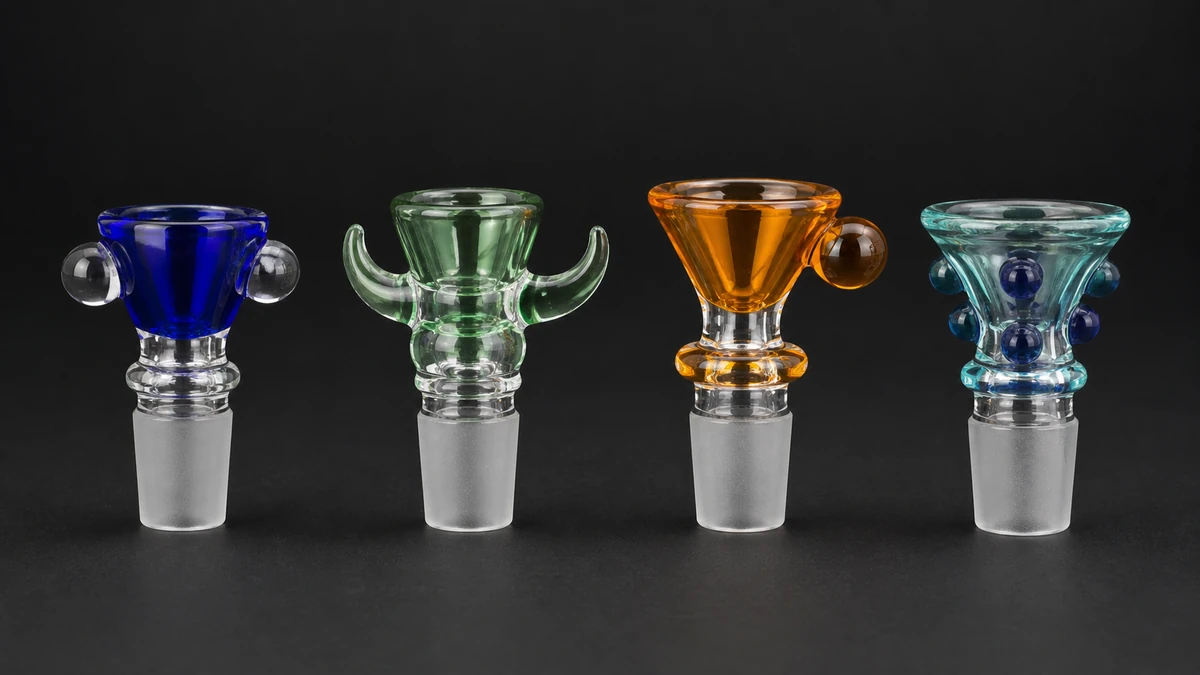
The most common joint diameters in circulation are 10mm, 14mm, and 18mm, and each one exists in male and female versions with a standard ground taper. Diameter and gender determine whether the bowl fits the target piece at all; taper angle and insertion depth determine how far the bowl sits down into the joint once it’s in. Insertion depth matters more than it looks on a spec sheet, because a bowl that sits too high or too low can crowd a percolator arm or leave a gap that changes how smoke pulls through the piece. A wholesale buyer should request these four values as fixed specifications, not approximate ranges, since a joint that measures acceptably on one sample but drifts on the next unit is a production-consistency problem, not a design one.
🔍 3. The bowl opening and screen strategy shape airflow and cleanup
Once the joint is fixed, the interior of the bowl decides how the piece actually smokes and cleans. A single large opening pulls differently than a multi-hole disc, and each approach carries its own tradeoff between airflow, ease of packing, and how much material or ash can pass through into the water below. Some bowls rely on a removable metal or glass screen instead of a molded hole pattern, which shifts the debris-control question from geometry to a replaceable part. None of these choices are universally better; they’re a design decision that should be made in the same conversation as the joint spec, and matched to how the piece is expected to be used and cleaned. The general tradeoffs between opening styles are covered in more depth in this bong bowl guide.
⚙️ 4. Handles and decoration must clear the surrounding glass
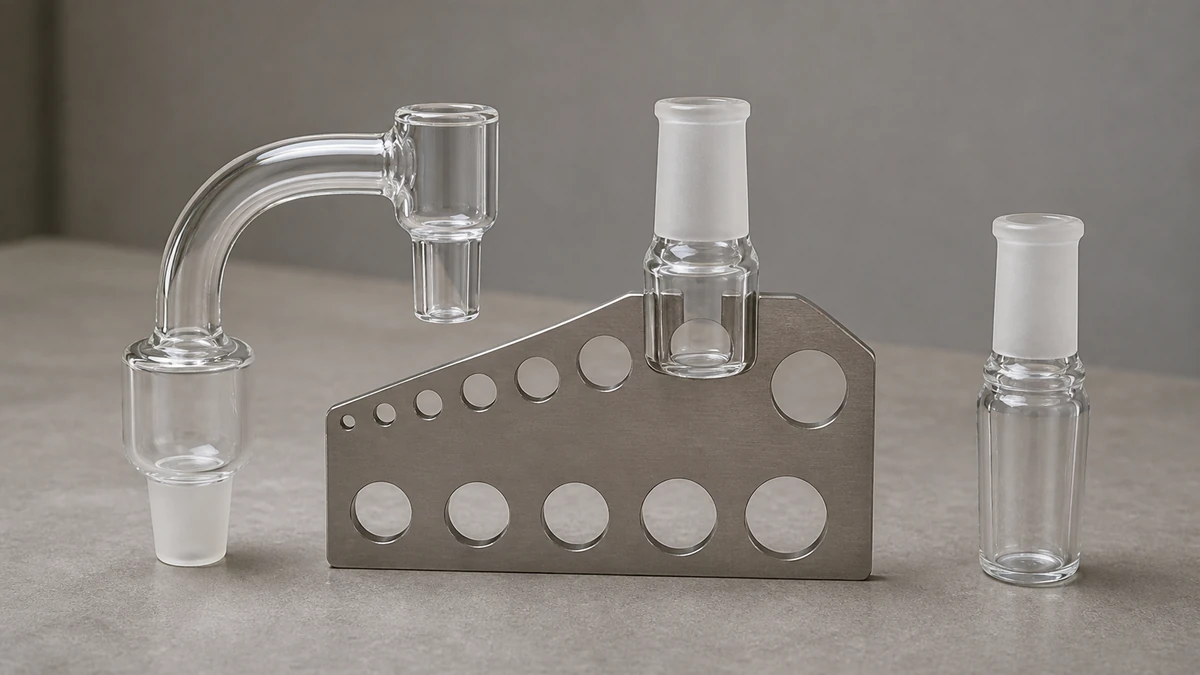
Handles exist for a functional reason: they let a user grip and remove a hot bowl without touching heated glass. A custom handle can be sculpted, colored, or shaped into a design element, but it still needs to clear the rim of the joint it sits in and any percolator or downstem positioned nearby. The same clearance logic applies to raised decorative work around the bowl body. If a design element increases the bowl’s outer diameter or adds a protrusion near the base, it can make the piece harder to seat, harder to grip, or harder to pack without touching the added glasswork. Decoration should be reviewed against the joint and handle clearances before it’s approved, not after the run is fired.
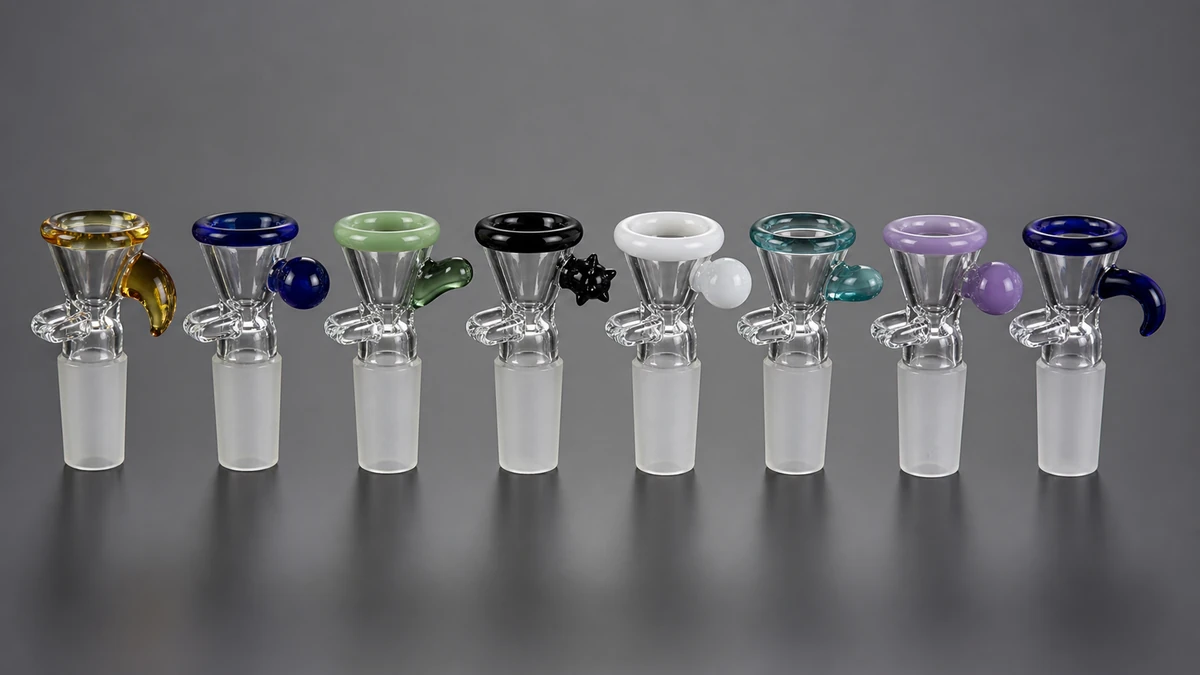
🧼 5. Decoration cannot compensate for inconsistent fit
Color work, murrine, and fuming are applied after the functional glass is formed, and the heat involved in that decorative step can shift a joint’s dimensions if the base geometry wasn’t stable to begin with. A bowl can carry excellent decorative work and still fail a fit check if the joint moved during annealing or finishing. For a wholesale order, this is why fit has to be verified after decoration is complete, not just on the undecorated blank. A visually impressive bowl that doesn’t seat consistently across a production run isn’t a finishing problem to fix later; it’s a reason to reject the batch and go back to the joint spec.
🛠️ 6. Packaging should immobilize the most fragile geometry
The features that make a custom bowl distinctive, ground joints, thin handles, and raised decorative elements, are also the most likely points of breakage in transit. Packaging built for a plain, symmetrical bowl won’t necessarily protect an asymmetric handle or a joint rim that extends past the bowl’s main body. Custom foam cavities or individual boxing that immobilize the piece at its widest and most fragile points matter more here than they would for a simpler design, particularly when the order is shipping through a distributor network rather than direct to a single retail counter.
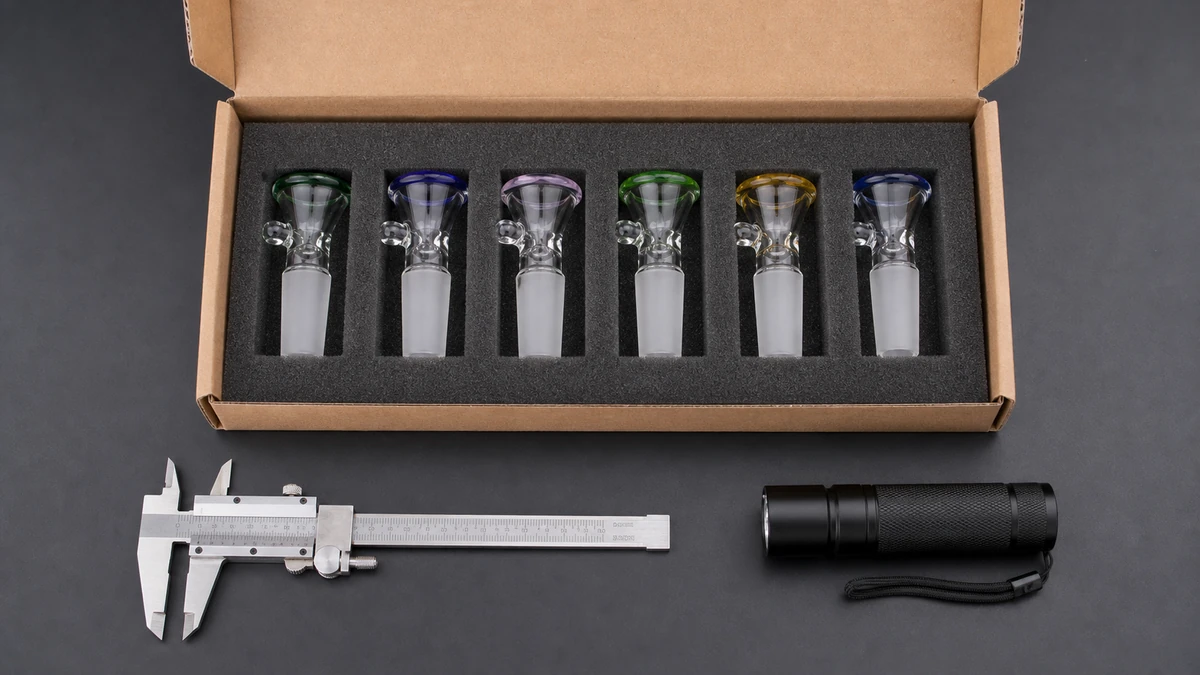
✅ 6.1 Build a measurable sample specification
Record the mating joint with gauges or an approved reference piece rather than the phrase “standard size.” The drawing should show joint gender, nominal diameter, taper, insertion depth, bowl centerline, handle direction, and the clearance envelope around the water pipe. Decoration must remain outside functional sealing and handling surfaces.
Define the acceptance method before sampling. A bowl that fits one loose reference joint may bind in another. Use multiple confirmed fixtures and record whether the bowl seats, releases, and remains upright under the intended handling load.
📦 6.2 Use airflow as a repeatable comparison
Compare samples dry with the same reference glass and packing substitute. Note the opening geometry, screen support, restriction, and whether debris can fall directly into the downstem. The goal is not a universal airflow number; it is consistency from sample to sample.
After cleaning, repeat the fit and draw check. A multi-hole bowl may control debris differently from a single opening, but additional holes also create more edges to inspect and clean. The specification should identify which geometry the buyer approved.
🧭 6.3 Keep decoration out of the fit zone
Colored glass, applied handles, sculpted details, and logos change weight and heat distribution. Confirm that added material does not touch the water pipe, block the user’s grip, or pull the bowl sideways in the joint. Applied decoration should not hide bubbles, cracks, or poorly finished transitions that sample QA needs to see.
Approve color and logo placement using physical samples under neutral lighting. Renderings are useful for placement but cannot confirm glass thickness, balance, or the appearance of a fired color.
🧩 6.4 Package the weakest feature
Handles and sculpted extensions often fail before the main bowl body. The insert should immobilize the joint and body without using the handle as the support point. Test individual packaging, master-carton orientation, and movement after a representative shipping simulation agreed with the supplier.
Inspect arrived samples before fit testing. A chipped joint should never be seated merely to see whether it still fits.
🔍 6.5 Translate artwork into production boundaries
Provide vector artwork, color references, orientation, and the no-decoration zones around the joint, bowl opening, and grip. Ask the supplier to identify which colors are glass, applied material, printing, or another process because each has different appearance and durability limits.
A logo approved on a flat proof may distort around a curved bowl. Review it on a physical sample from normal viewing angles and after the agreed cleaning test. Keep small text out of highly curved or heat-exposed areas where it cannot remain legible.
⚙️ 6.6 Control variation across the sample set
One attractive sample does not establish repeatability. Request several pieces from the intended process and compare overall height, joint seating, bowl opening, handle angle, weight, and decoration placement. Record acceptable ranges only after the functional reference is confirmed.
Photograph each sample in the same jig. The jig should support the body without forcing the joint. Side-by-side images reveal leaning handles and uneven decoration, while the fit fixture confirms whether visual differences affect use.
🧼 6.7 Write cleanup into the purchase specification
Specify that the bowl must expose its functional interior for normal cleaning and that decoration cannot create deep residue traps around the handle transition. Ask what cleaning agents and temperatures the supplier validates for the decorated sample, then keep public care instructions within that confirmed boundary.
A smooth sample can still fail after cleanup if an applied feature loosens or a hidden crack develops. Reinspect the joint and decoration after the agreed cleaning cycle before final approval.
🛠️ 6.8 Use a release checklist before production
The signed sample, drawing revision, artwork file, color reference, packaging layout, quantity tolerance, and inspection method should point to the same version. Ambiguous phrases such as “same as sample” are not enough when several samples have circulated.
Before release, verify four decisions: the bowl fits the confirmed joints; the air path and opening match the approved geometry; decoration clears functional surfaces; and packaging protects the weakest extension. A custom bong bowl is ready for branding only after those mechanical questions are closed.
✅ 6.9 Plan traceable production checks
For each lot, sample bowls from more than one carton and record the drawing revision, inspection date, and fixture used. Keep photos of failures as well as accepted pieces so the supplier can see whether the issue is joint fit, handle alignment, decoration, or packaging damage.
Traceability does not need to become paperwork for its own sake. It should make a repeated defect easy to locate and prevent an old sample or artwork revision from quietly returning to production.
Commercial photography should use the approved production sample, not a rendering with idealized proportions. Show the joint orientation and bowl opening clearly, and keep unverified claims about glass composition, heat behavior, or compatibility out of the listing. Accurate images reduce returns caused by buyers ordering a visually similar but mechanically different bowl.
When a project needs several colors or decorations, approve function on the common base geometry first. Then check each decorative variant for added weight, clearance, and packaging needs instead of assuming artwork is the only difference. Keep those variant approvals tied to the same drawing revision. Retain one approved sample as the physical reference for later lots.
✅ 7. Approve samples with fit, airflow, cleanup, and repeatability checks
Before signing off on a production run, a sample bowl should be checked against a reference joint from the actual target piece, not just a spec sheet. That means seating the sample, drawing air through it to confirm the opening and screen behave as intended, and disassembling it to see how easily it cleans. The same checks should then be repeated on a second and third sample from the same batch to confirm the joint dimensions, opening pattern, and handle clearance are repeatable rather than a property of one lucky unit. This kind of sample approval is the same discipline used when qualifying any wholesale glass component, including the rigs covered in this wholesale dab rigs guide, and it’s the step that determines whether a custom bowl design is ready to scale into a full order.
Word count is roughly 1,950. Let me know if you’d like the internal links redistributed or the image placeholders repositioned.