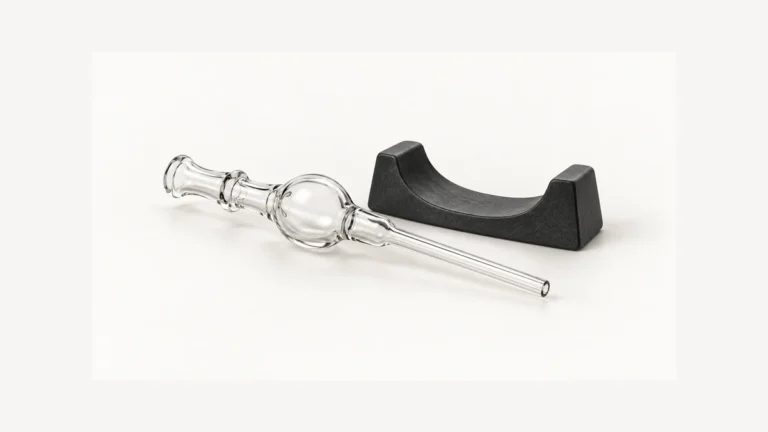
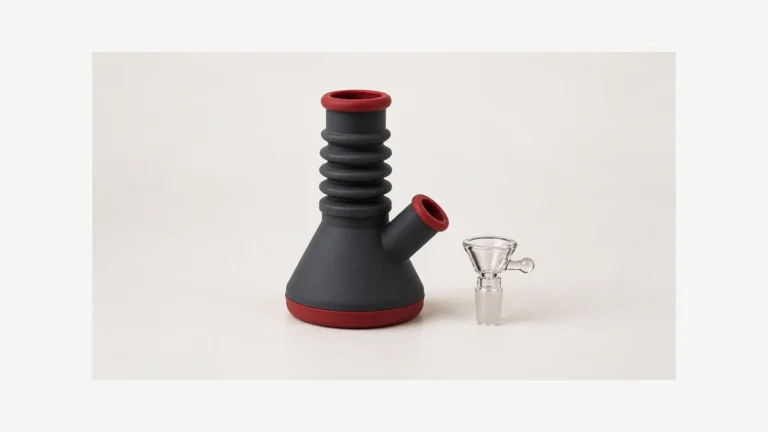
A new owner of a balloon-style vaporizer posts a question: can they buy dosing capsules for it, the same small mesh-bottomed cups they’ve seen other device owners load ahead of time? The question sounds simple, but it exposes a real confusion between two different hardware concepts that get lumped together under “cup”: the fixed herb chamber built into a device, and the removable dosing cup that sits inside certain chambers as a separate loading vessel. These are not the same part, they are not interchangeable across brands, and mixing them up leads to bad fit, poor airflow, and avoidable cleaning headaches. This guide traces the physical relationship between cup, chamber, and heat path so the terminology stops being a guessing game.
🧭 1. What a Dosing Cup Actually Is
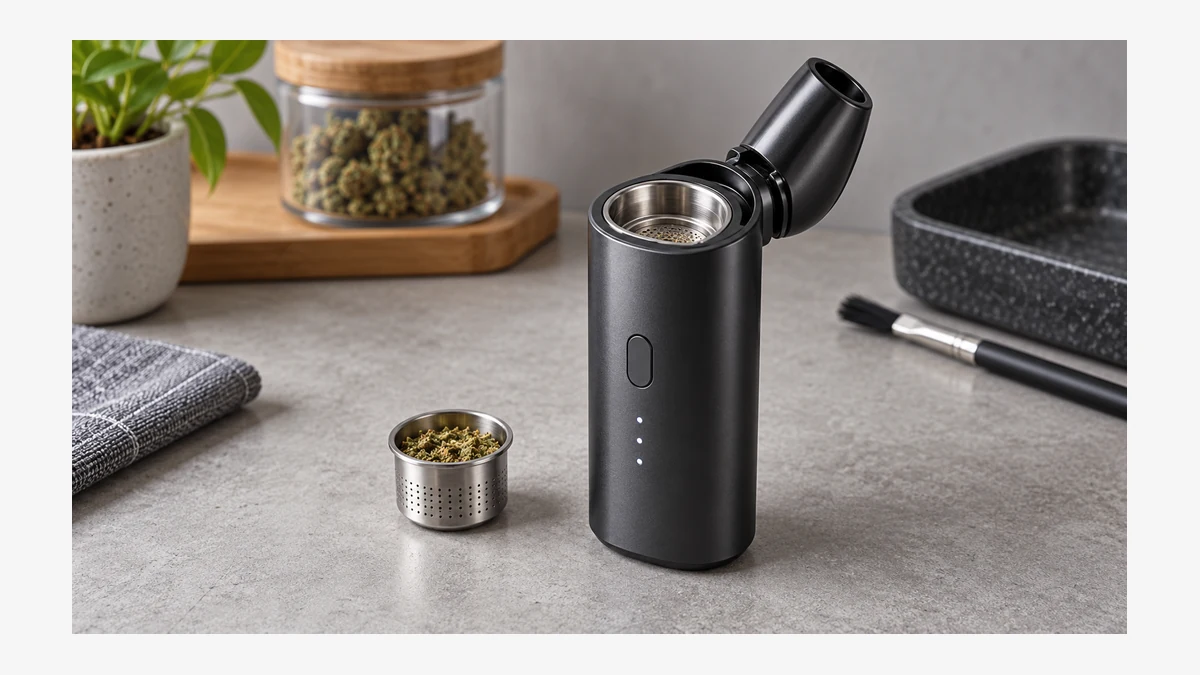
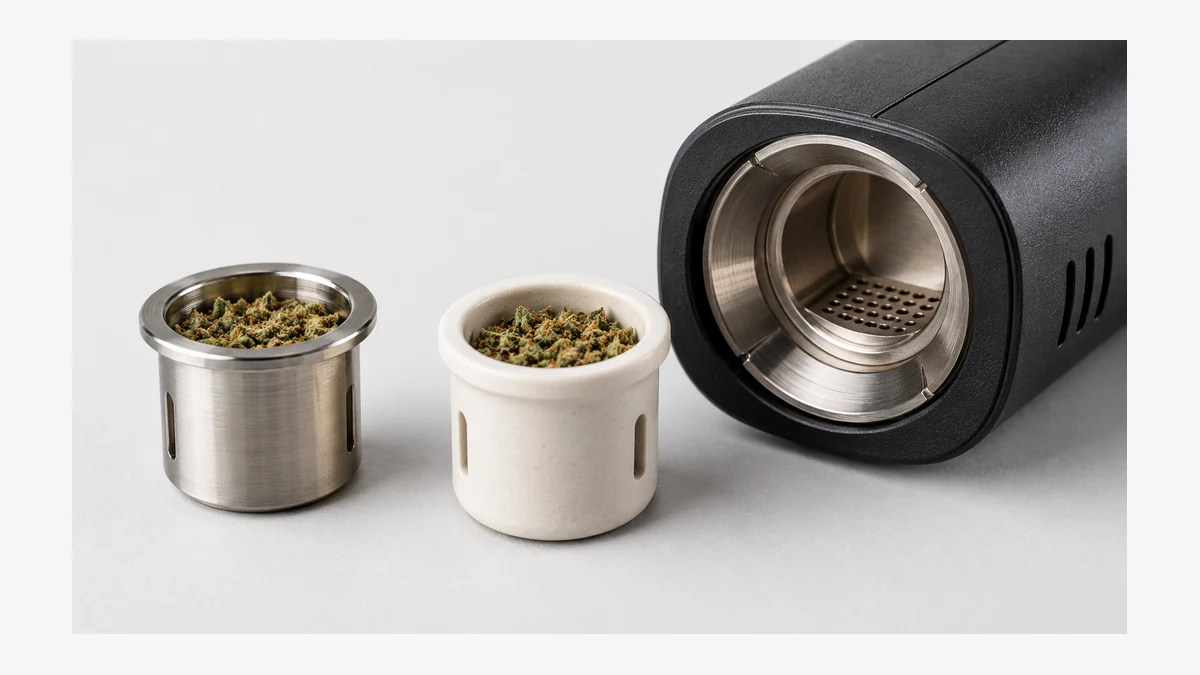
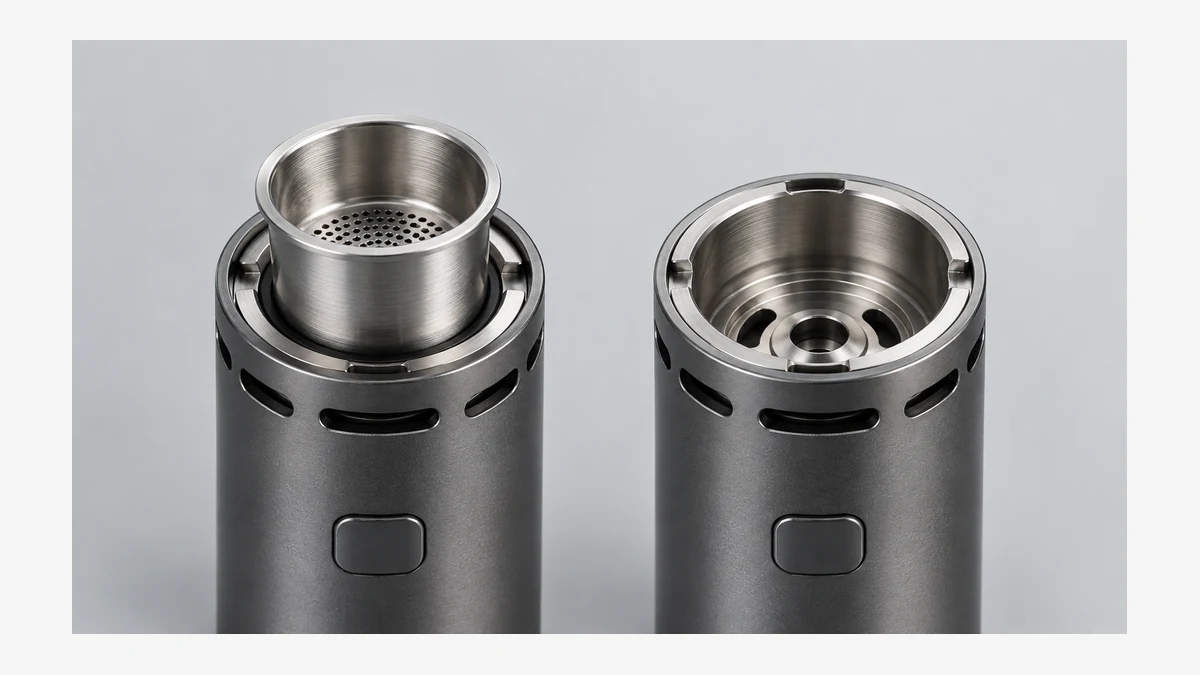
A dry herb vaporizer’s chamber (sometimes called the oven) is the fixed cavity built into the device where ground material sits during heating. A dosing cup, sometimes called a dosing capsule or dosing pod, is a separate, removable, mesh-bottomed container that drops into that chamber. The cup is not the chamber. It is an insert that sits inside the chamber and is itself the thing in direct contact with the herb.
This distinction matters because the two hardware approaches handle heat and air differently. A device with no cup system heats the herb directly against the chamber wall and screen. A device designed around cups heats the herb through an additional metal or ceramic layer, with the cup acting as an intermediary between the chamber wall and the material inside it.
The confusion in the Volcano question above comes from assuming any vaporizer chamber can accept any dosing cup. In practice, cup systems are built for a specific chamber geometry on a specific product line. A balloon-valve device’s filling chamber and a capsule-based device’s oven are not necessarily sized, threaded, or shaped to accept the same insert, even when both come from the same manufacturer’s broader catalog.
📐 2. How Cup Fit Relates to Chamber Tolerance
🌬️ 2.1. Diameter and Height Tolerances
A dosing cup has to match the chamber’s inner diameter and depth closely enough that it seats flush, with no significant gap around its sides and no excess height that would prevent the chamber lid or cap from closing fully. Manufacturers machine these parts to tight tolerances on purpose, because a loose cup changes how air moves around it, and an oversized cup simply will not seat.
🔥 2.2. Why One Brand’s Cup Rarely Fits Another Device
Because chamber dimensions vary by device, and even by generation within the same product family, a cup designed for one chamber is unlikely to fit another without noticeable play or resistance. Reddit threads asking whether a given capsule “fits” a given device are really asking a dimensional-tolerance question, not a brand-compatibility preference. If the cup is visibly loose, tilts inside the chamber, or needs force to remove, it was not made for that chamber, regardless of what the packaging implies.
For related component context, see the dry-herb vaporizer overview.
🧩 3. Heat Transfer Through a Metal Cup
🔍 3.1. Conduction Path: Chamber Wall to Cup to Herb
In a direct-load chamber, the chamber wall heats the herb largely through direct conduction and some convective airflow. When a cup is introduced, there is an added conduction step: the chamber wall heats the cup’s metal body, and the cup then transfers that heat into the herb packed inside it. This added layer means the herb is one step removed from the heat source compared to loading straight into the chamber.
🧼 3.2. Convection and the Role of the Mesh Screen
Most dosing cups have a perforated or mesh base rather than a solid bottom. This mesh allows heated air drawn through the device to pass through the herb inside the cup rather than only around it. The size and density of that mesh affects how much convective airflow reaches the material versus how much the user relies on conduction from the cup walls alone. A clogged or coated mesh screen reduces this airflow path, which is one reason cup maintenance has a direct effect on how the device performs over repeated use.
⚙️ 4. Airflow and Draw Resistance
🧱 4.1. Gaps Around the Cup
Draw resistance depends partly on whether air is forced through the herb or allowed to bypass it. A cup that fits loosely in its chamber leaves a gap along the sides, and air drawn through the device will take the path of least resistance, moving around the cup rather than through the packed herb and mesh. This bypass airflow does not pass through the material and contributes to inconsistent heating session to session, since the proportion of air that goes around the cup versus through it is not fixed.
💧 4.2. Sealed Fit and Consistency
When a cup is correctly sized for its chamber, there is minimal space for air to travel anywhere other than through the mesh and the packed material. This is the main functional argument for using a cup system over loose-fill loading: it standardizes the airflow path from one loaded cup to the next, provided the cups themselves are packed with a similar density and grind consistency each time.
🧲 5. Loading Cups vs Loading Chamber Directly
📏 5.1. Grind Size and Packing Density
Because airflow in a cup system depends on air passing through the mesh and the herb bed above it, grind consistency matters more than it might in a direct-load chamber with a shallower material bed. Herb ground too coarsely leaves large air pockets that let air bypass smaller particles; herb ground too fine can compact against the mesh and restrict airflow through the screen itself. Neither failure mode is unique to cup systems, but the enclosed geometry of a cup makes the effect more noticeable, since there is no way to loosen or redistribute the pack once the lid is on and the cup is seated.
🔌 5.2. Pre-Loading Multiple Cups
One practical reason cup systems exist is to allow a cup to be packed in advance and carried separately from the device, then dropped into the chamber when needed. This separates the loading step from the heating step in time and location. It does not change how heat or airflow interacts with the herb once the cup is seated; the physical relationships described above apply the same way whether the cup was packed a minute ago or earlier in the day.
🔋 6. Residue Control and Cleaning Boundaries
🖥️ 6.1. Where Residue Accumulates
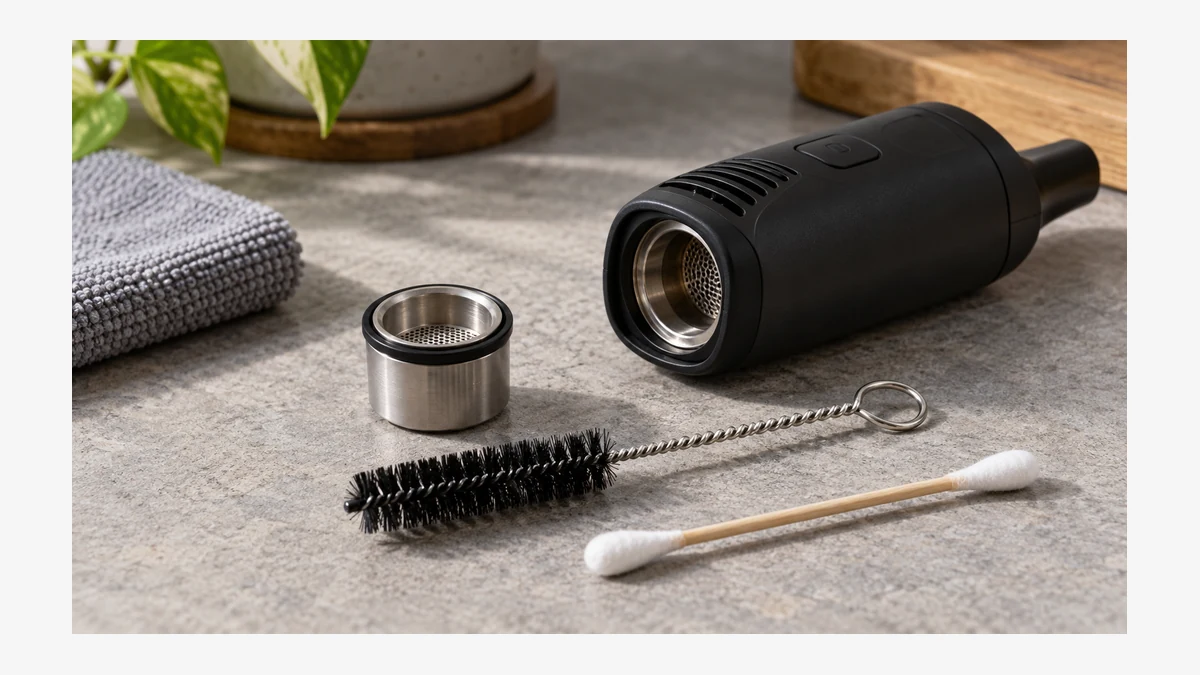
Heating plant material releases oils and particulate that condense on nearby surfaces. In a cup system, a meaningful share of that residue collects on the cup itself, particularly on the mesh screen and interior walls, rather than directly on the chamber wall. This is a shift in location, not an elimination of the maintenance task: the chamber still needs attention, but the cup becomes an additional component that accumulates residue on its own and needs to be addressed separately.
🧪 6.2. Cleaning the Cup Without Damaging the Mesh
The mesh screen is the part most likely to be damaged by cleaning methods that are too aggressive. Scraping it with a hard metal tool can bend or tear the screen, which changes its airflow characteristics permanently. Soaking in isopropyl alcohol and using a soft brush is the common approach for loosening residue without deforming the mesh, followed by thorough air-drying before the cup goes back into use, since residual alcohol near a heat source is a basic safety concern.
🛠️ 6.3. Cleaning Boundaries Between Cup and Chamber
The cup and the chamber it sits in are cleaned separately and on different schedules, because they accumulate residue at different rates and are made of different materials in many designs. Cleaning only the chamber while ignoring a buildup of residue on the cup’s mesh will not restore full airflow, since the restriction sits on the cup, not the chamber wall. Conversely, a spotless cup inserted into a heavily residue-coated chamber will not fix airflow problems that originate from the chamber side. Tracking both separately is the more reliable approach than treating “cleaning the vaporizer” as a single undifferentiated task.
For related component context, see the dosing capsule guide.
| Hardware Component | Primary Function | Main Maintenance Concern |
|---|---|---|
| Chamber / oven | Fixed cavity that houses the cup or loose herb and applies primary heat | Residue buildup on walls and base screen |
| Dosing cup / capsule | Removable vessel that holds pre-loaded herb and seats inside the chamber | Mesh clogging, residue on interior walls |
| Mesh screen (cup base) | Allows convective airflow through the packed herb | Physical damage from scraping, restricted airflow from buildup |
| Chamber lid / cap | Seals the chamber and keeps the cup seated correctly | Wear at the seal point affecting fit tightness over time |
For related component context, see the conduction and convection explanation.
📋 7. Practical Hardware-Identification Takeaway
Before assuming a dosing cup will work with a given device, check three physical facts rather than relying on general brand familiarity: whether the cup’s outer diameter matches the chamber’s inner diameter with minimal gap, whether the cup’s height allows the chamber lid or cap to close fully without force, and whether the mesh screen is intact and allows air to pass freely when held up to light. If any of these fail, the cup is not a match for that chamber, regardless of what product family it came from. Confirming fit this way, and cleaning the cup and chamber as two distinct maintenance tasks rather than one, resolves most of the confusion that starts with questions like “does this capsule work with my vaporizer.”
✅ 8. Fit Can Be Checked Without Guessing
A compatibility check starts with documentation, not trial-and-error. Compare the device model and generation, the chamber opening, the cup’s outside diameter and overall height, and whether the cup needs a separate lid or carrier. Product-family names alone are not enough because manufacturers sometimes revise chambers while keeping familiar naming.
With the device cold and powered off, a correct empty cup should lower into place without force and lift out without scraping. The top should not hold the cap open. There also needs to be a defined air route through or around the insert. A cup that merely fits inside the opening can still block an inlet, bypass the load, or rattle because its intended carrier is missing.
🧯 8.1. Capacity Is Secondary to Geometry
A deeper cup may appear to offer more room, but height changes the distance to the lid, screen, and heater. Packing beyond the cup’s intended volume can press material into the cap and restrict flow. Conversely, a very shallow insert in a deep chamber can leave an uncontrolled air gap. The useful specification is the complete cup-and-chamber relationship, not cup volume in isolation.
🌀 8.2. Treat the Cup as a Device-Specific Service Part
Keep the cup with the vaporizer it was designed for and inspect the rim, base, and perforations after cleaning. A bent rim changes seating; blocked perforations change airflow; baked residue changes how readily the part releases. If replacement dimensions or compatibility are not documented, the safest conclusion is that visual similarity does not prove interchangeability.
Before ordering a replacement, compare the cup drawing with the chamber manual and confirm whether a lid, screen, or carrier is part of the system. That documentation check prevents most category mistakes and gives cleaning instructions a defined material and part number. Photograph the cold, empty chamber and record the device generation before discarding a damaged cup, since small rim and base differences can be easier to compare visually than from memory.