Search for “smell proof weed grinder” and the term starts to feel like a yes-or-no spec, the same way “waterproof” implies a rating. It isn’t. A grinder is a machine with moving parts, exposed threads, and an open chamber that has to come apart every time you use it. Whatever containment it offers comes from how well those parts fit together, not from a stamped label. Several recurring questions in grinder discussions circle the same confusion: why does a grinder marketed as smell proof still leak odor after a few weeks, and what is actually supposed to be sealing it in the first place. The answer sits in five physical details — threads, gaskets, lid overlap, residue, and handling — and each one degrades or helps independently of the others.
🧭 1. What “Smell Proof” Actually Means for a Grinder
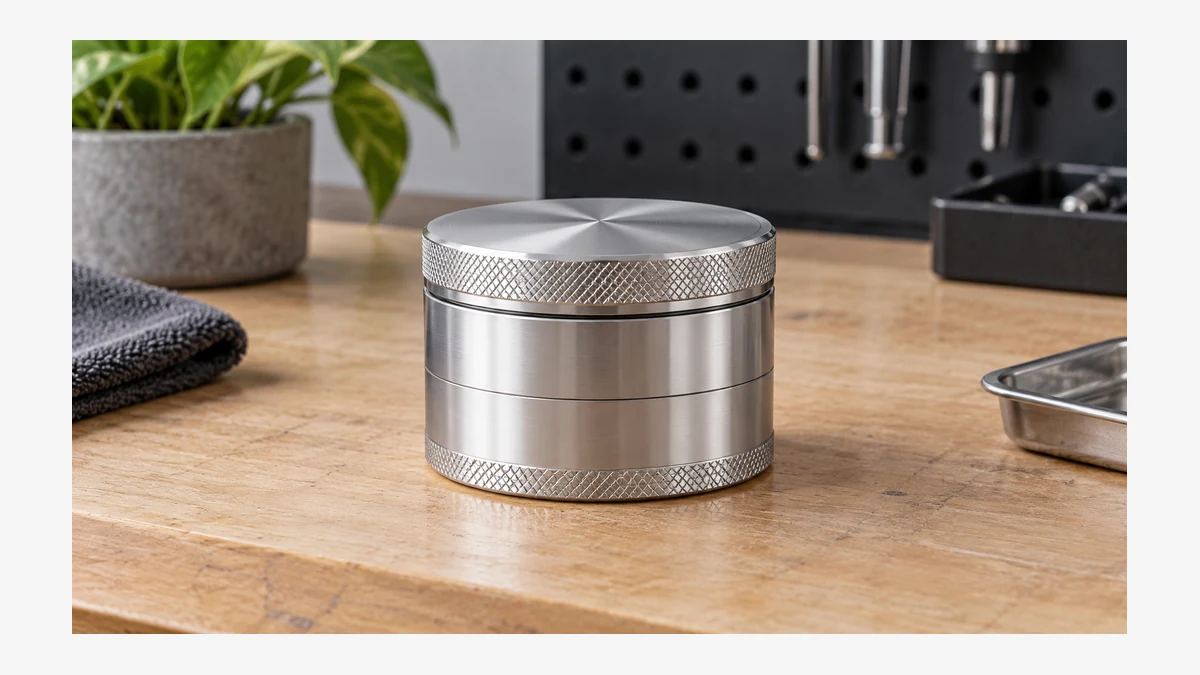
No consumer grinder is hermetically sealed. Metal and plastic parts that are manufactured to be unscrewed, opened, and cleaned by hand will never match the seal of a welded or gasket-bonded container designed never to be reopened. What manufacturers mean by “smell proof” is closer to “odor-reduced under normal handling” — a grinder with tighter tolerances, a gasket, and a well-fitted lid will contain more odor than one without those features, but containment is a spectrum, not a switch.
📐 1.1. Odor Containment vs. Odor Reduction
Odor containment implies zero escape; odor reduction implies meaningfully less escape than a baseline. Grinder hardware only ever delivers the second. Volatile compounds in ground plant material are small enough to migrate through microscopic gaps, residue films, and porous plastics over time, even when a lid looks perfectly flush. The practical question isn’t “does this seal completely” but “how long does this stay meaningfully reduced before it needs cleaning or resealing.”
🌬️ 1.2. Why Marketing Language Causes Confusion
Terms like “airtight,” “smell proof,” and “sealed lid” get used interchangeably in product listings even though they describe different mechanical features. An airtight claim refers to the absence of air exchange, which is a pressure/fit property. A sealed lid may just mean the lid has an overlap edge, with no gasket at all. Without a shared vocabulary, buyers reasonably assume more engineering than is actually present, and the resulting disappointment gets attributed to the whole category rather than to a specific missing part.
| Term seen in listings | What it usually means mechanically |
|---|---|
| Smell proof | Marketing shorthand, no fixed engineering standard |
| Airtight | Gasket or O-ring present, claims about pressure fit |
| Sealed lid | Lid has an overlap edge; gasket not guaranteed |
| CNC machined | Tighter manufacturing tolerances, better thread fit |
🔥 2. Threads: The First Seal Point
Before a lid or gasket ever comes into play, the threads connecting the grinder’s sections are the first and most continuous barrier against odor. Every chamber in a grinder — the cutting chamber, the kief catcher, the base — is held together by threading, and the quality of that threading determines how tight the gap is at every seam.
🧩 2.1. Thread Pitch and Engagement
Thread pitch is the spacing between threads, and engagement is how many full turns the threads make contact before stopping. A grinder with fine pitch and several turns of engagement closes down to a smaller residual gap than one with coarse threads that bottom out after a turn and a half. Coarse threading is cheaper to manufacture and more tolerant of dirt, but it leaves a wider helical gap along the entire seam, which is exactly the kind of continuous path odor molecules travel through.
🔍 2.2. Metal vs. Plastic Threading Wear
Metal threads, typically aluminum, hold their shape better over repeated use. Plastic threads can deform slightly each time they are torqued closed, and that deformation accumulates — a grinder that closed snugly out of the box may close more loosely after months of regular twisting. This is a mechanical wear pattern, not a defect, and it explains why older grinders in otherwise good condition can perform worse on odor than when new, independent of cleaning.
For related component context, see the fine-grind herb grinder guide.
🧼 3. Gaskets and O-Rings
A gasket is the single component most responsible for the difference between a grinder that merely closes and one that actually compresses a seal. Not every grinder has one, and among those that do, placement and material vary enough to matter.
⚙️ 3.1. Material and Placement
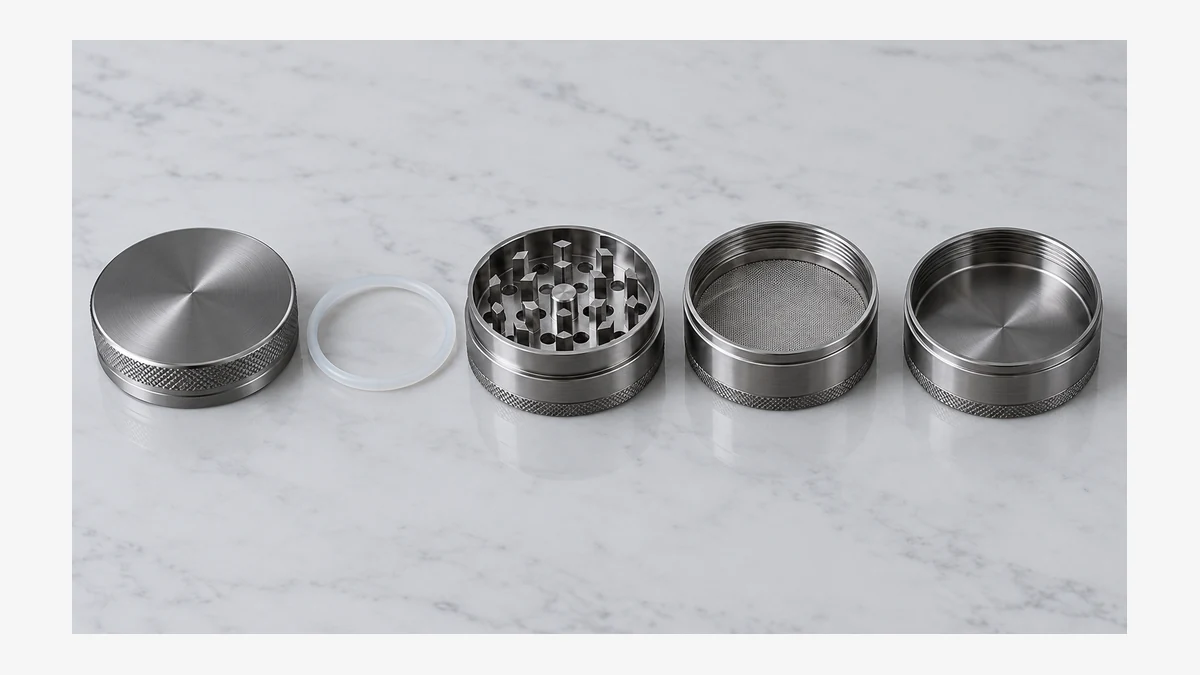
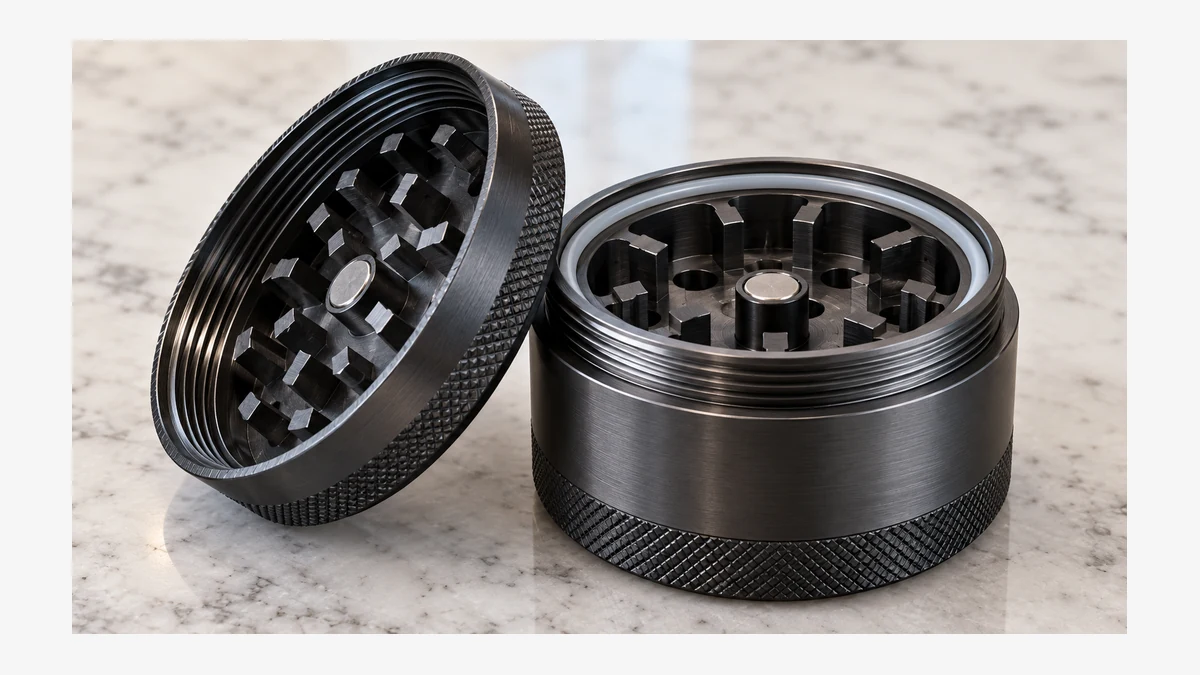
Most grinder gaskets are silicone or rubber O-rings seated in a groove between chamber sections. Their job is to compress slightly when the sections are screwed together, filling the microscopic irregularities that threading alone can’t close. Placement matters: a gasket positioned between the grinding chamber and the kief chamber does more useful work than one placed only at the very top lid, since the grinding chamber is where fresh plant material and its odor are most concentrated.
🧱 3.2. Degradation Over Time
Rubber and silicone gaskets lose elasticity with age, especially when exposed to oils and resin from ground material. A gasket that has flattened or cracked no longer compresses evenly, and the seal becomes inconsistent around its circumference rather than failing all at once. This gradual, uneven degradation is a common reason a grinder “used to work fine” and now doesn’t — the gasket, not the overall design, has reached the end of its useful compression range.
💧 4. Lid Overlap and Chamber Joints
The lid is the part people interact with most, so it gets the most scrutiny, but lid geometry is only one of several joints in a multi-chamber grinder, and all of them need to be evaluated together.
🧲 4.1. Flush-Fit vs. Overlap-Style Lids
A flush-fit lid sits level with the grinder body, relying entirely on thread tightness for its seal. An overlap-style lid extends down over the lip of the chamber below it, adding a second physical barrier in addition to the threads. Overlap designs generally contain odor better for the same thread quality, because escaping air has to travel a longer, more convoluted path before it is actually outside the device.
📏 4.2. Multi-Chamber Stacking Gaps
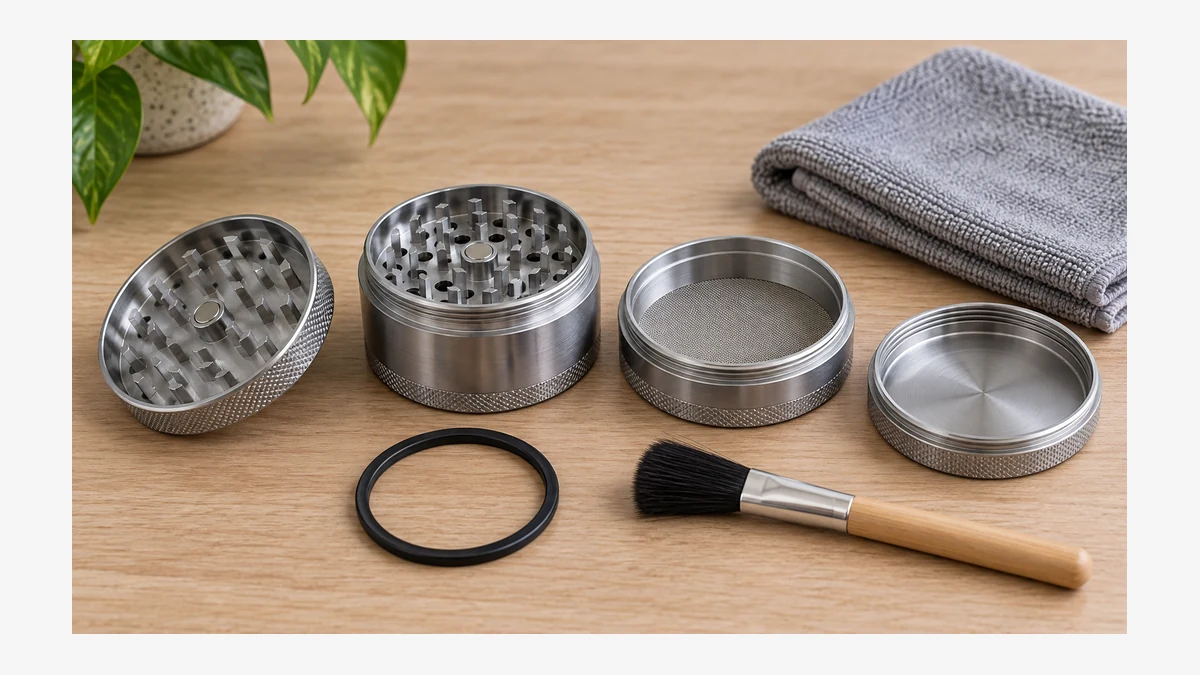
Grinders with three or four chambers have that many more joints, and odor only needs one weak joint to escape — the strength of the whole chain is set by its weakest link. A kief catcher at the bottom with a loose connection to the chamber above it can undermine an otherwise excellent lid and gasket at the top, since odor can travel upward through the internal screen before it ever reaches the top seal at all.
For related component context, see the grinder with dispenser guide.
🔌 5. Residue and Kief Buildup
Even a well-engineered grinder loses its seal if the sealing surfaces themselves are coated in residue. This is the mechanical factor most within a user’s control, and the one most often overlooked when odor performance is attributed only to design.
🔋 5.1. How Residue Defeats Seals
Sticky plant resin accumulates on threads, gasket grooves, and the inner lip of the lid with regular use. That buildup does two things: it physically props joints open by a fraction of a millimeter, preventing full thread engagement or gasket compression, and it becomes its own ongoing odor source sitting directly at the seam that is supposed to be sealed. A grinder can have excellent threading and a fresh gasket and still smell noticeably worse than a cleaner, lower-spec unit simply because of what has built up inside it.
🖥️ 5.2. Cleaning Cadence and Material Choice
Metal grinders tolerate isopropyl alcohol cleaning without degrading, which makes it realistic to fully strip residue from threads and gaskets periodically. Plastic or acrylic grinders are more limited in what they can be cleaned with, since some solvents cloud or weaken plastic over time, which means residue is more likely to accumulate gradually on these models. Checking threads and gasket grooves specifically, not just the main chamber, is the step most commonly skipped.
- Unscrew every section fully, not just the lid, during cleaning
- Wipe thread grooves directly rather than just the flat chamber surfaces
- Remove and inspect the gasket separately if it is a removable O-ring
- Let parts dry completely before reassembly to avoid trapping residue under a damp gasket
🧪 6. Handling and Storage Habits
The last variable isn’t a component at all — it’s frequency of use. How often a grinder is opened and how it’s stored between uses both affect real-world odor performance independent of the hardware itself.
🛠️ 6.1. Opening/Closing Frequency
Each open-and-close cycle is an opportunity for odor to escape before the seal re-engages, and it’s also a small amount of additional wear on threads and gasket compression. A grinder opened once a day behaves differently over its lifespan than one opened several times in a single session, even though the hardware is identical. This is a usage pattern, not a flaw, but it explains inconsistent experiences between two people using the same model.
📋 6.2. Pairing with Storage Bags or Cases
A grinder’s internal seal and an external storage bag solve different problems. The grinder’s seal is about containing odor during the time plant material sits inside the device; an outer bag or case is a second, independent barrier for when the grinder itself is being transported or stored long-term. Relying on only one of these, and expecting it to compensate for weaknesses in the other, is a common source of disappointment — a loose grinder lid isn’t fixed by an odor-proof bag if the grinder is opened frequently while inside it, and a tight grinder doesn’t need a redundant bag for short-term desk storage.
For related component context, see the automatic weed grinder guide.
Taken together, these five factors form a simple diagnostic order for evaluating any grinder’s real odor performance rather than trusting a label. Check thread engagement first by feeling how many full turns it takes to close each joint. Look for a visible gasket or O-ring between chambers, not just at the lid. Note whether the lid design overlaps the body or sits flush. Inspect threads and gasket grooves for resin buildup before assuming the hardware is underperforming. And match handling habits — frequency of use, pairing with external storage — to how the grinder is actually being used day to day. A grinder that scores well on these points will reduce odor meaningfully; one that’s missing several will not, regardless of what the packaging claims.
✅ 7. Odor Containment Is a System Property
A grinder can reduce odor escape only when every joint in the closed stack is reasonably continuous. The lid interface receives the most attention, but lower collection sections and removable screens create additional threaded paths. A gasket at one level cannot compensate for a loose lower chamber.
Check the empty grinder under bright light. The lid should sit level, the gasket should remain in its groove, and the threads should engage smoothly for several turns. Cross-threading leaves an uneven gap even when the outside looks closed. Resinous residue can also hold a lid slightly proud of its seat, so cleaning the mating faces is part of preserving the seal.
🧯 7.1. Storage Claims Need Boundaries
“Smell proof” should not be read as an absolute laboratory rating unless a test method is supplied. Odor can transfer to the exterior during handling, and opening the grinder releases whatever the closed body contained. For longer storage, the grinder itself is still a frequently opened working tool; a separate documented container provides a clearer containment boundary.
A practical inspection should also include the exterior. Odor-bearing residue on knurling, magnets, or the collection rim bypasses every internal seal. Wipe the outside after handling and let washed parts dry before closing them, because trapped moisture creates a different maintenance problem without improving containment.