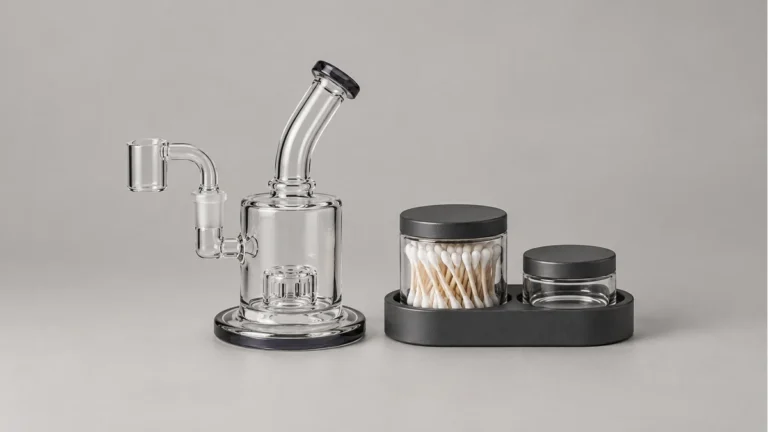
A novelty dab rig shaped like a juice box, a soda bottle, or a stacked carton draws attention for the sculpture, but the questions that show up in maker threads are almost never about the theme. They’re about whether the piece sits flat on a table, where the joint lands relative to the torch hand, and whether a narrow decorative neck chokes off airflow. One recent build thread asked the community to help name an oddly folded accordion-style piece, another documented a “bottle inception” design with one vessel nested inside another, and a third simply asked “what would you call this?” about a rig that didn’t match any standard silhouette. None of those threads were really about labels. They were about people trying to describe hardware that didn’t fit the vocabulary they already had for base, neck, and chamber. That gap between a fun shape and a functional description is exactly where buyers run into trouble, because a carton-shaped rig still has to behave like a rig first.
🧭 1. Why Novelty Shapes Raise Hardware Questions First
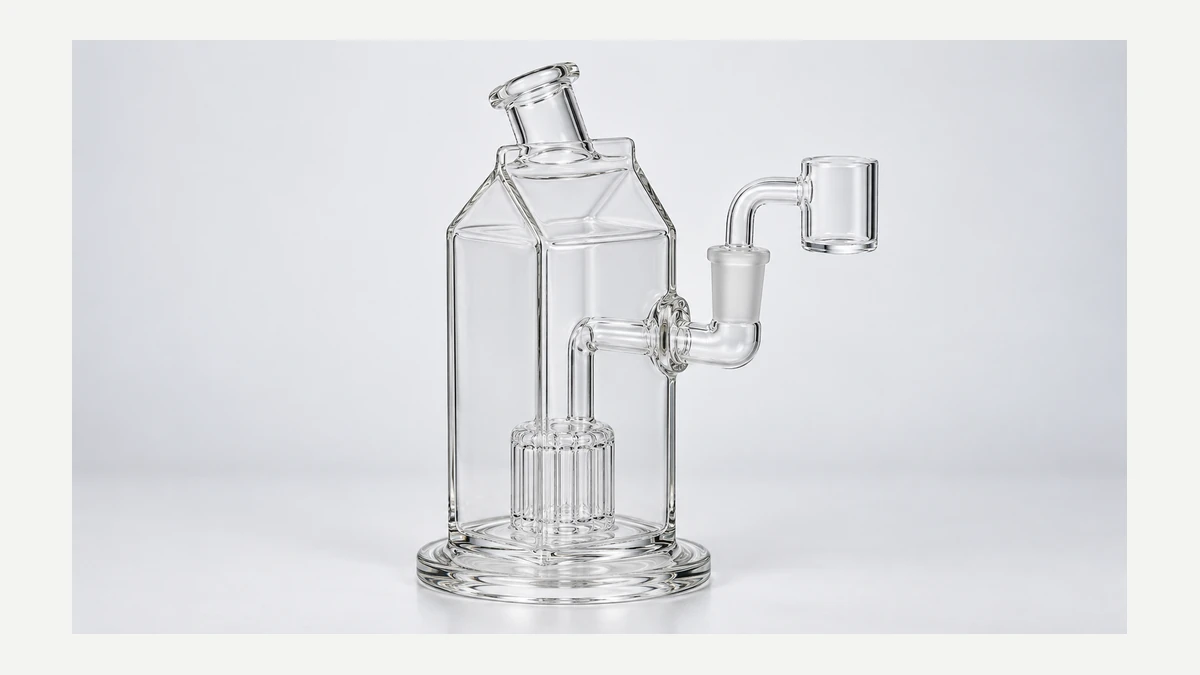
A juice box or carton rig replaces the familiar cylinder or beaker base with a rectangular or faceted footprint. That change isn’t cosmetic — it shifts where the glass is thickest, where stress concentrates at seams, and how the piece distributes weight when it’s full of water. A round base spreads a knock evenly around its circumference. A boxy base with flat panels and corners concentrates force at the edges, which is also where glass is usually thinnest if the maker tapered the walls for the sculpted look.
Stability on a table follows the same logic. A wide, flat-bottomed carton shape can actually sit more securely than a narrow cylinder, provided the base diameter is large relative to the height of the piece. The problem shows up when a tall, narrow “juice box” proportion is paired with a top-heavy neck or an off-center mouthpiece, because that combination raises the center of gravity above a base that was designed to look like packaging rather than to anchor glass. Before anything else, a novelty rig should be evaluated the way any functional piece is: does the footprint match the height, and does the piece return to vertical on its own if it’s nudged.
🧩 2. Joint Placement and Angle on Non-Cylindrical Bodies
On a standard beaker or straight-tube rig, the joint angle is chosen so the torch has clear access without the user’s hand crossing over hot glass or a full water chamber. Carton and box-shaped rigs complicate that geometry because the maker has to fit a joint into a flat panel instead of a curved wall, which changes both the angle options and the clearance around the joint.
📏 2.1. Angle Considerations
A joint set too close to a corner or seam on a box-shaped body leaves little room for the banger or nail to sit without touching an adjacent panel. A joint set on a flat front panel, by contrast, can actually offer a cleaner, more predictable angle than a curved wall would, since the flat surface gives the glassblower a consistent reference plane to work from.
🌬️ 2.2. Joint Size Standardization
Regardless of the exterior shape, the joint size and gender still need to match standard banger and connector hardware — most commonly 14mm or 18mm female. A novelty shape is not a reason to deviate from standard joint sizing, and any rig that uses a nonstandard joint diameter limits which accessories will physically fit, independent of how well the rest of the piece is built.
📏 3. Chamber Path and Percolation Inside an Irregular Shape
The internal path smoke and vapor travel from the joint, through any percolation, and up to the mouthpiece determines how the rig actually performs. On a sculpted carton body, that path has to bend around decorative elements — a straw-like spout, a folded “flap” at the top, or a narrow neck meant to evoke a bottle cap — without creating unnecessary restriction.
🌬️ 3.1. Diffusion and Chamber Geometry
A percolator or diffused downstem works by breaking vapor into smaller bubbles as it passes through water, which increases surface contact and cools the vapor before it reaches the mouthpiece. That function depends on chamber volume and percolator placement, not on the exterior silhouette. A carton-shaped chamber can house a standard percolator design as long as there’s enough internal width for the percolator to sit without touching the chamber walls.
⚖️ 3.2. Airflow Restriction from Decorative Necks
The more a novelty rig narrows its neck for visual effect — to mimic a juice box straw hole or a bottle spout — the more it risks creating a bottleneck that restricts airflow regardless of how well the lower chamber is built. A neck narrow enough to look accurate to the theme can end up narrower than the rig’s own joint or downstem opening, which creates a restriction point that has nothing to do with percolation and everything to do with geometry.
🌬️ 4. Waterline Visibility Through Carton-Style Walls
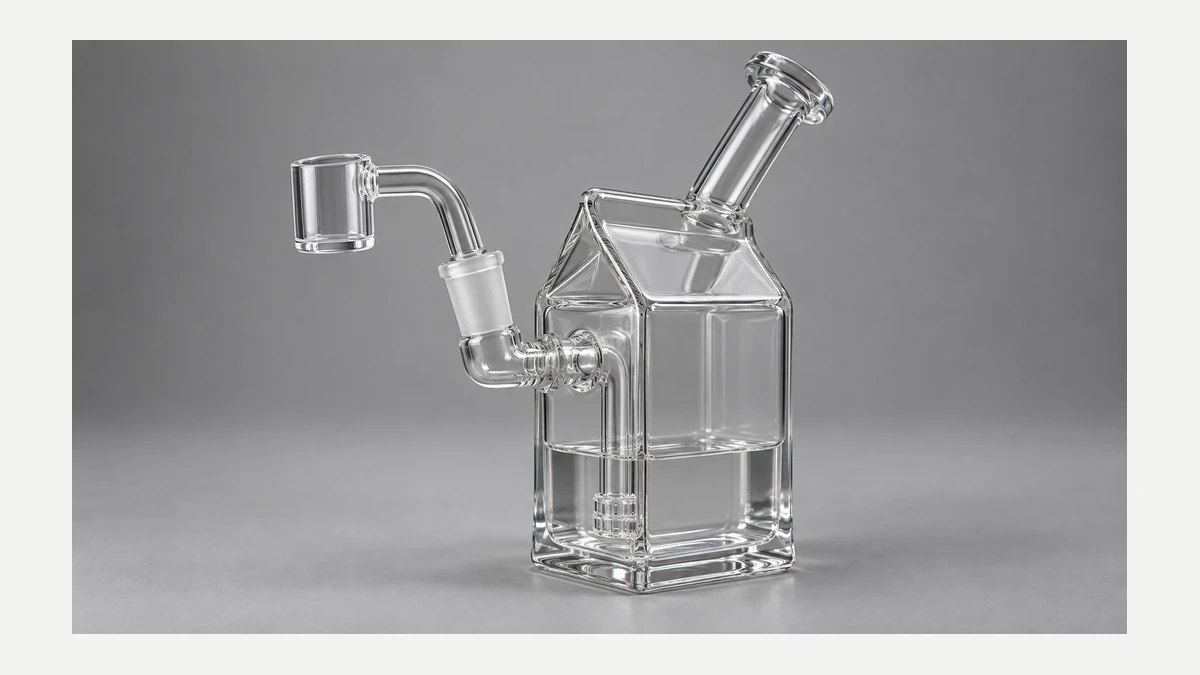
One of the more practical complaints in build threads about boxy or carton-shaped rigs involves not being able to see the waterline clearly before use. A cylindrical rig made of clear borosilicate gives a full view of the water level from any angle. A carton-shaped piece with flat or frosted panels, color accents, or printed/etched graphics can obscure that view substantially.
⚖️ 4.1. Viewing Windows and Opaque Panels
Some novelty builds solve this by leaving one panel clear as a viewing window while decorating the rest, similar to how a label wraps a real juice box but leaves a gap. Others keep the entire body opaque or heavily tinted for the sake of the theme, which means the user has to estimate water level by weight or by removing the joint attachment to check directly.
🧼 4.2. Splash-Back Risk When Visibility Is Limited
Not being able to see the waterline matters because overfilling a chamber increases the chance of water traveling up into the mouthpiece during use. On a rig where the chamber shape is already irregular — angled panels, internal baffles meant to look like folded cardboard — the margin between a correct waterline and an overfilled one can be narrower than on a simple cylindrical chamber, simply because the usable internal volume is less predictable at a glance.
⚖️ 5. Mouthpiece Clearance and Ergonomics
A juice box theme naturally suggests a straw-style mouthpiece, and several build threads lean into that by adding a narrow tube at an angle reminiscent of a straw poking through a carton. That detail is where form and function most directly compete.
🧼 5.1. Handle and Spout-Style Mouthpieces
A straw-style mouthpiece set at a sharp angle changes how the user has to hold and tilt the rig during use compared to a vertical mouthpiece centered over the chamber. That’s not necessarily a flaw, but it does mean the piece should be tested for comfortable lip and hand positioning before assuming the angled mouthpiece works the same way a standard one does.
🔍 5.2. Clearance from Decorative Elements
Handles, folded “flap” details, or an attached carton-style cap near the mouthpiece can interfere with grip or with access to the joint. A mouthpiece needs enough clearance around it that the user’s hand isn’t forced against a decorative edge while lighting or adjusting the piece.
🧼 6. Cleaning Access on Sculpted Novelty Rigs
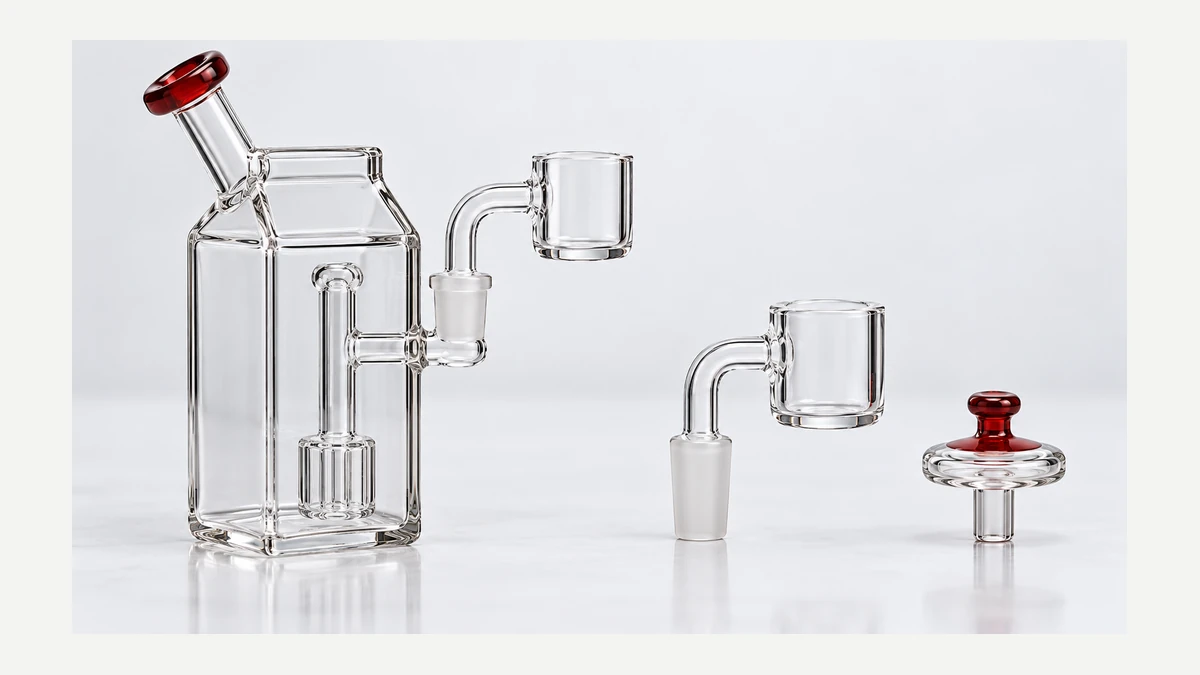
Cleaning is where novelty shape and function diverge most. A straight-tube or beaker rig can be cleaned with a bottle brush or by swirling cleaning solution through a wide, uninterrupted chamber. A carton or box-shaped rig with internal folds, narrow necks, or percolators tucked behind decorative panels makes that same process harder.
🔍 6.1. Narrow Necks and Internal Corners
Residue tends to collect in corners and narrow transitions more than on smooth curved walls, simply because those spots get less direct contact from swirling liquid or a brush. A rig with a carton-like silhouette, by nature, has more internal corners than a round piece of similar volume.
🧲 6.2. Maintenance Routine Adjustments
Below is a general comparison of what differs in care expectations between a standard cylindrical rig and a sculpted novelty shape with similar percolation.
| Factor | Standard Cylindrical Rig | Carton/Box-Style Novelty Rig |
|---|---|---|
| Brush access | Straight path, standard bottle brush fits | May require a flexible or pipe-cleaner style brush for corners |
| Soak effectiveness | Even contact across curved walls | Corners and flat-panel seams may need extra soak time |
| Waterline check during cleaning | Visible through clear walls | May require removing joint hardware to check fully |
| Drying | Air flows evenly through open chamber | Narrow necks or baffles can trap moisture longer |
None of this means a novelty shape is harder to own responsibly — it means the cleaning routine should be adjusted to the actual internal geometry rather than assumed to match a standard tube just because the exterior looks playful.
🔍 7. Terminology Confusion: Naming a Shape vs Naming a Function
Part of why novelty rigs generate so much discussion around what to even call them is that glass terminology was built around function — recycler, straight tube, bent-neck, showerhead perc — not around theme. A build that folds glass to resemble an accordion, or nests one vessel inside another like a bottle-within-a-bottle, doesn’t map cleanly onto that existing vocabulary, which is why makers end up asking the community for a name rather than reaching for an established term.
That naming gap is worth separating from the functional one. A rig can be hard to categorize by shape and still be straightforward to evaluate by the same criteria as any other piece: base stability, joint size and placement, chamber path, visible waterline, mouthpiece clearance, and cleaning access. The carton or bottle theme is a design layer on top of that hardware, not a replacement for it. When a shape doesn’t have an obvious name, it’s a sign to look more closely at the underlying structure — not to assume the novelty label tells you anything about how it performs.
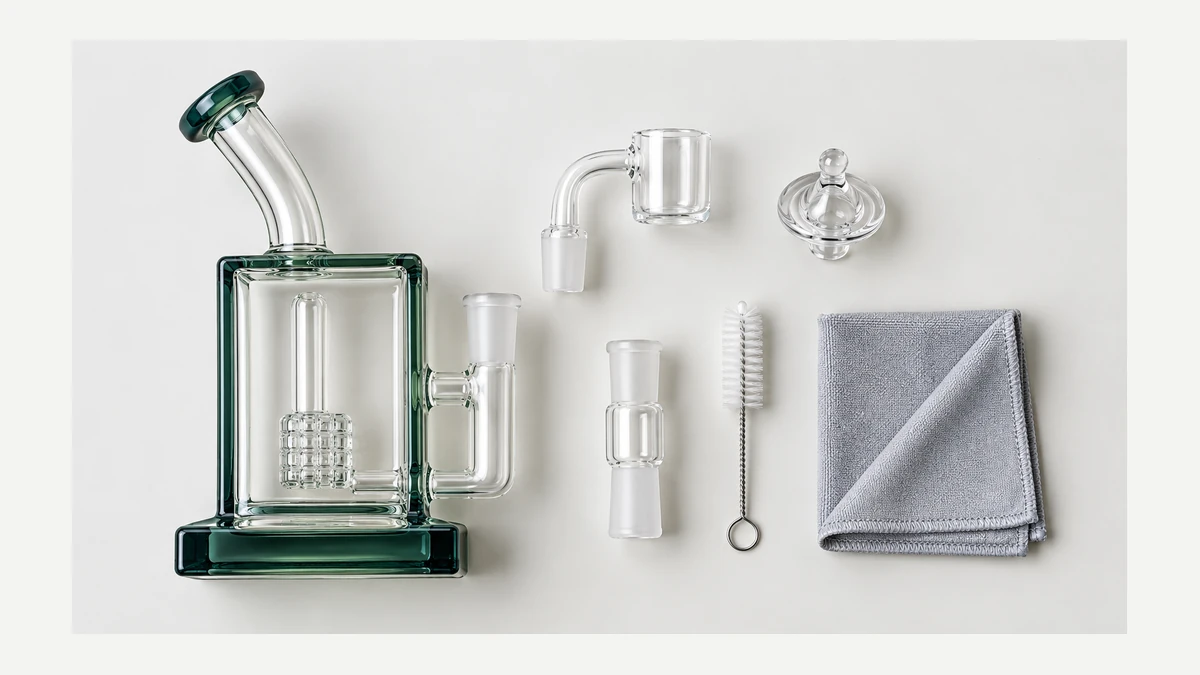
🧲 8. Checklist for Evaluating a Juice Box or Novelty-Shaped Rig
- Base footprint is wide enough relative to height that the piece self-rights when bumped.
- Joint is a standard 14mm or 18mm size, positioned with clear torch access.
- Internal chamber width accommodates the percolator without crowding the walls.
- No neck or spout section is narrower than the joint or downstem opening.
- At least one clear panel or window allows a direct view of the waterline.
- Mouthpiece has enough clearance from handles, flaps, or other decorative details.
- Internal corners and narrow necks are reachable with a flexible brush or extended soak.
A juice box or carton-shaped dab rig can be a genuinely well-built piece, but the theme itself proves nothing about the hardware underneath it. The practical move is to treat the exterior as decoration and inspect the piece the same way you would any rig: check that the base holds the weight upright, confirm the joint is a standard size with real clearance, trace the chamber path for pinch points, look for a clear view of the waterline, test the mouthpiece angle for comfortable use, and think through how a brush or cleaning solution will actually reach every internal corner. If a piece passes those checks, the novelty shape is simply a bonus — not a substitute for the glass geometry that determines how it works.
🌊 9. ✅ Novelty Form Still Needs Ordinary Documentation
A juice box dab rig should still disclose joint size and gender, base dimensions, internal diffuser, waterline range, mouthpiece position, and included heated accessory. The carton reference describes the silhouette, not performance. Side and rear photographs are especially useful because they reveal whether the apparent box is the chamber itself or a decorative shell around a smaller airpath.