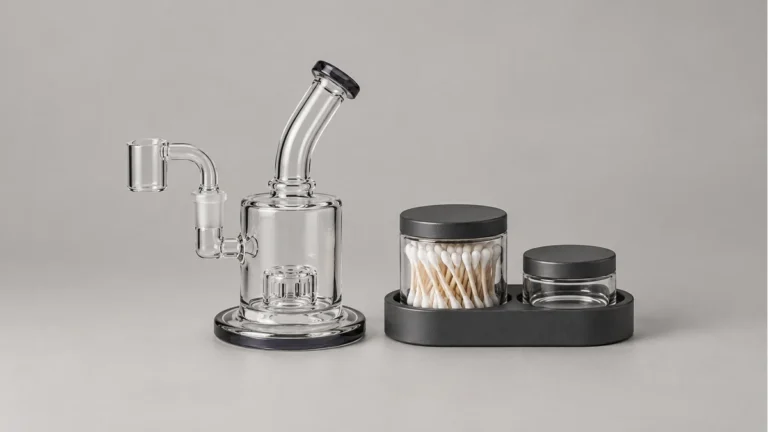
Rolling trays used to mean one thing: a rigid rectangle that either fit in your bag or it didn’t. Over the past few years, foldable rolling trays have carved out their own category, promising the same organized surface without the permanent shelf space. But “foldable” covers a lot of ground, from soft silicone mats that scrunch into a pocket to hinged rigid panels that fold like a laptop. Shoppers comparing these options are really asking one question: does the flat-pack version give up anything important to get its portability?
The short answer is that it depends heavily on construction. A well-built foldable tray can match a rigid one on usable surface area, wall height, and cleanability while beating it on storage. A poorly built one turns into a floppy mess the first time you set something heavier than a lighter on it. This guide walks through the materials, the hardware details, and the everyday complaints that separate a tray worth buying from one that ends up in a drawer.
🧭 1. Why People Are Switching to Flat-Pack Trays
The appeal of a foldable rolling tray starts with a simple frustration: rigid trays are only convenient when you’re not moving them. The moment a tray needs to travel — in a bag, a car console, a drawer with limited height — a fixed 11×7-inch slab becomes awkward. Foldable designs solve the storage problem directly, collapsing down to a fraction of their open size.
The second driver is organization. People don’t just want a flat surface; they want a surface with raised edges that stop small items from rolling off, and increasingly they want built-in pockets or loops for tools so nothing gets separated during a fold-and-stash cycle. A tray that also functions as light tool storage, similar in spirit to what’s covered in this dab tool holder guide, tends to earn more daily use than one that’s just a flat mat.
The third driver, less discussed but very real in forum threads, is cleaning. A tray with fewer seams and no fabric weave is easier to wipe down between sessions, which matters more to most owners than any other single feature.
🧵 2. The Four Main Construction Types
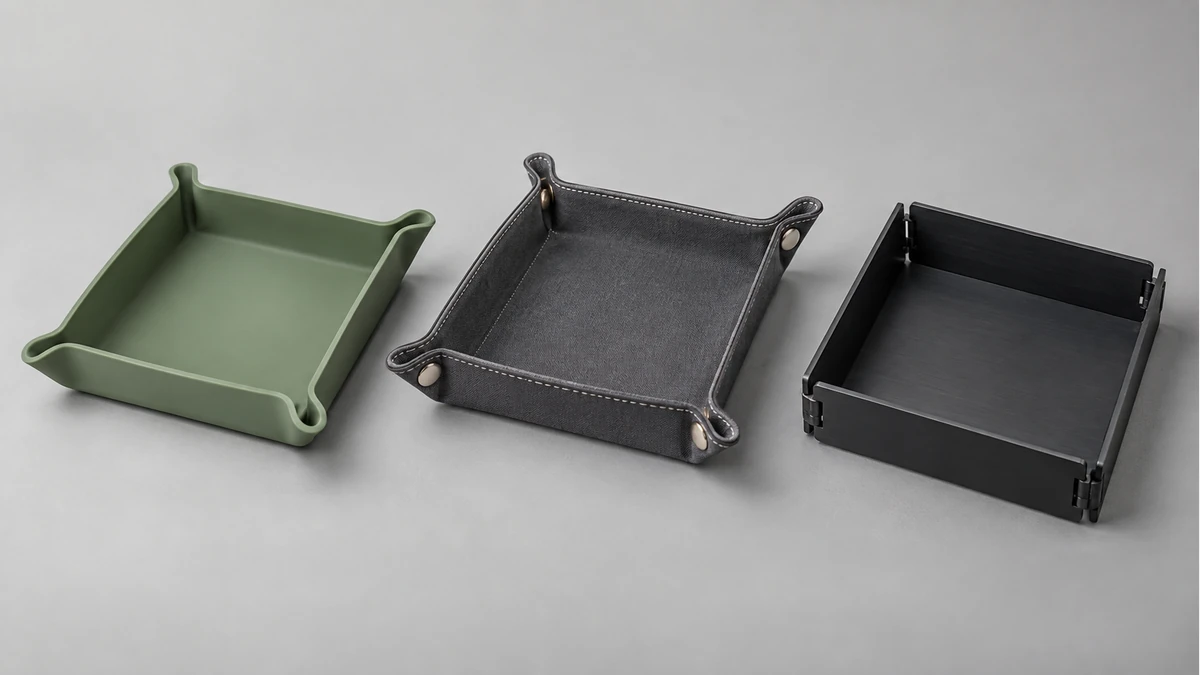
Almost every foldable rolling tray on the market falls into one of four construction families. Each has a different failure mode, so understanding them changes what you should actually test before buying.
🟢 2.1 Silicone Trays
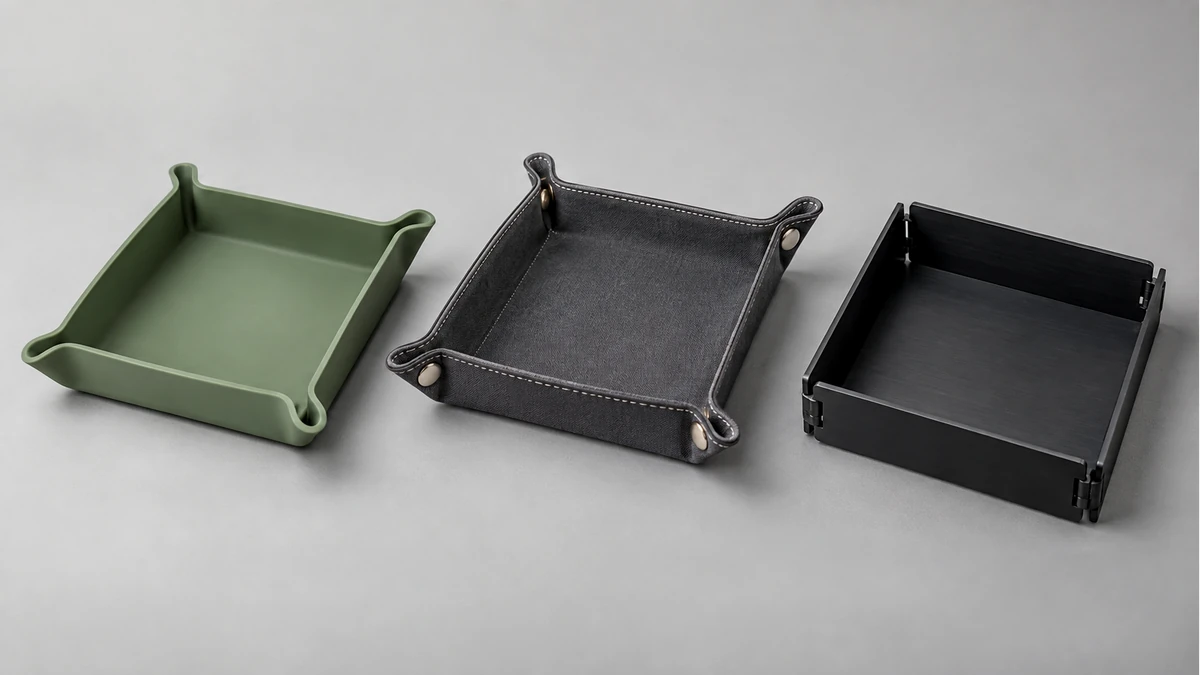
Silicone is the most common material because it’s naturally flexible, wipes clean easily, and tolerates a reasonable amount of heat without warping. A silicone tray typically has molded raised walls and sometimes a slightly textured base to keep small objects from sliding. The fold comes from the material’s own elasticity rather than a hinge, so the tray can be rolled or flattened into almost any shape for storage.
The tradeoff is structural. Thin, cheap silicone sags in the middle under any real weight, which is the “floppy center” complaint that shows up constantly in product reviews. Thicker, higher-durometer silicone solves this but adds bulk, partially undercutting the “folds flat” selling point. The best silicone trays use a reinforced base layer — often a thin fiberglass mesh or a stiffer inner silicone core — sandwiched between softer outer layers.
🟡 2.2 Coated Fabric Trays
Coated fabric trays use a woven base — usually polyester or nylon — laminated with a waterproof coating such as PU or PVC. These fold the way a placemat or a small tarp folds, creasing rather than flexing uniformly. They’re light, cheap to produce, and can be printed with detailed graphics, which is why they dominate the budget and novelty end of the market.
The weak point is the seam where the fabric edge meets any raised wall or binding. Over time, especially with repeated folding along the same crease, the coating can crack and expose the raw fabric underneath. Once that happens, residue and moisture get into the weave itself, and no amount of wiping fully removes it. This is the single most common long-term complaint about fabric trays in owner discussions.
🟤 2.3 Leather-Like Sheet Trays
PU leather or vegan leather sheet trays sit between silicone and coated fabric in feel. They have a firmer hand than fabric, a smoother non-porous surface, and often look more premium with a matte or pebbled finish. Because the sheet itself has some inherent stiffness, these trays can hold a flatter shape without needing thick padding.
Their main weakness is the material’s tendency to crack at fold lines after repeated use, particularly in colder environments where the PU coating becomes brittle. Quality varies enormously by supplier; a dense, well-formulated PU sheet can fold thousands of times without visible wear, while a cheap one shows white stress lines within weeks. Stitched or reinforced fold lines, rather than a single continuous crease, tend to hold up longest.
🔵 2.4 Hinged Rigid-Panel Trays
Instead of one flexible sheet, hinged rigid-panel trays use two or more solid panels — wood, dense plastic, or metal — connected by a fabric, silicone, or metal hinge along one or more edges. This is the closest thing to a “rigid tray that also folds,” and it solves the floppy-center problem outright because each panel is fully stiff on its own.
The compromise is bulk and hinge durability. A folded hinged tray is still roughly as thick as two stacked panels, so it never compresses down as small as a rolled silicone mat. The hinge is also the component most likely to fail, especially if it’s a thin fabric strip glued rather than stitched or riveted to the panels. When shoppers complain about “corners popping open” or “a folded tray that’s still bulky,” they’re usually describing this category.
📌 3. Corner Snaps and Fasteners
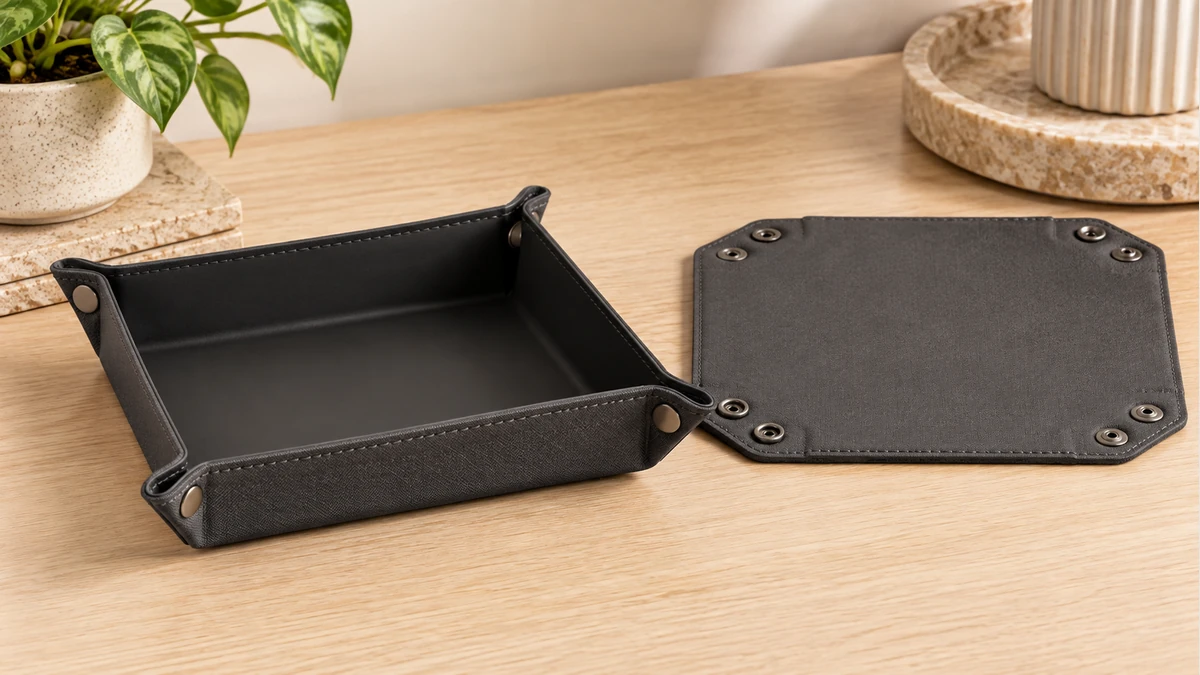
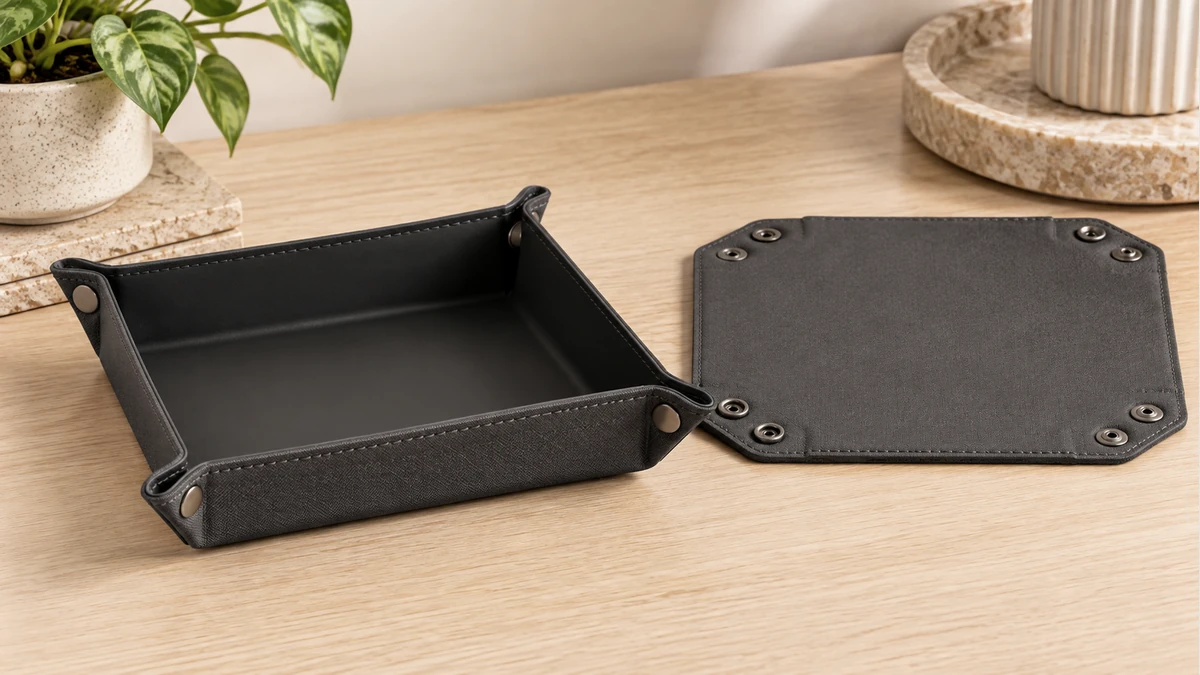
Whatever the base material, most foldable trays rely on some kind of corner fastener — a snap button, a magnetic tab, a hook-and-loop strip, or a simple clip — to hold the walls up once unfolded. This hardware gets far less attention than it deserves, because it’s the part that fails first in daily use.
Snap buttons are common because they’re cheap and give a satisfying, confident click, but the plastic or metal post they’re riveted to is only as strong as the material around it. In thin fabric or low-grade PU, repeated snapping stresses the same small area until it tears or the rivet backing pulls through. Magnetic corners avoid that wear pattern entirely since there’s no puncture point, but weaker magnets can pop open under the weight of a full tray. Hook-and-loop is the most forgiving option for longevity but wears out gradually as the loop fibers flatten, becoming less secure with each open-close cycle rather than failing all at once.
When comparing trays, it’s worth flexing a corner fastener by hand in a store, or checking review photos for close-ups of the snap area, before assuming it will hold up.
📏 4. Wall Height and Usable Flat Area
Two numbers matter more than the tray’s overall footprint: wall height and usable flat area. Wall height determines how forgiving the tray is — a taller lip keeps small items contained even if the tray gets bumped or tilted, while a shallow lip under half an inch is really just a visual border. Foldable trays generally have shorter walls than rigid trays because tall raised walls resist folding flat, so this is one of the genuine tradeoffs of the category rather than a manufacturing defect.
Usable flat area is the open, unobstructed center space, not the total exterior dimensions. Trays with thick corner hardware, integrated pockets, or curved inner walls can lose a surprising amount of real working surface compared to their listed size. It’s worth checking the interior floor measurement, not just the folded or overall dimensions listed on a product page.
🪨 5. Stiffness and Avoiding the Floppy Center
Stiffness is the property that most separates a good foldable tray from a bad one in everyday use, and it’s rarely listed as a spec. A tray needs enough rigidity that setting an item down doesn’t cause the whole surface to dip or tilt, but not so much stiffness that it resists folding or springs back open when stored.
Manufacturers balance this with layered construction: a firm inner core (fiberglass mesh, dense foam, or a semi-rigid plastic sheet) wrapped in a flexible outer material. Trays that skip the core entirely and rely on a single layer of silicone or fabric are the ones most likely to sag. A simple pre-purchase test, if you can handle the product in person, is to lay it flat and press down gently in the center — a well-built tray resists with even pressure across the surface rather than caving at one spot.
🧼 6. Seam Design and Cleaning
Seams are where residue collects, and they’re also where trays fail structurally over time. The two biggest culprits are the seam between the flat base and the raised wall, and any seam created by a fold line itself. A tray molded in one continuous piece, common in higher-end silicone designs, avoids the wall-to-base seam entirely and is noticeably easier to keep clean.
Fold-line seams are harder to eliminate because folding requires a hinge or crease somewhere. The best designs route that seam along a raised, non-contact edge rather than through the flat working surface, so residue never accumulates directly in the crease. Cleaning recommendations vary by material — a damp cloth and mild soap work for most silicone and PU trays, while fabric trays generally need spot cleaning only, since soaking the coating can accelerate delamination. For a broader look at keeping a full tray setup tidy, including small tool storage, the dab tray organizer guide covers cleaning routines in more depth.
🔥 7. Heat Boundaries
Foldable trays are frequently used near small heated tools, so heat tolerance matters even for a basic accessory tray. Food-grade silicone generally tolerates the highest sustained temperatures without deforming, which is part of why it remains the default choice for trays meant to sit near warm tools. Coated fabric and PU leather sheets have much lower heat ceilings; brief contact with something hot can leave a permanent scorch mark or melt spot, and repeated exposure accelerates the cracking discussed earlier. Rigid panel trays vary by panel material — wood chars, most plastics warp, and only certain heat-resistant composites hold up reliably.
None of this means any of these materials are unsafe when used sensibly; it just means a tray’s rated heat tolerance should match how it’s actually going to be used, and manufacturer guidance on maximum safe temperature is worth checking rather than assuming.
👃 8. Odor Containment
Odor containment in a tray context is mostly about material porosity rather than any special sealing feature. Non-porous surfaces like silicone and quality PU don’t absorb odor the way woven fabric does, so they’re easier to keep neutral-smelling with a simple wipe-down. Fabric trays, especially once the coating has any cracks, can hold onto odor in the weave itself, which is one more reason seam and coating integrity matters beyond just looks.
🧰 9. Accessory Pockets and Tool Organization
A growing number of foldable trays include small elastic loops, zippered pouches, or fabric slots along one edge specifically for holding tools upright and separated. This addresses a common complaint directly: loose tools sliding around and clattering together, or getting lost entirely, when a tray is folded and tossed in a bag.
The quality of these pockets varies as much as the tray material itself. Elastic loops loosen with repeated use and eventually stop holding tools snugly. Zippered pouches hold up longer but add bulk to the folded package. If tool organization is a priority alongside the tray surface itself, it’s worth looking at dedicated holder options, covered in the dab tool holder guide, and considering whether a combined tray-and-holder or two separate pieces better fits how you actually pack and unpack.
📊 11. Material Comparison Table
| Material | Fold Method | Stiffness | Heat Tolerance | Cleaning | Common Failure Point |
|---|---|---|---|---|---|
| Silicone | Flexes/rolls | Medium (needs reinforced core) | High | Wipe or rinse | Floppy center if too thin |
| Coated fabric | Creases at fold lines | Low | Low | Spot clean only | Coating cracks, seam wear |
| PU/leather-like sheet | Creases at fold lines | Medium | Low-medium | Wipe with damp cloth | Cracking at fold, cold brittleness |
| Hinged rigid panels | Hinges open/closed | High | Depends on panel material | Wipe (panel-dependent) | Hinge tearing, bulky when folded |
✅ 12. Buying Checklist
- Check the interior floor measurement, not just the tray’s overall folded or unfolded dimensions.
- Look closely at corner fasteners — snap, magnet, or hook-and-loop — and how they’re anchored to the material.
- Confirm wall height is enough to contain small items during normal handling, not just for display photos.
- Press the center of the tray if possible; it should resist evenly rather than sagging in one spot.
- Trace the fold-line seam and any wall-to-base seam for gaps where residue could collect.
- Match the material’s heat tolerance to how close it will actually sit to warm tools.
- Decide whether built-in pockets are worth the added folded bulk, or whether a separate holder makes more sense.
- If customization matters, weigh whether a printed fabric/PU design or a molded silicone color fits your budget and durability needs.