🔍 1. Why Does a Cart Get Clogged?
Before fixing the problem, it helps to understand what is actually happening inside the cartridge. A vape cart clogs in one of two distinct ways — and the fix depends on which type you are dealing with.
💧 1.1 Airflow Clog (Condensation in the Mouthpiece)
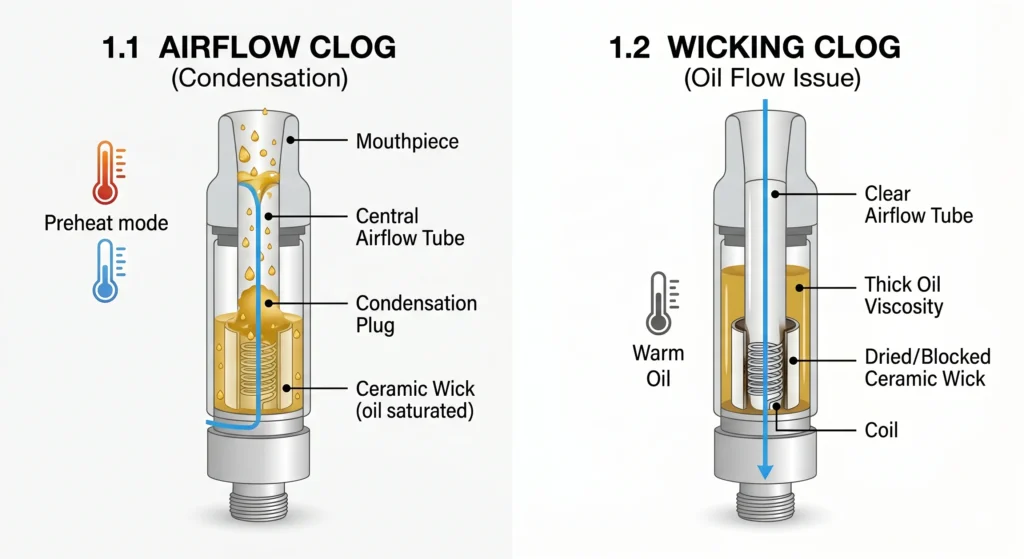
This is the most common type. Vapor that does not fully leave the cartridge during a session condenses back into liquid oil inside the airflow channel and mouthpiece. Over time — especially with frequent use or storage in varying temperatures — this condensation builds into a sticky plug that blocks airflow entirely.
Signs of an airflow clog:
- 🔇 No airflow at all — completely blocked draw
- 💧 Gurgling or bubbling sounds when you try to pull
- 🟡 Visible sticky residue around the mouthpiece opening
- ✅ Battery fires normally (LED lights up, you can feel heat) but nothing comes through
🍯 1.2 Wicking Clog (Oil Not Reaching the Coil)
This type is less obvious. The airflow path is clear, but the ceramic wick inside the cartridge is not absorbing oil fast enough — either because the oil is too cold and thick to flow, because the wick is saturated with residue, or because the oil level is very low.
Signs of a wicking clog:
- 💨 Airflow feels normal but vapor is very thin or nonexistent
- 🔥 Slightly harsh or burnt taste even with oil remaining in the cart
- 🌡️ Happens more in cold weather or after the cart has been sitting unused
📋 1.3 Common Root Causes
| Cause | How It Creates a Clog | Clog Type |
|---|---|---|
| Hard, aggressive puffing | Forces excess oil into the airflow channel | Airflow clog |
| Stored on its side or upside down | Oil pools around mouthpiece and seals the opening | Airflow clog |
| Cold storage or cold weather | Thickens oil viscosity so it won’t flow or wick | Wicking clog |
| Infrequent use (1–2+ weeks) | Condensation film builds up inside the airpath | Airflow clog |
| Not exhaling after each hit | Vapor condenses back into the airpath | Airflow clog |
| High-viscosity oil (live resin, rosin) | Thick oil is slow to wick and prone to pooling | Wicking clog |
| Old or heavily used cartridge | Residue buildup narrows and eventually blocks airpath | Both types |
🔧 2. How to Unclog a Cart: 7 Methods That Actually Work
Work through these methods in order — start with the fastest and least invasive, escalate only if needed. Most clogs are resolved by Method 1 or 2.
✅ Method 1 — Use the Preheat Function (30 Seconds)
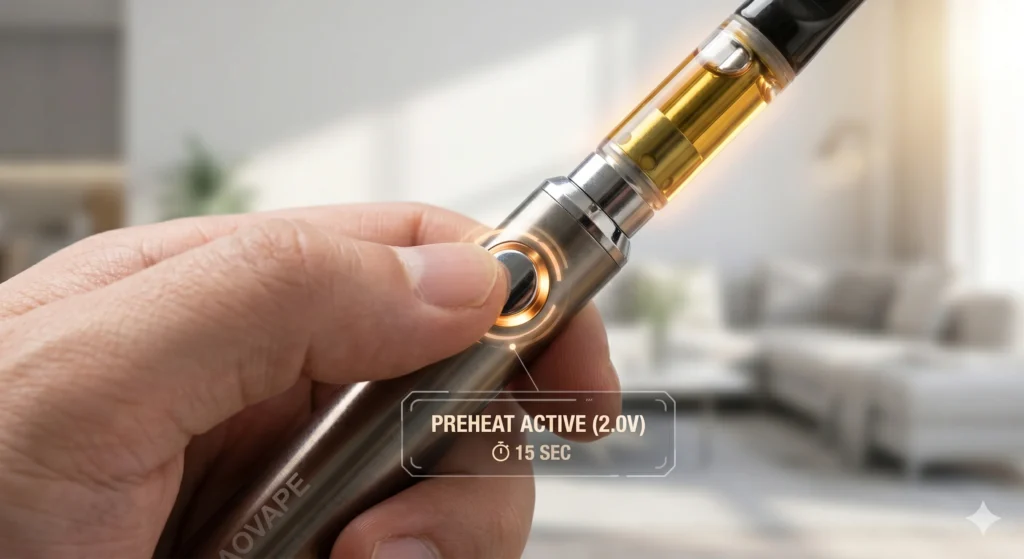
If your 510 thread battery has a preheat mode — activated on most devices by pressing the button twice rapidly — this is always your first step. Preheat delivers a low, sustained voltage (typically 1.8V–2.2V) to the cartridge coil for 10–15 seconds, gently warming the oil without vaporizing it. This reduces oil viscosity and loosens any condensation plug in the airpath.
- 🔘 Press the button twice quickly to activate preheat on most batteries
- ⏱️ Let the preheat cycle complete (usually 10–15 seconds)
- 💨 Take a slow, gentle draw immediately after the cycle ends
- 🔁 Repeat once if needed — most airflow clogs clear within 1–2 preheat cycles
📌 This works because cannabis oil viscosity drops sharply with even modest temperature increases. Live resin and rosin oils — which are the thickest and most clog-prone — become significantly more fluid at just 30°C–40°C (86°F–104°F), well below vaporization temperature. AOVAPE’s Pro 45S and Vertex both include dedicated preheat modes for exactly this situation.
✅ Method 2 — The Dry Pull (No Battery Required)
A dry pull means inhaling through the cartridge without activating the battery — no button press, no heat. This creates gentle suction that can dislodge a soft condensation plug in the mouthpiece without the risk of overheating.
- 💨 Remove the cart from the battery (or leave attached with battery off)
- 🫁 Place your lips on the mouthpiece and inhale slowly and firmly
- 🔁 Repeat 3–5 times with increasing firmness
- 👂 Listen for a faint “pop” — this is the condensation plug breaking free
If you hear the pop, reattach to the battery and take a normal draw. The clog is cleared. If no pop after 5–6 attempts, move to Method 3.
✅ Method 3 — Hair Dryer / External Heat (2 Minutes)
External gentle heat works for both airflow clogs and wicking clogs by reducing oil viscosity. Hold a hair dryer set to low or medium heat approximately 6 inches away from the cartridge and warm it for 30 seconds to 1 minute. Avoid high heat settings — temperatures above 60°C–70°C can degrade oil quality and risk warping plastic cartridge components.
- 🌬️ Hair dryer on low setting only — held 15cm (6 inches) away
- ⏱️ Warm for 30–60 seconds while rotating the cart slowly
- 👀 Watch for small bubbles forming around the coil inside the cart — this confirms the oil is moving
- 💨 Take a slow draw immediately while the cart is still warm
No hair dryer available? Your own body heat works as a gentler alternative — hold the cartridge in your closed fist for 3–5 minutes. It takes longer but is completely safe for the cart.
✅ Method 4 — Toothpick or Thin Pin (Mechanical Clear)
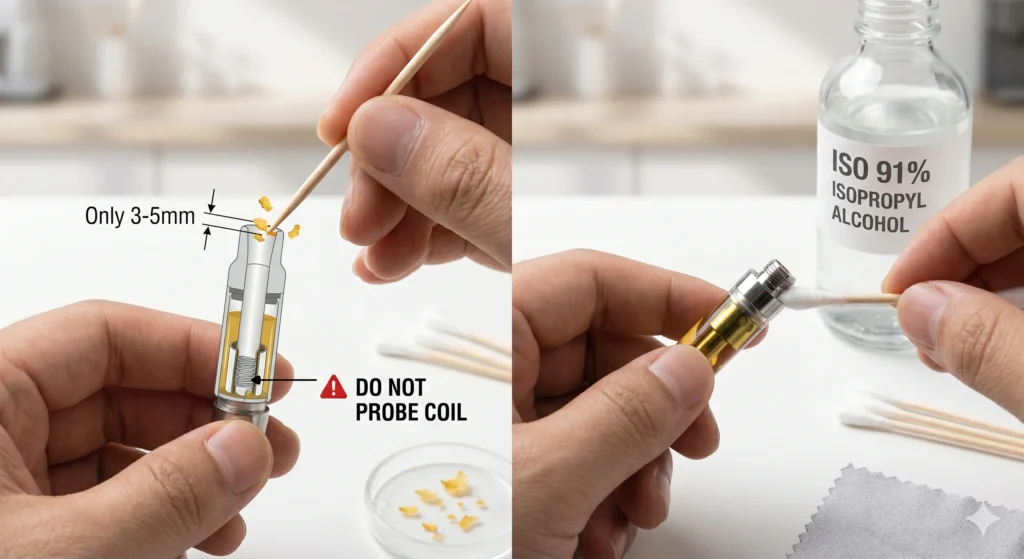
For visible blockages in the mouthpiece opening — dried oil, hardened residue, or a wax buildup — a thin mechanical tool removes the plug directly. Any pointed, small object like a toothpick or pin can help. Insert it gently into the mouthpiece and use it to remove any residue collected inside — do not press too hard, as you do not want to damage the coil.
- 🪥 Use a toothpick, straightened paperclip, or thin sewing needle
- 🔍 Insert only 3–5mm into the mouthpiece — you are clearing the tip, not probing the coil
- 🔄 Rotate gently to loosen and scoop out residue
- 🧹 Follow with a cotton swab to wipe away loosened debris
⚠️ Never insert a tool deeper than the mouthpiece channel. The ceramic coil is fragile and pushing a tool into the coil chamber destroys the cartridge permanently.
✅ Method 5 — Isopropyl Alcohol Swab Clean
When the mouthpiece is coated in sticky oil residue that the toothpick can only partially remove, isopropyl alcohol (IPA) dissolves it completely. Lightly dampen a cotton swab with rubbing alcohol — making sure it is not dripping wet — and gently wipe around the mouthpiece and air holes to dissolve any sticky buildup.
- 🧪 Use 70%–91% isopropyl alcohol (higher concentration = faster dissolving)
- 🩺 Dampen the swab — do not saturate it; no liquid should drip into the cart
- 🔄 Wipe around the mouthpiece opening and the external air intake holes
- ⏱️ Let the cart air dry for 2–3 minutes before using
- 🔌 Also clean the 510 connection pin at the base of the cart while you have the swab out
✅ Method 6 — Reverse Air Pressure (Blow Back Method)
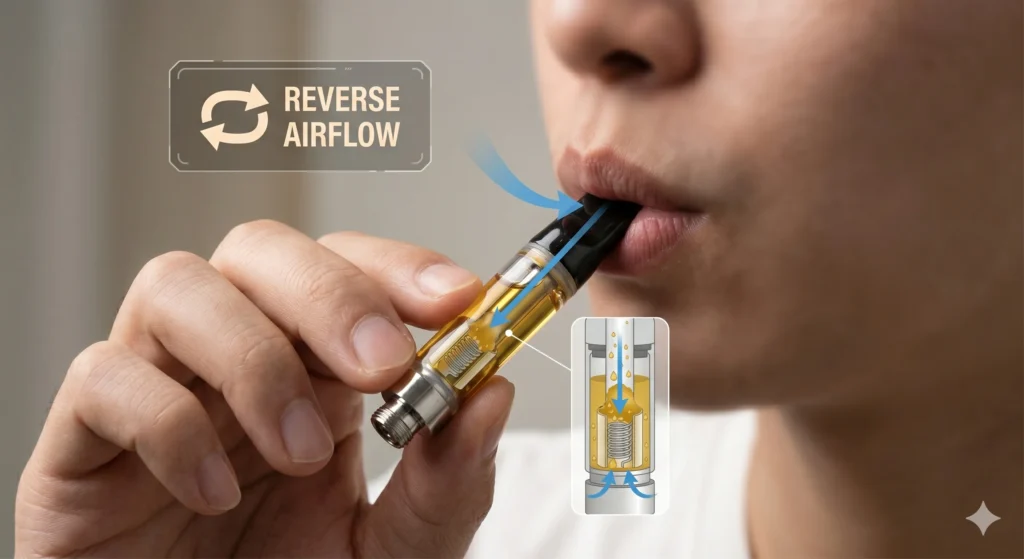
When the clog is deep in the airpath rather than at the mouthpiece, blowing air back through the cart can push the blockage toward the coil where heat will dissolve it. Hold the clogged vape cartridge upright and gently blow through the mouthpiece — this forces the oil back toward the heating area, allowing it to melt and clear out.
- ⬆️ Hold the cart upright (mouthpiece up)
- 💨 Blow gently but firmly through the mouthpiece — 2–3 seconds of steady pressure
- 🔁 Reattach to battery and take a short preheat cycle to melt any displaced oil
- 💨 Follow with a slow draw
📌 Do not blow too hard — excessive pressure can push oil into areas of the cartridge where it causes permanent damage. Short, controlled pressure only.
✅ Method 7 — Low Voltage Draw with Short Pulses
If the cart fires but gives almost no vapor (wicking clog, not airflow clog), a series of short, low-voltage puffs can gradually warm the coil and wick until the oil flows freely again. Use short, low-wattage draws to help loosen the clog — avoid longer draws until it is cleared, as extended heat on a clog can burn out the coil.
- ⚡ Set battery to its lowest voltage (2.4V or Low setting)
- ⏱️ Take 2–3 second button presses with 10–15 second breaks between each
- 🔁 Repeat 4–6 times — you should notice vapor increasing with each pulse
- 🌡️ Once vapor production normalizes, resume regular use
📊 3. Which Method to Use: Quick Decision Guide
| Your Situation | Best Method | Time Needed |
|---|---|---|
| No airflow, battery fires fine, had it a while | Method 1 (Preheat) → Method 2 (Dry pull) | 1–2 minutes |
| Visible sticky residue at mouthpiece tip | Method 4 (Toothpick) → Method 5 (IPA swab) | 3–5 minutes |
| Cart sat in cold car or cold room overnight | Method 3 (Hair dryer / body heat) | 2–5 minutes |
| Fires but weak vapor, oil visible in cart | Method 1 (Preheat) → Method 7 (Low-voltage pulses) | 2–3 minutes |
| Gurgling, bubbling when drawing | Method 6 (Blow back) → Method 1 (Preheat) | 1–2 minutes |
| Nothing works after all methods | Cart hardware has failed — replace the cartridge | — |
🛡️ 4. How to Prevent Carts from Clogging: 6 Habits That Work
Most clog problems are preventable. These six habits eliminate the majority of clogging issues before they start:
- ⬆️ Always store carts upright — mouthpiece up. Lying flat or upside down allows oil to migrate into the mouthpiece and airpath, creating the conditions for a clog every time. AOVAPE’s concealed battery designs like the Law naturally keep carts in the upright position inside the device body.
- 💨 Inhale after each session ends — one slow breath after releasing the button clears residual vapor from the airpath before it condenses back into liquid. After each puff, continue to breathe in — this stops vapor from condensing back into a clog.
- 🌡️ Keep carts at room temperature — avoid cold cars, cold bags, and direct sunlight. Cannabis oil viscosity increases sharply below 15°C (59°F), making wicking failures and condensation clogs far more likely.
- 🫁 Puff gently, not hard — aggressive puffing forces excess oil into the cartridge’s coil assembly, and that oil gets into the airflow system. Slow, steady draws of 2–4 seconds are optimal for both vapor quality and clog prevention.
- 🔋 Use preheat before the first draw of the day — especially with live resin, rosin, or any thick oil. A single preheat cycle warms the oil and ensures clean wicking before you take a real draw.
- 🧹 Wipe the mouthpiece weekly — a dry cotton swab around the mouthpiece opening every few days removes early condensation buildup before it hardens into a plug.
⚠️ 5. When to Stop Trying and Replace the Cart
Not every clogged cart can be saved — and knowing when to stop saves you time and frustration. Replace the cartridge if:
- 🔥 Burnt taste persists at the lowest voltage — the coil has been damaged, likely from running dry or excessive heat. No amount of unclogging fixes a burnt coil.
- 💀 No vapor after all 7 methods above — the internal atomizer assembly has failed.
- 💧 Oil visibly leaking from the base or threading — the seal has broken. Stop using it immediately — oil leaking into your battery’s 510 connection causes corrosion.
- 🎨 Oil color has turned dark brown or black — the oil has degraded from heat exposure. The cartridge is spent.
- 📅 Cart is more than 6–12 months old — cannabis oil degrades over time, and residue buildup in older carts eventually becomes impossible to clear.
📌 When replacing, ensure your new cartridge is compatible with your battery. AOVAPE’s vape cartridge range uses standard 510-thread connections compatible with all AOVAPE batteries and most other 510 batteries on the market.
🔋 6. Does Your Battery Contribute to Clogging?
Yes — your battery settings directly affect clog frequency. Two battery-side issues cause or worsen cartridge clogs:
⚡ Too-High Voltage
Running a cart at 3.5V–4.2V when the oil only needs 2.8V–3.2V produces excess vapor that the airpath cannot handle quickly enough — the surplus condenses back into liquid in the mouthpiece. Lowering voltage to match your oil type reduces condensation dramatically. See AOVAPE’s 510 battery voltage guide for oil-type voltage recommendations.
🔌 No Preheat Function
A battery without preheat mode forces users to take hard, aggressive draws on cold thick oil — exactly the behavior that pushes oil into the airpath and causes airflow clogs. If you use live resin, rosin, or any high-viscosity oil, a battery with dedicated preheat mode is not optional — it is essential. AOVAPE’s Pro 45S, Vertex, and Law all include preheat modes purpose-built for thick oil cartridges.
❓ FAQ: How to Unclog a Cart
What is the fastest way to unclog a vape cart?
The preheat function on your 510 battery is the fastest fix — press the button twice to activate it, let the 10–15 second cycle complete, then take a slow draw. Most condensation clogs clear in one or two preheat cycles. If your battery does not have preheat, a few firm dry pulls (inhaling without activating the battery) often dislodge the plug in under a minute.
Why does my cart keep clogging even after I fix it?
Recurring clogs have one of three causes: you are storing the cart lying flat or upside down (oil migrates to the mouthpiece), you are taking hard draws rather than slow, gentle ones (excess oil gets pushed into the airpath), or you are using too high a voltage for your oil type (excess vapor condenses back as liquid). Fix the storage position and puff technique first — these resolve the majority of repeat-clog situations.
Can I use water to unclog a vape cart?
No. Never introduce water or any liquid other than isopropyl alcohol (used externally on the mouthpiece only) to a vape cartridge. Water inside the cartridge ruins the ceramic wick, degrades the oil, and creates a safety hazard when the cartridge is powered. Use heat or mechanical methods only for internal clogs.
Why is my cart gurgling when I draw?
Gurgling means liquid oil has entered the airflow channel. The fix is the reverse air pressure method (Method 6): hold the cart upright and blow gently through the mouthpiece to push the oil back toward the coil. Follow with a preheat cycle. Gurgling that persists after multiple attempts usually means the cartridge’s internal seals are failing — replace the cart.
Does cold weather cause carts to clog?
Yes — cold temperatures significantly increase cannabis oil viscosity. Below approximately 15°C (59°F), thick oils like live resin and rosin become too viscous to wick properly, causing both airflow failures and wicking clogs. Always warm a cold cart to room temperature before use, and use preheat mode before the first draw after any cold exposure.
How do I know if my cart is clogged or dead?
If the battery fires (LED lights up, device activates) but you get no airflow and no vapor despite trying preheat and dry pulls, the cart is clogged. If the battery fires and you get airflow but still no vapor, the coil is burnt or failed — the cart is dead. If the battery does not fire at all, the problem is the battery, not the cartridge.
What type of oil clogs the most?
Live resin and live rosin oils clog most frequently because they have the highest viscosity and the richest terpene profiles — compounds that condense readily at room temperature. Standard THC distillate clogs less often due to its lower viscosity. If you use premium high-terpene oils regularly, a battery with preheat mode and a habit of gentle puffing are both essential.
📌 Final Thoughts
A clogged cart is a hardware and habit problem — and both are fixable. The seven methods above resolve the vast majority of clogs in under five minutes, from a 30-second preheat cycle to a deep isopropyl alcohol clean. The six prevention habits eliminate most repeat clogs entirely.
The single biggest lever: match your battery to your oil. A battery with preheat mode and variable voltage control set correctly for your oil type prevents the majority of clog conditions before they develop. AOVAPE’s 510 thread battery collection covers every form factor — from slim pen-style to palm-style variable voltage — all with preheat mode and USB-C charging.
👉 Browse AOVAPE’s full 510 battery collection →
👉 Shop AOVAPE vape cartridges →
📚 References
- Cannabis oil viscosity and temperature relationship: live resin and rosin oils become significantly more fluid above 30°C–40°C (86°F–104°F) — well below vaporization temperature (source: cannabis hardware engineering reference data)
- Ceramic wick absorption rate: standard 510 cartridge ceramic wicks require 20–30 seconds of rest after a draw to fully re-absorb oil at room temperature (source: Lookah hardware specification data)
- Isopropyl alcohol concentration: 70%–91% IPA is effective for dissolving cannabis oil residue; 91% evaporates faster and is preferred for electronics cleaning (source: Electronics Cleaning Institute reference guide)
- Preheat voltage range: 1.8V–2.2V is the standard low-voltage preheat range used by major 510 battery manufacturers including AOVAPE, CCELL, and Yocan
- Cannabis oil degradation temperature: quality degradation accelerates above 60°C–70°C for most cannabis oil formulations (source: SC Labs cannabis oil stability testing data)
- Condensation clog mechanism: vapor condenses at temperatures below the oil’s vaporization point — typically in the 35°C–50°C range for cannabis oil vapor in a cartridge airpath (source: general vaporization thermodynamics reference)