🔩 1. What Is a Vape Cartridge Battery? (And What It Actually Does)
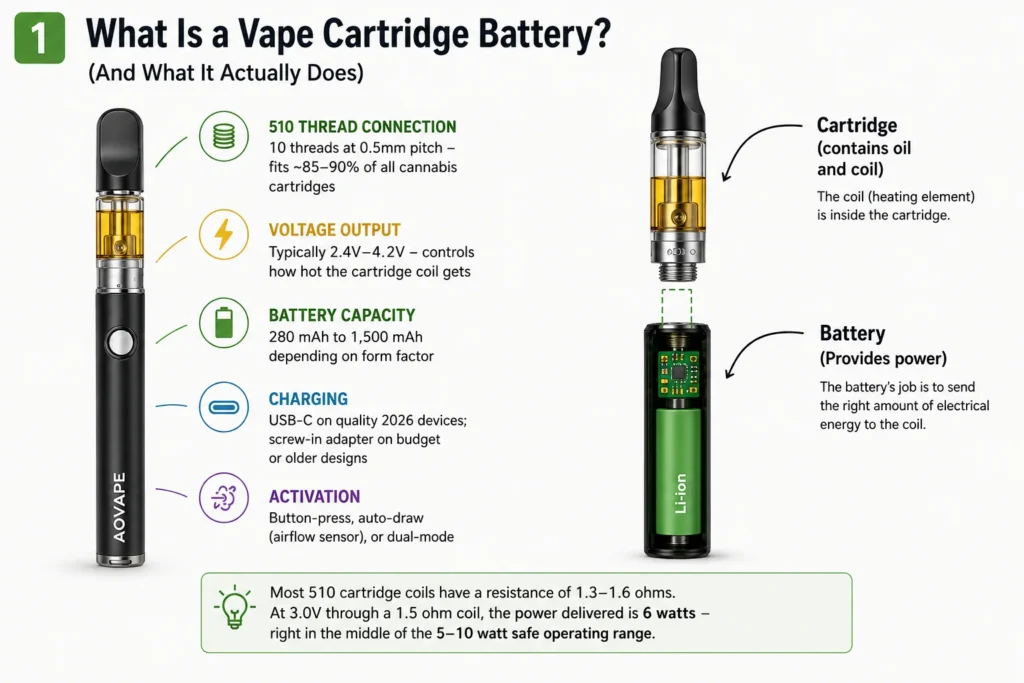
A vape cartridge battery is a rechargeable device that powers a pre-filled oil cartridge containing cannabis oil — CBD, THC distillate, live resin, Delta 8, Delta 9, HHC, THCA, or similar extracts. The connection standard used by approximately 85%–90% of all dispensary cartridges in North America is the 510 thread: 10 threads at 0.5mm pitch (source: Leafly cannabis glossary; Weedmaps cartridge guide).
Here is the part most users miss: the battery does not contain the heating element. The coil — the thing that actually heats your oil — is inside the cartridge. The battery’s only job is to send the right amount of electrical energy to that coil. Get the energy level wrong (too high or too low) and everything falls apart: burnt taste, weak vapor, dead coils, and wasted oil.
- 🔗 510 thread standard: 10 threads at 0.5mm pitch — fits ~85–90% of all cannabis cartridges
- ⚡ Voltage output: typically 2.4V–4.2V — controls how hot the cartridge coil gets
- 🔋 Cell capacity: 280 mAh to 1,500 mAh depending on form factor
- 🔌 Charging: USB-C on quality 2026 devices; screw-in adapter on budget/older designs
- 💨 Activation: button-press, auto-draw (airflow sensor), or dual-mode
📌 Most 510 cartridge coils have a resistance of 1.3–1.6 ohms (source: Lookah coil resistance data). At 3.0V through a 1.5 ohm coil, the power delivered is 6 watts — right in the middle of the 5–10 watt safe operating range that experienced users and hardware manufacturers consistently recommend for cannabis oil carts.
🌡️ 2. The #1 Community Complaint: “My Cart Tastes Burnt” — and How to Fix It
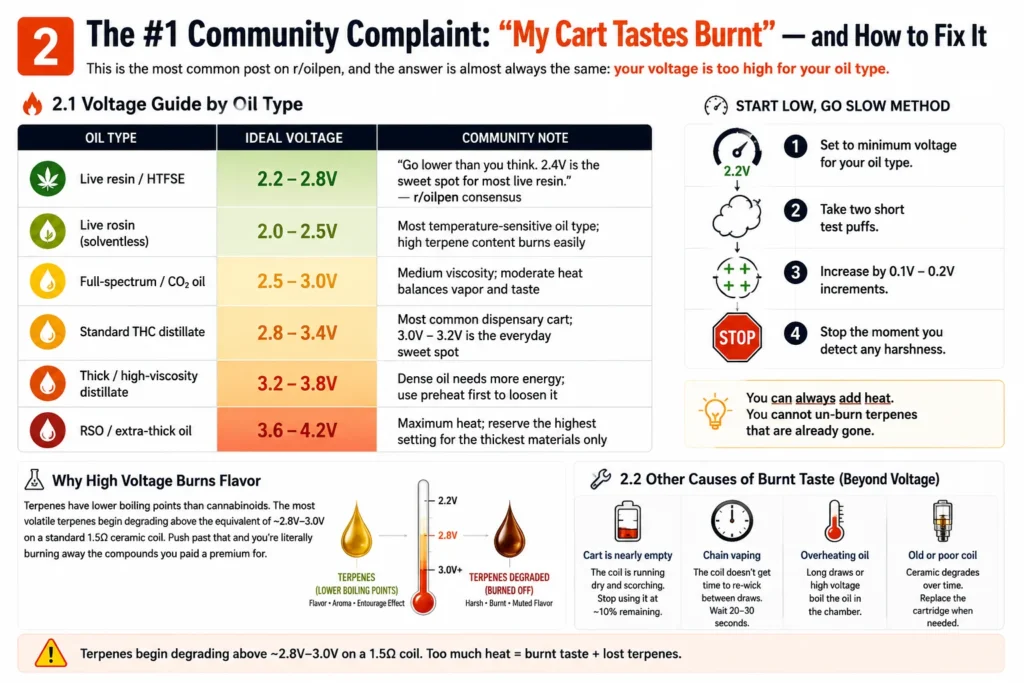
This is the most common post on r/oilpen, and the answer is almost always the same: your voltage is too high for your oil type. Community feedback consistently shows that users running carts at 3.0V+ on live resin report a burnt popcorn taste — the same cart at 2.2V–2.4V delivers smooth, full-flavor hits (source: mood.com community voltage data; discountvapepen.com user testing, 2026).
Here is what is physically happening: terpenes — the aromatic compounds that give your oil its flavor and contribute to the entourage effect — have lower boiling points than cannabinoids. The most volatile terpenes begin degrading above the equivalent of approximately 2.8V–3.0V on a standard 1.5 ohm ceramic coil. Push past that and you are literally burning away the compounds you paid a premium for.
🔥 2.1 Voltage Guide by Oil Type
| Oil Type | Ideal Voltage | Community Note |
|---|---|---|
| Live resin / HTFSE | 2.2–2.8V | “Go lower than you think. 2.4V is the sweet spot for most live resin.” — r/oilpen consensus |
| Live rosin (solventless) | 2.0–2.5V | Most temperature-sensitive oil type; high terpene content burns easily |
| Full-spectrum / CO₂ oil | 2.5–3.0V | Medium viscosity; moderate heat balances vapor and taste |
| Standard THC distillate | 2.8–3.4V | Most common dispensary cart; 3.0V–3.2V is the everyday sweet spot |
| Thick / high-viscosity distillate | 3.2–3.8V | Dense oil needs more energy; use preheat first to loosen it |
| RSO / extra-thick oil | 3.6–4.2V | Maximum heat; reserve the highest setting for the thickest materials only |
💡 The “start low, go slow” method — referenced across nearly every experienced user thread — works every time: set to your oil type’s minimum voltage, take two short test puffs, increase by 0.1V–0.2V increments until vapor production feels right, stop the moment you detect any harshness. You can always add heat. You cannot un-burn terpenes that are already gone.
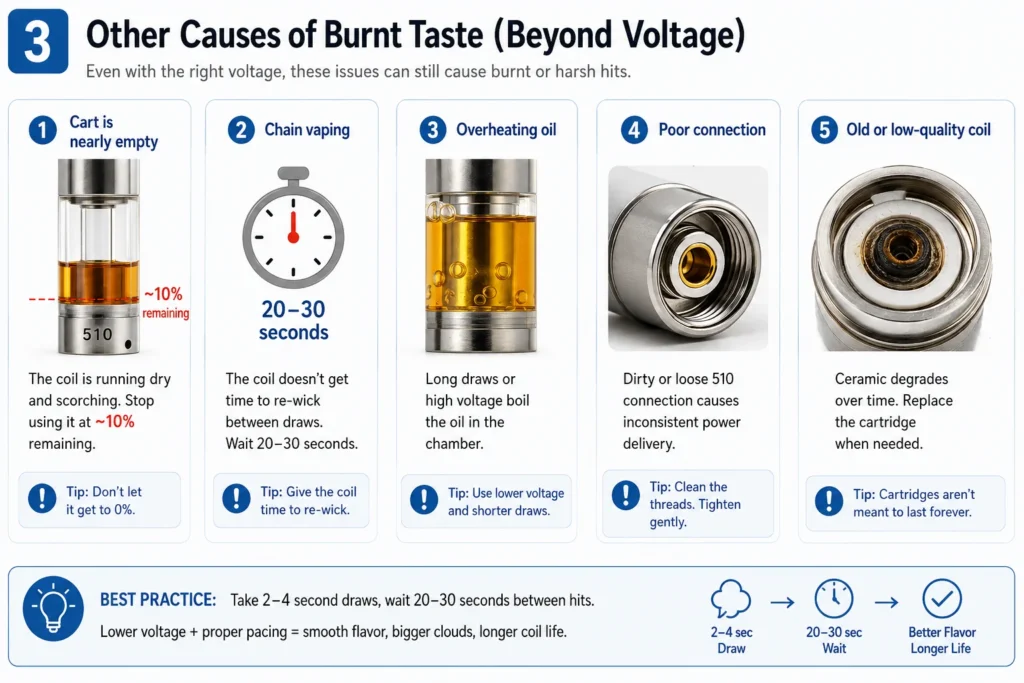
🔧 2.2 Other Causes of Burnt Taste (Beyond Voltage)
- 🪫 Cart is nearly empty — the coil is running dry and scorching. Stop using it at ~10% remaining.
- 🌡️ Chain vaping — the coil does not get time to re-wick between draws. Wait 20–30 seconds between hits.
- ❄️ Cold oil — thick oil in cold weather does not wick fast enough. Use preheat mode first.
- 🛒 Low-quality cartridge — if a brand-new, full cart tastes burnt at the lowest voltage, the cart hardware is the problem, not the battery.
💨 3. “My Cart Is Not Hitting” — Troubleshooting Guide
The second most common complaint in the r/oilpen community. There are five likely causes, each with a specific fix:
| Symptom | Most Likely Cause | Fix |
|---|---|---|
| No vapor, no airflow | Clogged mouthpiece or airhole | Clear with a thin paperclip or toothpick; warm the cart gently with preheat mode |
| No vapor, airflow exists | Poor connection at 510 threading | Clean battery threads and cart base with a dry cotton swab; check center pin is not pushed down |
| Wispy / weak vapor | Voltage too low for oil viscosity | Increase voltage in 0.2V increments; use preheat on thick oils |
| Battery fires, no vapor | Dead or flooded coil inside cartridge | The cartridge hardware has failed — replace the cart |
| Battery will not turn on | Dead cell or travel lock engaged | Charge for 30+ minutes; try 5 rapid button clicks to unlock travel lock |
📌 The center pin fix: the most overlooked connection problem. The 510 center pin on the battery can get pushed down over time from overtightening cartridges. Using a toothpick or thin tool to gently lift it 0.5mm–1mm restores contact. This single fix resolves a large percentage of “battery stopped working” complaints that actually have nothing to do with the battery cell itself.
🔋 4. How to Choose the Right Vape Cartridge Battery: The Key Specs
⚡ 4.1 Voltage Control: The Single Most Important Feature
The community consensus on this is clear: if your budget allows only one upgrade, make it variable voltage. A single-voltage budget battery set at 3.7V will destroy a live resin cart. A variable-voltage battery lets you match the device to the oil. The three design tiers:
- 🟢 Fixed single voltage (3.3V–3.7V typical) — no adjustment. Works acceptably for standard distillate. Poor choice for live resin or premium oils. Price range: $10–$20.
- 🟡 3-preset variable voltage (Low / Mid / High) — covers ~90% of everyday use cases. Most popular design in the mid-range cart battery market. AOVAPE’s Law, MAW, and B1 operate here. Price range: $20–$50.
- 🔴 Continuous variable voltage (0.1V increments, 1.8V–4.2V) — full precision. Best for users running multiple cart types. AOVAPE’s Vertex and Pro 45S offer this level of control. Price range: $40–$80+.
🔋 4.2 Battery Capacity (mAh): How Long It Actually Lasts
| Capacity | Draws Per Charge | Real-World Runtime | Best For |
|---|---|---|---|
| 280–400 mAh | 80–130 draws | Light users: 1–2 days | Slim pen-style, occasional use |
| 400–600 mAh | 150–220 draws | Moderate users: full day | Daily carry, balanced size |
| 600–1,000 mAh | 250–380 draws | Heavy users: 1–2 days | All-day sessions, travel |
| 1,000–1,500 mAh | 400+ draws | Heavy users: 2–4 days | Multi-day, infrequent charging |
The community rule of thumb: most small batteries (350–500 mAh) last a light user 1–2 days, heavy users may need a top-up by evening. Larger 650–1,000 mAh models run 2–4 days for light use (source: vapebatt.com user data, 2025).
💨 4.3 Activation: Button vs. Auto-Draw
This is one of the most-discussed preference topics in vaping communities:
| Feature | Button-Activated | Auto-Draw (Buttonless) |
|---|---|---|
| How it fires | Hold button while inhaling | Airflow sensor detects inhalation automatically |
| Session control | Better — you control exact draw length | Automatic — fires as long as you inhale |
| Stealth | Moderate — visible button press | High — completely silent, no clicks |
| Pocket safety | Travel lock (5 clicks) prevents accidental fire | Can misfire from tight pockets — sensitivity varies |
| Best for | Experienced users who want control | Beginners, discreet use, casual sessions |
💡 The community split: r/oilpen users with multiple cart types tend to prefer button-activated with voltage control — it gives the most precision. Casual users overwhelmingly prefer auto-draw for its simplicity. Many top-tier batteries (including several in AOVAPE’s lineup) now offer dual activation — button for home use, draw-activation for out-and-about.
🔌 4.4 Charging: USB-C Is Non-Negotiable in 2026
Any vape cartridge battery worth buying in 2026 charges via USB-C. The screw-in adapter charger (which threads onto the 510 connection) is a dead-end design: it requires carrying a proprietary cable, wears down the 510 threading with repeated use, and charges more slowly. USB-C charges most batteries in 60–90 minutes using cables you already carry.
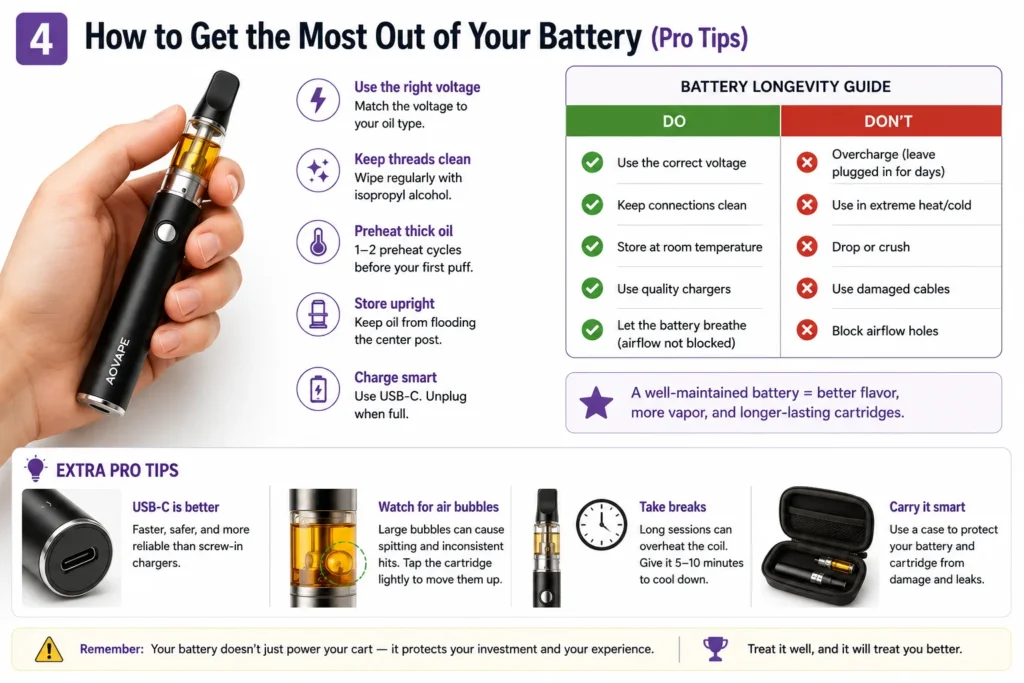
Charging best practices that extend lithium-ion cell life (source: Battery University, batteryuniversity.com):
- ⛔ Never charge overnight — sustained overcharging degrades the cell; disconnect at full
- ⛔ Never drain to zero — recharge at ~20% remaining to avoid deep discharge stress
- ✅ Keep charge between 20%–80% — lithium-ion cells age fastest at the extremes
- ✅ Charge on a hard, flat surface — not on a bed or couch; always use a stable surface with good airflow
- 🌡️ Avoid charging in the heat — hot cars and direct sunlight accelerate cell degradation significantly
Lithium-ion vape cartridge batteries are rated for 300–500 full charge cycles at recommended charge habits. Follow these habits and your battery lasts years, not months.
🗂️ 5. Types of Vape Cartridge Batteries: Which Form Factor Fits Your Life?
✏️ 5.1 Pen-Style (Slim / Cylindrical)
The most pocketable format. Slim profile limits cell capacity (typically 280–500 mAh) but keeps the device invisible in a shirt pocket or bag. The community go-to for discreet daily carry. Best for users who run one cartridge type consistently.
- 📏 Shirt-pocket friendly — the least conspicuous form factor
- ⚙️ Usually single-button or auto-draw
- 💰 Most affordable tier — quality options available at $20–$40
AOVAPE’s B1, V1, and MAW are pen-style designs built for reliable daily cartridge use.
🧱 5.2 Palm / Box Style
Wider, flat body allows a larger cell (500–1,000 mAh), more sophisticated circuit electronics, and often a display screen showing voltage and battery state. The community pick for home use and heavy daily users who hate charging every day.
- 🔋 All-day power — 500+ mAh handles even heavy sessions without a mid-day charge
- 🖥️ Display screen — see exact voltage at a glance instead of counting LED flashes
- 🎛️ More likely to offer fine-increment voltage control
AOVAPE’s Pro 45S and Vertex represent this direction — multi-voltage control, preheating mode, and a robust build for heavy daily use.
🕵️ 5.3 Concealed / Discreet Designs
A discreet vape cartridge battery encloses the cart fully inside the device body — nothing visible from the outside. The community loves these for public use, travel, and professional environments. Added bonus: enclosed storage protects oil from UV light exposure, which degrades cannabinoids and terpenes over time.
- 🫙 Cart completely hidden — no exposed hardware
- 🌞 UV protection — keeps your oil fresh between sessions
- 🧲 Often uses magnetic cartridge loading for fast, silent swaps
AOVAPE’s Law and cRoll are clean concealed designs in the AOVAPE 510 lineup. For the full range of discreet options, browse the complete 510 thread battery collection.
🛒 6. What the Community Says About Budget vs. Premium
The community consensus on price tiers (from r/oilpen and discountvapepen.com user data, 2026):
| Price Tier | What You Get | Community Verdict |
|---|---|---|
| Under $15 | Fixed voltage, basic LED, minimal safety features | “Usable, but you’ll notice the voltage consistency problems fast.” |
| $15–$30 | 3-preset voltage, USB-C, basic safety circuit | “This is the sweet spot. The jump from $8 to $20 is absolutely worth it.” |
| $30–$60 | Fine-increment variable voltage, display, full safety suite, better build | “Premium features, noticeably better consistency. Worth it for daily users.” |
| $60–$100+ | OLED display, 0.1V steps, premium materials, concealed design, haptic feedback | “Great hardware, but over $60 you’re mostly paying for design and brand name.” |
📌 The community’s actual best-value range: $15–$30. This tier delivers variable voltage, USB-C charging, and a full safety circuit — everything that matters for a clean, consistent session. Everything above $60 is incremental improvement, not a step change in experience.
🛡️ 7. Safety Features: What to Look for and What to Avoid
Safety design matters in vape cartridge batteries because they combine active battery management with precision voltage delivery. The complete safety suite that any quality device should include:
- ⚡ Short-circuit protection — cuts power instantly if the cartridge coil shorts
- 🔋 Overcharge protection — stops charging current when the cell reaches capacity
- 🔋 Over-discharge protection — prevents the cell voltage from dropping below its minimum safe level
- 🌡️ Overheat cutoff — shuts down if device body temperature exceeds safe limits
- ⏱️ Auto-shutoff — cuts power after 8–15 seconds of continuous draw to prevent coil damage
- 🔒 Travel lock — 5-click power on/off prevents accidental pocket activation
⚠️ Red flags to avoid in any battery: visible dents or deformation in the body, swelling of the device (lithium-ion cell failure), a shell that feels hot during normal use (not just warm), and any battery that continues firing past 15 seconds without cutting off. These are not minor issues — they are hardware failures that require replacing the device immediately.
🔧 8. Maintenance: The 5-Minute Habit That Extends Battery and Cart Life
Most battery and cartridge problems that users post about in communities are maintenance issues, not hardware failures. A 5-minute weekly habit prevents nearly all of them:
- 🧹 Clean the 510 threads — dry cotton swab on the battery threading and the cart base. Oil residue builds up and increases electrical resistance, causing inconsistent heating and connection failures.
- 📌 Check the center pin — it should be slightly raised (spring-loaded). If it’s flush or depressed, gently lift it 0.5–1mm with a toothpick.
- ⬆️ Store carts upright — keeps oil wicking consistently to the coil; prevents leaks into the battery threading.
- 🌡️ Warm cold carts before use — cold temperatures thicken oil, causing wicking failures and harsh draws. Use preheat mode or store the device in a warm pocket for a few minutes first.
- 🔋 Recharge at 20% — do not wait for the battery to die completely before charging. Consistent shallow cycles significantly extend cell life over months of use.
❓ FAQ: Vape Cartridge Battery
What voltage should I use for my vape cartridge battery?
For most standard THC distillate cartridges, 2.8V–3.2V is the community sweet spot. For live resin or high-terpene oils, go lower: 2.2V–2.8V. For thick or high-viscosity oils, go higher: 3.2V–3.8V. Always start at the lowest setting and increase in 0.1V–0.2V increments. Above 3.8V risks burning any standard cartridge.
Why does my vape cartridge taste burnt?
In most cases, voltage is too high for the oil type. Drop down one voltage setting and let the cart cool for a few minutes before retrying. Other causes include a nearly empty cart running dry, chain vaping without rest periods, cold oil not wicking properly, or a low-quality cartridge. If a brand-new, full cart tastes burnt at the lowest voltage, the cartridge hardware is the problem.
Why is my vape cartridge battery not hitting?
Common causes: clogged mouthpiece or airhole (clear with a thin pin), poor 510 connection from oil residue buildup (clean with a dry swab), a depressed center pin (lift gently with a toothpick), voltage too low for the oil viscosity (increase slightly), or a dead cartridge coil (replace the cart). Check the connection and center pin first — these fix the majority of cases.
How long does a vape cartridge battery last per charge?
A 400–500 mAh battery delivers approximately 150–200 draws per charge. Light users get 1–2 days; heavy users may need a daily charge. A 650–1,000 mAh battery extends this to 2–4 days for moderate use. Lithium-ion cells are rated for 300–500 full charge cycles — proper charging habits (avoid overnight charging, avoid full discharge) double the practical service life.
Do all cartridges work with any 510 vape cartridge battery?
Most do — approximately 85%–90% of dispensary cartridges use 510-thread connections. However, compatibility has limits: some batteries have housing rims that restrict maximum cartridge diameter (typically 10–14mm), and proprietary pod systems (like Pax Era pods or Bloom pods) require brand-specific batteries and will not fit 510 threading at all. Always check that your cartridge is “510-thread compatible” before purchasing a battery.
What is the difference between a vape cartridge battery and a 510 battery?
They are the same thing. “510 battery,” “cart battery,” “cartridge battery,” and “510 thread battery” are all terms used interchangeably in the industry and in vaping communities to describe the same device: a rechargeable power unit with 510 threading designed to power pre-filled oil cartridges.
How do I fix a vape cartridge battery that won’t charge?
Try a different USB-C cable and wall adapter first — faulty cables are the most common cause. Check the charging port for lint or debris. If the battery has been completely drained, it may take 15–30 minutes of connection before the charging LED activates. If none of these work, the lithium-ion cell may have failed from over-discharge or age and the device needs to be replaced.
📌 Final Thoughts
The vape cartridge battery is the most underrated component in the cannabis oil setup — and the one that most directly controls whether your expensive cartridge delivers the experience you paid for, or burns it away at the wrong voltage. Getting the hardware right means understanding three things: voltage matched to oil type, quality circuit regulation, and basic maintenance. Everything else is secondary.
AOVAPE manufactures a full range of 510 thread batteries across all form factors — the slim B1 and MAW for everyday pen-style carry, the Pro 45S and Vertex for variable voltage performance, and the Law and cRoll for discreet, concealed designs. Full OEM/ODM services are available for brands building a private-label 510 battery line.
Browse the full 510 thread battery collection at AOVAPE →
📚 References
- 510 thread standard — 10 threads at 0.5mm pitch; universal adoption tracked by Leafly cannabis glossary and Weedmaps cartridge guide
- Cannabis oil cartridge market share using 510 threading: 85%–90% of North American dispensary cartridges (medxdrg.com compatibility data, 2025)
- Standard 510 cartridge coil resistance: 1.3–1.6 ohms (Lookah coil specification data)
- Safe wattage range for cannabis oil carts: 5–10 watts (vidaoptimacbd.com; Vessel brand technical documentation)
- Community voltage data: mood.com user-reported voltage preferences, 2026; discountvapepen.com user testing, 2026
- Lithium-ion cell cycle life: 300–500 full charge cycles at recommended charge habits (Battery University, batteryuniversity.com)
- Terpene degradation reference: cannabis terpene boiling points — myrcene 167°C, limonene 176°C, linalool 198°C (Steep Hill Labs terpene data)
- Community price tier analysis: discountvapepen.com cart battery guide, 2026; vapebatt.com beginner mistakes guide, 2025