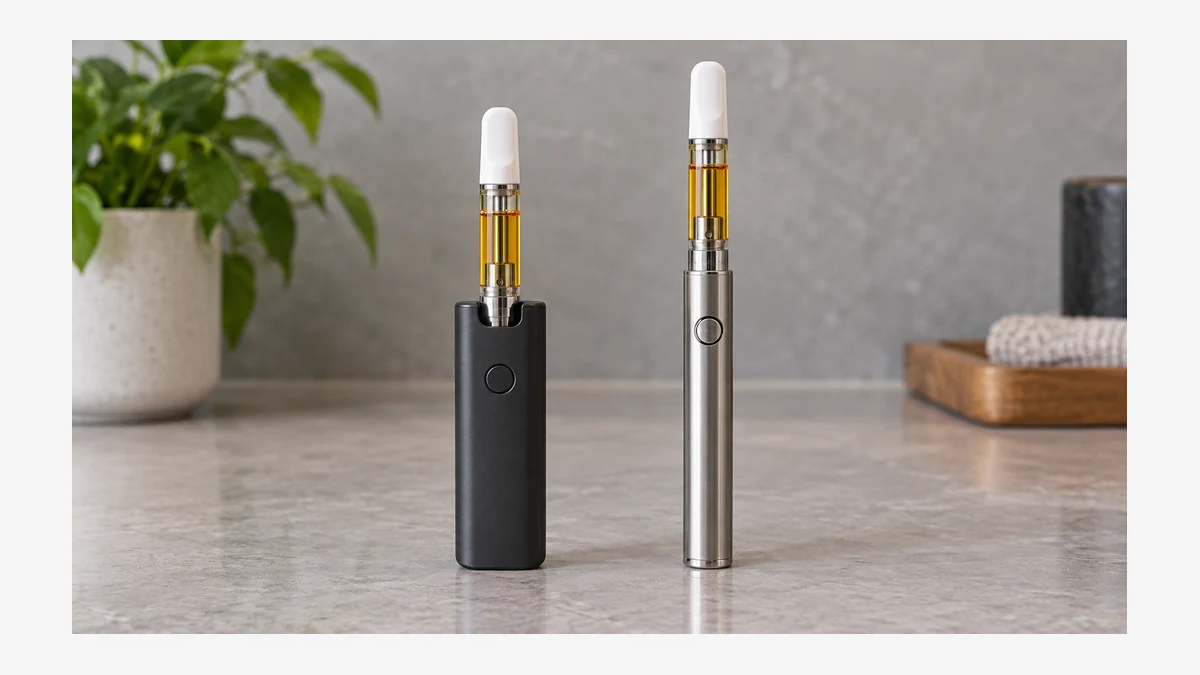
A side-by-side 510 battery is built around a simple decision: instead of stacking the cartridge on top of the battery cell in a straight line, the two sit next to each other inside a flattened housing. The 510 connector is recessed into a slot cut along one edge, and the cell occupies the rest of the body. This layout changes how the connector seats, how air reaches the coil, how the unit fits a hand or pocket, and how easy the housing is to clean. Most of the fit and “why won’t this cart seat right” questions that come up around these devices trace back to that one structural choice.
🧭 1. The Side-by-Side Layout, Explained
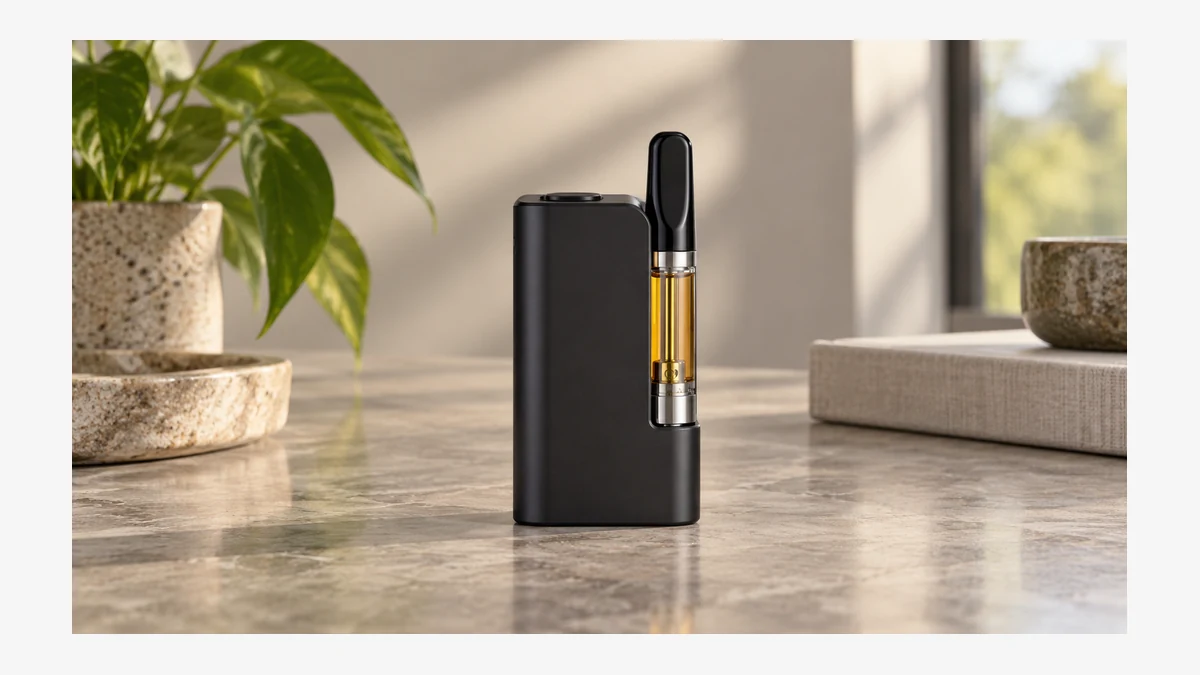
In a standard inline 510 battery, the cartridge threads onto the top of the cell and the whole unit reads as one continuous cylinder. A side-by-side battery instead carves a cartridge bay into the body, usually along one flattened face, with the 510 threading sitting inside that recess rather than at the very top of the device. The battery cell — typically a small cylindrical or pouch cell — runs parallel to that bay rather than underneath it.
This is a packaging decision, not a performance spec. Manufacturers use it to keep the overall device shorter and flatter than a stacked design would allow, which is part of why these batteries get marketed around portability and a low-profile silhouette. The tradeoff is that the cartridge is no longer a straight extension of the housing — it is nested into a cutout, which means the cutout’s dimensions now matter as much as the 510 threading itself.
📐 2. Why Blinking Lights Trace Back to Fit, Not Fault
A common point of confusion with these batteries is that some cartridges fire fine while others cause the indicator light to blink repeatedly — often read by users as an error code — even though both cartridges are described as “510 compatible.” The 510 standard only guarantees that the threading pitch and center-pin spacing match. It says nothing about the cartridge’s outer diameter, its overall height, or how its base is shaped around the connector.
In a side-by-side housing, the cartridge has to fit inside a recessed bay with fixed interior walls. If the cartridge’s body is slightly wider than that bay, or its base shoulder is a different shape than the one the slot was designed around, the threads can still engage — the device just can’t get full, flush metal-to-metal contact at the center pin. Many battery circuits read that shallow or inconsistent contact as a resistance fault and respond with a blink pattern, even though nothing is actually broken. The cartridge isn’t incompatible in the 510 sense; it’s a dimensional mismatch with the recess, not the connector.
This is also why swapping brands of prefilled cartridges on the same battery produces inconsistent results — each manufacturer sizes the cartridge body to its own tolerances, and a side-by-side bay has far less margin for variation than an open-air inline connector does.
For related component context, see the 510 box-mod cartridge guide.
🌬️ 3. The 510 Connector’s Job in a Recessed Housing
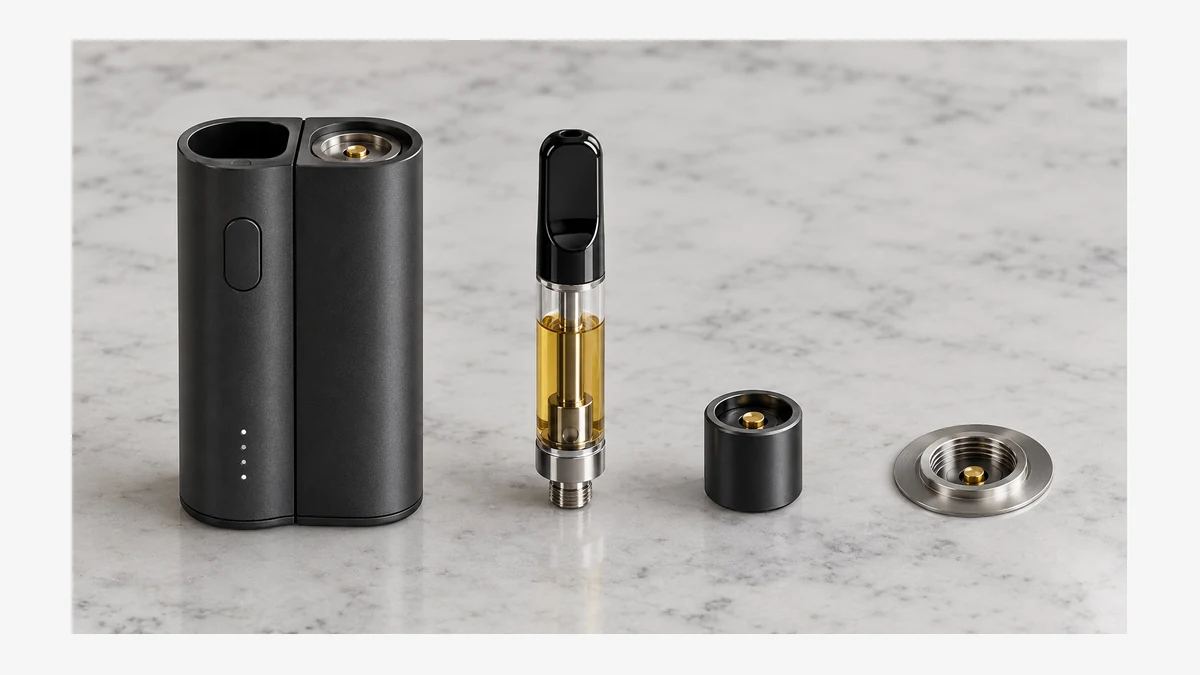
The 510 connector itself — the threaded ring and spring-loaded center pin — does the same job in every battery: it completes an electrical circuit between the cell and the cartridge’s heating element. What changes in a side-by-side design is the environment around that connector. Instead of sitting exposed at the top of the device, it’s set back inside a molded slot, surrounded on three or four sides by the housing wall.
That recess has to be deep enough to let the cartridge’s base seat fully, but shallow enough that the walls still support the cartridge laterally so it doesn’t wobble. If the slot is cut for a specific cartridge shape — square-shouldered versus tapered, for example — a cartridge with a different base profile may bottom out against the housing wall before the threads are fully engaged. The connector makes contact, technically, but not the amount of contact the spring pin was designed to compress against. That’s a geometry problem the threading alone can’t fix.
🔥 4. Airflow Clearance and Why It Matters Beside the Cell
Inline batteries draw air through a straight path: intake at the base of the device, up through the center, into the cartridge’s mouthpiece. A side-by-side battery has to route that same airflow sideways, because the cartridge isn’t centered over the cell — it’s offset next to it. Manufacturers handle this with small intake vents cut into the wall of the cartridge bay itself, positioned to line up with the air hole on the underside of the cartridge.
This is a second place where cartridge-to-bay fit matters. If a cartridge’s intake hole doesn’t align with the battery’s vent — because the cartridge is slightly rotated, undersized, or shaped differently than the bay expects — airflow gets restricted even though the electrical connection is fine. A tight or gurgling draw on an otherwise “working” cartridge is frequently an airflow clearance issue inside the bay, not a problem with the cartridge’s internal wicking.
🧩 5. Controls and Button Placement on a Side Body
Because the cartridge occupies one side of the housing, the fire button, any voltage-adjustment buttons, and the charging port all get pushed to the remaining surface area — usually the flat face opposite the cartridge bay, or a narrow edge beside it. This is different from an inline battery, where the button typically sits directly below the cartridge on the same central axis.
The practical effect is that side-by-side devices often have a more rectangular button placement, sometimes positioned where a thumb naturally rests when the device is gripped like a flattened bar rather than a cylinder. Multi-function batteries — ones with voltage selection or preheat functions — tend to put a small LED or button cluster on this same flat face, which is why it’s usually opposite the cartridge rather than beneath it.
🔍 6. Pocket Profile and Carry Considerations
The main reason manufacturers choose a side-by-side layout over a stacked one is profile: a device where the cartridge sits beside the cell instead of on top of it can be noticeably shorter and flatter overall, closer to the shape of a flattened case than a pen or cylinder. That’s the appeal referenced in casual battery comparisons — a flatter, pocket-friendly shape rather than a thin tube with a cartridge sticking out the end.
The tradeoff shows up in width rather than length. Because the cartridge and cell sit next to each other, the housing has to be wide enough to hold both, so these devices are often broader front-to-back than an inline battery of similar capacity. Comparing devices by length alone misses this — two batteries can be the same height while one is noticeably thicker because of how the internal components are arranged.
🧼 7. Cleaning Access in a Side-by-Side Chassis
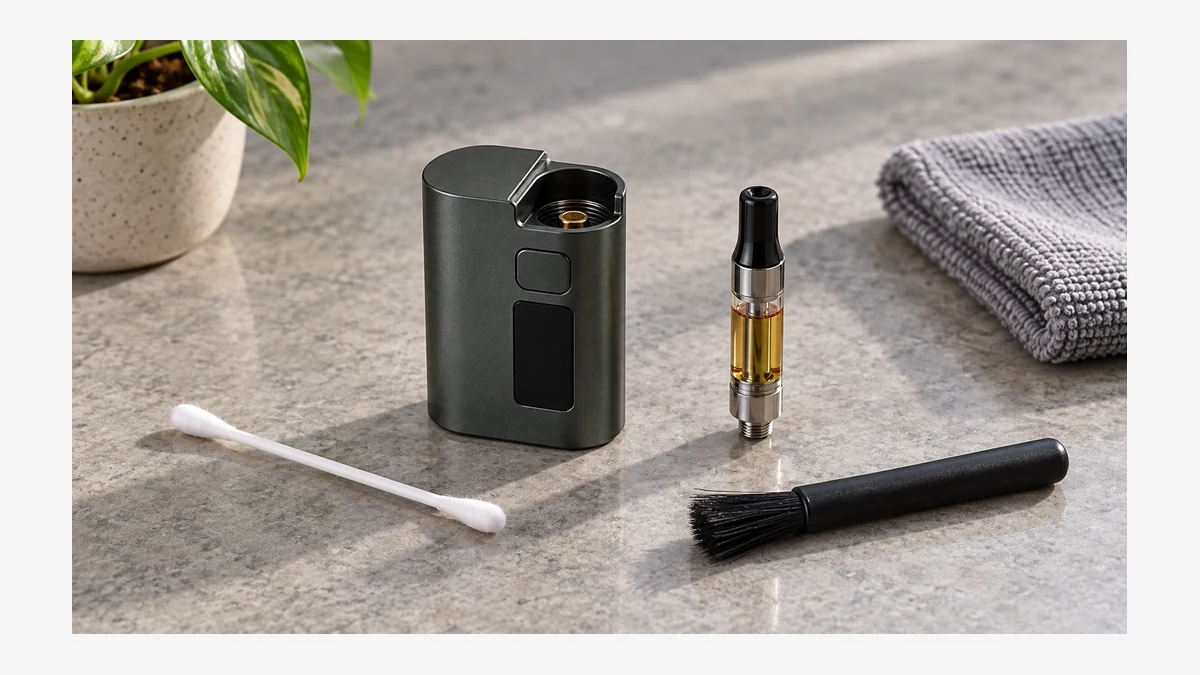
Maintenance access is where the recessed design creates the most friction. On an inline battery, the 510 connector is exposed and easy to wipe down or clear with a small brush. On a side-by-side battery, that same connector sits at the bottom of a narrow, walled bay, often just slightly wider than the cartridge itself.
Residue from a cartridge base — condensation, oil seepage around the threads — tends to collect in the corners of that bay rather than wiping away cleanly, since there’s less open space for a cloth or swab to reach around the connector. Over time, buildup in the corners of the recess can itself become a fit problem: it narrows the effective bay dimensions, which is why a cartridge that seated and fired fine when the battery was new can start producing the same blinking or weak-contact behavior described earlier, even with no change to the cartridge.
⚙️ 8. Quick Identification Checklist
Because “510 compatible” only describes the threading and not the cartridge’s outer shape, identifying whether a cartridge actually suits a given side-by-side battery means looking past the connector spec. The table below breaks down what to check and why each point matters for this specific housing style.
| What to check | Why it matters in a side-by-side housing |
|---|---|
| Cartridge outer diameter vs. bay width | A recessed bay has fixed walls; a slightly wider cartridge can’t seat flush even if the threads engage |
| Base shoulder shape (tapered vs. squared) | Bays are molded around a specific base profile — a mismatched shoulder can bottom out early |
| Cartridge height vs. bay depth | A cartridge that’s too tall or short changes how much spring-pin travel is available at the center contact |
| Position of the cartridge’s air intake hole | It needs to align with the battery’s side vent, or draw resistance increases regardless of connection quality |
| Visible residue inside the bay | Buildup in the recess narrows available space and can mimic a bad-cartridge fit over time |
Running through these points before assuming a cartridge or battery is defective usually points to a straightforward mechanical explanation: in a side-by-side device, the connector only ever tells part of the story — the shape of the recess around it tells the rest.
For related component context, see the flip 510 battery guide.
For related component context, see the dual 510 battery guide.
The practical takeaway for anyone troubleshooting this hardware is to treat the cartridge bay as a second spec alongside the 510 thread: diameter, base shape, height, and intake alignment all have to match the recess, not just the threading, for a side-by-side battery to make full, consistent contact.
🧱 9. Recess Depth Defines Cartridge Compatibility
The side bay protects the cartridge by surrounding part of its glass or metal body, but that protection creates a dimensional limit. Measure cartridge diameter at its widest point, overall height from the threaded base to the mouthpiece, and the position of any intake holes. A cartridge that threads onto the connector can still be too wide for the bay or too short to reach comfortably.
Clearance around the cartridge matters for airflow and removal. If the bay presses against the body, it can block side inlets or make the cartridge bind as it warms. If only the mouthpiece remains exposed, there must still be enough grip to remove the cartridge without levering the glass against the battery shell.
💧 9.1. Adapters Change Both Height and Contact
Some recessed batteries use a magnetic threaded adapter. The adapter adds height and becomes another electrical interface that must remain clean. Different adapter collars can look similar while placing the cartridge at different depths. Keep the matched adapter with the battery and thread it onto the cartridge only finger-tight.
🧲 9.2. A Protected Cartridge Still Needs an Open Air Route
Air may enter through holes near the cartridge base, through a gap around the body, or through a channel in the battery housing. The bay should not be treated as empty decorative space. Condensed oil, lint, or a mis-sized cartridge can obstruct that route even when the 510 connection still works.
📏 10. Identify the Layout Before the Feature List
“Vape with battery on the side” usually describes a side-by-side or recessed 510 battery, not a different cartridge standard. Confirm the bay dimensions, connector or adapter type, control layout, charging port, and documented airflow path. Those physical facts determine compatibility more reliably than the compact silhouette.
Finally, inspect how the battery stands and rests with a cartridge installed. A recessed format lowers the exposed height, but a narrow base can still tip on a hard surface. Store it powered off in the orientation and temperature range documented by the maker, away from loose metal objects that could contact the charging port or connector.