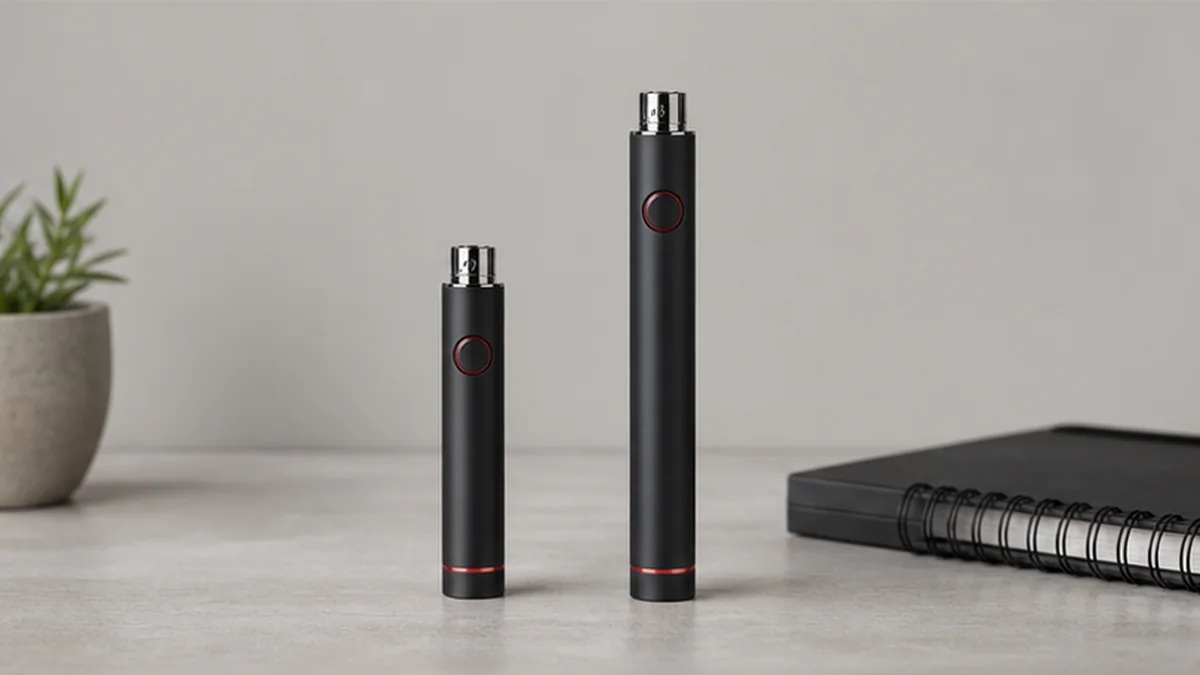
You’re holding two 510 batteries side by side. One is labeled 900mAh, the other 650mAh. Common sense says the bigger number wins the day —more capacity, longer runtime, simple math. Except when you actually use them with the same cartridge, the 650mAh battery keeps pace, and on some days it outlasts the “bigger” one. That’s not a defect and it’s not marketing sleight of hand. It’s just what the mAh number was always telling you, and what it was never telling you.
What mAh actually measures
Milliampere-hour is a unit of electric charge, not energy. It tells you how much current a fully charged cell can theoretically deliver over one hour before it’s empty —900mAh means roughly 900 milliamps for one hour, or 450 milliamps for two hours, and so on, under a defined test condition. Current itself is just the rate of charge flow, so mAh is really a bookkeeping figure for how much charge the battery can hand off, not how much work that charge can do.
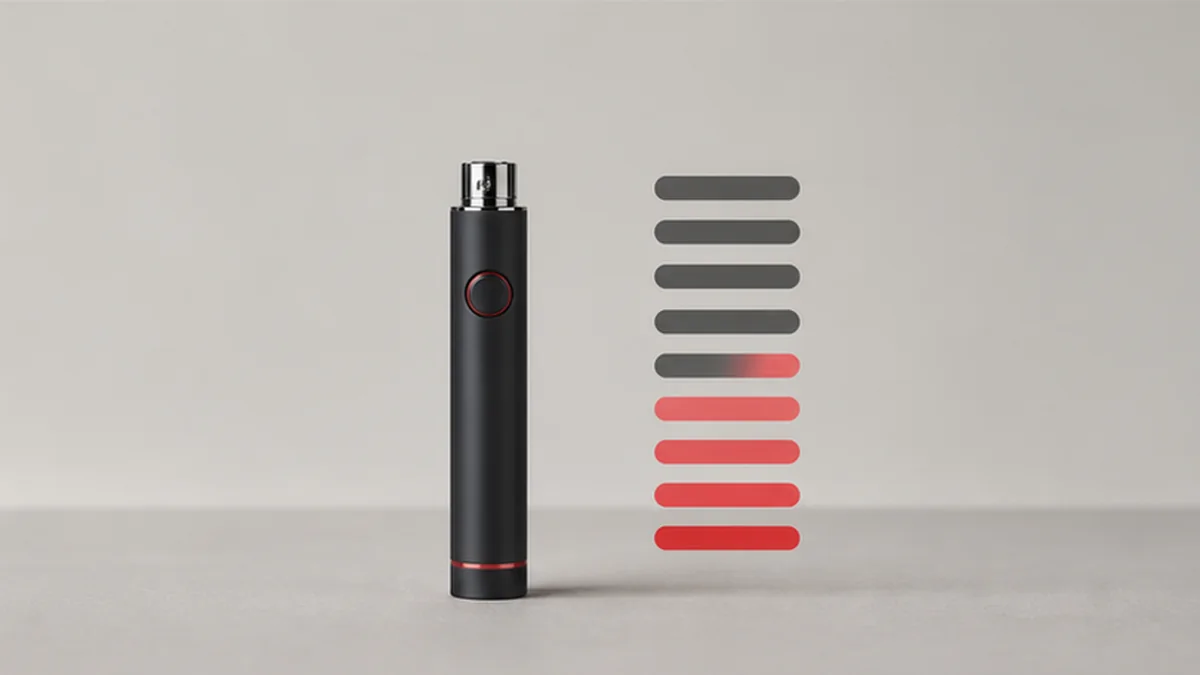
Work —the part you actually feel as heat, vapor, or screen-on time —depends on voltage too. Two cells can carry the same charge rating and still deliver very different amounts of usable energy, because energy is charge multiplied by voltage. That’s the gap between what mAh promises and what your device experiences.
Why identical mAh doesn’t mean identical runtime
This is the part that trips people up, and it’s also the exact question that keeps surfacing in battery-shopping threads: why does a “bigger” battery sometimes lose to a smaller one in real use? A few things are doing the work here, and none of them show up on the spec sheet next to the mAh number.
Output power and voltage
A 510 battery that runs at a higher voltage or wattage setting pulls more current per second, which drains the same charge pool faster. Set two batteries with equal mAh to different power levels and you’ll get two different runtimes, full stop. This is also why comparing batteries strictly by mAh only makes sense when voltage and draw are held equal —otherwise you’re comparing two different jobs, not two different tools doing the same job. A quick look at a voltage guide for live resin carts makes this concrete pretty fast.
Efficiency and cutoff behavior
No battery converts 100% of its rated charge into usable output. Internal resistance bleeds some of it off as heat, and most protection circuits cut power off before the cell hits true zero, both to protect the battery and to avoid the weak, sputtering draw you’d get at the very bottom. Battery University’s breakdown of capacity ratings covers this well —the rated mAh is a lab number, and real-world usable capacity is always somewhat less, with the gap varying by cell design and how aggressively the cutoff is tuned.
Battery condition and temperature
A cell’s real capacity shrinks with cycle count and age —a year-old battery rarely delivers what it did new, even if the label hasn’t changed. Cold weather slows the internal chemistry and temporarily reduces how much current a battery can deliver, which is why the same device can feel noticeably weaker on a cold morning. None of this shows up in the mAh printed on the box, because that number reflects a fresh cell under controlled conditions, not the one in your pocket six months later.
Your own use pattern
Longer draws, higher wattage settings, and more frequent use all pull more total charge per session. Someone using a battery all day at a low setting and someone hitting it hard for a couple hours will land on very different runtimes with the identical hardware. This is a big part of why “how long does a 510 battery last” doesn’t have one clean answer —it’s less about the battery and more about the session.
mAh vs. Wh —the comparison that actually matters
If you’re comparing batteries that run at the same voltage, mAh is a reasonable shorthand —more charge, more runtime, roughly proportional. But once voltage differs, mAh alone can mislead you. The more honest comparison is watt-hours (Wh), calculated as nominal voltage multiplied by amp-hours. Two batteries can carry the same mAh rating and still store meaningfully different amounts of energy if their voltages differ.
| Battery | Rated capacity | Nominal voltage | Approx. energy (Wh) |
|---|---|---|---|
| Battery A | 900 mAh (0.9 Ah) | 3.2 V | ≈2.9 Wh |
| Battery B | 650 mAh (0.65 Ah) | 3.7 V | ≈2.4 Wh |
In this example the 900mAh battery still edges out on stored energy, but by a much smaller margin than the mAh gap alone would suggest —and depending on how each one is tuned to deliver its power, that gap can close further or even flip once you factor in efficiency and cutoff behavior. The lesson isn’t “always calculate Wh before buying.” It’s that mAh by itself is an incomplete comparison whenever voltage isn’t identical across the batteries you’re weighing.

Does higher mAh mean a better device?
No, and this is probably the most common assumption worth pushing back on. A higher mAh rating means more charge capacity, which is one input among several. It says nothing about build quality, how well the battery regulates output as it depletes, how consistent the draw feels near the bottom of a charge, or how the battery holds up after a hundred charge cycles. A well-engineered battery with a modest mAh rating can feel more consistent day to day than a higher-rated one with sloppy voltage regulation. Capacity is a spec, not a verdict.
So how do you actually compare compact 510 batteries?
Treat mAh as one line item, not the whole decision. A more useful comparison looks at:
- Voltage range and whether it’s adjustable or fixed —this determines actual power delivery, not just capacity
- Whether the battery specifies watt-hours or only mAh (a spec sheet that gives you voltage too is more transparent)
- Charging behavior and cycle life claims, since usable capacity fades over time —a vape battery charger guide is worth a look if you’re also weighing charge speed
- Physical size and how it matches the cartridges you actually use, since draw habits with a given 510 thread batteries setup matter as much as the cell inside it
- Real reviews or discussions describing day-to-day runtime, not just the label
None of this requires a spreadsheet. It just means reading the mAh number as “how much charge this cell holds” and nothing more —then checking voltage, build quality, and your own habits to fill in the rest of the picture.

The decision rule
If you’re comparing two batteries at the same voltage, go ahead and let mAh break the tie —it’s doing exactly the job it’s rated for. The moment voltage differs, or one listing gives you Wh and the other doesn’t, stop trusting mAh alone and look for the energy figure, or calculate it yourself from voltage and amp-hours. And regardless of what the label says, judge runtime by how the battery performs in your actual routine over a few charge cycles —that number will tell you more than anything printed on the packaging.