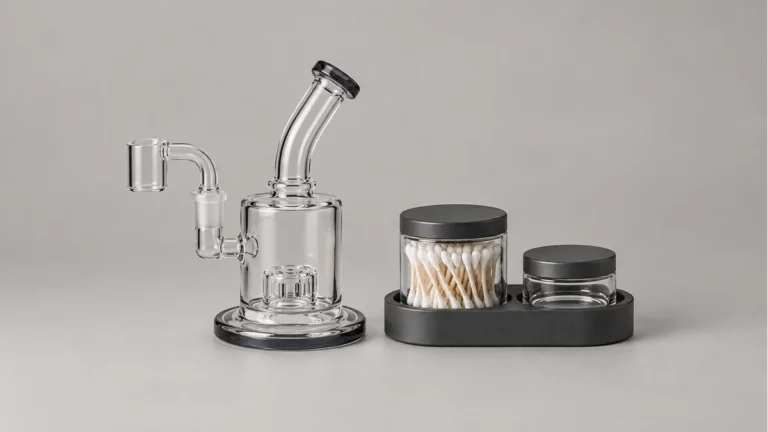
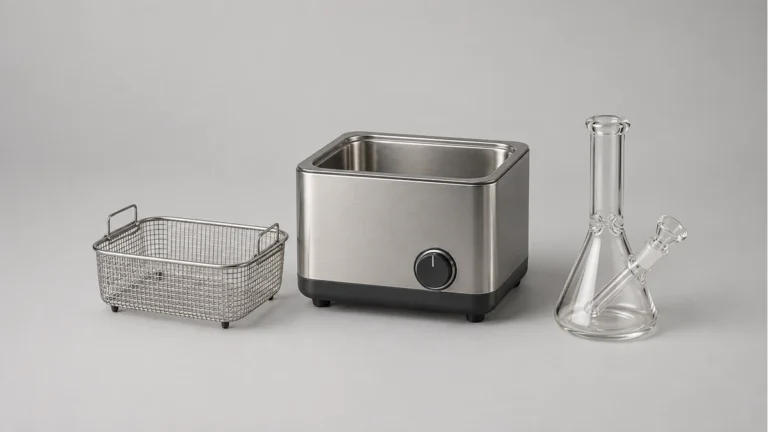
A bong cleaning machine is not automatically large enough for the glass you want to clean. An external ultrasonic bath has a tank, a permitted load and its own cleaning restrictions. Compare the complete water pipe with the usable supported space, then establish that the process is suitable for the actual object.
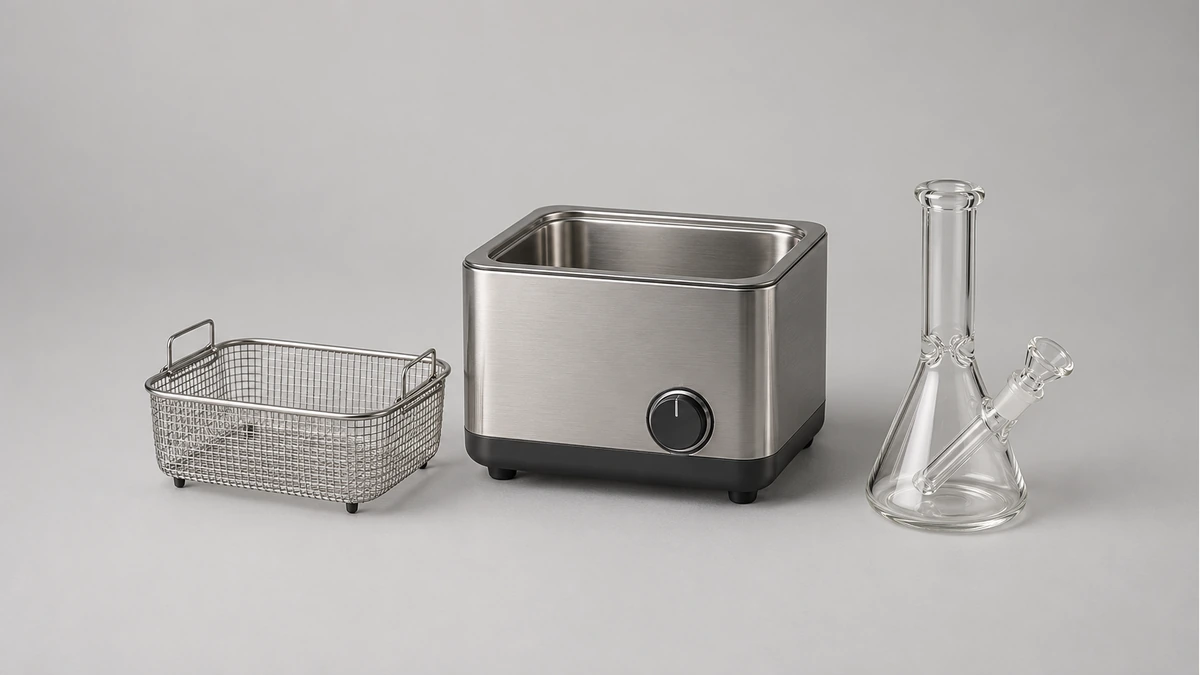
That is a different question from whether a glass piece is advertised as self-cleaning. It is also different from moving a manual magnetic scrubber by hand. Identify the equipment and the job first; otherwise, advice about one method can be mistaken for instructions for another.
🧲 1. Which kind of bong cleaning machine is being discussed?
An ultrasonic bath is separate powered cleaning equipment. A hand-operated magnetic scrubber is a tool whose movement the owner controls. A “self-cleaning” description attached to a water pipe is another claim again. A similar search result can contain all three without explaining the differences.
Our self-cleaning bong guide addresses the wording applied to the glass itself. Here, the focus is an external bath: whether the object fits, which components are permitted and what its operating manual actually allows.
A Reddit discussion about a manual magnetic cleaner described a visible cleaning result. That is an owner’s account of that tool, not a test of an ultrasonic machine. It cannot establish that another process will remove a particular mark or make the equipment ready for reuse.
Keep the observation precise. “A patch remains after the care method I followed” is useful. “This needs a stronger machine” is a conclusion that has not yet been established. A powered process should not become the automatic next step whenever a deposit is difficult to reach.
📐 2. Tank capacity does not describe the whole usable space
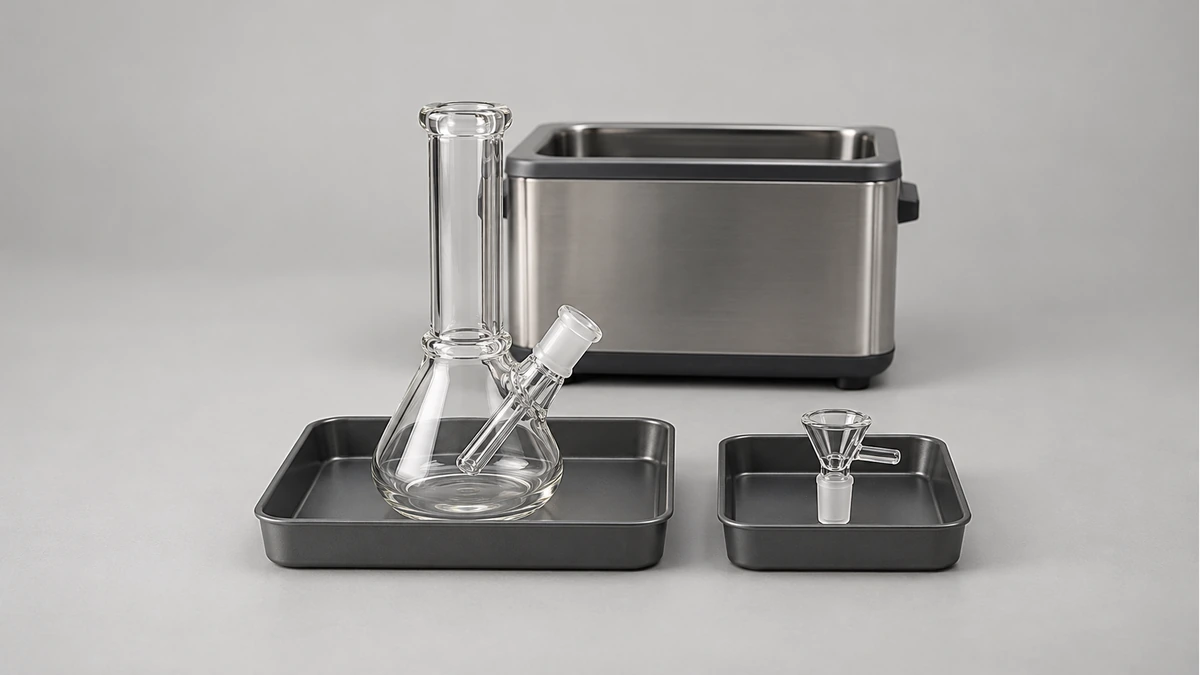
A short, broad chamber and a tall, narrow chamber can pose different fit questions even before side joints are considered. Describe the outside dimensions rather than calling both pieces small. The machine’s support information should give you the corresponding usable space; if it provides only tank capacity, request the missing dimensions.
Use a sketch of the cool, empty object’s outline if that makes the comparison easier. Mark the parts that are fixed and distinguish them from documented removable accessories. There is no need to immerse the object to make this record. It can also help support understand why a chamber fits while its side connection does not.
Do not omit a protrusion on the assumption that it can hang over the edge during cleaning. Whether any particular loading arrangement is permitted belongs to the machine’s instructions. A photograph of a partially submerged object in someone else’s tank does not supply that permission for yours.
Look beyond the capacity number in a listing. You need the actual usable dimensions of the permitted basket or support arrangement, including any clearance the instructions require. A liquid-capacity figure alone does not give the three-dimensional space available for an irregular object.
Compare the complete glass outline while it is cool, empty and appropriately supported outside the machine. Include the base, mouthpiece, side joint and every permanently attached protrusion. Measuring only the chamber leaves the rest of the shape out of the decision.
Then compare the documented support space, not merely the tank opening. An object might pass through an opening yet be unsuitable for the intended supported position. Do not tip, wedge or force it into the tank just to see whether the lid can close.
One Reddit discussion made the practical distinction clear: an owner said a smaller bath would not accept a whole water pipe, although they used it for accessories. That is a question about the scale of the task. It is not a universal endorsement of cleaning every small part in a bath.
📏 2.1 Include the path in and out
Allow the space the instructions require for lifting the permitted support and removing the load. A shelf above the machine can interfere with that motion even when the tank fits on the counter. Check the empty workspace before introducing any equipment or cleaning liquid.
Also identify a suitable place to set permitted removed parts. If the only available surface is already covered with other equipment, solve that layout problem first. A capacity decision includes the surrounding handling space, not only the box on the desk.
🧩 3. A removable component needs its own approval
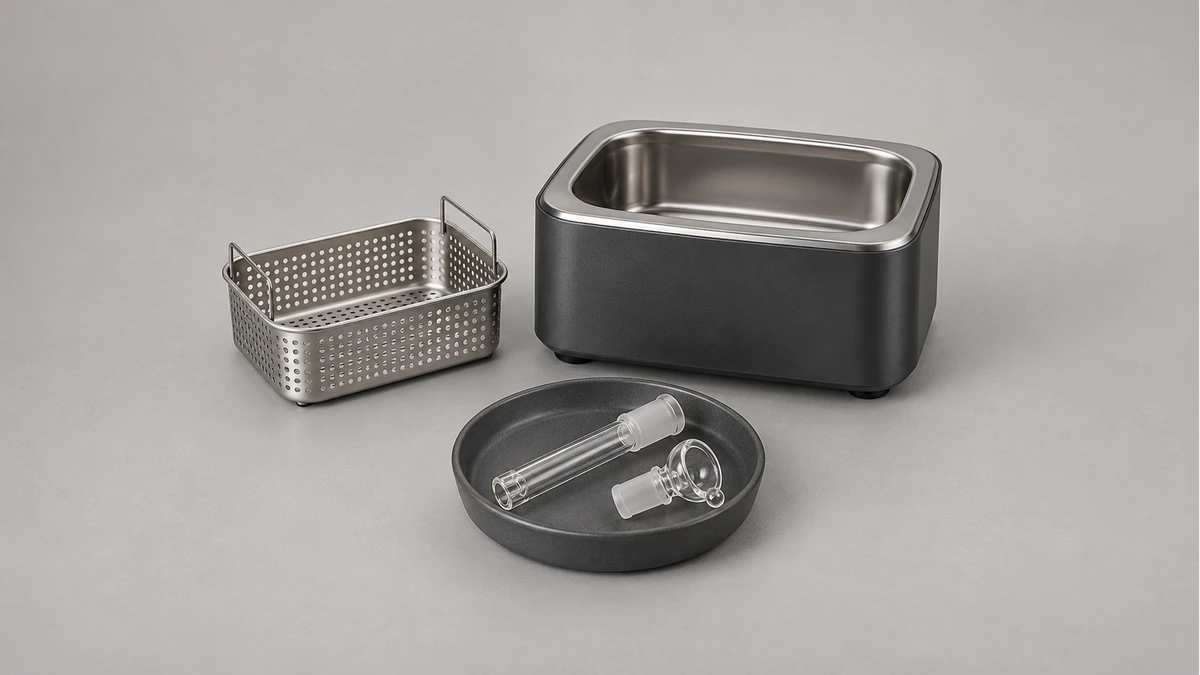
When a complete water pipe does not fit, do not start separating fixed sections to make it smaller. Establish which components are designed to detach. A visible seam or accessible tube is not proof that ordinary owner disassembly is permitted.
For each genuinely removable component, check its care information separately. A glass bowl, a coated attachment and a part with a seal are not interchangeable cleaning loads merely because all three fit in the basket. Size and process compatibility are different checks.
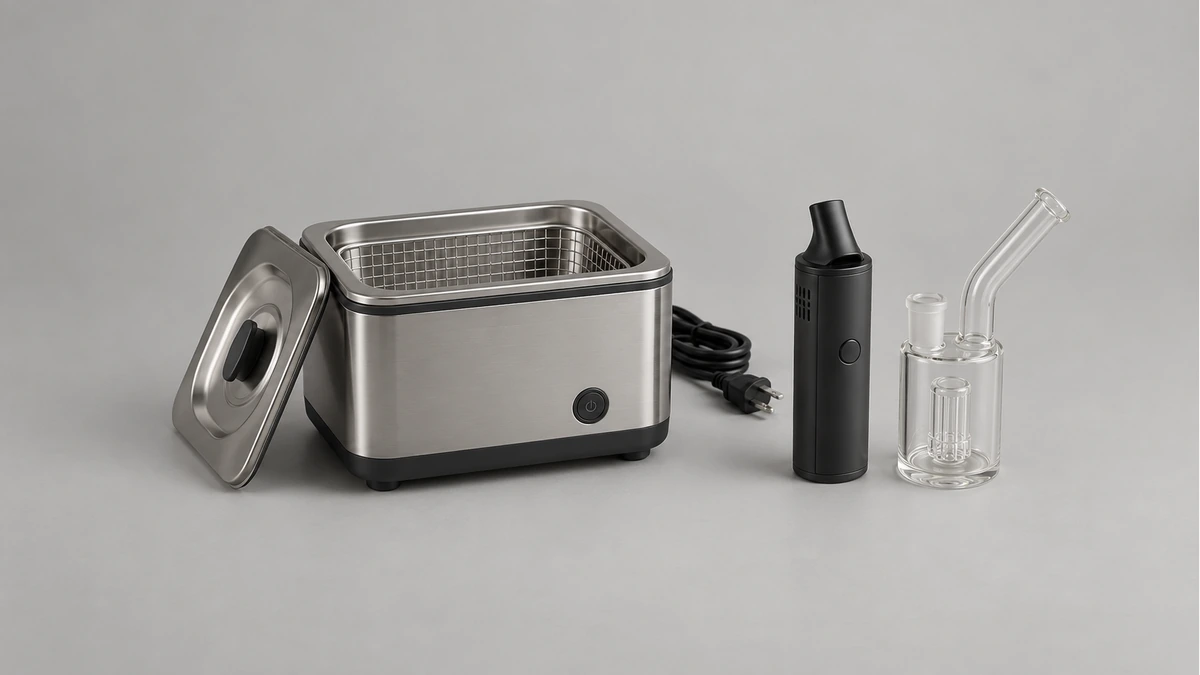
A battery-powered vaporizer is not a passive glass accessory. Nothing in this article authorizes immersing a complete device, battery, charging accessory or electronic assembly. Keep powered equipment outside the bath and follow its own care instructions.
If you are uncertain about a small part, describe it to the equipment maker rather than placing it in with a known load. Our cleaning-kit guide discusses the separate hand-tool task. A permitted manual method does not establish permission for ultrasound.
📄 4. Check the machine and the object’s instructions together
The cleaner’s manual defines its permitted operation. The object’s maker defines the care restrictions for that object. You need a suitable combination, rather than relying on either document to answer questions outside its scope.
For a documented example, Elma’s April 2023 Elmasonic Easy manual specifies permitted cleaning agents and accessories, prohibits flammable liquids and requires the operator to assess results. These are instructions for that equipment, not approval of smoking accessories as a category.
A general reference to glass does not identify every finish or attached component. Ask about the actual coating, seal, adhesive or other material where relevant. If its identity is unknown, do not replace the missing information with an assumption based on appearance.
The issue extends beyond clear glass. Our steel water-pipe care guide distinguishes the main body from other components. A metal exterior does not establish that the whole assembly can undergo the same process.
Keep any approval specific: the identified part, its permitted assembly condition and the intended process. If the response covers only the bare body, it has not answered the question about an attached seal. Resolve the remaining component instead of treating a partial answer as permission for everything.
⚠️ 5. Do not transfer a hand-cleaning recipe into the bath
Forum discussions of manual cleaning contain many liquids, soaking periods and heat suggestions. Those are not interchangeable with a machine’s operating instructions. A method someone describes at the sink does not establish that the same liquid belongs in powered cleaning equipment.
The Elma manual cited above prohibits filling its tank with flammable liquid and specifies approved aqueous agents. Follow the actual unit’s instructions and the cleaning product’s safety data, rather than borrowing an alcohol mixture from a comment thread.
Do not use a sealed bag, improvised jar or beaker as a workaround for a prohibited process. A different accessory arrangement would need explicit equipment documentation of its own. This article provides no solvent-in-container technique, concentration, heating setting or cycle recipe.
If the machine’s permitted cleaner and the object’s care restrictions do not align, the process is unresolved. More dilution or an extra rinse should not be invented to bridge that gap. Ask the relevant maker whether an appropriate documented method exists.
🧺 6. Use the documented support arrangement
Identify the basket and any other support accessories specified for the actual unit. The cited Elma manual directs users to appropriate support rather than placing objects on the tank bottom. That is a model-specific instruction to follow, not an invitation to improvise a substitute.
In the Reddit bath discussion, another owner reported a chipped glass slide and interest in a tray. The comment does not establish the cause of the chip. It does highlight a support question that should be resolved before loading fragile accessories.
Do not assume a homemade printed tray, kitchen insert or foam pad is suitable. Ask about the required accessory and its permitted arrangement. A part being physically held above the bottom does not establish compatibility with the machine or the cleaner.
Separate the loading assessment from operation. Follow the instructions for when and how permitted objects are inserted or removed. The cited manual also says not to reach into the bath while ultrasound is operating; it does not authorize an owner to adjust glass by hand during a cycle.
If a part cannot rest as the documented arrangement requires, stop. Do not balance it on another piece, compress several items together or depend on the lid to hold it in position. A fit problem remains a fit problem even when the machine is large enough to contain the objects.
🖥️ 7. A completed program is not a condition report
Interpret timers, indicators and completion messages according to the unit’s instructions. They describe the equipment’s operation; they should not be treated as a certificate that a particular object is clean, undamaged or ready to use.
Follow the documented removal, rinsing and drying requirements for the permitted load. Do not assume the cycle includes those later tasks. Prepare the receiving and drying area beforehand, so the end of a program does not leave you searching for somewhere appropriate to place the parts.
Inspect the accessible result as directed. Do not label a remaining cloudy patch as a particular deposit, or diagnose glass damage from a distant photograph. If the condition is uncertain, keep the object out of use while you obtain the relevant guidance.
A machine does not eliminate its own maintenance. Follow the unit’s cleaning and fluid-management instructions separately from care of the load. A clean-looking object does not tell you whether the tank, basket or other equipment has received the required attention.
📝 8. Stop repeating an unexplained result
Keep the original accessory identification with those notes. If a basket or support has been replaced, include its part information rather than assuming it matches the original arrangement.
If the permitted procedure does not produce the documented result, note what actually happened. Record the equipment model, the identified load, the approved cleaner used and the selected program. Include photographs of the accessible condition without probing or scraping an uncertain area.
Do not keep increasing time, heat or chemical strength until the mark disappears. Those changes would create a new process rather than explain the old one. Take the specific question to the machine’s support service and, where appropriate, the object’s maker.
Clarify whether the difficulty is fitting the complete outline, supporting a small accessory, identifying a material or evaluating a remaining mark. Each calls for different information. A broad request for “more cleaning power” leaves those distinctions unanswered.
Once the compatibility and handling requirements are known, keep them with the equipment. If they cannot be established, use only a care method the object’s maker actually permits. The useful next step is the one that resolves the missing information, not another improvised cycle.