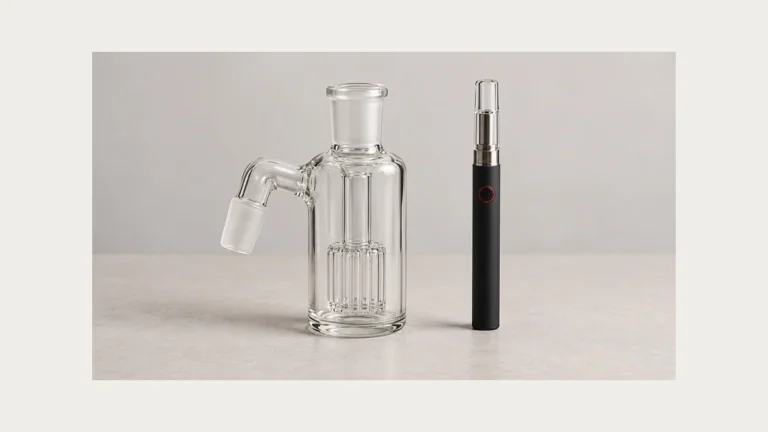
A bong filter attachment is not one standardized part. The name might refer to a small screen, a built-in ash-catching feature, a separate catcher chamber or an accessory intended for a particular filter medium. Identify the physical component and its documented connections before treating “filter” as a specification.
This becomes a practical problem when an extra glass piece arrives in a box without a clear name. A small insert and a chamber with two joints may both be called filters in casual conversation, but their cleaning access and replacement questions are different. Start with the complete, inactive object and whatever manufacturer information came with it, rather than assuming the label tells you what is inside.
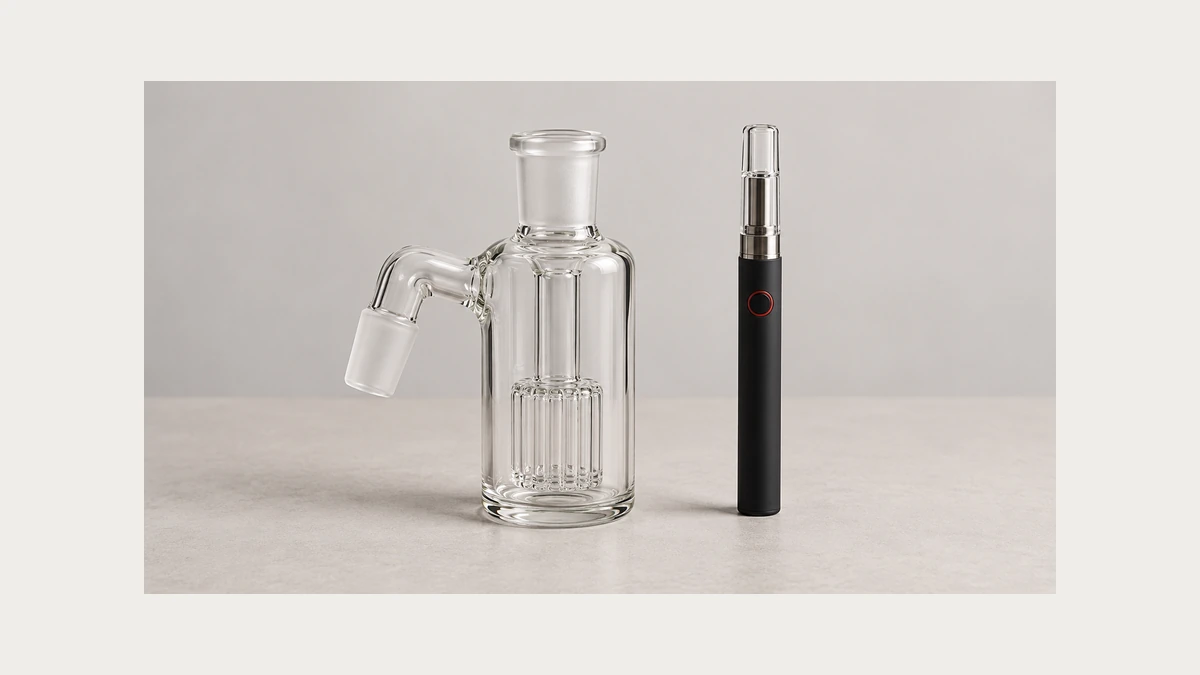
🔍 1. The word filter does not identify the part
In a May 2024 identification thread, an owner asked about an unfamiliar glass component. Visible replies called it an ash catcher or a percolator and included unverified health claims. Those comments reveal a vocabulary problem, not an agreed technical assessment. A commenter’s confidence does not establish what an unknown component contains or which glass it will fit.
The useful distinction is the part’s role and construction. Is it a small insert within another component, a feature formed into the main glass, or a separate chamber with its own connections? Those descriptions narrow the question without assigning an efficiency rating. They also help you avoid asking for a replacement “filter” when the part that needs identification is actually an adapter or a removable downstem.
🧩 2. A screen, built-in catcher and accessory chamber are different
A bowl screen is a small insert rather than a chamber. Screens can have different shapes and materials; the important distinction here is that the insert does not provide the same enclosed body and connection arrangement as a separate ash catcher. A loose screen, a shaped glass insert and a built-in restriction should not all be assumed to remove in the same way.
AOVAPE’s glass-screen guide addresses those smaller parts. Use it for the screen question rather than assuming a catcher chamber’s care instructions apply to an insert. A photograph showing something inside a bowl does not establish whether it is loose, retained or formed into that bowl.
The GRAV glossary distinguishes ash-catching structures built into a piece from separate accessory ash catchers. Its description identifies interception of ash and debris as the intended job. It does not provide a health assessment or a measured efficiency for an unidentified attachment.
“Built-in” matters because an internal feature may belong to the main glass rather than be a removable insert. A visible change in shape is not automatically a seam. If there is no manufacturer-described separation point, do not pull at the feature as though it were a replaceable cartridge.
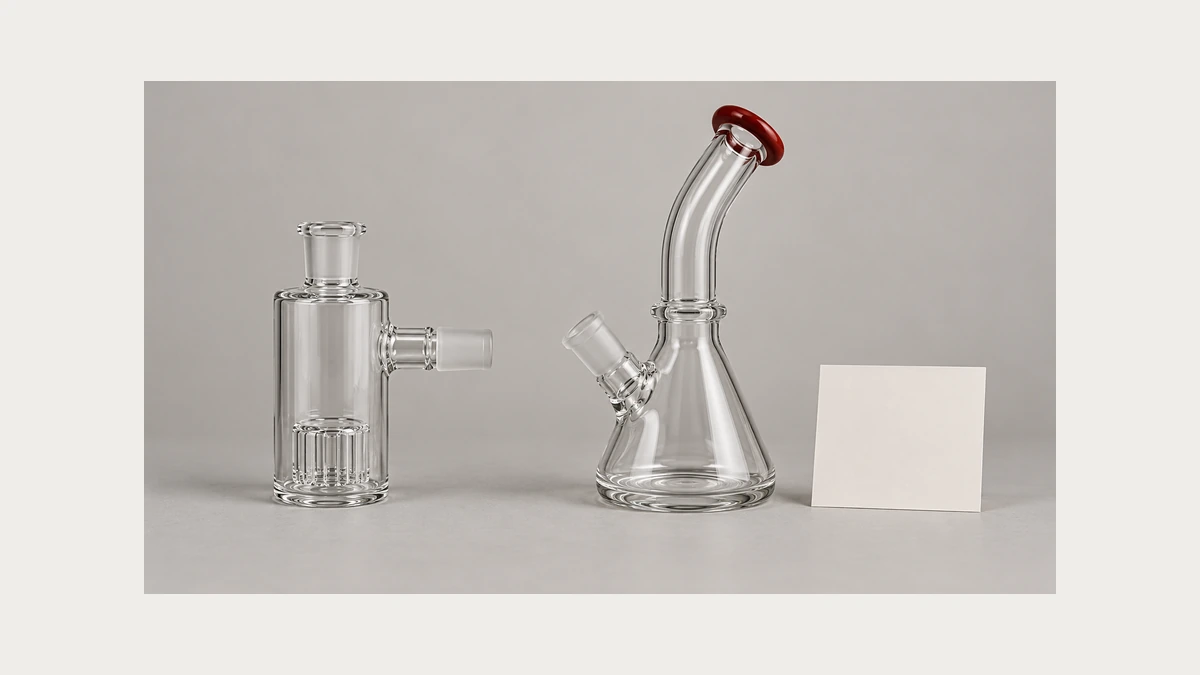
A separate catcher chamber has its own body and interfaces with other components. Look for that distinct body as well as its connection points. Two joints alone do not prove it is a catcher: a plain elbow adapter can also have two joints, without an intervening collecting chamber. Likewise, a chamber’s internal stem or slots do not establish that it accepts replaceable media.
The guide to individual glass components is useful for naming the surrounding parts. Keep a plain adapter, the main vessel and a separate chamber distinct in your description. Calling every extra piece a filter conceals the very differences needed to identify it.
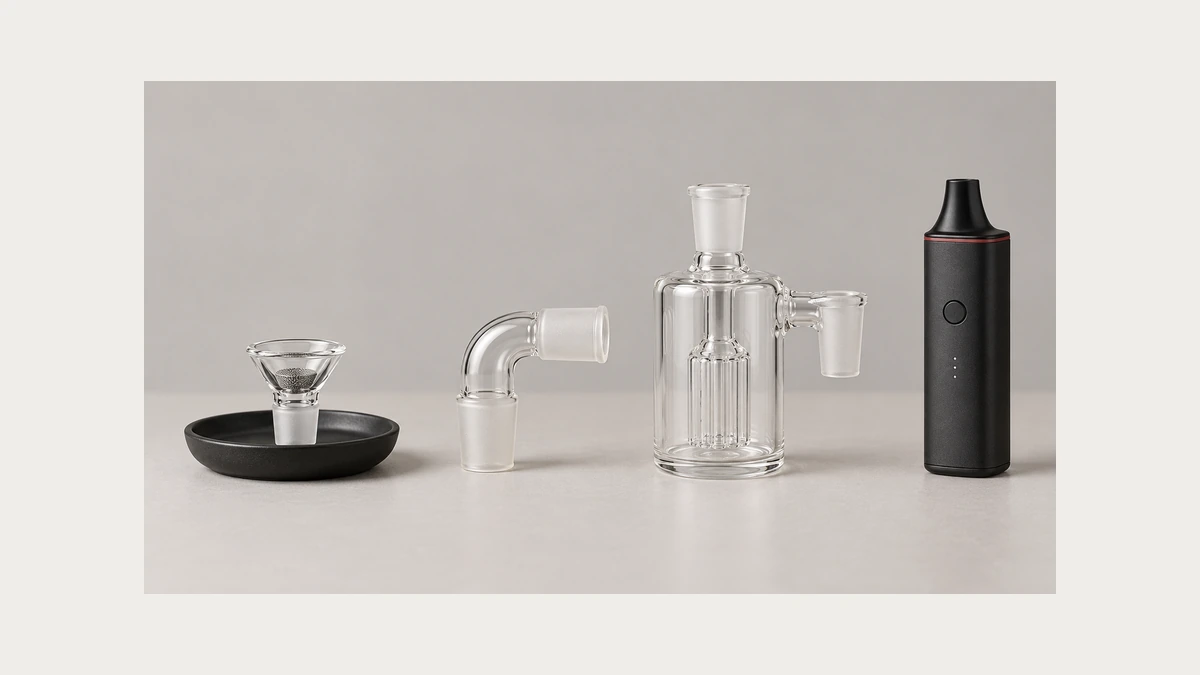
🔗 3. Look at both connections rather than only one number
Once you’ve identified a separate chamber by its two joints, the next mistake is to treat one joint size as the whole specification. A chamber has an incoming connection and an outgoing one, and they are not necessarily identical in every respect even when they’re labeled with the same nominal size.
🧩 3.1 Size, gender and angle are three separate facts
An example of explicit connection information appears on GRAV’s own 90-degree Phoenix ash-catcher page. It specifies a 14 mm male joint and a 90-degree arm, and names a female receiving joint on the water pipe as part of its compatibility description. The female receiver mentioned there belongs to the paired water pipe; it should not be misreported as another specification for the catcher’s own upper connection.
The lesson is to read what each identifier describes. A nominal size, a male or female designation and an arm angle are separate facts. AOVAPE’s adapter terminology guide explains those identifiers in another hardware context. It does not verify a particular mystery chamber’s dimensions or permit combining arbitrary components.
“It is 14 mm” is incomplete because it does not say which connection the number describes. A male joint and a female receiver are different interfaces, and neither label tells you the diameter of the chamber around them. Record both ends separately using the maker’s stated specifications, not measurements inferred from a photo.
For an unmarked component, a clear description might be “one projecting ground-glass joint, one receiving socket and a separate cylindrical body.” That identifies what is visible without pretending to know a size. Do not force an unknown joint into another piece to turn that uncertainty into an answer.
A packaging label can introduce another ambiguity: it may describe a bundle rather than the individual chamber. A box containing a chamber, removable internal component and adapter does not make every printed dimension a specification for every piece. Keep each component’s name next to the dimension attributed to it. If the diagram does not make the association clear, ask which part the label describes.
The same applies to a seller’s photograph of several possible configurations. It may illustrate separate variants, not all the components supplied with one item. Use the parts list for the exact version and distinguish a missing part from a permanently fixed feature. This can resolve an identification question without trying to separate bonded glass or assuming that an absent insert needs a homemade substitute.
⚠️ 4. Why matching joints can still leave glass touching glass
Matching connection labels do not describe every surrounding surface. A wide chamber, a collar or the curve of a main vessel may occupy space outside the taper itself. This is why a correctly named nominal size is only part of a compatibility description. The component still needs the clearance and support intended by its maker.
It helps to distinguish the connection from its surroundings in a support photograph. Show the whole detached accessory and the intact receiving area separately. A close-up of the joint alone can omit the large shoulder or curved body involved in the reported interference. Keep the hardware inactive while its compatibility is uncertain.
A September 2022 fit discussion makes that distinction concrete. A reply asked whether the issue was joint size or contact with a rounded part, and the owner clarified that the rounded part was being hit. That does not establish the dimensions or approve any adapter suggested in the thread. It shows that “does not fit” can describe a collision outside the joint.
Do not translate that example into a universal diagnosis. A crooked or incomplete connection might involve a wrong part, damage, deposits or surrounding geometry. The observation alone does not establish which. Force, improvised padding and home heating are not ways to confirm the intended match. Ask about the actual interference rather than assuming a different joint-size label will resolve it.
🧽 5. Removable parts change cleaning access
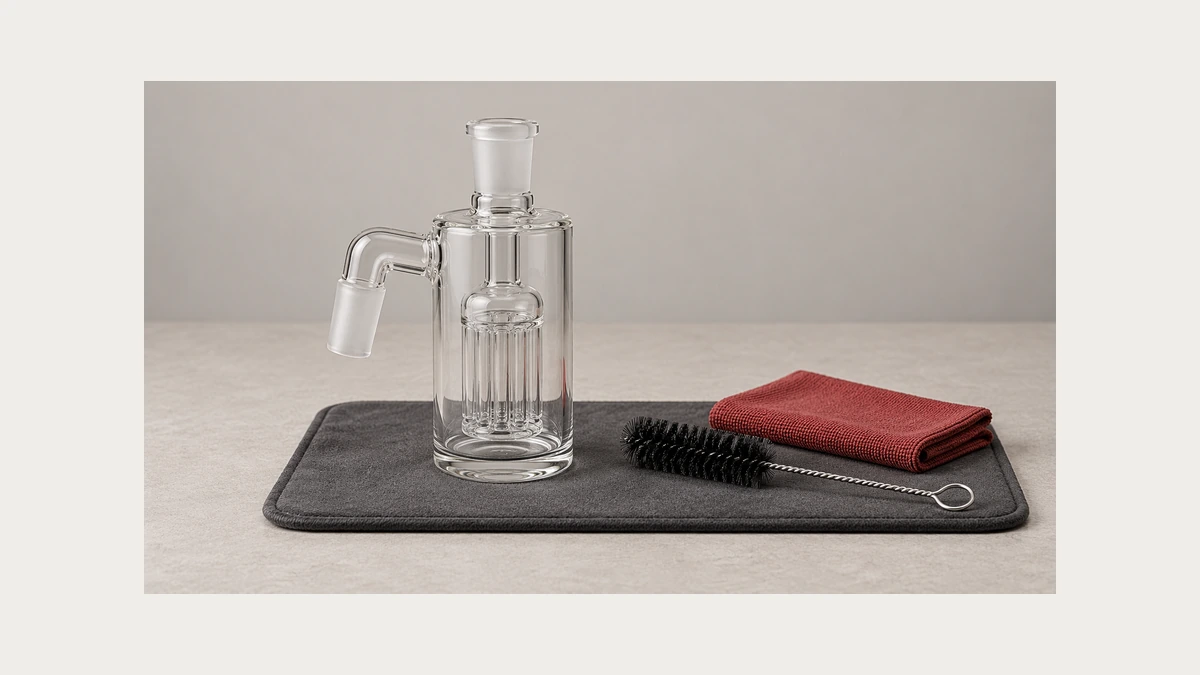
Cleaning access follows the construction. A loose insert may be removable if the maker identifies it that way; a formed-in feature remains part of its parent glass. A separate chamber may also contain removable components of its own, but the presence of a chamber does not establish that its internal stem or lid is serviceable.
Identify those boundaries before deciding what needs cleaning. A straight brush outside an opening may appear small enough at its tip but still be unsuitable because of its wider head, handle or the bends inside the glass. Do not use an external photograph as permission to push a tool into an unseen path. The specific part’s care instructions govern access and permitted tools.
When instructions identify a removable lid or stem, keep the whole assembly’s care limits in view. A removable component may be cleaned separately under the maker’s procedure, while the surrounding glass still needs its own care. “Take apart” is too vague if it leaves you guessing which joint is a designed opening and which is a permanent bond.
If a part has become stuck, that is a changed-condition question. Stop before escalating to twisting, impact or temperature changes copied from a forum. Record the exact components and ask for the maker’s procedure. A generic article cannot establish a force limit or a suitable solvent for an unknown surface.
🧴 6. A cleaner chamber is not evidence of safer inhalation
It’s worth being precise about what looking at a piece of glass can and can’t tell you. A visibly clean chamber tells you that the glass is visibly clean. It doesn’t establish anything about filtration effectiveness, airflow, or safety, because a visual inspection isn’t a test of any of those things — it’s an observation of surface appearance, nothing more.
The word “carbon” also needs context. It may identify a chamber designed for specified media, a cartridge assembly or only an imprecise listing description. None of those possibilities establishes what is actually present in an unmarked piece. A separate media product has its own identity, compatibility and service instructions; this article does not supply a filling or regeneration method.
A simple ash catcher should not be assigned gas-removal properties because someone calls it a filter. Equally, finding deposits inside a chamber does not measure what continued beyond it. Keep the claim at the level supported by the documentation: a part name, a connection specification or a stated maintenance procedure. Do not turn a visibly cleaner main vessel into a claim of safer inhalation.
🛑 7. Set aside damaged hardware and describe the actual mismatch
If a connection is cracked, set the component aside instead of continuing a fit investigation with it. In a December 2024 discussion, an owner reported a cracked attachment stem and said the accessory interfered with the main body’s thickness. Visible replies contradicted one another about continued use. That does not establish the fracture’s cause, and a reply saying the piece still seals does not verify its condition.
Do not treat sanding, glue or home reshaping as an approved repair. GRAV’s own support information asks owners to document broken or unusually fragile items and contact the company; it also says it does not offer repairs. Those are that manufacturer’s policies, not a universal warranty promise or an instruction to ship damaged hardware.
For another maker’s product, obtain its own service guidance. Avoid handling sharp remains to obtain a dimension or prove that a broken joint will still enter a socket. Keep any earlier photos, part identifiers and purchase documentation that can answer the identification question without approaching the damaged edge.
A useful support description names the object, then the unresolved detail: “separate catcher chamber, lower connection size unconfirmed, body reported to touch the vessel before seating.” That is more informative than “the filter is bad.” It gives the maker a component and a specific question to answer without claiming a diagnosis, a performance result or permission to keep using damaged glass.