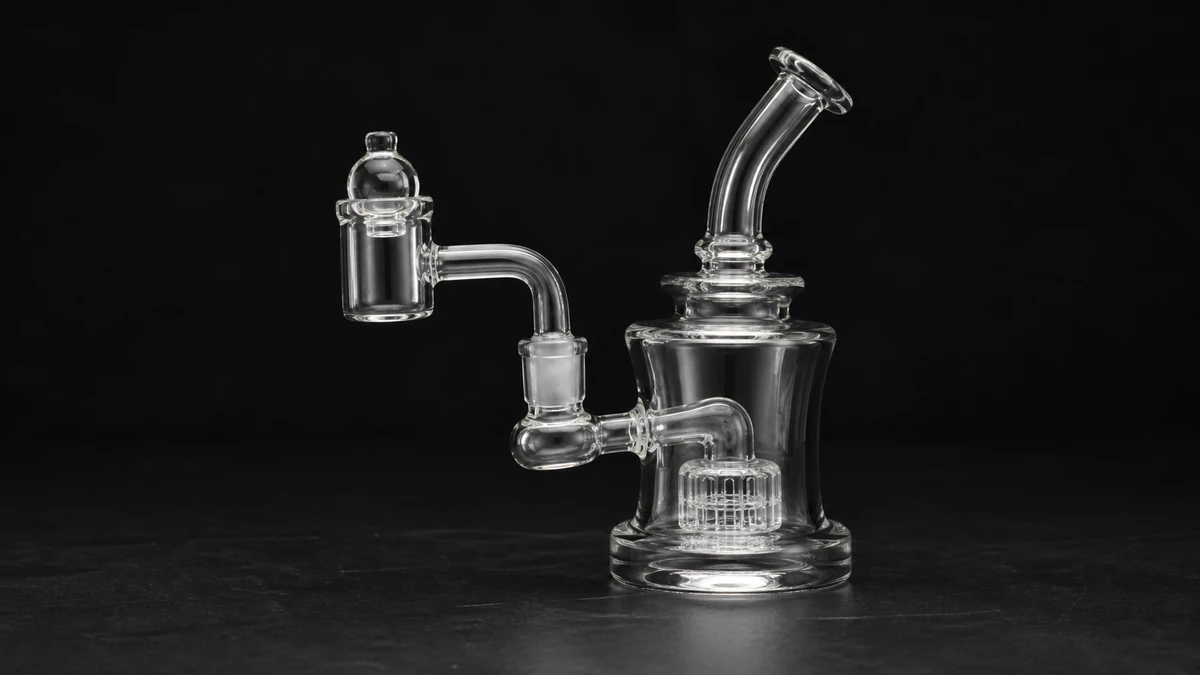
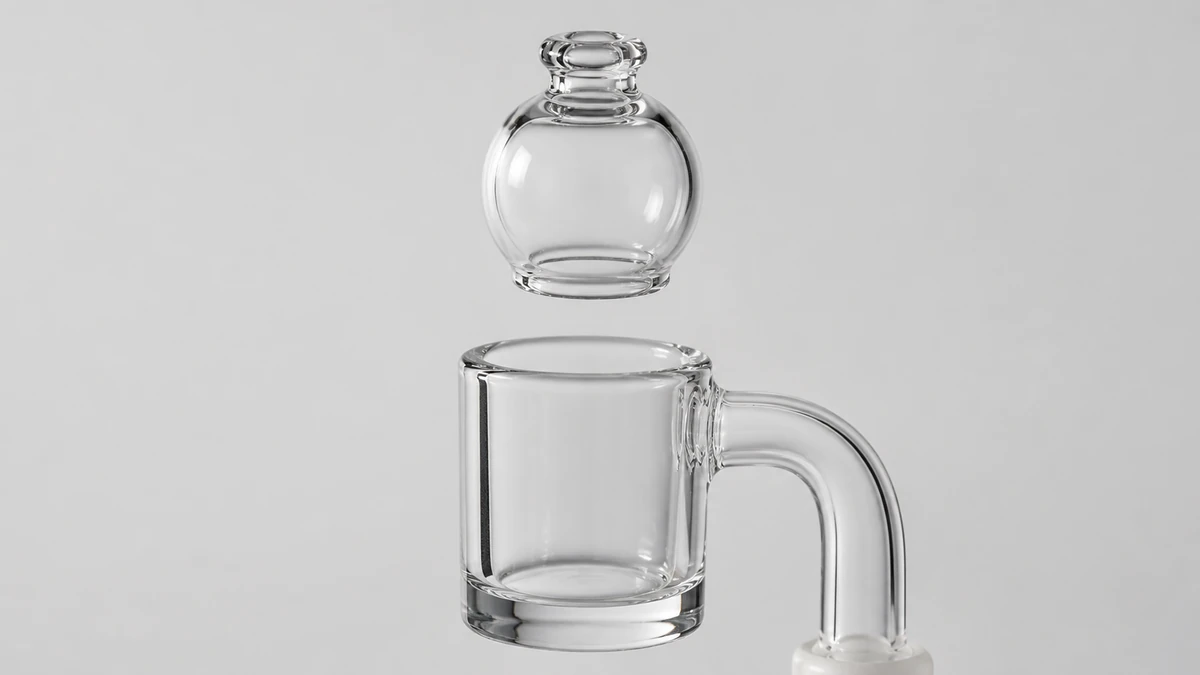
A bubble carb cap is a rounded, dome-shaped cap that sits over a banger’s opening to trap airflow and let concentrate vaporize under lower, more controlled heat. The “bubble” comes from its curved profile, not from a claim about performance, and that curve is exactly why fit matters more than shape when you’re deciding whether one will actually work on your rig. A bubble cap that doesn’t seat against the banger rim behaves like no cap at all, no matter how well-reviewed the style is.
That’s the piece that gets lost in most cap comparisons. People ask whether a bubble cap, a directional cap, or a spinner cap is “better,” but the honest answer depends on whether the cap you’re holding actually mates with the banger you own. A cap that looks like the right diameter can still leak air around the rim if the curvature doesn’t match, and once that happens, none of the airflow behavior the cap is designed for will show up. This guide walks through what makes a bubble cap seal, how its movement differs from directional and spinner airflow, and where pearls, cleaning, and banger geometry change the outcome.
🧭 1. A bubble cap must seal before its movement can help
Every carb cap, bubble-style or otherwise, does two things: it restricts the amount of outside air entering the banger, and it redirects whatever air does get in. The restriction part depends entirely on contact between the cap and the banger’s opening. If that contact is incomplete, air leaks in around the gap instead of moving through the cap’s designed path, and the cap’s shape becomes irrelevant. A bubble cap’s dome is built to hold a small volume of air and vapor inside the banger, but that volume only forms if the base of the cap closes off the opening.
This is why two bubble caps that look nearly identical can perform very differently on the same banger. One might rest flush against the rim, holding a seal at rest and while being lifted or rotated; the other might only make partial contact, letting air slip past even though it “fits” in the sense that it’s the right general size. Seal quality is a physical outcome of how the cap’s underside meets the rim, not a property of the bubble shape itself.
Before evaluating movement, airflow speed, or vapor production, it helps to check the seal on its own. With the cap resting in place and no heat involved, look for even contact around the entire rim rather than contact at just two or three points. A cap that rocks slightly, or that shows a visible gap on one side, will not seal consistently even if it seems to sit “on” the banger.
🧩 2. The banger rim and cap curve create the working interface
The actual seal is formed where two curved surfaces meet: the outer or inner edge of the banger rim, and the underside of the cap. Bangers vary in rim thickness, rim angle, and overall bucket diameter, and bubble caps vary in dome depth and base curvature. When those two curves are compatible, the cap seats consistently across its whole edge. When they aren’t, the cap may only touch at high points, leaving low points where air passes through freely.
This is the practical reason cap-and-banger pairing matters more than cap style alone. A bubble cap sized for a shallow, wide-rimmed banger may not seal at all on a deep, narrow-rimmed one, even though both are within a normal size range for concentrate rigs. The mismatch isn’t a defect in either piece; it’s simply two curves that don’t correspond. For background on how banger geometry and cap selection interact more broadly, our carb cap for dab rig guide covers rim and bucket variables in more depth.
Because this interface is physical rather than adjustable, checking fit before use is worth the extra minute. Rotate the cap slowly while it rests on the rim and feel for any point where it lifts or wobbles. A cap that stays level through a full rotation is far more likely to hold its seal once heat and airflow are introduced.
🔍 3. Directional movement and spinner airflow solve different jobs
Bubble caps, directional caps, and spinner caps all restrict airflow, but they route that airflow differently, and conflating them is a common source of confusion. A directional cap has a single angled channel or opening that aims incoming air at one specific point inside the banger. That focused stream is meant to push concentrate toward, or away from, a particular spot on the banger’s surface.
A spinner cap, by contrast, has multiple angled holes arranged around its base so that incoming air creates a swirling, circular motion inside the banger. The goal there isn’t to hit one location but to keep concentrate moving continuously across the surface. A bubble cap’s dome shape doesn’t inherently do either of these things on its own; its main job is forming the sealed air pocket described above. Some bubble-style caps add directional or angled openings to their design, which is when the two categories overlap, but the bubble profile itself is about seal and airflow volume, not steering.
Understanding this distinction matters when troubleshooting. If a user expects a bubble cap to move concentrate the way a spinner cap does, and it doesn’t have the angled holes to create that motion, the cap isn’t malfunctioning — it’s simply built for a different mechanism. Matching expectations to the actual airflow design of the cap in hand avoids a lot of unnecessary swapping between styles that are each working exactly as intended.
⚙️ 4. Pearls add another compatibility variable
Terp pearls, whether glass, quartz, or another material, are often used alongside a carb cap to help distribute concentrate across the banger’s surface as they roll. Airflow from the cap is usually what sets pearls in motion, so the cap’s seal and air volume directly affect how consistently pearls move. A bubble cap that seals well can still struggle to move pearls if the banger’s bucket shape doesn’t give them room to roll, or if the pearl size doesn’t suit the bucket’s diameter.
This is a separate compatibility question from the cap-to-rim fit discussed earlier. A bubble cap can seal perfectly against the rim and still produce inconsistent pearl movement if the pearls are too large for the bucket, too few in number to roll freely, or if the banger’s internal shape restricts their path. Because pearl movement depends on the interaction of cap airflow, bucket geometry, and pearl size together, changing any one of the three — swapping the cap, the pearls, or the banger — can change the result even when the other two stay the same.
When pearls aren’t behaving as expected, it’s worth isolating which variable changed. If the cap and banger combination previously worked well and pearls stopped rolling after switching pearl size or material, the pearls are the more likely variable to revisit before assuming the cap itself needs replacing.
🧼 5. A poor seal looks like a temperature or draw problem
One of the more misleading aspects of a poor cap seal is that its symptoms mimic other issues entirely. Concentrate that vaporizes unevenly, sessions that feel harsher than expected, or draws that seem thin can all be signs of a leaking cap rather than a heat or timing problem. Because a leak lets in extra, uncontrolled air, it effectively changes how much oxygen reaches the concentrate regardless of what temperature the banger was heated to.
This means two sessions run at the same target temperature, as discussed in our guide to dab temperatures, can still produce different results if one uses a properly sealed bubble cap and the other doesn’t. Before adjusting heat settings or wait times to chase a better result, it’s worth ruling out the cap as the source of the inconsistency. Reseating the cap, rotating it to check for even contact, or trying it on a different banger are quicker diagnostic steps than repeatedly changing temperature.
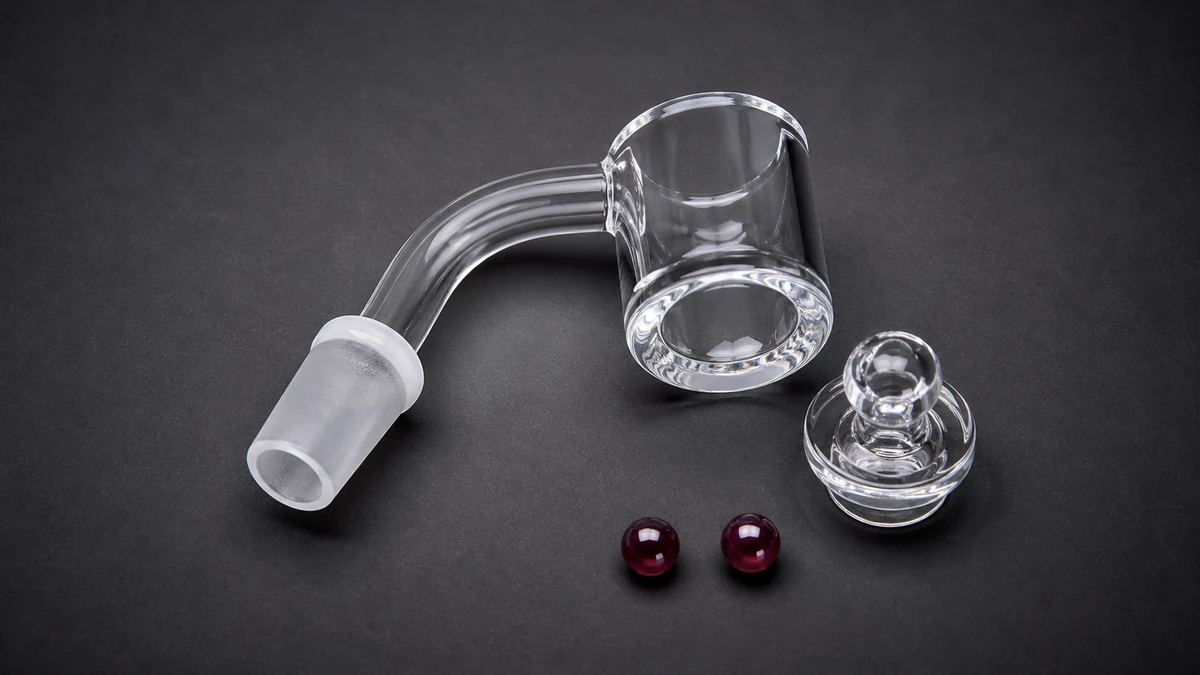
This diagnostic order also applies when a bubble cap has worked well in the past and suddenly seems less effective. Rather than assuming the concentrate or the banger’s heat retention has changed, checking the cap’s seal first is a faster way to isolate what actually shifted.
🛠️ 6. Cleaning preserves movement and the contact surface
Residue buildup affects a bubble cap in two distinct ways. On the underside and rim-contact surface, accumulated residue can change the effective curvature enough to interfere with the seal that took care to establish in the first place. On any moving or airflow-related surfaces — including handles, spinning mechanisms on caps that include them, or the interior of the dome — buildup can restrict the small clearances those parts depend on.
Because these two surfaces serve different functions, cleaning both matters, and neither should be assumed clean just because the other is. A cap that looks clear through the glass can still have a film across the contact edge, or vice versa. Following the maker’s cleaning instructions for the specific cap and banger material is the safest approach, since recommended cleaning methods vary by glass thickness and any added components. Our carb cap for dab rig guide outlines general cleaning considerations that apply across most bubble and spinner cap designs.
Regular cleaning is less about appearance and more about keeping the seal and airflow behavior consistent from session to session. A cap that sealed well when new can gradually seal less reliably as residue builds along the rim-contact area, even without any change to the cap or banger themselves.
✅ 6.1 Use a cold seal check
Place the clean cap on the clean banger while both are cold. Block and release the intended inlet with a finger while taking a gentle air-only draw through the rig. This does not measure hot performance, but it reveals obvious rocking and bypass before material is involved.
Watch clearance as the bubble moves. The cap should direct air without striking the inner wall, jamming at an angle, or lifting off the rim. A cap that needs constant downward pressure is not a good functional match.
✅ 7. Choose the cap and banger as a pair
Given how much of a bubble cap’s performance depends on matching a specific banger’s rim and bucket geometry, the most reliable approach is to evaluate cap and banger together rather than shopping for either in isolation. A bubble cap purchased separately from the banger it will be used with is worth test-fitting before relying on it, using the rotation check described earlier to confirm even contact around the full rim.
It’s also worth remembering that a carb cap isn’t strictly required to use a banger — some setups are run without one, which changes the airflow and heat dynamics considerably, as covered in our guide to using a dab rig without a carb cap. Deciding whether a bubble cap, a directional cap, a spinner cap, or no cap at all fits a given setup comes down to the airflow behavior each option produces on that specific banger, not a general ranking of cap styles.
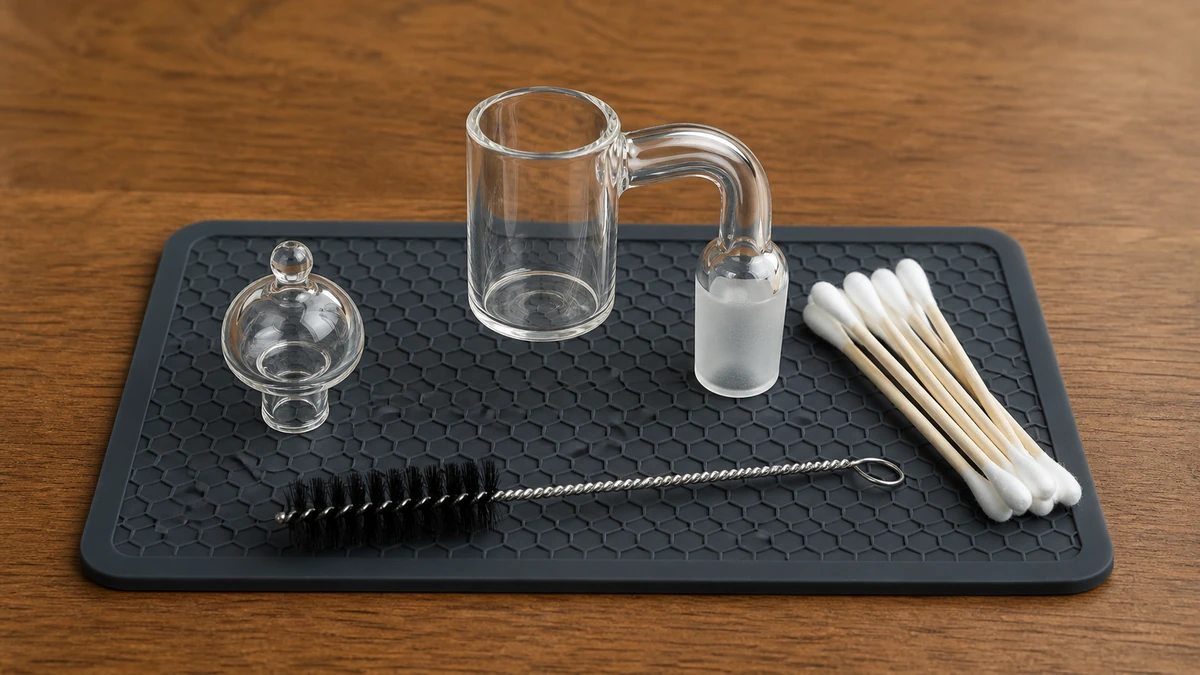
Ultimately, a bubble carb cap earns its usefulness the same way any cap does: by sealing consistently against the banger it’s paired with, then contributing whatever airflow or movement its particular design adds on top of that seal. Checking fit first, understanding what the cap’s shape is and isn’t built to do, and keeping both the seal surface and any moving parts clean will do more for consistent results than switching between cap styles in search of one that performs better on its own.