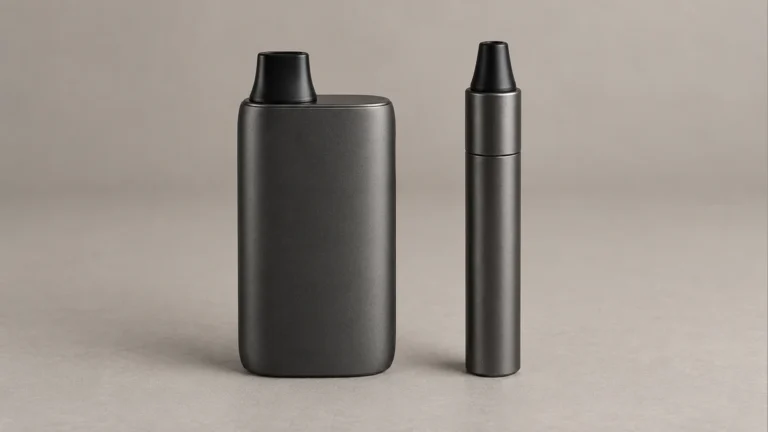
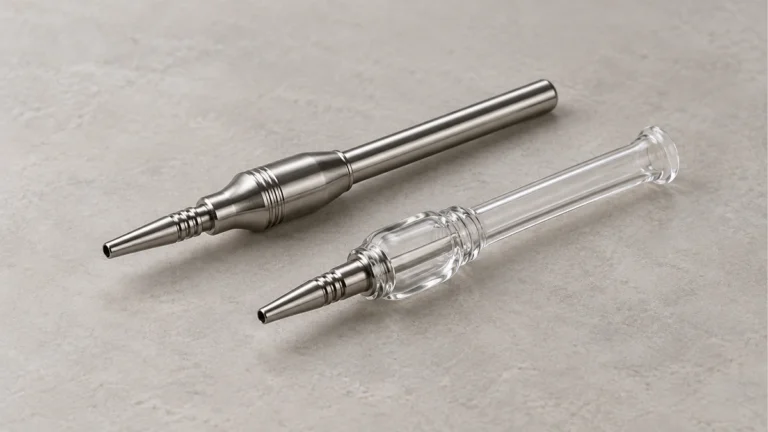
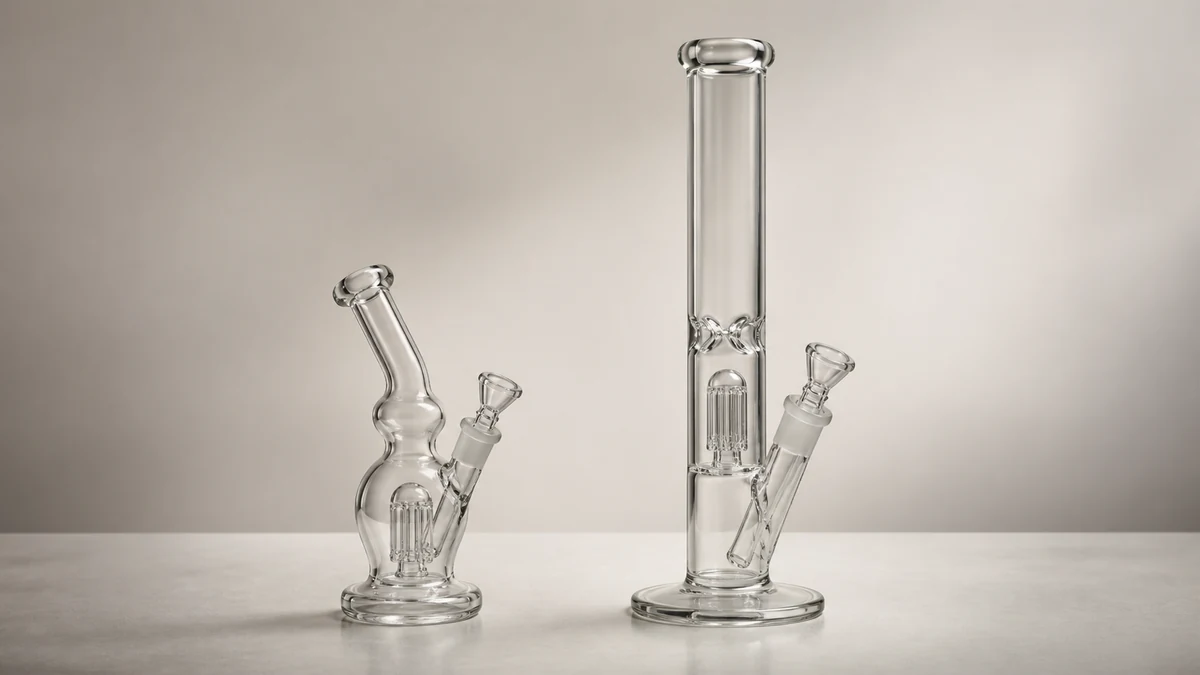
Two glass pieces sit side by side on the same desk, morning light catching the water inside both. One is short, squat, and looks like it grew straight up out of its own base. The other is taller, with a slim shaft rising into a wide mouth and a separate glass bowl seated in a joint near the bottom. Ask someone who has only ever seen photos which one is “the bong” and which one is “the bubbler,” and the honest answer is that either could pass for both. The real difference isn’t visible from across a room. It’s in how each piece is built, how it behaves on a table, and how it’s meant to be used, cleaned, and carried.
For distributors and retail buyers stocking water pieces alongside vaporizers, dab rigs, and accessories, that distinction matters more than it might seem. Bubblers and bongs get lumped together in casual conversation, but they solve different problems for different customers. Understanding the architecture behind each one — not just the silhouette — is what separates a well-curated catalog from a pile of look-alike glass.
💡 1. Two Water Pieces, Two Different Philosophies
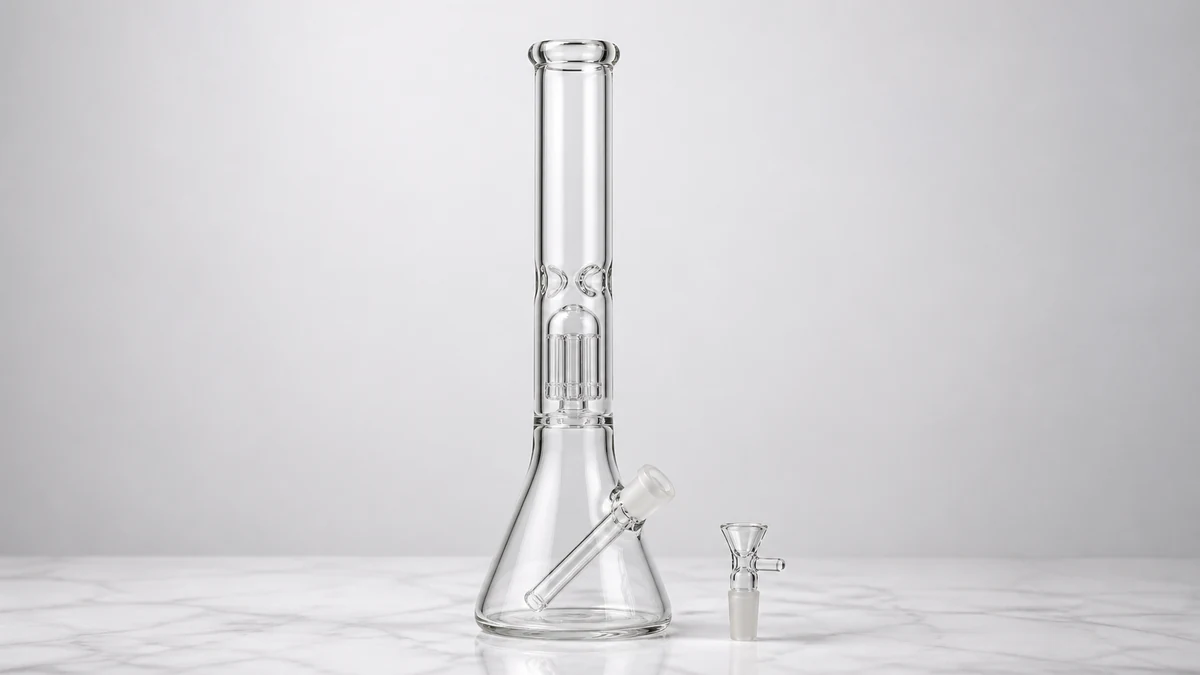
At the most basic level, both a bubbler and a bong are water pipes: a chamber holds water, a downstem or fixed tube carries air through that water, and a mouthpiece delivers the draw. The split happens at the bowl. On most bongs, the bowl is a removable piece — often glass-on-glass, sometimes fitted with a rubber grommet — that slots into a joint and can be pulled out independently of the rest of the piece. A bubbler, by contrast, is typically built as one continuous unit. The bowl is fused or blown directly into the body, with no separate joint to disconnect.
🧩 1.1 Integrated-Bowl Bubblers
Because the bowl and body are one piece, a bubbler has fewer points of failure and fewer parts that can be misplaced. There’s no downstem to lose, no joint to worry about chipping when it’s removed for cleaning, and no loose bowl rolling off a shelf. That simplicity is also the tradeoff: everything on a bubbler is fixed, so there’s less room to swap components or scale the piece up for a different kind of session.
🧩 1.2 Removable-Bowl Bongs
A bong’s separable bowl and downstem open up options that a fused piece can’t offer. Buyers can size up or down, swap in a different percolator style, or replace a single cracked component instead of the whole piece. That modularity is a large part of why bongs remain the reference point for water-pipe comparisons in general — see our broader look at dab rig vs. bong for how this same removable-joint logic plays out against dab rigs. It’s also why bongs tend to accumulate a small ecosystem of spare parts around them in a way bubblers rarely do.
⚙️ 2. Chamber Volume and How Water Behaves
Chamber size follows directly from body shape. A bubbler’s compact, all-in-one build usually means a smaller water chamber tucked close to the bowl, sometimes with a simple internal chamber or a single fixed percolator disc. A bong’s taller shaft and wider base generally allow for a larger water reservoir, and often room for a dedicated percolator section — anything from a straight diffused downstem to a multi-chamber recycler, depending on the specific model.
More water volume changes how the piece behaves during use, but exactly how much diffusion or cooling a given design delivers depends entirely on its internal geometry — slit width, percolator type, chamber height — none of which can be assumed from category alone. This is one area where “bubbler” and “bong” are really just starting points, and the manufacturer’s own specification sheet or manual is the only reliable source for how a particular model performs.
🔍 3. Footprint, Stability, and Desk Presence
Set a bubbler and a bong next to each other and the difference in stability is immediate. A bubbler’s low center of gravity and compact base make it hard to tip over accidentally — a genuine advantage for retail environments where the piece sits on an open counter, or for buyers who want something that survives a crowded desk. A bong’s height, especially on taller shaft styles, means a wider or heavier base is doing more work to keep the whole piece upright. Well-designed bongs account for this with flared or weighted bases, but the physics still favor the shorter piece when floor space or shelf stability is a priority.
That said, height isn’t purely a liability. Taller bongs put more distance between the water and the mouthpiece, and that shaft length is part of what allows for larger percolator sections in the first place. The stability question and the volume question are really the same tradeoff described two different ways.
🧭 4. Cleaning Access and Everyday Maintenance
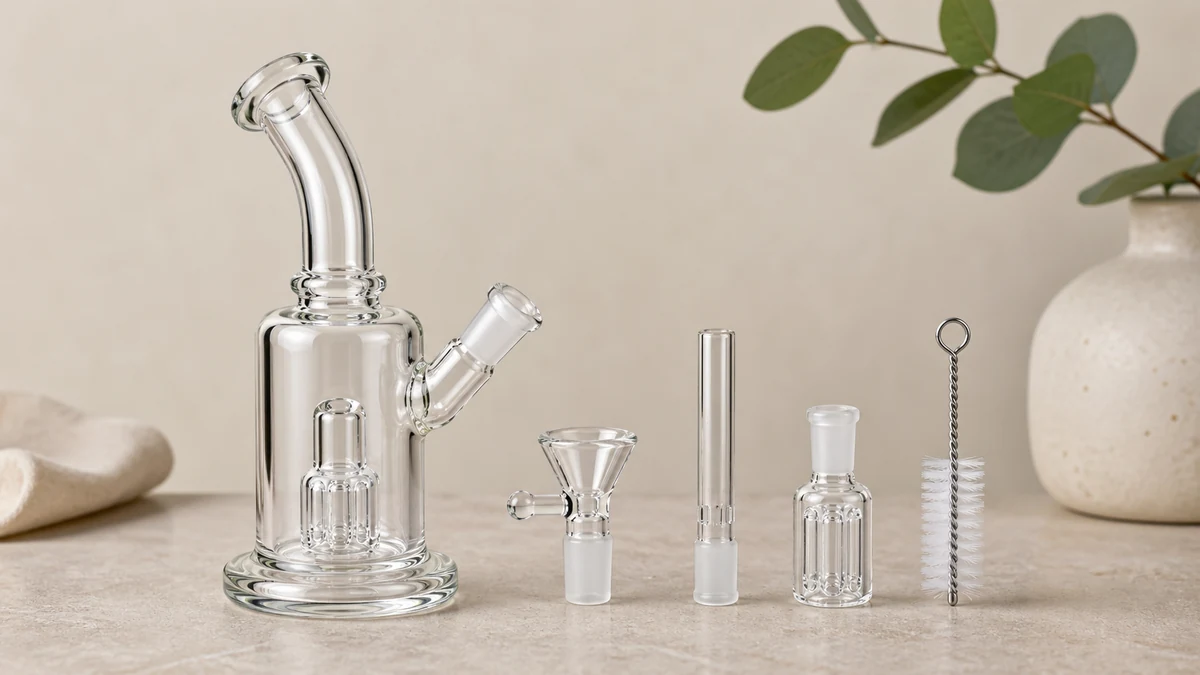
This is where the fused-versus-removable distinction shows up most in daily use. A bong’s detachable bowl and downstem can be pulled and cleaned separately from the main chamber — soaked, brushed, or run through isopropyl and salt independently — which generally makes it easier to keep every internal surface reachable. A bubbler’s sealed construction means the bowl, stem, and chamber all have to be cleaned as a single unit, often by filling and swirling cleaning solution through the same mouthpiece and joint the smoke travels through.
That single-opening design isn’t a flaw, but it does mean residue has fewer exits. Buyers who prioritize low-maintenance ownership tend to favor bongs specifically because the parts come apart; buyers who prioritize fewer parts to manage overall tend to lean toward bubblers despite the slightly more involved cleaning routine. Neither compromise is universal — it depends on how often the piece actually gets used.
🧩 5. Portability and Travel Behavior
A bubbler’s fused, compact build is the closer of the two to something you could reasonably carry in a bag without a hard case. There’s no bowl to secure separately, no downstem sliding loose in transit, and the shorter profile is less likely to crack against the inside of a bag. It’s the water-pipe equivalent of a one-piece tool: nothing to reassemble at the other end.
Bongs, especially taller ones, are built for a desk or a shelf rather than a pocket or a daypack. Even when a removable bowl makes disassembly for transport possible, the shaft itself is still long, thin glass — the single most fragile shape in the category. Some buyers solve this with padded travel cases, but that’s an accessory purchase layered on top of the piece, not a built-in advantage the way it is with a bubbler.
🛠️ 6. Splash Management and Draw Feel
Water splash — liquid pulling up into the mouthpiece during a hard draw — is a function of chamber shape and how much airspace sits above the waterline, not of category alone. Bubblers, with their tighter internal geometry, generally give the water less room to slosh before reaching the mouth, which is part of why compact pieces are often described as having a more direct, contained draw. Bongs with taller necks put more distance between the water surface and the mouthpiece, which can reduce splash risk simply through added air column length, even before any percolator is factored in.
Draw resistance — how much effort a pull takes — follows the same logic: it’s shaped by percolator style, slit count, and stem width, all of which vary between individual models regardless of whether the piece is labeled a bubbler or a bong. Two bongs from different manufacturers can draw completely differently from each other; the category name doesn’t predict it.
🧼 7. Replaceable Parts and Device-Adapter Compatibility
Because a bong’s bowl and downstem are separate components on a standard joint, they’re also replaceable and, in many cases, interchangeable with parts from other pieces sharing the same joint size. That opens the door to swapping a stock downstem for a different percolator style, replacing a bowl without buying a new piece, or fitting compatible adapters — including the kind of vape-cartridge-to-water-bong adapters covered in our guide to bong adapters. A bubbler’s fused construction generally rules this out; what ships as the bowl is the bowl for the life of the piece.
For OEM and private-label buyers evaluating a catalog, this is a meaningful sourcing consideration rather than a cosmetic one. A bong-style line gives a brand room to sell companion parts and adapters as a secondary product category. A bubbler line is simpler to source and stock — fewer SKUs, fewer parts that need to match — but it’s also a narrower catalog on its own. Buyers weighing removable-joint architecture against fixed designs more broadly may find it useful to compare this same tradeoff across dab rig styles in our overview of dab rig types, where joint-based modularity plays out in a related but distinct product category.
📌 8. Matching the Piece to How You Actually Use It
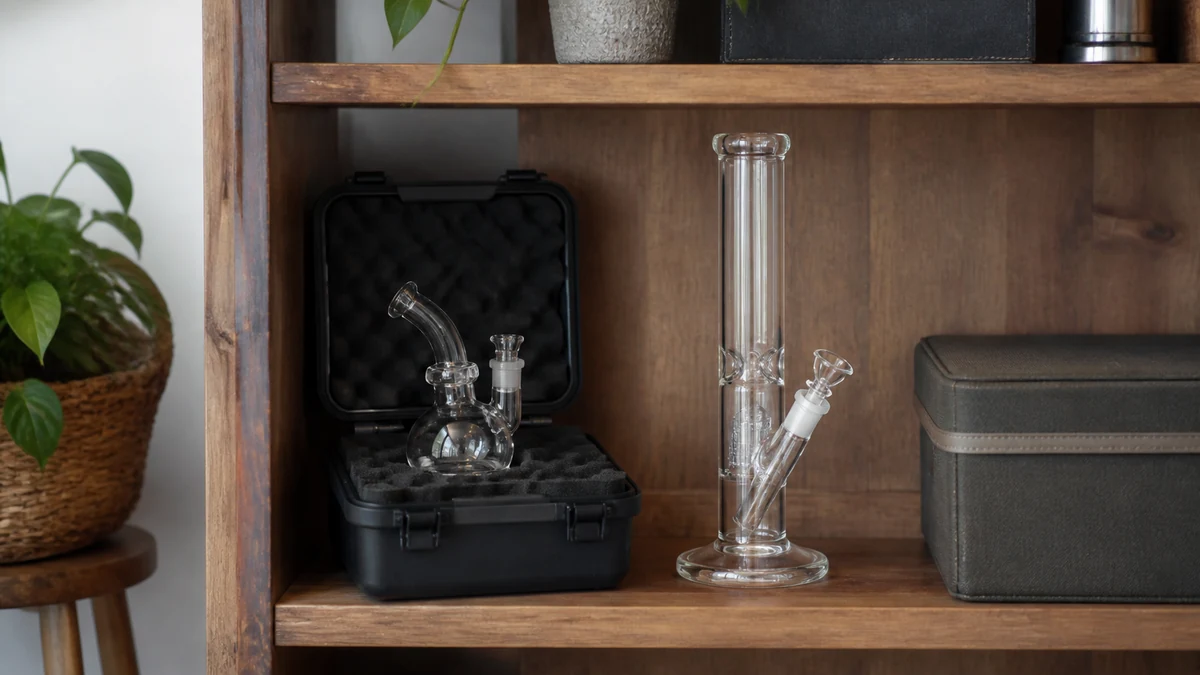
None of this makes one category better than the other — it makes them suited to different habits. A bubbler earns its place with buyers who want something sturdy, low-fuss, and easy to move without a case: a compact piece that lives on a desk during the week and travels without much thought on the weekend. A bong earns its place with buyers who want to customize a setup over time — upgrading a percolator, replacing a cracked bowl instead of a whole piece, or fitting an adapter for a different use case — and who have a stable, dedicated spot for a taller piece to live.
For a retail buyer building out a shelf, the practical move is usually to carry both, positioned honestly rather than as interchangeable versions of the same thing. A customer asking for “something simple that won’t tip over” and a customer asking for “something I can build on” are shopping for two different products, even if both walk out holding a piece with water in it.
The short version: reach for the specification sheet, not the silhouette. A squat profile suggests a bubbler’s fused, low-maintenance build; a tall shaft with a visible joint suggests a bong’s modular, upgrade-friendly one. But volume, draw feel, and splash behavior are set by each manufacturer’s internal design, not by the category label — which is exactly why the manual for a specific model, not a general comparison, should be the last word on how it actually performs.
Good hardware tells you where its limits are. A timed cutoff, a removable joint, a material-specific cleaning note or a clear compatibility table is useful because it reduces guesswork. Workarounds that defeat a cutoff, suspend weight from a small connector, or expose an unknown material to a strong solvent trade a small convenience for a much larger uncertainty.
🧩 8.2 Prefer Clear Limits to Clever Workarounds
A purchase decision is incomplete until the maintenance path is visible. Count the removable pieces, inspect narrow passages, note whether consumable seals can be replaced, and decide where wet parts can dry without touching electronics. The most comfortable setup is usually the one whose routine remains obvious when the novelty wears off.
🧩 8.1 Make Maintenance Part of the Comparison
Do not force a universal answer where the hardware does not provide one. Material, joint geometry, electronics and cleaning instructions vary. When a manual conflicts with a generic tip, the manual wins. When a connection only works under pressure or at an angle, stop rather than tightening harder. And when a cleaner or replacement part is not explicitly compatible with the material, test nothing on a valuable or powered component.
The last check is deliberately ordinary: picture the complete routine, not the product on an empty catalog background. Where will it sit, which parts will be removed, what has to dry, and which connection will take the load? Those questions expose inconvenient details that a feature list hides. A compact piece may be easier to store but harder to reach inside. A larger piece may be steadier yet awkward at the sink. A more adjustable device may be useful only if its manual and controls remain understandable after the first week.
🧭 8. A Practical Decision Check Before You Buy
✅ 9. Sources
- Manufacturer product manuals for device-specific bowl, joint, and percolator behavior (consult the exact model’s documentation for specifications not covered generally above).