An empty cannabis ashtray can still have a sticky lid. Removing loose waste and cleaning the surfaces that held it are different jobs; a clean-looking center tells you little about the rim, the underside of a cover or a removable insert. Before scrubbing harder, establish which part is dirty and which parts the maker actually intends you to remove.
That distinction matters most when something has changed. A lid that used to rest flat now rocks, a covered cup leaves a ring on the table, or a spinner top catches during its movement. Those observations are useful descriptions. They do not, by themselves, identify the material of the residue, prove a broken mechanism or tell you which cleaner the finish can tolerate.
🗑️ 1. A cannabis ashtray is a waste receptacle, not a clean accessory tray
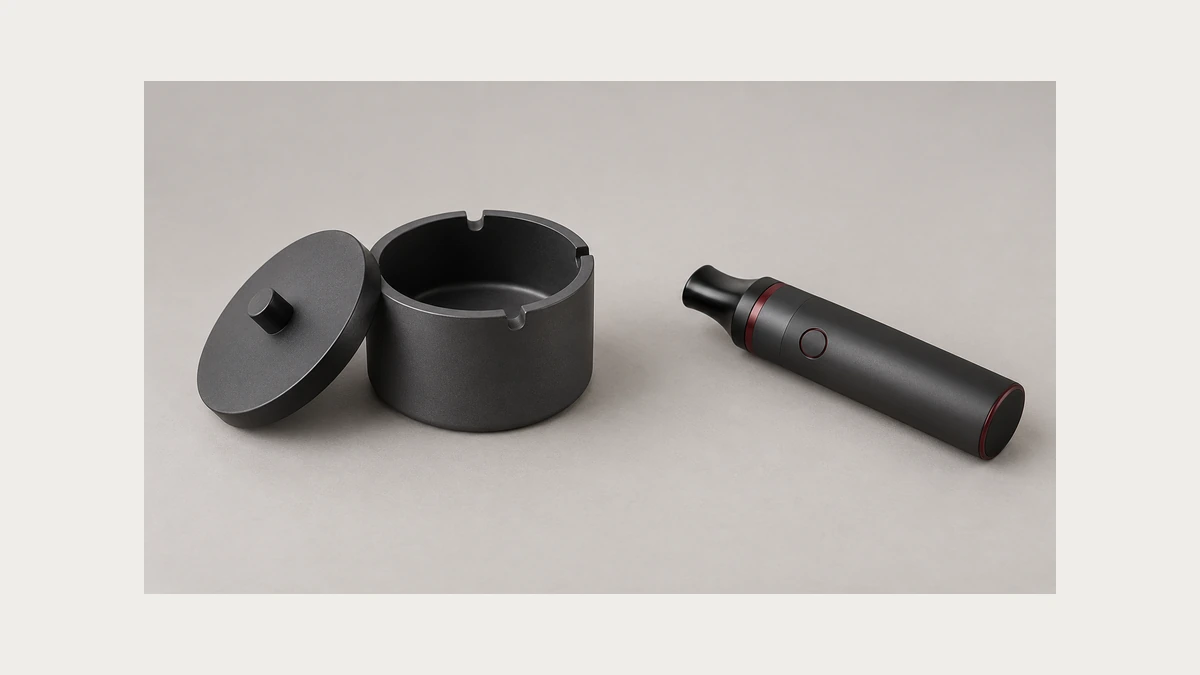
A cannabis ashtray holds discarded material. It is not a container for clean mouthpieces, a resting place for an exposed charging connector or a substitute for a clean parts dish. Even after its loose contents have been removed, treat the interior as a used waste surface until it has received the care appropriate to that particular product. An apparently empty bowl is not evidence that the inside is clean.
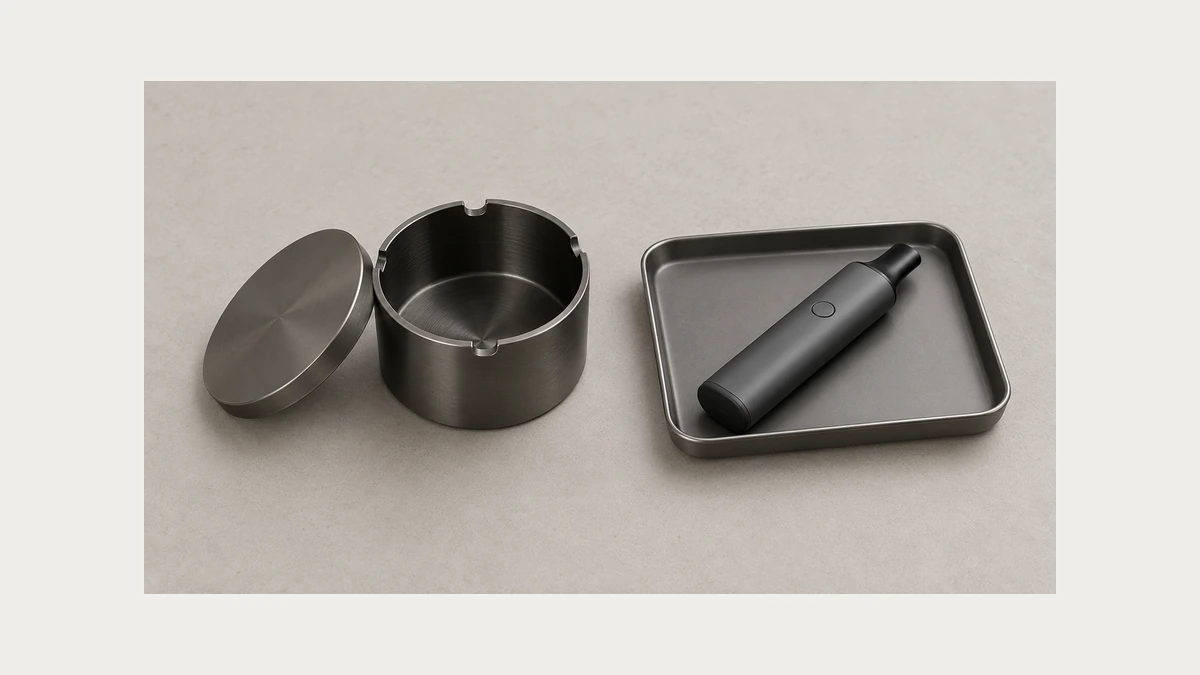
A rolling tray has a different role: keeping loose items and tools within a working area. The distinction is easy to lose when both objects are shallow, round or made of the same metal. Keep the waste receptacle separate from the surface used for clean hardware. An inactive vaporizer beside an ashtray is still a separate object with its own care requirements; neither object establishes the cleanliness of the other.
This also clarifies what a lid can and cannot do. Covering the receptacle changes access to its contents. It does not wash the interior, establish that discarded material is extinguished, or turn the ashtray into a protective case for electronics. If you need somewhere to put a clean detachable mouthpiece while other parts dry, use a different clean surface.
🔓 2. Open bowls, covered cups and spinner tops have different access
Not every cannabis ashtray reaches its interior the same way, and the access style changes what “finished emptying” actually means. An open bowl is the simplest: a wide, unobstructed basin with nothing between you and the surface. The basin is visible from above, but its underside, base pad and any decorated edges still have their own care questions. Visibility does not make every surface suitable for the same cleaning method.
A covered cup adds a lid — screw-on, press-fit, or hinged — that has to come off before you can see the interior at all. The underside is a separate surface from the basin. Inspect it only through the opening or removal method the maker provides; a hinge does not imply that the entire lid should be detached.
Spinner-top designs add a moving assembly above a lower receptacle. Depending on the product, the upper assembly may lift off for emptying or include components that stay together. A photo of the top cannot establish which arrangement you have. Look for the maker’s opening and care instructions before treating the central button, spindle or edge of the disc as a removable part.
In a March 2022 discussion about spinner ashtrays, readers asked what the moving top was for, while one commenter reported having examples break or get stuck. That comment does not establish where a part broke or what caused it. It does show why an explanation of the mechanism’s access points is more useful than assuming every covered ashtray opens like a plain bowl.
✨ 3. Why the rim can stay sticky after the center looks clean
An empty center and a tacky rim are not contradictory observations. Loose contents can be removed while material remains attached elsewhere. The edge of a lid, the groove that receives it and the lower face of a removable insert are different surfaces from the center of the receptacle. A glance straight down into the bowl misses some of them.
Consider a lid with a shallow lip. Its top may look clean while the narrow lower edge still leaves a mark on a cloth during an authorized wipe. That finding identifies an area that needs attention; it does not prove that all of the lid’s poor fit comes from dirt. A bent cover or damaged rim can remain misaligned after cleaning.
Describe the observation before assigning a cause: sticky, gritty, visibly chipped, rocking on one edge, or catching at a particular position. These are more useful than deciding that a dark mark is necessarily burnt resin or that a cloudy ring is necessarily mineral scale. If you cannot identify a finish or deposit, do not escalate to a stronger chemical on the strength of its color.
The rim deserves attention because it is an interface: two surfaces meet there. A broad basin can be easy to reach while a narrow groove is awkward. That is an access problem, not proof that the whole ashtray needs an aggressive treatment. Follow the product’s permitted cleaning method for that interface, including any restrictions on seals, paint or decorative surfaces.
🧩 4. Separate removable parts only when the design allows it
Some ashtrays are built with genuinely removable components — a tray-style insert that lifts out, a lid that unscrews, a liner that clips free. Others only look separable because a seam is visible, when in fact that seam is a manufacturing joint, not an access point. Do not force a seam open just because it is visible. Check whether the care instructions identify a removable component before treating the line as an access point.
A base pad illustrates why appearance is not enough. A soft ring on the bottom might be a removable sleeve, or it might be felt or cork bonded to the body. Those constructions require different handling. Unless the care instructions identify it as removable, leave it attached rather than peeling it up to investigate. A visible boundary between materials is not automatically an opening seam.
Likewise, a lid may contain a fixed internal assembly even when the whole lid lifts off. Permission to remove the lid is not permission to dismantle its mechanism. If the instructions describe only removal of the complete upper section, keep the smaller components together. A jam that remains inaccessible is a support question, rather than an invitation to pry at the spindle.
Where an insert is expressly removable, its lower face is worth inspecting as well as the visible upper surface. Look at its edge and the surface on which it rests. Residue found there may explain why a part no longer sits flat, but do not assume that cleaning will correct damaged or distorted hardware. Keep track of the orientation specified by the maker so that a correctly cleaned part is not returned upside down.
A simple layout helps during permitted disassembly: keep the body, removable cover and removable pad apart on a suitable surface, rather than piling them inside one another. This is about knowing which face you are working on. It is not a reason to remove a pad, gasket or insert that the manufacturer has not identified as serviceable.
🧱 5. Material and finish decide the care instructions
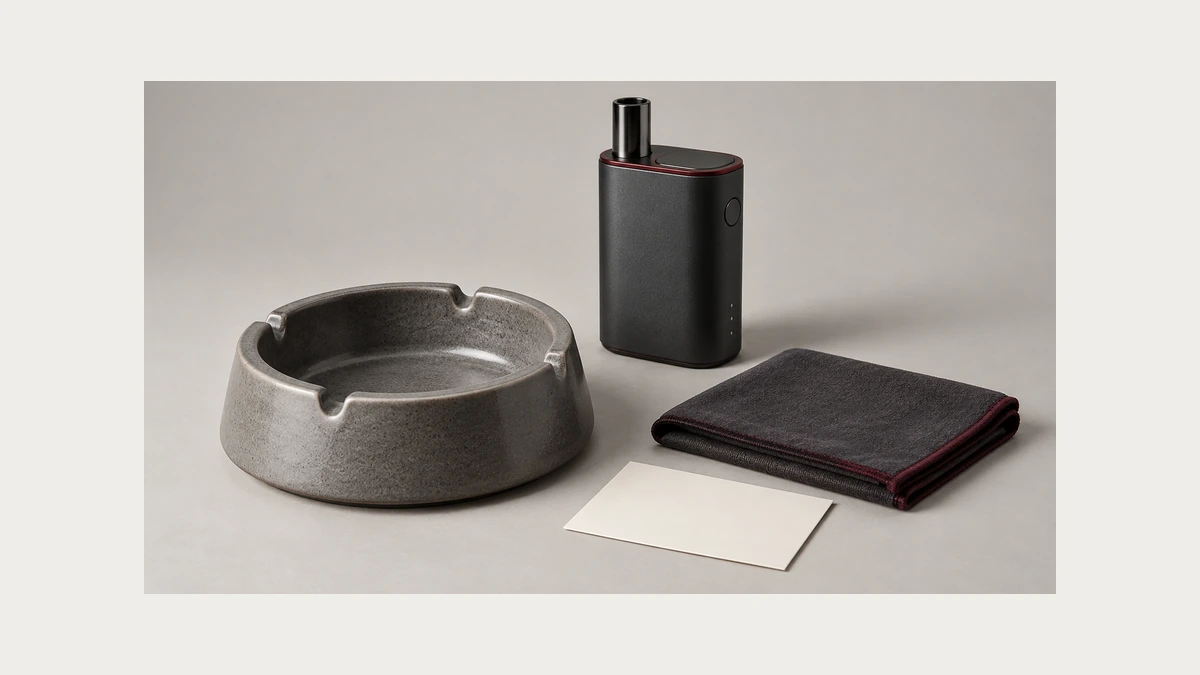
A material name is only part of the care information. A ceramic ashtray may include glazing, decoration and an attached base pad. A metal one may include a coating. A glass body may have a soft lid. The surface in front of you, not just the noun on the packaging, determines which manufacturer’s instructions apply.
If the rim is chipped, do not treat it as an ordinary stain and try to scrub the edge back into shape. Set the damaged item aside and ask the maker about replacement or service. The appearance of a chip does not reveal the composition of the exposed body or establish that the rest of the finish is sound. There is no need to diagnose porosity from a photograph to recognize that damage and dirt are different problems.
The same distinction between substrate and finish comes up with a metal accessory tray. A method described for bare metal cannot automatically be applied to a printed surface, and permission to wash a removable liner does not necessarily extend to an attached underside pad. Avoid treating the least delicate component as the rule for the whole assembly.
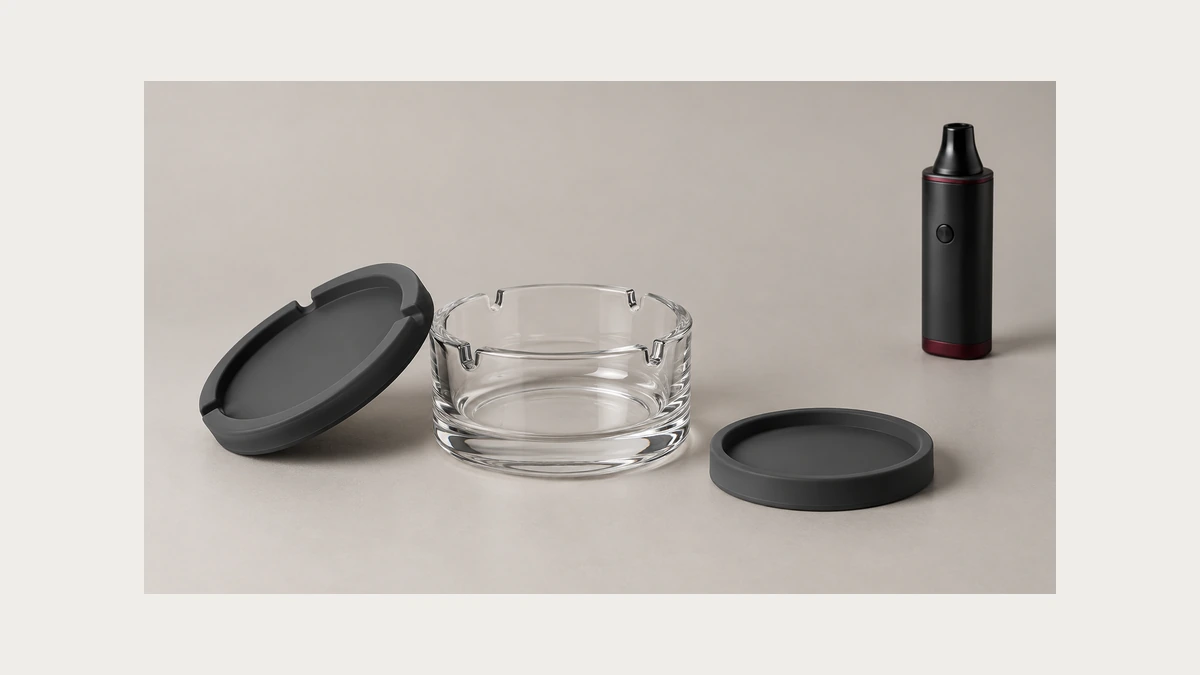
A concrete manufacturer example is Session Goods’ care guide for its own ashtray. It separates the glass body, silicone lid, silicone footer and debowler, describes mild dish soap and a soft cloth or sponge for the silicone components, and calls for rinsing and drying before reassembly. That is guidance for the identified product, not authorization to use the same process on an unfamiliar painted, wooden or ceramic object.
For an older unmarked item, uncertainty may remain. Keep any surviving care card and note the construction you can actually see. Avoid filling that gap with a household-cleaning recipe selected solely because another ashtray looks similar. Unknown coatings and bonded components do not become identifiable after a successful-looking test on one small area.
🧽 6. Emptying and washing are separate jobs
Disposal comes before washing, and its safety requirements should not be inferred from a discussion about odor. The U.S. Fire Administration’s smoking-fire guidance calls for a wide-base ashtray, fully extinguishing discarded smoking materials and wetting ashes and butts before putting them in the trash. It also directs people not to walk away from lit materials. An ashtray lid is not a substitute for those precautions.
This is why an odor complaint does not justify putting dry waste straight into a household bin. Nor does an arbitrary waiting period establish that the contents are out. The guidance is about preventing a fire during disposal; it is not a recommendation to leave a container of wet waste sitting around or a cleaning method for the ashtray’s finish.
Once contents have been dealt with appropriately, surface care is the separate task. Emptying may leave a stain, an attached deposit or a dirty lid. The care instructions determine how those surfaces are washed or wiped and what should stay dry. Complete the specified rinsing and drying before putting removable parts back together; a cover should not conceal unfinished cleaning.
An owner in a September 2024 cleaning discussion asked separately about ashtrays and grinders. One visible reply described cleaning the ashtray while leaving the grinder alone until it became sticky. The later alcohol-and-swab answer in that thread concerned a grinder, so it should not be presented as a tested ashtray recipe. Forum conversations often switch objects mid-thread, and a cleaning suggestion can lose that context when repeated.
🔧 7. A lid that fits again is more useful than a polished center
After the permitted care is complete, compare the part with its intended fit. A plain removable lid should rest as the maker designed it to rest; a moving top should not require you to overcome a new obstruction by force. Neither statement means that all lids must be airtight or that every ashtray is supposed to have a perfectly flush cosmetic seam. Some covers intentionally sit loosely.
If the same corner still lifts, or the same section catches after the accessible surfaces are clean and dry, record that rather than repeating increasingly forceful cleaning. A clearer description is “the lid rocks at this edge” or “the complete top no longer rests on the body,” with a photograph of the empty item. You do not have to name the failed part before requesting help.
Do not use odor alone as the fit test. An ashtray cover may reduce exposure of the contents without having a gasket or an advertised seal. A separate storage jar has its own closure and seal questions; that does not establish a containment standard for an ashtray. Equally, a smell noticed nearby does not identify which surface or object it came from.
For a lid that has stopped seating properly, the useful next move is modest: identify the exact ashtray, locate its permitted opening points, and describe the condition of the rim and cover. If a removable part is damaged or the mechanism remains stuck, set it aside for the maker’s advice. A clean basin is useful, but it cannot compensate for a cover that now needs repair or replacement.