A handheld smoke filter can have a wipeable housing and a filter core that must never be washed. If yours became waterlogged after cleaning, identify the exact model and its media-care instructions before doing anything else. A removable mouthpiece does not necessarily mean the filtering material behind it is removable, replaceable or washable.
Here, “handheld smoke filter” means the small personal exhalation-filter accessory, not an inline component on a vaporizer and not a filter intended for inhalation. It is also different from a powered room air cleaner. Keeping those categories separate prevents a surprisingly common mistake: borrowing cleaning advice from a product that contains an entirely different kind of serviceable part.
🌀 1. Harder airflow does not identify a washable part
A change in airflow is a symptom, not a parts diagram. It does not identify a washable component or prove that moisture is the only problem. The useful question is whether the maker treats that symptom as a reason to replace the complete unit, service a designated cartridge or seek support. Do not keep forcing air through a clogged accessory to diagnose it.
In a May 2025 owner discussion, someone described a filter becoming waterlogged after a cleaning attempt and asked whether it was disposable. Visible replies asked about a replaceable element; other replies suggested improvised heating. The post does not establish the product’s exact internal condition or validate those suggestions. Its useful question is simpler: did the cleaning instructions apply to the shell, the filter media, or some other product?
The account also leaves an important ambiguity. The owner described following instructions, but that is not enough to identify which instructions or which model they covered. When asking for help, retain the original care page or leaflet alongside the model name. That gives support something concrete to compare with what happened, instead of turning a report of a wet filter into a debate about whether every product in the category can be washed.
🧩 2. Separate the housing, mouthpiece and filter media
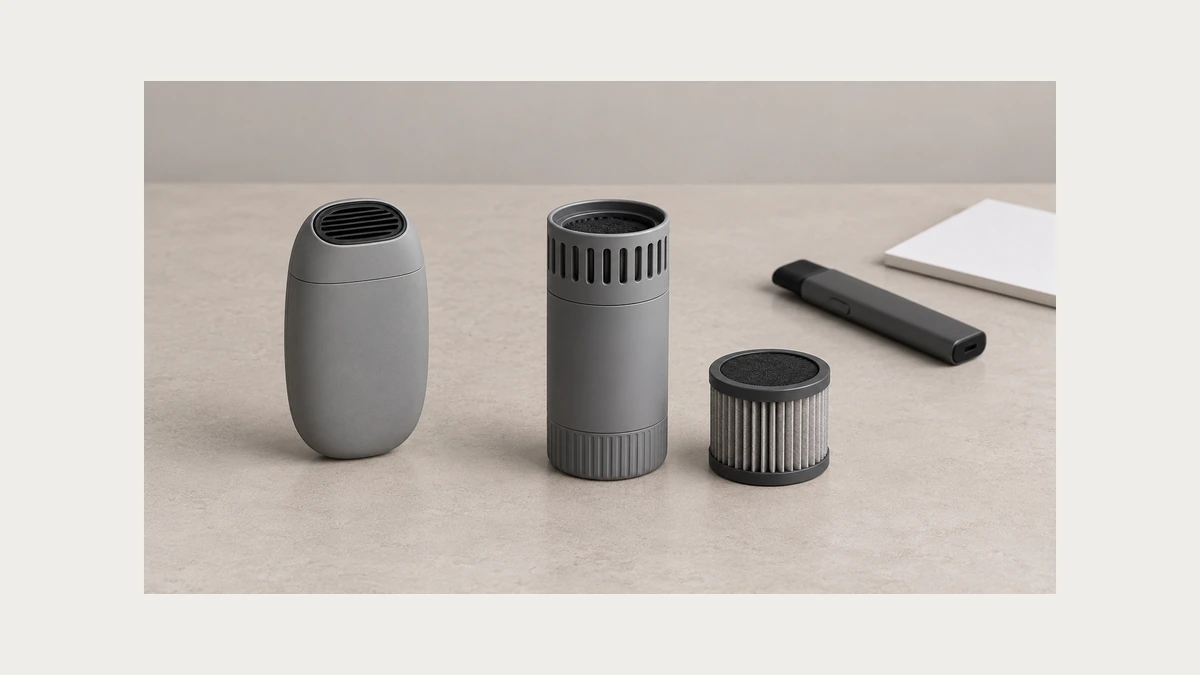
Three terms help organize the problem. The housing is the outer structure. A mouthpiece or cover is an interface or closure, which may or may not separate from it. The media is the material that performs the filtering function. Depending on the design, that media may be enclosed in its own cartridge or built into a body the owner is not meant to open.
These words describe roles, not a universal parts list. A visible line around a plastic body might be a molding or assembly seam rather than a service joint. A cap that comes off may expose only the opening, not authorize access to the core. Check the maker’s diagram before deciding that a part should unscrew.
A November 2024 discussion illustrates the confusion: commenters described filters that need whole-unit replacement alongside products with replaceable elements. That is useful vocabulary to investigate, but it is not proof that the pictured unit belongs to either construction. Suggestions about heating, homemade fillings and bypassing the core should not be substituted for the identified manufacturer’s care instructions.
The same caution applies when a friend describes cleaning “the filter.” They might mean wiping an outer shell while you mean rinsing the packed core. Before copying the advice, name the actual part. Two people can use the same word for maintenance actions that have very different consequences.
🔄 3. A replaceable cartridge is different from a sealed body
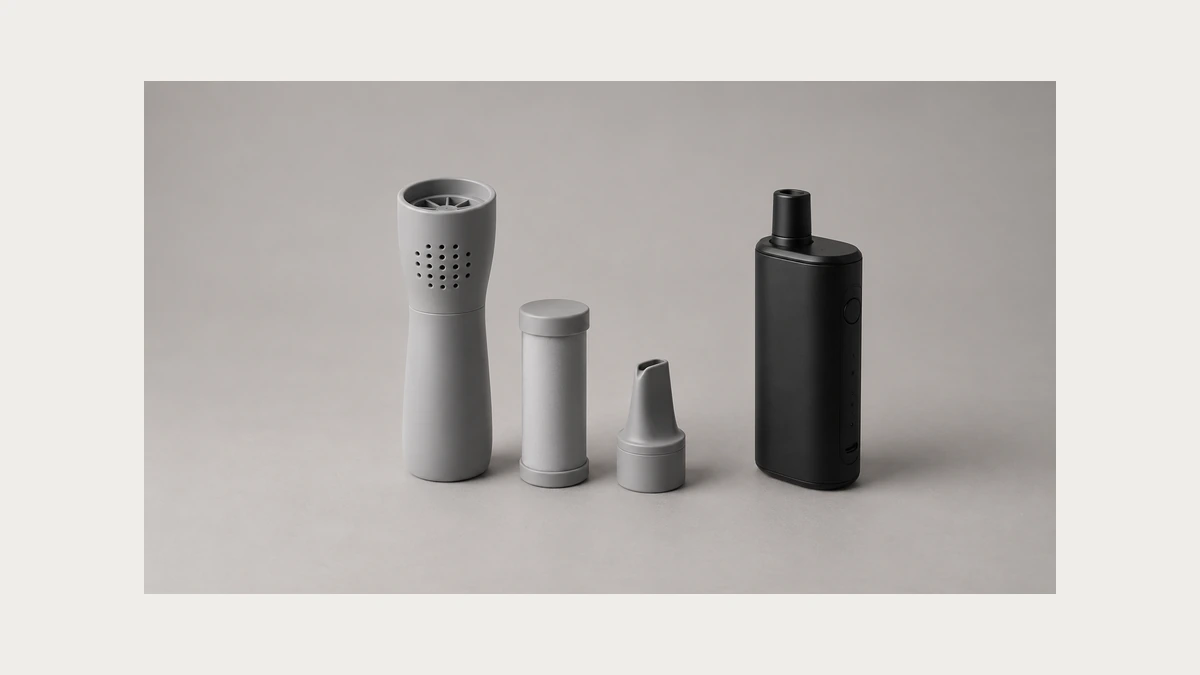
A documented replaceable cartridge gives the owner an intended service boundary. The instructions identify what separates, which replacement component belongs to that housing and what care is permitted for the remaining parts. The cartridge may itself still be disposable. Replaceable describes how it connects to the product; it does not mean the material inside it can be refreshed with water or another liquid.
A sealed unit has a different boundary. If the maker provides no core-removal procedure, do not convert an assembly seam into an access point. The absence of a screw is not the only clue, and the presence of threads elsewhere is not proof of a removable core. Intended serviceability comes from the exact product documentation.
For example, a mouthpiece can detach from a sealed filter, or a reusable outer shell can accept a cartridge whose end caps stay closed. Those are distinct levels of separation. Removing a permitted external part does not authorize opening the next layer.
If a spare cartridge is already on hand, compare its printed identity with the housing’s documented replacement part. Similar height, matching color or a similar-looking screw end is not a compatibility statement. This is an identification check, not a recommendation to fit whatever happens to enter the opening. When the component cannot be positively identified, leave the housing unassembled and ask the maker.
There are three different permissions worth distinguishing when reading a leaflet. A removable cover permits access to an opening. A replaceable cartridge permits exchange of the specified complete element. A washable component permits the cleaning method stated for that component. None of those permissions automatically supplies the next one. A product described as reusable may reuse only its outer body.
This distinction can also explain apparently conflicting paperwork. A package may describe the complete accessory while a separate insert refers only to a spare mouthpiece. Compare the item named at the top of each instruction page before combining their advice. If the names or illustrations do not match the parts in front of you, keep that discrepancy for the support request rather than interpreting it as permission to rinse everything together.
💧 4. Moisture advice belongs to the exact product
Moisture advice needs the same precision. A damp cloth on an outer plastic surface is different from liquid entering the core. Likewise, instructions to let a designated cartridge air dry do not mean the maker permits washing its media. Keep the verbs attached to the named part: wipe the housing, remove the specified cartridge, or replace the complete unit.
If a filter was accidentally submerged or flushed contrary to its instructions, describe that event plainly to support. A dry-looking outer shell cannot establish what remains inside. Do not assume that a generic drying interval will reverse damage or restore the filtering function.
📋 4.1 Two manufacturer examples, read separately
For its own products, Smokebuddy’s FAQ says the filter is not cleanable, permits a moist towel for interior and exterior plastic, and identifies difficult airflow as a disposal signal. That wording does not authorize flushing the core simply because some plastic surfaces can be wiped.
Sploofy’s FAQ describes a separable cartridge and instructions for letting that cartridge air out. It provides an example of a different service arrangement. Neither page should be read as instructions for a third manufacturer’s accessory, and their care details are not a reason to choose one product over another.
The practical distinction is between routine handling described by the maker and an improvised attempt to regenerate spent media. Do not substitute a microwave, oven, hair dryer, solvent flush or homemade refill for the specified service procedure. A forum account of airflow returning is not evidence that the original filtering function or construction has been restored.
👀 5. What ordinary external inspection can tell you
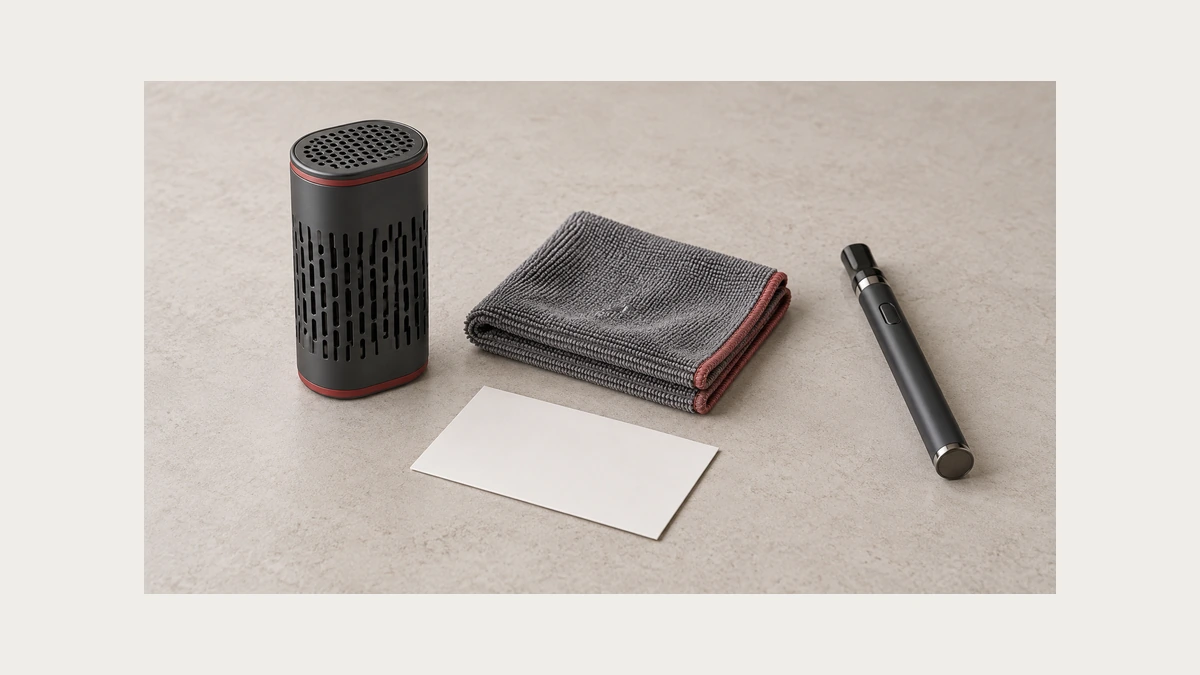
External inspection can give you a useful description without opening the core. You may notice a cracked outer body, a cover that no longer fits, or visible deposits on an exposed surface. Record those observations. Do not call the unit sound merely because you cannot see a crack, and do not press on the housing to test its strength.
A cover that stops seating after a drop is a different report from one that feels sticky after cleaning. Include the sequence when requesting support. It helps distinguish a fit question from a cleaning question without pretending to diagnose hidden media through an opaque shell.
Color is not a service indicator unless the maker explicitly identifies it as one. Some filter materials are dark when new, and a dark mark at an opening need not reveal the condition of the whole core. Avoid poking, scraping or peeling back a retaining layer merely to obtain a better view. Photograph only what is already exposed through the intended opening.
A cleaner-looking mouthpiece also does not establish a clean core. These are separate surfaces with separate care limits. The distinction between a fresh emission, residue on hardware and an odor noticed later is discussed in AOVAPE’s guide to different odor sources around concentrate hardware. That background should not be treated as a diagnostic chart for filter media.
👃 6. Odor impressions are not a filter performance test
A smell impression is not a measurement of filtration. A person can notice an odor near an accessory without identifying its source, the compounds involved or the condition of the core. Likewise, not noticing an odor does not establish pollutant removal, remaining service life or suitability for a shared room.
In the visible comments on an August 2025 discussion, people disagreed about odors around vaporizers, and another branch discussed reusable housings and replacement filters. These are personal reports, not a controlled comparison. The useful editorial lesson is to keep maintenance questions separate from claims about what other people will or will not notice.
The U.S. EPA’s room-air-cleaner guidance distinguishes particle filtration from gas filtration and explains that even room cleaners do not remove every pollutant or replace source control and ventilation. That document concerns room-scale cleaners and HVAC filters. It does not test or certify the handheld accessories discussed here, so room-air ratings cannot be assigned to them.
The surrounding hardware matters when describing an odor problem, but not as proof of a filter’s effectiveness. AOVAPE’s pages on odors around a water pipe and cartridge odor in use and storage discuss different possible sources. Linking those topics does not turn a handheld filter into a remedy for all of them. A maintenance article cannot establish that emissions are harmless, undetectable or acceptable under a building’s rules.
🏷️ 7. Record the model and service limit before doing more
For a support request, the most useful identifiers are the model, any separate cartridge part number and the care instructions you actually followed. Add whether the unit was dropped, wiped externally or exposed to liquid internally. Say what changed without inventing a diagnosis: for example, “the cap no longer seats after cleaning” rather than “the carbon is definitely swollen.”
Keep a date for that event if you know it, but do not turn another owner’s replacement interval into a service schedule. The manufacturer may publish its own estimate or replacement signal; that still belongs to its product and stated conditions. No single number of days or uses can be assigned to the entire category from the anecdotes in these discussions.
If a known sealed unit has reached its documented disposal signal, do not open its core in search of a washable part. If the model has a serviceable cartridge, stay within the procedure for that exact cartridge and housing. If its identity or care limits are uncertain, set it aside and obtain that information. The next useful fact is which part the manufacturer permits you to service, not how much force or heat an unknown core can tolerate.