A smell proof jar needs a lid that closes correctly, but a closed lid does not explain every odor around a storage drawer. The jar may have been opened recently, its outside may need cleaning, or the closure may have a problem. Start by separating those possibilities. Tightening the lid harder is a poor first response when you have not established which part needs attention.
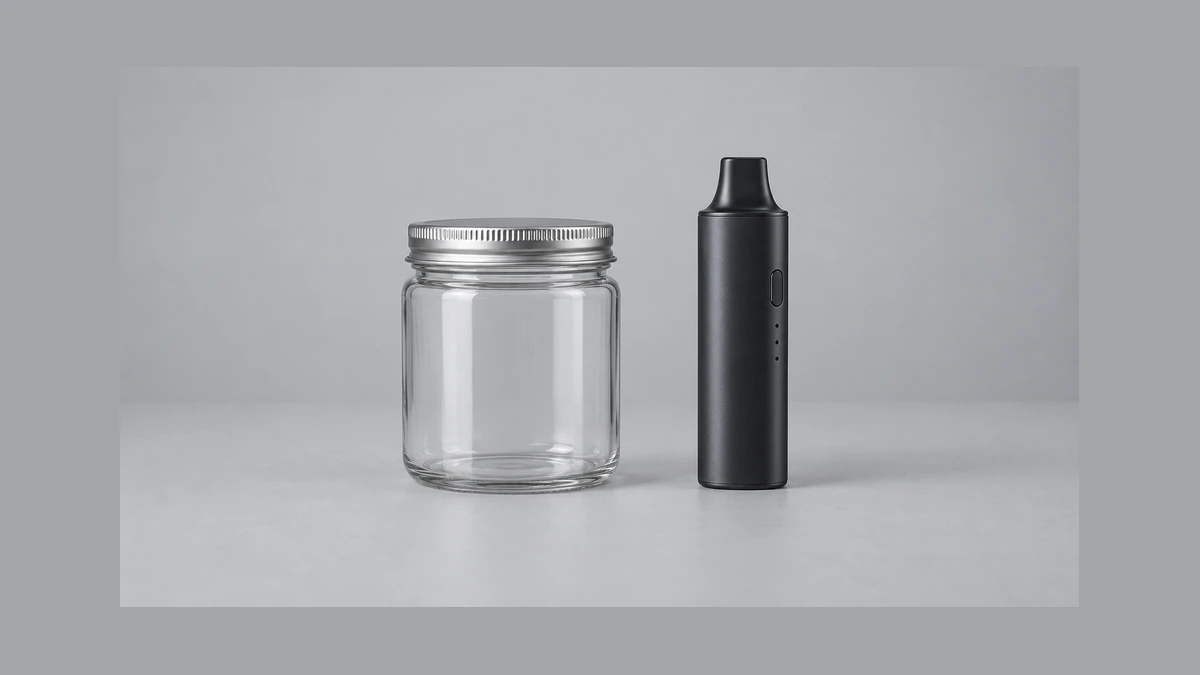
For an adult who keeps a storage jar beside a dry-herb vaporizer, the useful question is practical: can this particular jar be opened, cleaned and closed as its maker intended? A product name or a photo cannot establish that. Neither can this guide promise a completely odor-free room. What follows concerns dry-storage hardware, rather than the contact materials or handling of concentrate containers.
🔒 1. A closed jar and a recently opened jar tell different stories
Imagine returning a jar to a drawer after opening it on the desk. You notice an odor nearby and immediately wonder whether the lid is leaking. That observation alone does not distinguish a closure problem from an odor associated with the opening. Before blaming the gasket, remember what was opened and handled in the same space.
This matters when several accessories share a drawer. The jar, grinder, device mouthpiece and used cleaning cloth are separate objects. Closing one does not clean or close the others. Our guide to grinder threads and seals addresses that accessory separately; a storage jar cannot compensate for residue on another item.
It is tempting to turn a household observation into a performance test: move the jar, wait a certain number of minutes, then decide whether it passes. Without a defined test and controlled conditions, that would still be an impression. There is no universal waiting period in this article, and deliberately sniffing an unknown residue is not an inspection method.
Instead, describe the situation accurately. “I noticed an odor after opening the drawer” is useful context. “This lid is definitely defective” is a conclusion that needs more support. That difference helps when you later ask the maker about a part, especially if the same drawer contains several sources of residue.
🧩 2. Look at the empty jar before changing the closure
Inspect an emptied jar in good light, following its instructions for opening or removing parts. Look at the accessible rim, the underside of the lid and any visible seal. A ring folded out of its seat, a piece of debris across a mating surface or a visibly damaged lid gives you something specific to report. Do not run a finger along a chipped rim or probe a suspected crack.
You are checking visible condition, not certifying airtightness. An even-looking gasket may still leave questions unanswered. Conversely, a cosmetic color difference is not enough to identify the material or declare a seal failed. Photos can document what you see, but they cannot establish a polymer formulation or a measured odor-containment result.
Leave the clasp and hinge within their intended travel. Bending the wire tighter, adding extra washers or fitting a lid from a similar-looking jar changes the arrangement before you know what was wrong. A closure that needs an improvised adjustment should be taken out of use while you obtain the actual instructions or a confirmed replacement.
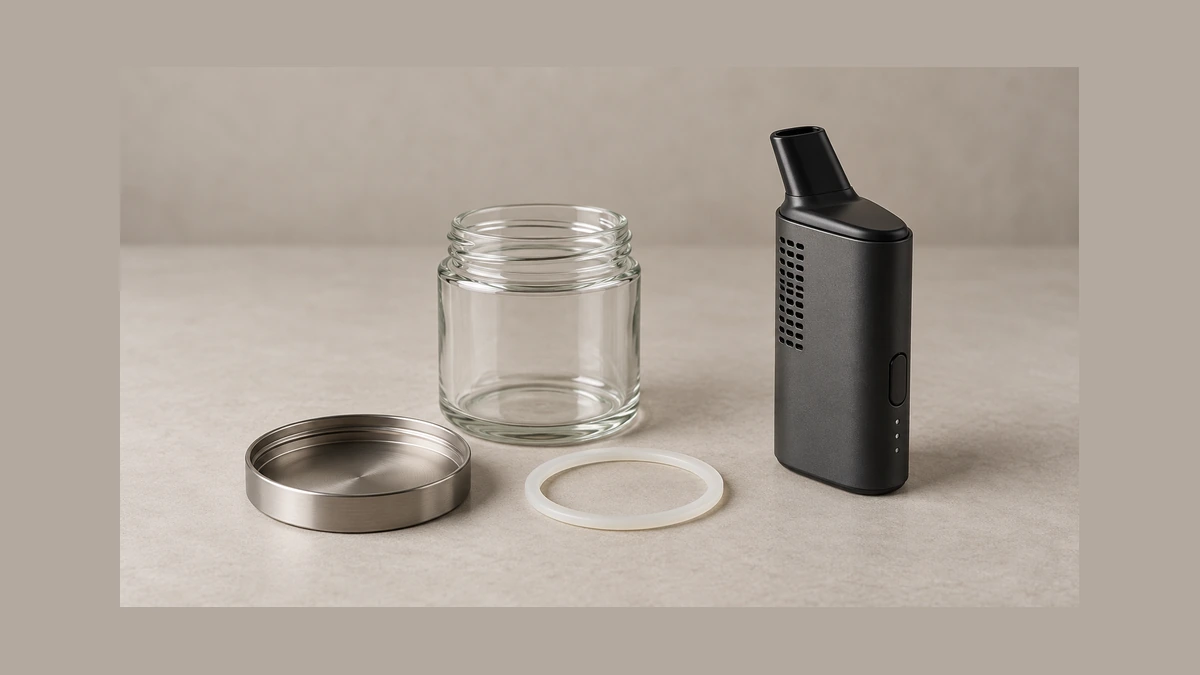
Replacement rings also have a fit specification. For example, Kilner lists a replacement seal for specified three-litre clip-top jars and marks the seal hand-wash only. That is a narrow example of model-specific fit and care, not evidence that the ring fits another jar or guarantees odor containment.
⚙️ 3. Match your checks to the kind of lid you have
A threaded cap, a hinged clip-top lid and a push-on lid do not close by the same motion. Identify yours before following advice that assumes a different mechanism. A photograph of the entire lid, including its underside, is more informative than a close view of the decorative top alone.
On a screw-top jar, notice whether the cap starts squarely and follows its intended path. If it sits crooked or stops in an unfamiliar position, remove it normally and inspect accessible surfaces rather than continuing to turn harder. Follow the maker’s closing instructions; there is no general extra quarter-turn that this guide can prescribe.
🧭 3.1 A resistant lid needs an explanation, not more leverage
A clamp that suddenly feels difficult and a screw lid that suddenly binds are different observations. Record which movement changed. Did the lid stop sitting level? Is the seal visibly displaced? Was a replacement part just installed? Those details help support distinguish a fit question from a damaged component.
Do not use pliers, a lever or body weight to make the closure feel secure. If ordinary operation no longer works as described, stop. Nor should you add tape, glue or an extra liner as a general solution. Those additions leave you with another material and another interface whose intended use and cleaning limits remain unknown.
🧴 4. Clean the outside as a separate job
The jar’s outer wall, lid grip and surrounding tray can be handled while the container is open. Keeping those surfaces tidy is a different task from managing the contents. Plan where the detached lid will sit so its inner face does not share a spot with a used tool or cleaning cloth.
Take a simple desk example: the jar is closed, but the cloth used around the setup is tucked underneath it. Replacing the jar would leave that cloth in place. This does not prove the cloth explains an odor; it shows why the whole storage arrangement deserves attention rather than treating the lid as the only possible issue.
Use the care method specified for the jar and its finish. Instructions for a plain glass body do not automatically cover a painted lid, adhesive label or removable seal. Do not introduce a stronger solvent because a forum commenter used it on something that looked similar. Keep cleaning materials separate from the stored material and the device.
If the concern is odor from the device itself, our discussion of device use and residue considers that separate source in the context of dab pens. The distinction is useful even though a dab pen and a dry-herb storage jar are different hardware: closing a container does not address everything else in a room.
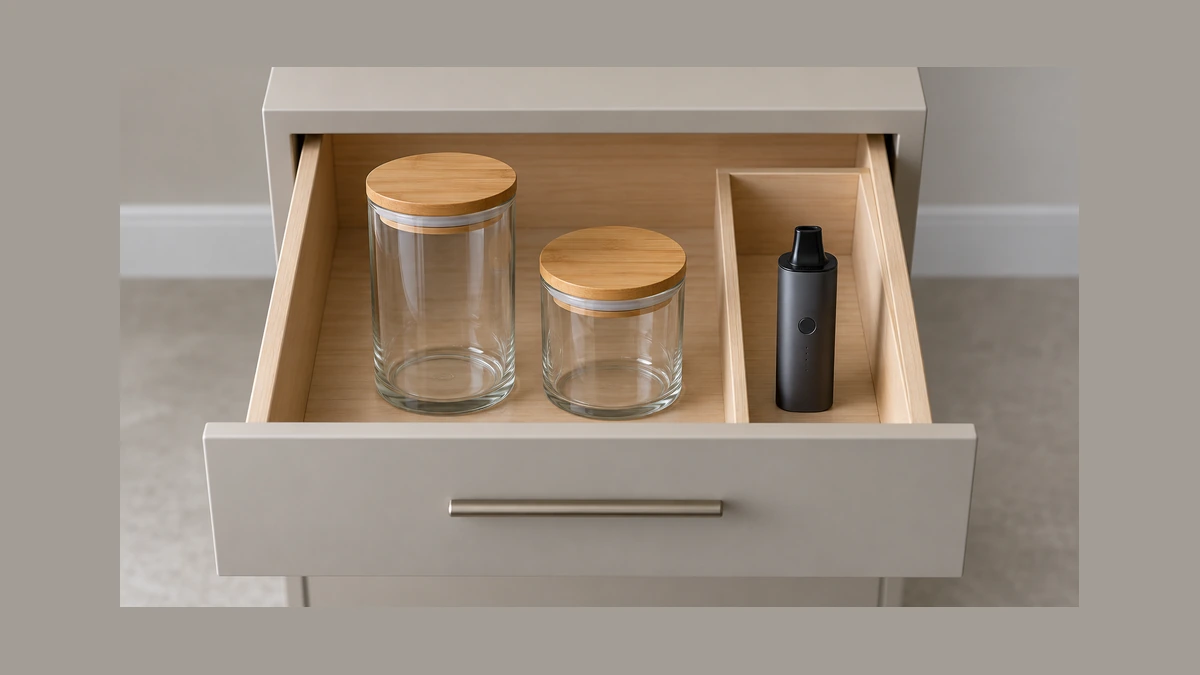
📏 5. A jar must fit the space where you actually open it
Capacity is only one dimension. A tall jar may fit a shelf when closed but have no room for its lid to swing. A broad cap may be awkward to grasp between neighboring accessories. Measure the available space and compare the jar’s actual outside dimensions, including its open-lid position where relevant.
Think about the opening motion rather than arranging a photograph of the closed setup. Can you lift the jar onto a stable surface? Is there somewhere clean for the lid? Can you return it without pressing it against a device control, mouthpiece or loose tool? A drawer that looks orderly when shut can still make each opening unnecessarily awkward.
A very large jar is not automatically better because it holds more, and a very small one is not automatically better because it takes up less space. The useful size permits the intended contents and any maker-approved accessory while allowing the closure to seat normally. This is not a guide to translating jar volume into a weight or dose.
Leave enough room to handle one object without shifting several others first. If the jar only comes out after you move a grinder, cable and cleaning bottle, reconsider the arrangement. A little empty drawer space can be more useful than another compartment that forces everything into a tight fit.
🧼 6. The seal and body may have different care instructions
Before washing, establish which pieces the maker permits you to remove. Some seals are separate service parts; others should remain assembled. Do not pull a liner out of a cap simply because another jar uses a removable ring. Keep the original instructions with the container or save an identifiable copy for later.
Clean and dry each permitted component by its own directions. A dishwasher symbol for one part is not permission to put the complete assembly through a cycle. Likewise, preserving instructions involve a different use from ordinary dry storage. There is no need to improvise boiling, home vacuum treatment or a canning process to troubleshoot a storage lid.
Plan the drying space before disassembly. A tiny ring set beside several similar rings can become impossible to identify later. Keep each jar’s permitted parts together in a clean, labeled area, with enough separation for the approved drying method. Do not assemble a jar merely to clear the counter if the parts are still wet.
Persistent tackiness, a torn edge or an unexplained change after cleaning is a reason to stop and ask about that component. Repeating the same cleaning method more aggressively does not resolve uncertainty about compatibility. Record the cleaner and method already used so the maker has useful information rather than only “the seal feels different.”
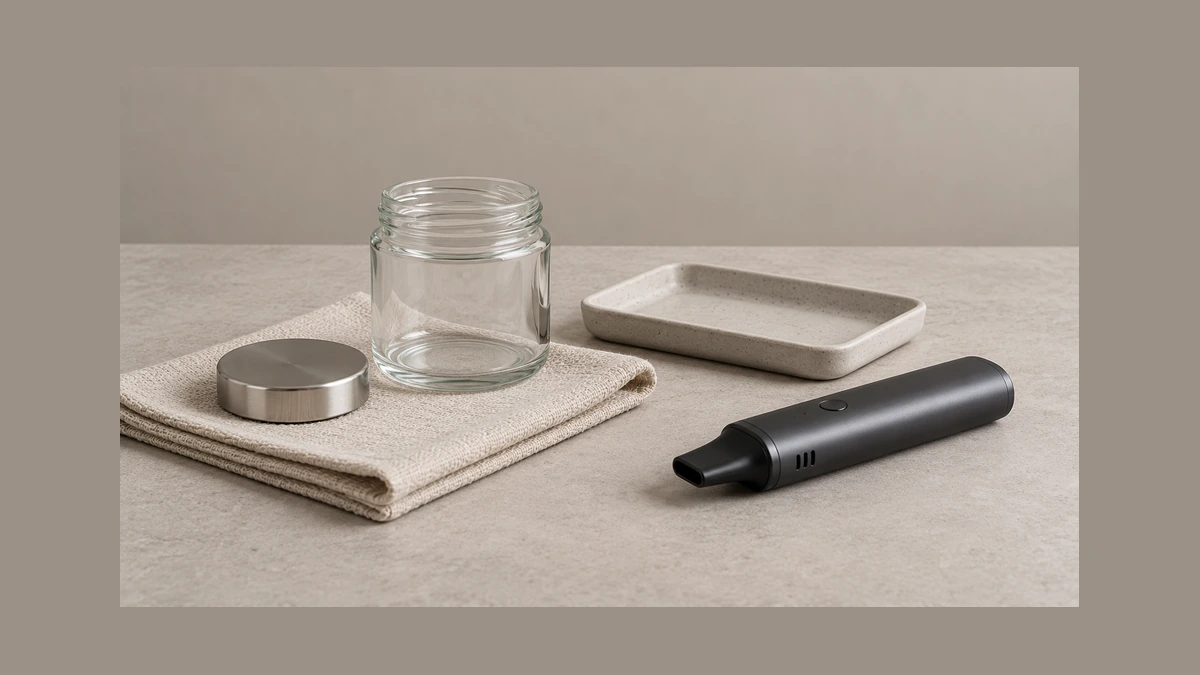
📦 7. A closed jar still needs protection in storage
A container can close correctly and still be poorly placed. A jar beside an open drawer edge, under a stack of tools or loose in a bag has handling problems that a lid does not solve. Keep glass away from objects that can strike it, and avoid balancing a jar on a narrow shelf ledge.
For desk storage, reserve a stable location where the complete jar sits upright as intended. For moving it, follow the container’s transport instructions and use appropriate protection for its shape. Do not treat a decorative sleeve or a closed lid as a drop rating. Empty space around a jar is not necessarily cushioning.
A divided accessory box can help keep unrelated parts apart, but the jar must still be suitable for the box. Our accessory storage-box guide explains compartment planning for tools and containers. It does not replace the care or storage directions for whatever goes inside.
Keep the storage arrangement accessible only to the appropriate adults. A jar described as smell proof does not, by that wording alone, establish a locking function or child-resistant design. Choose the location and access controls independently of what the packaging says about odor.
🔍 8. Make a replacement request specific
If the lid no longer operates normally, set the jar aside and gather the few details that matter: the identifiable jar, outside dimensions, closure style, part markings and photographs of the visible problem. Mention whether a seal was replaced and whether the change appeared after cleaning or an impact. Do not guess at the cause.
Ask whether the seal is a service part, which exact replacement is compatible and what cleaning method applies to both the lid and the body. If the jar cannot be identified, do not force a universal ring into place. A confirmed compatible container is a clearer next step than continuing to rely on an unknown closure.
Return to the original observation when explaining the problem. A recently opened jar, a dirty outside surface and a lid that will not seat are different situations. Naming the one you can actually establish gives you a useful next action without turning an odor impression into a claim that a particular jar passed or failed a test.