A label says “coil-less.” A parts list says “replacement coil.” Read together, they sound like a contradiction. For a coil-less 510 wax atomizer, though, those words may be describing different things: the surface visible inside the chamber and the name given to a larger heating assembly. The useful question is where the heat is generated, not whether a familiar word appears on the box.
That distinction gets lost surprisingly easily in conversation. One person means “I don’t want an exposed wire.” Another means “I am looking at a ceramic cup.” A third is asking about temperature control. They can all use the word coil-less while discussing different features. Separating those features gives the term a more useful meaning without turning it into a promise about the whole device.
🔍 1. Coil-Less Can Describe More Than One Thing
Start with the most concrete distinction: a heating element can be hidden from the chamber’s contact surface without being absent from the assembly. The absence of a visible spiral does not, by itself, reveal what lies underneath. Equally, a heater could have a different shape rather than being a hidden version of a familiar wire coil.
These are different explanations of the same word. They should not be collapsed into a universal definition that every product must follow. The documents discussed below use coil-less language for more than one arrangement. A clear description needs an additional sentence explaining the particular construction.
A Reddit discussion about coil-less atomizers illustrates the vocabulary problem. The author was looking for unexposed heaters but described encountering visible coils in something listed among coil-less options. The important point here is the mismatch between the author’s expectation and the terminology—not the product recommendations that followed.
Before interpreting a claim, it helps to ask which meaning the speaker intends. Are they describing the shape of the electrically active element? Its position? Or simply the surface visible in a photograph? Those questions concern the description itself. They do not require opening or testing a device.
🧩 2. The Cup, Heater, and Assembly Are Different Names
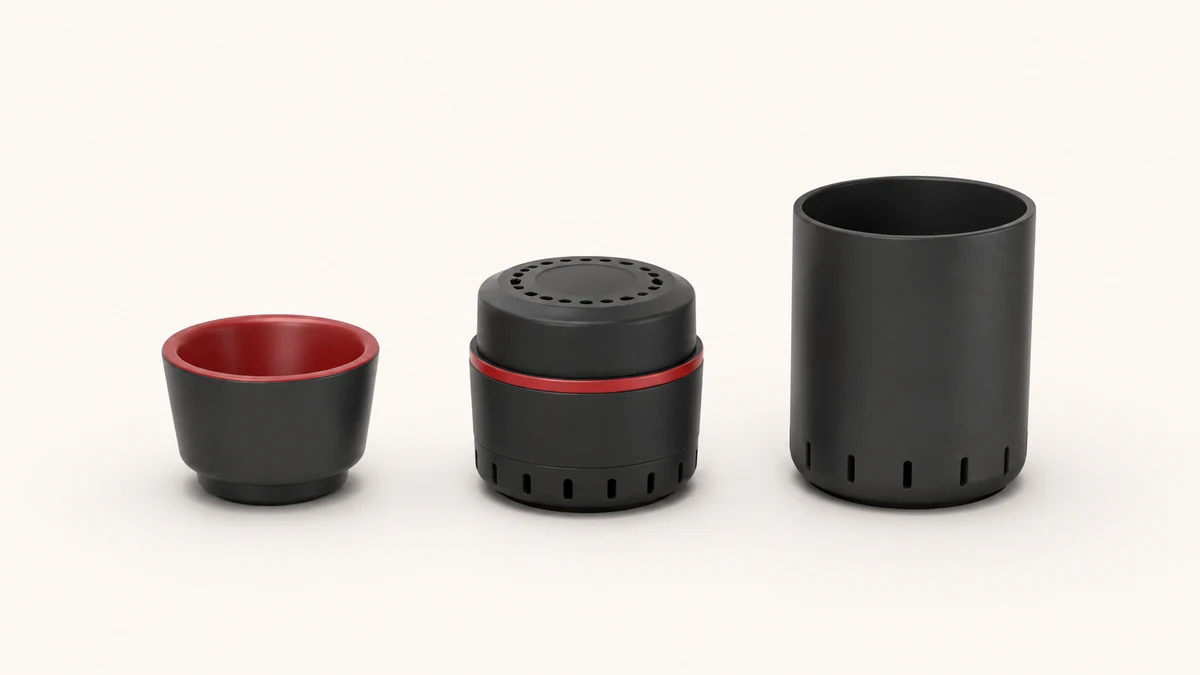
In an explanatory drawing, it is useful to distinguish the contact surface from the heating element. The contact surface is the surface being described as a cup, bowl, or chamber interior. The heating element is the component responsible for generating heat. Whether they are separate parts or integrated into a larger component depends on the design.
“Assembly” is a wider description. A diagram might group several parts under one assembly name even though the drawing gives those parts individual labels. That is why a word in a replacement-parts list is not enough to identify the material or geometry of everything included.
This component-level reading is easier if the wider device is already familiar. AOVAPE’s guide to the parts of a vape follows the power, material, and air paths through a complete device; this page narrows the discussion to what one heating-system label can mean.
Think of how a lamp can be described by its shade, socket, or complete fixture. Those words identify different levels of the object. Calling something a fixture does not tell you what the shade is made from. In the same way, a chamber name and a heater description should not be treated as interchangeable specifications.
🥣 2.1 A Separate Cup Can Receive Heat From Another Part
One concrete example appears in US10271579B2, “Removable cup atomizer,” published April 30, 2019. It describes a cup positioned on a separate ceramic heating element, with heat transferred into the cup by conduction. Here, the cup and the heat-generating element have distinct roles.
That is evidence of one documented arrangement, not a description of every atomizer carrying a coil-less label. A product name alone does not establish that the product implements this patent, uses the same materials, or has the same construction. The example is useful because it makes the distinction between receiving heat and generating heat explicit.
🧱 2.2 An Embedded Element Is a Different Concept
An embedded element is another way to separate an external surface from the electrically active part. Kyocera’s explanation of industrial ceramic heaters describes a heating element built into a ceramic body and integrated through sintering. The element is present even though the ceramic surrounds it.
This is a general engineering example. It does not show that Kyocera supplies a particular atomizer, that a photographed cup has this construction, or that an industrial component is suitable for any inhalation application. It simply demonstrates why “ceramic” and “contains a heating element” are not contradictory descriptions.
🧵 2.3 Coil-Less May Also Refer to the Element’s Shape
A different published application, WO2015161459A1, uses coil-less terminology for a fiber-based heating element. That is a different idea from a separate cup above a heater. It shows why the word alone cannot identify an architecture; it does not establish that this arrangement is common in wax atomizers.
📷 3. A Product Photograph Answers Only Part of the Question
A top-down photograph can show an apparently smooth interior. It cannot, on its own, identify every layer behind that surface. A dark circle could be a surface, an opening, a shadow, or a separate part. Without an accompanying description, interpreting it as a complete explanation of the heating system is a guess.
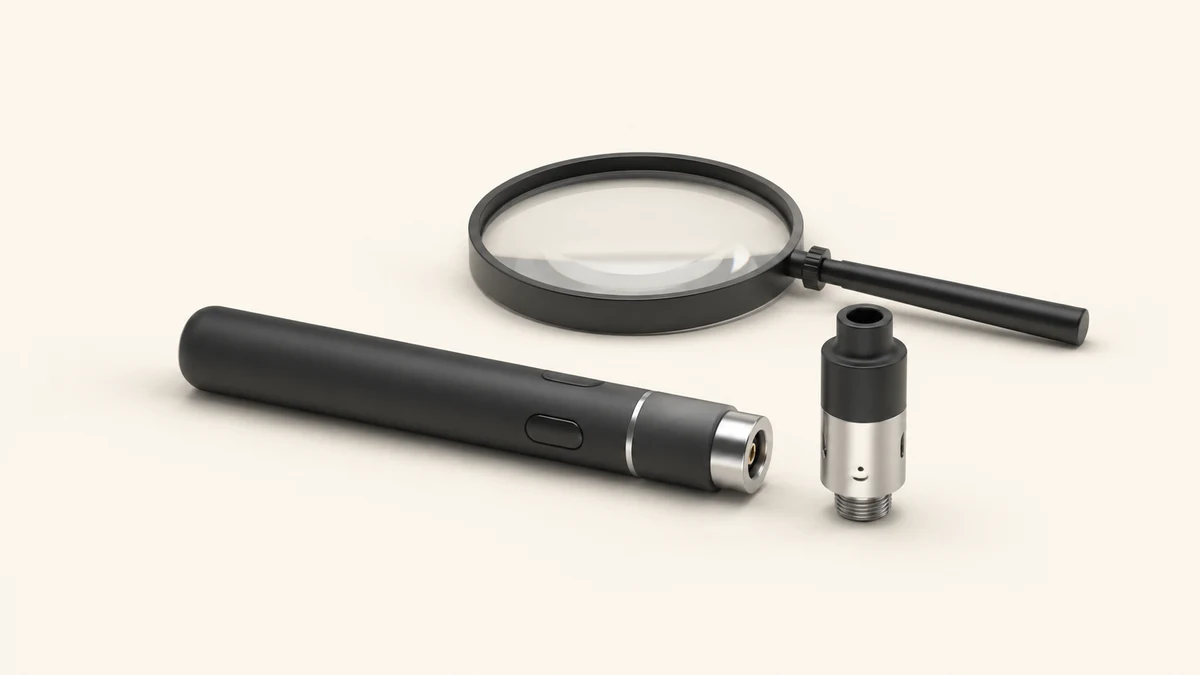
The same limitation applies to a picture of a detached component. Unless the image identifies what is included, it may be showing one part of an assembly rather than the complete assembly. A photograph can be accurate and still leave the reader uncertain about the relationship between the pictured item and the words beside it.
In another discussion of a coil-less-labeled atomizer, one participant asked about a heater that looked more like a ribbon than a coil. That observation is useful as a question about shape. It is not a material identification, a performance test, or proof of how another version was made.
A caption that says “interior view” is therefore doing a different job from a caption that identifies the heater’s location. The first tells you where the camera is looking. The second makes a construction claim that needs documentation. Keeping those two kinds of information separate prevents an attractive image from supplying facts that its caption never actually states.
🌡️ 4. Surface Appearance Does Not Specify Temperature Behavior
Another question often gets attached to the word: does a smooth cup imply controlled or evenly distributed heat? Appearance alone cannot answer it. A description of the surface and a description of the control system are separate pieces of information.
OpenStax’s treatment of conduction explains that conductive heat transfer depends on thermal conductivity, area, thickness, and temperature difference. A familiar illustration is a pan on a hot surface: energy must move through the pan, and its geometry and material matter. This general principle does not provide a temperature prediction for a particular atomizer.
“Smooth,” “ceramic,” and “coil-less” are consequently not substitutes for measured thermal information. A claim about uniform temperature would need evidence about temperature. A claim about response time would need evidence about time. Neither follows automatically from a close-up photograph.
A discussion titled “Temp control coilless” puts the distinction in context: the question mentions a bowl material, an internal element, a connector, and temperature control together. Those are understandable interests, but they do not become one specification just because they appear in the same sentence.
This article does not assign operating settings to any of these arrangements. Its point is narrower: the location and shape of an element do not, by themselves, describe how a complete system measures or controls temperature.
🔗 5. The 510 Label Belongs to the Connection
In this product terminology, “510” names the connector family. “Coil-less” concerns a description of the heating arrangement. Keeping the two labels separate avoids reading a construction claim into a connector name.
A description such as “coil-less 510 wax atomizer” can therefore contain several layers of information without fully explaining any of them. It names a product category, identifies a connection family, and adds a broad heating-system label. It does not become a detailed engineering drawing when those words are combined.
For the purpose of understanding the term, no pairing exercise is needed. The connector label can remain one entry in the description while the heater and chamber are explained separately. This is a vocabulary distinction, not an assertion that any two components can be connected or operated together.
For the broader electrical and mechanical distinction, the existing 510 wax atomizer compatibility guide explains why a matching thread is only one property. Here, the same point has a smaller purpose: connector terminology cannot identify the heater behind the chamber surface.
📖 6. Why a Replacement “Coil” Can Still Need an Explanation
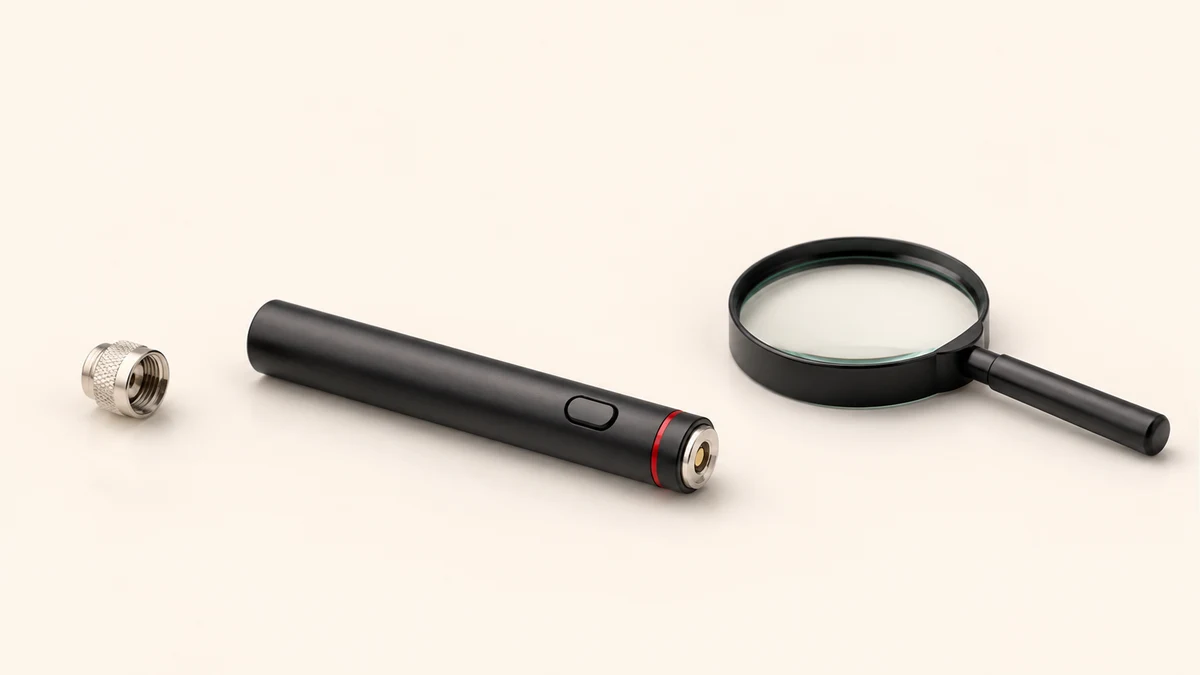
Return to the apparent contradiction in the opening. If a parts page calls an item a coil, first establish what the page means by that noun. It may be identifying an element, or it may be using a shorter label for an assembly. The name needs to be read alongside the description of what the item includes.
There is no need to invent a history of the entire industry’s vocabulary to resolve a particular listing. Nor is the apparent contradiction enough to conclude that a seller is being deceptive. The wording may simply be incomplete. A precise explanation should identify the component rather than relying on either “coil” or “coil-less” to do all the work.
For example, “replacement chamber assembly” and “replacement heating element” would describe different scopes. Those are illustrative descriptions, not specifications for a real product. If documentation never says which scope applies, that information remains unknown.
Readers who need the general role of the heat-generating component can start with how an atomizer works. That overview addresses power, heat, and airflow; the present article deals only with the narrower naming ambiguity around coil-less construction.
The distinction is especially important when comparing two descriptions written by different people. A reviewer may use “coil” for the item they replaced, while a diagram gives individual names to the pieces inside it. Both accounts can use ordinary language without describing the object at the same level of detail.

🗂️ 7. Read Each Label at Its Own Level
A compact terminology map helps keep the questions separate:
| Label | Question it concerns | What still needs explanation |
|---|---|---|
| Coil-less | What does this description mean by the absence of a coil? | Whether it refers to visibility, placement, or element shape. |
| Cup or contact surface | Which surface is being described? | Its material and relationship to the heater. |
| Heating element | Which component generates heat? | Its documented construction and location. |
| Chamber assembly | Which parts are being grouped together? | What is included in that particular assembly. |
| 510 | Which connection family is named? | The separate details of the chamber and heating arrangement. |
Suppose a description gives only “ceramic, coil-less, 510.” It has not yet said whether ceramic refers to a cup, a body surrounding an element, or another component. It has not explained what coil-less means in that sentence. Adding the connector name does not fill either gap.
A more informative description would name the relevant component and state the relationship being claimed. If that relationship is not documented, leave it unresolved rather than filling it in from a similar-looking photograph. That is the central distinction: coil-less is a starting point for understanding a heating arrangement, not a complete account of what the device contains.
For a cup-style chamber with persistent dark marks, see our ceramic dab pen care guide.