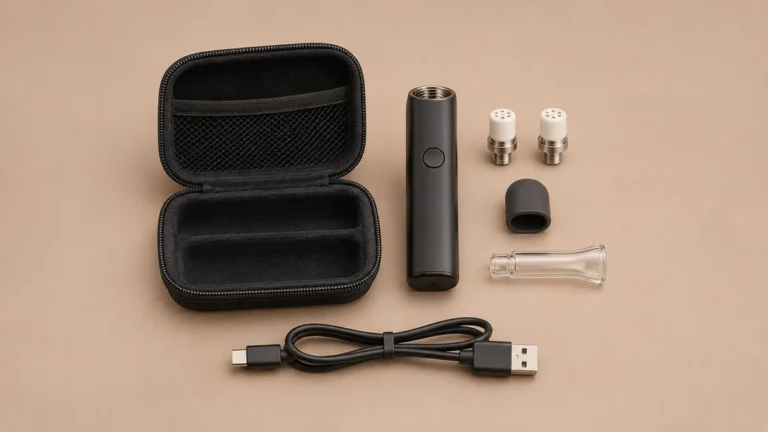
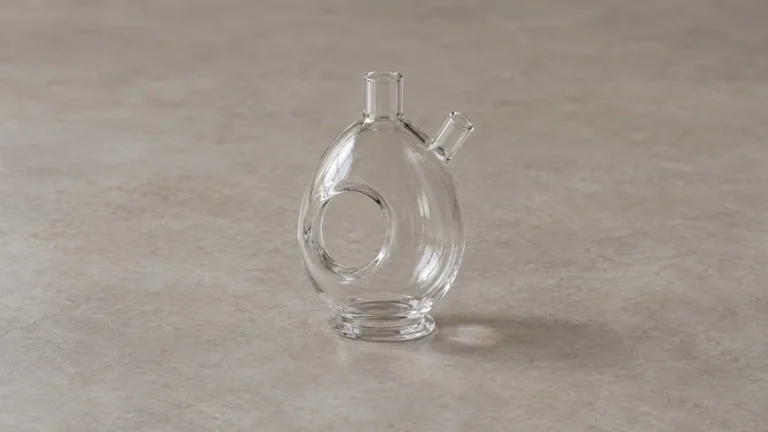
A dab pen globe may be the transparent cover alone, or it may be shorthand for everything above the pen body. If the glass broke and the heater is still attached to the pen, look for the exact term used for the glass-only piece. If the listing includes a glass shell, coil and seal, you are looking at an assembly. The words “globe atomizer” can name either the central heater in conversation or the complete upper accessory in a product catalogue.
One person can describe a “broken globe” and mean that the hollow dome chipped at the bottom. Another takes the cover off and discovers that the metal cup is bent. The two repair questions sound the same until you separate what failed from what stayed behind. The most useful view of a cool, empty pen is the place where the clear cover meets the metal base.
🔮 1. Identify What the Listing Calls a Globe
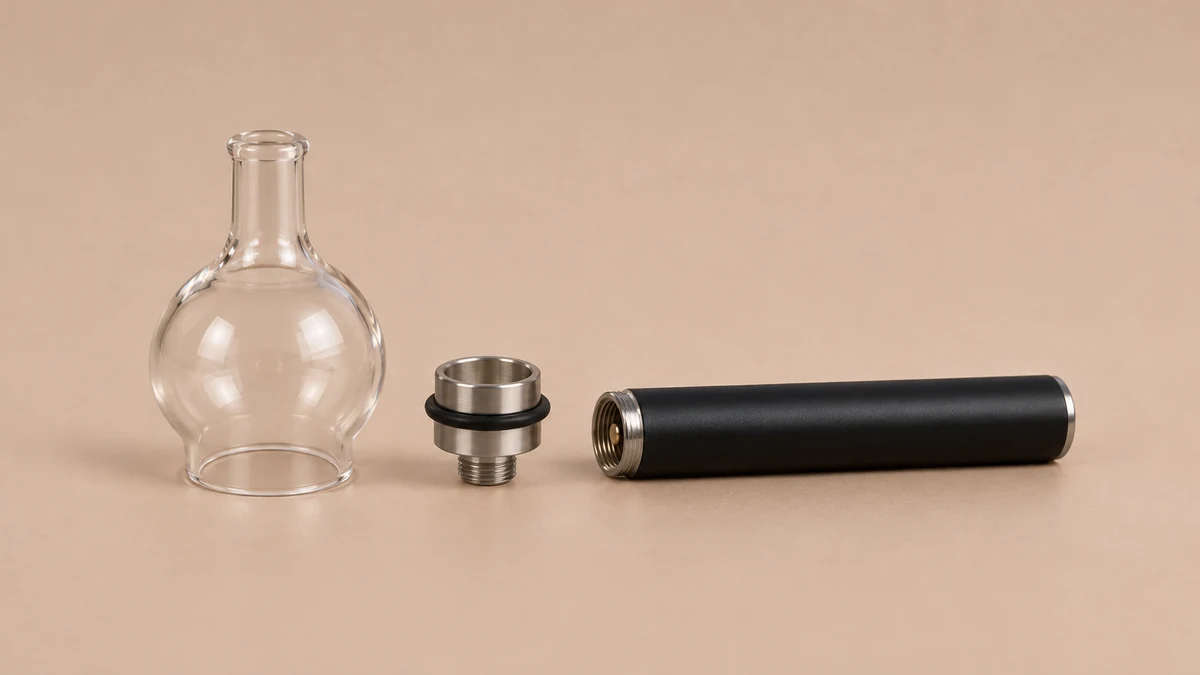
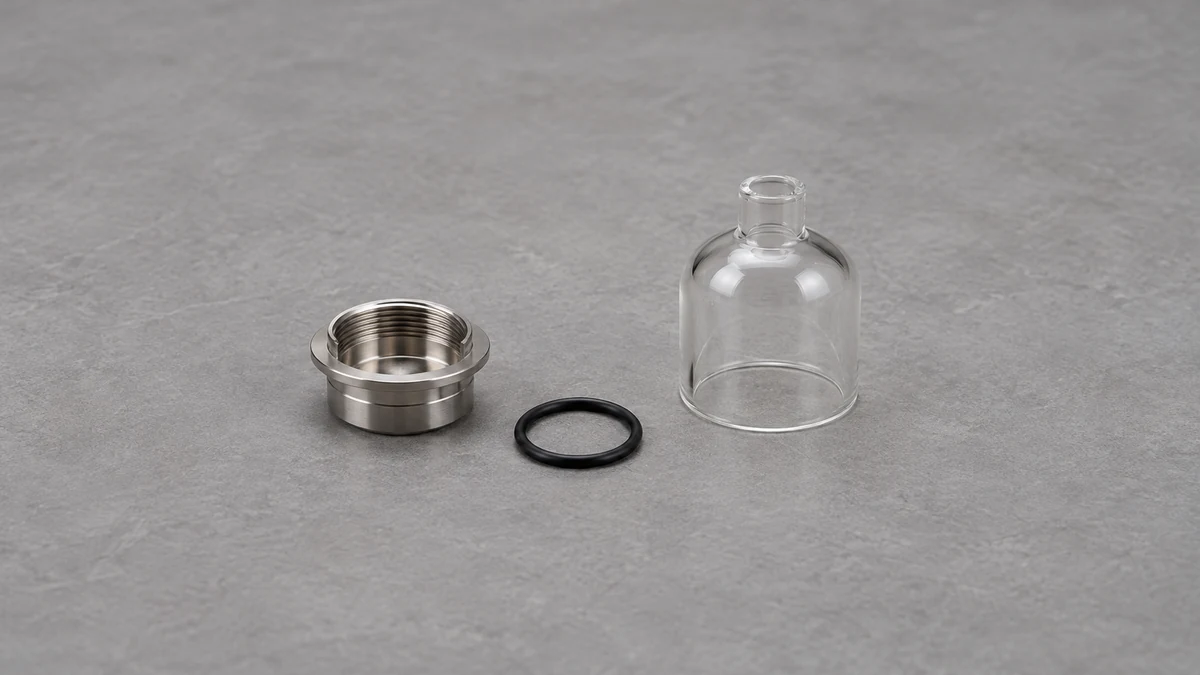
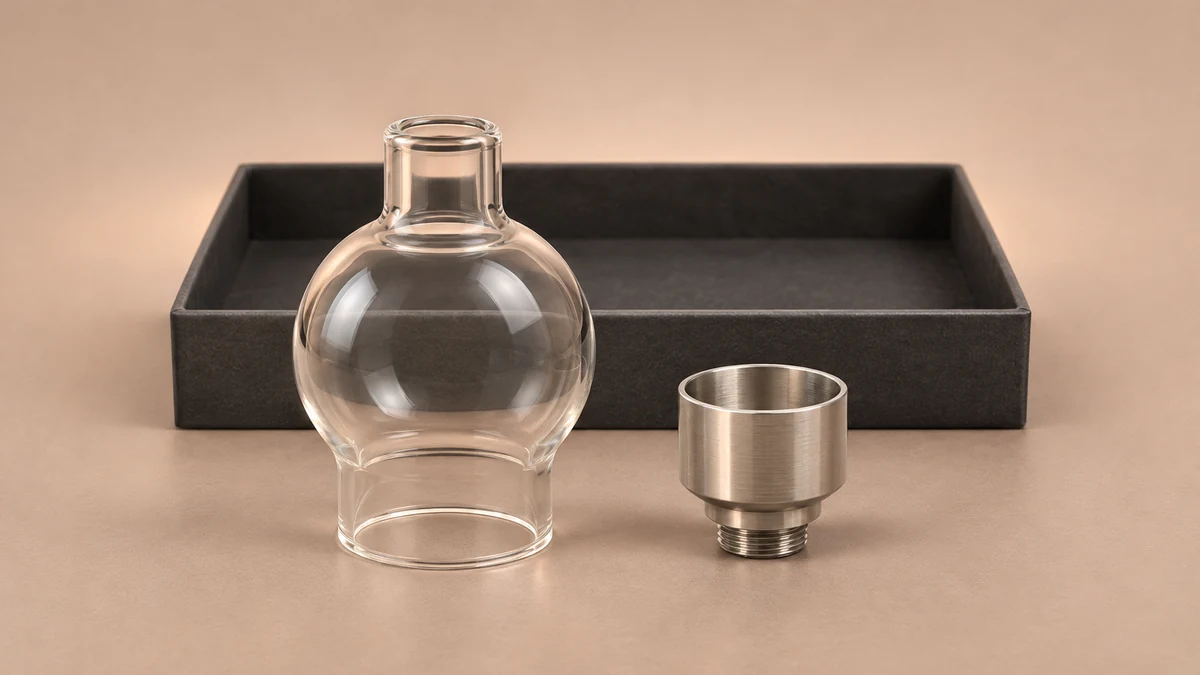
The transparent upper part is easy to recognize by its round or widened outline and its smaller mouth opening. It surrounds another part in a typical slip-on design. Seen from the side, the clear glass may look like a self-contained tank. A view of the underside is more informative. A cover with an open lower end can slide over a separate heater, while a complete accessory may already have its own base in the photograph. If these two items are shown together, see whether the text names the glass and coil as separate contents.
🗃️ 1.1 Distinguish the Cover From the Complete Upper Assembly
Read the selection field before relying on the largest photograph. A listing can use a photo of the complete assembly on the box while the selected variation names the glass only. A product title may emphasize the shape or color without saying what is included. Separate “clear dome,” “coil,” and “assembly” in your notes. If one term appears in a title and another in the itemized contents, check how the maker or seller defines the selected option instead of merging the two descriptions.
Our guide to the different glass parts found on dab pens distinguishes globes, mouthpieces and bubblers. For a replacement question, the extra distinction is the size of the assembly being sold. A photograph of a loose globe next to a mounted pen shows how a glass-only item is used in the design, but it is not an inventory of everything included in the package.
🧩 2. Find the Collar or Ring That Holds the Glass
On one documented design, the glass cover slides over the top of the atomizer and a silicone ring holds it there. Ooze describes this arrangement on its Genie Globe product page. That example gives the ring a specific job. It does not make every dab pen globe a friction fit of the same dimensions. Other mouths and lids can sit on different shoulders or use another retention arrangement. Look for the ring in the published parts view for the exact model.
🔍 2.1 Read the Bottom Opening as Its Own Shape
The outer body can be round, elongated or shaped like a bulb. At the bottom the contact area might be a short cylinder, a tapered lip or a drawn neck. Two decorative silhouettes can look very different while sharing a similar opening in photographs. Two nearly identical globes can have differently shaped undersides. The descriptive name for the shape therefore doesn’t establish the inside profile, the depth of the engagement or whether the matching ring comes in the carton.
In an illustration, a dark ring around the base may seem to be part of the glass. Look at the exact point where it appears on separate parts views. A ring belonging to the metal base can remain on the base when the glass is removed. If a ring is visible inside an illustrated dome, record that as a different observation. It is better to document an unresolved component than to describe the whole underside as “the seal” and lose track of the part that actually supports the cover.
🔗 3. Keep the Glass Fit and Electrical Interface Separate
The glass seat and the lower electrical connector are separate interfaces. In the documented 510 example, the thread joins the atomizer to a specified pen base. The glass sits against a shoulder above the threads. A complete upper assembly can therefore have the expected lower thread and still differ in how its cover seats. When all you need is a glass-only spare, document the upper seat and the existing heater model.
📐 3.1 Preserve Which Side a Measurement Belongs To
A ruler alongside a loose cover may help record its overall size in a support photograph. Leave enough room to show the rim at the bottom and the mouth tube at the top. When discussing fit, be clear if a number refers to the overall globe width or the inside of the mounting opening. Those are different boundaries, especially where the widest part of a dome is well above its seat. A rough picture is useful for identification and should not override the maker’s compatibility list.
If a complete atomizer seems to fasten to a battery, that visual fit alone does not confirm that the pairing is specified. The available power platform, insulation and controls are separate considerations best left to the product documentation. Our dab pen and cartridge comparison explains why a familiar lower connector can be found beneath very different upper hardware. There is no reason to power an empty unidentified accessory just to decide which shape you are holding.
🗂️ 4. Decode Old Product Names by Looking Inside the Box
“Globe vaporizer” appears in old descriptions for complete pen kits, while a current accessory page might use “glass globe” to mean an add-on placed over a separate compatible heater. People who originally got their pen as a complete kit sometimes remember a box label and the color but lose the model name. Go back to the itemized parts list if one is available. A diagram with the cover, upper assembly and lower body drawn apart is especially useful. It tells you where the relevant seams should be without opening parts that were never designed to come apart.
🧾 4.1 Count Components Independently
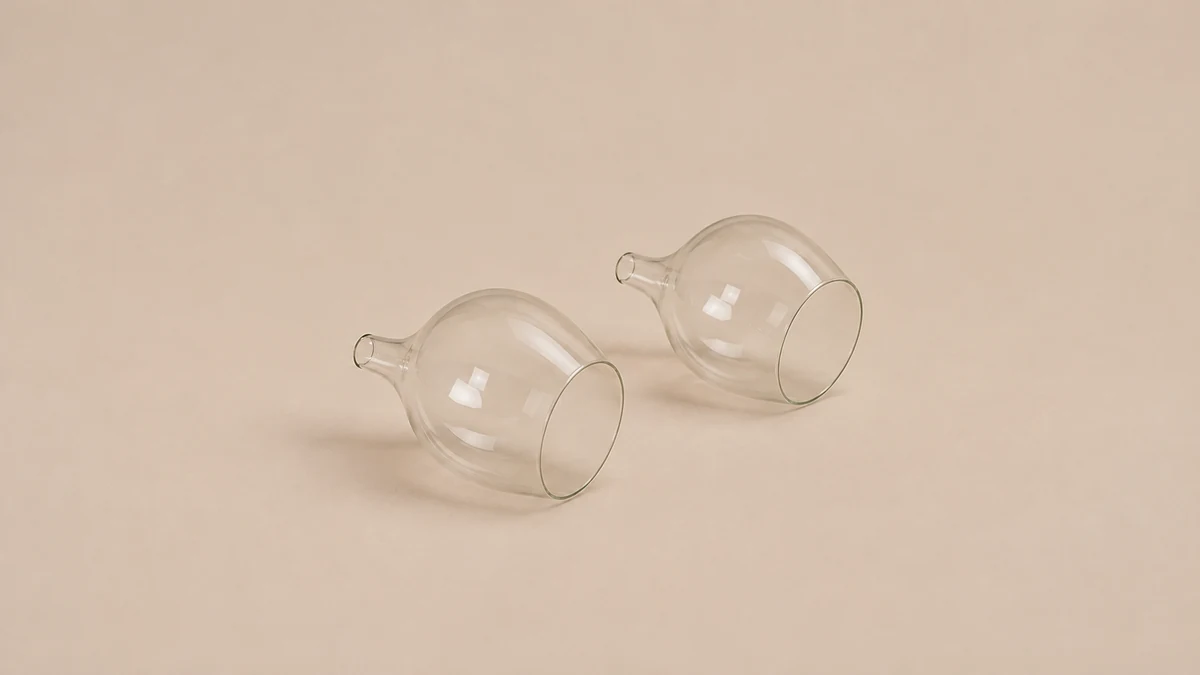
A pair of covers in a photograph can show alternate shapes or colors. Read the stated quantity for the selected model. A tray may also contain one loose atomizer while a second object in the image is already assembled. Record the loose and installed pieces on separate lines. If the seller describes a full kit and a glass-only variant on one page, save the text for the specific option alongside its picture.
A model line may also retain its prominent name while changing the accessory selection available for later versions. Historical photographs help identify what someone owned at a particular time. They cannot establish that today’s separately listed glass fits it. When you retain a box or paperwork, write down the visible model identifier and any revision alongside the photo. Mention explicitly if the glass and metal base originally came from different kits. That relationship is far more useful than the word universal in an unaffiliated listing.
🧰 5. Describe What Is Damaged or Missing
A chipped lower lip is a condition of the globe. A bent shoulder or a torn ring belongs to the interface that supports it. A visibly shifted part inside the heater belongs to the atomizer. Put those observations on separate lines in your notes even when several were discovered after the same drop. A new dome cannot repair a bent seat. Likewise, a ring included with a replacement coil is not proof that the old dome still has an intact opening.
⚙️ 5.1 Keep Surface Marks and Defects Distinct
Reflections on a rounded cover can draw a fine bright line that seems to move with the glass. A photo can also hide a chip behind the rim where the cover rests on the base. Try side lighting and a darker background to document what is visible without pressing on the part. If the glass is clearly cracked, do not try to check fit by pushing it back onto its seat. Out-of-service identification keeps the replacement question separate from the decision to operate the hardware.
Our overview of quartz coil rods and associated parts looks farther into the heater. You do not need to identify every internal feature to establish whether you are missing the clear cover. If the damage might be in the heater, ask for a manufacturer-approved replacement assembly rather than assuming that a visually similar globe includes it.
📷 6. Take Photos That Identify the Surviving Parts
Set the cool, empty components on a plain surface. The first useful frame shows the exterior of the pen body and the atomizer if those pieces are normally separable. The second shows the cover in profile and the opening from below. If you no longer have the cover, make that clear in the caption, and use an existing photo or box illustration to show what was originally there. A third close view of the shoulder or any documented ring should show which part of the assembly the ring belongs to.
Keep each photo tied to one specific observation. “Empty pen body, no upper attachment fitted” is more useful than “old pen.” “Clear globe with base opening visible” tells someone where to look. “This ring was on the atomizer when I removed the cover according to the manual” gives better service information than guessing the seal’s material. Do not pull unknown pieces off just to make a neater photo. If the condition prevents a useful view, say so.
✅ 7. Use the Smallest Accurate Replacement Description
Imagine opening a storage box and finding an intact pen base and short heater but no glass. The heater code is still visible and the dark retaining ring is in place. The most helpful question asks which glass-only part was specified for that heater code and whether the ring is supposed to remain with the old base. Asking for a complete globe kit would hide the fact that most of the hardware is already present.
In a different case you have the glass cover and an empty pen body, but the entire atomizer and retaining assembly are gone. The cover’s shape helps identify the family. It cannot establish the replacement heater model by itself. A useful support inquiry shows the cover underside, unit markings and a photo of the box. Ask what is included when the maker says “complete upper assembly,” since an item can come with a heater and seal but no glass. A full set with the wrong glass interface is just as hard to match as a spare part with an ambiguous label.
When a listing and a parts diagram disagree, save each image with its source and revision. Keep the items you can see on your own hardware in a separate note. Ask whether the offered item includes the exact glass, ring or atomizer you can identify from those notes. That turns a broad fit question into something the person answering can check on a drawing or a parts list.
For instance, an inventory could read: one open-bottom glass dome, one used smooth black ring and one metal assembly with an unknown revision. A second line might say that the glass came from a different box and that the old heater has a shoulder with a visible recess. This wording avoids assuming the ring came with the dome or that both parts share a revision. It gives the maker two separate questions about the retaining part and the mating glass.
Keep an overall photo of the glass even if the only interest is the underside. The full shape helps distinguish a mouthpiece with a built-in outlet from a simple glass sleeve. If the cover is absent, show the opening above the heater and the external shoulder it would sit against. A photo of the bottom of the pen can be useful for matching the housing, but its port and label cannot establish the globe’s inner opening.
There is one more distinction if the cover appears to sit loosely. A ring may be missing or damaged, the glass lip may be imperfect, or the two pieces may simply belong to different variants. Those are different observations. A documented parts view helps establish whether a ring was supposed to be there and where it should have been visible. A photo and a part number can settle more of that question than arguing about whether a globe seems to feel tight in the hand.
If you can document the original parts before damage occurs, include a photo of the detached cover and the intact collar in the same frame. This establishes which two pieces actually belonged together. It also helps when an older box uses a product name that a current parts catalogue no longer recognizes.