You fill the base chamber, watch water bubble through the first percolator, then notice a second chamber doing something entirely different—slowing the hit, adding a gurgle, sometimes leaving a puddle you can’t tip out. That puddle is the real answer: a second chamber changes airflow and water behavior in ways that are useful for some smokers and a maintenance headache for others, and the difference usually shows up the first time you try to clean it rather than the first time you smoke from it.
Double chamber bongs aren’t automatically better bongs. They’re a design choice that trades a smoother, cooler, sometimes quieter hit for extra glass, extra water to manage, and extra surfaces where residue can sit out of reach. Before deciding whether that trade is worth it, it helps to understand exactly what the second chamber is doing mechanically, where water tends to get stuck, and what a fixed percolator makes harder once buildup starts.
🧭 1. What double chamber means
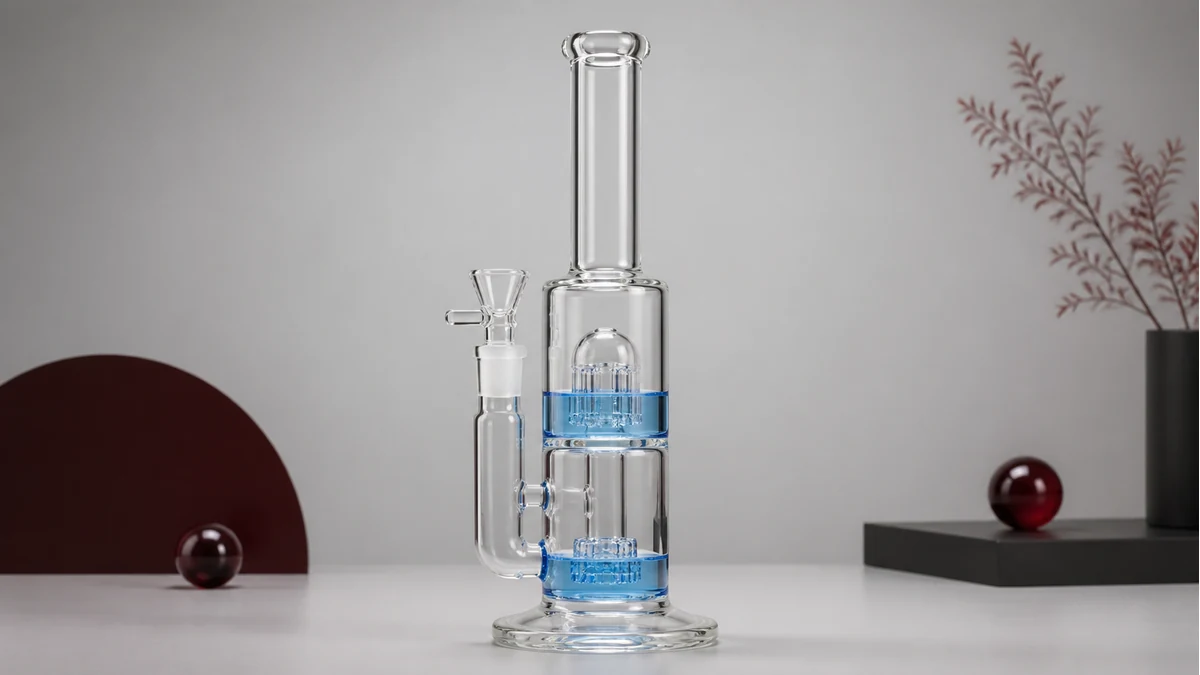
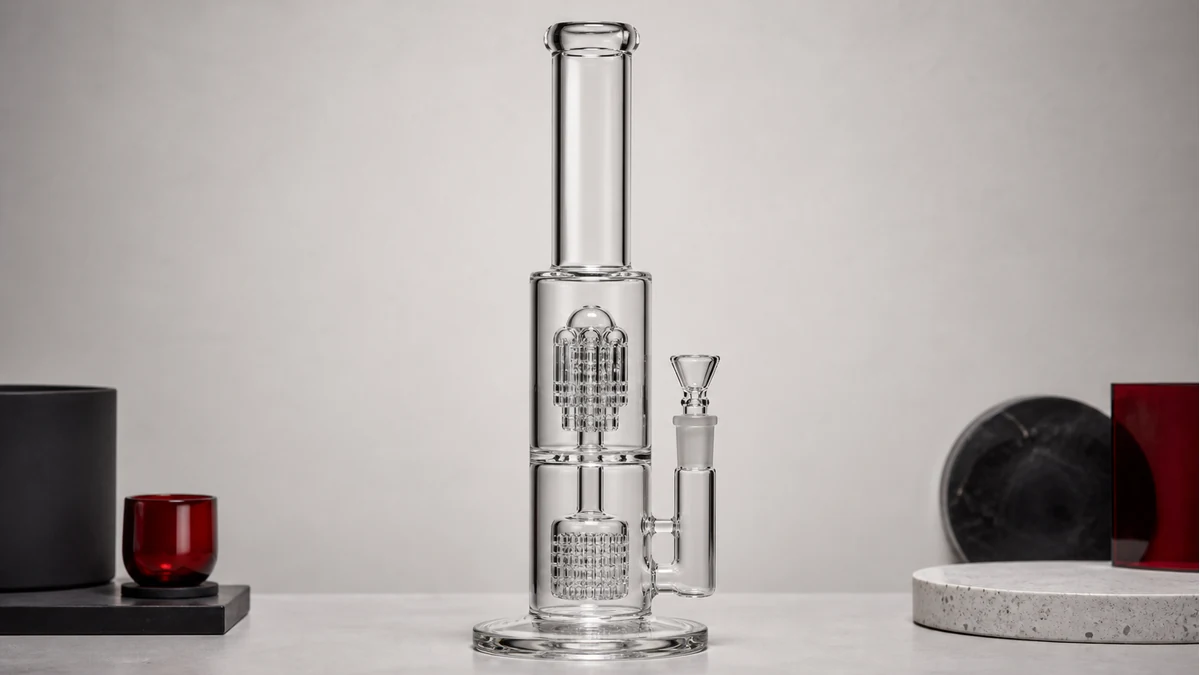
A double chamber bong has two connected water reservoirs instead of one. Smoke and air travel from the bowl through a downstem into the first chamber, where it passes through water, then continues through a connecting tube into a second chamber that usually holds its own water and its own percolator. The two chambers can be stacked vertically, side by side, or offset, but the basic principle is the same: the hit passes through two separate diffusion stages before it reaches your mouth, instead of one.
This is different from a single-chamber bong with multiple percs stacked inside one piece of glass. In a multi-perc single chamber, all the percolation happens in one connected pool of water. In a true double chamber, the water is split into two distinct bodies connected by a narrow tube, and each chamber can behave almost like its own mini-bong. That distinction matters later, because it’s the connecting tube and the second reservoir—not the percs themselves—that tend to create the drainage and cleaning problems owners run into.
Design mixes vary a lot across the market. Some double chamber pieces put a simple diffused downstem in the first chamber and a tree perc or honeycomb disc in the second. Others reverse that order, or use two different perc styles to create distinct texture at each stage. There’s no single “double chamber” specification—water levels, chamber capacity, and joint sizes are model-specific, so anything you read here about how the mechanism generally works should be checked against the actual piece in front of you before you fill it.
🧩 2. How the second chamber changes draw and water movement
Adding a second chamber means the air and smoke have to pass through two water columns and two sets of percolation slits or holes instead of one. Each stage adds resistance, which is why double chamber pieces often draw differently than a comparable single-chamber bong—generally requiring a bit more lung effort to pull air through, in exchange for more contact time between smoke and water at each diffusion stage.
Where that resistance shows up depends on chamber size and connecting tube diameter, which again differ by model. A wide connecting tube lets air move between chambers with less pressure buildup; a narrow one can make the draw noticeably harder and can also change how water splashes as air pushes through. This is a mechanical consequence of physical geometry, not a guarantee tied to any specific brand or design—two double chamber bongs can draw very differently depending on how their connecting passages are sized.
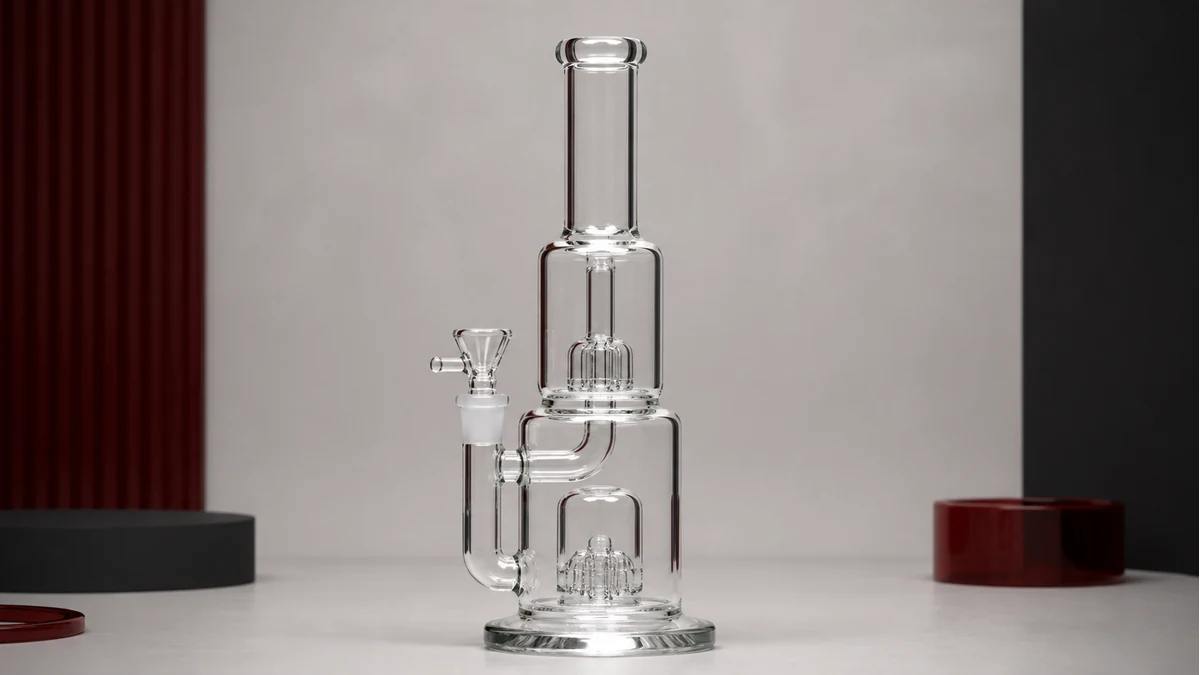
The practical result can be a different draw and perceived cooling than a comparable single-chamber piece, because the path sends air through additional water and internal surfaces. Whether that extra path is worth the added draw resistance is a personal preference question, not a performance guarantee—some smokers find the extra pull effort tiring, especially with pieces that already have dense percolation in each chamber.
🛠️ 3. Percolators, splash control, and trapped water
The percolator in each chamber is doing double duty: breaking up smoke into smaller bubbles for more water contact, and also controlling how much splash reaches the mouthpiece. Well-designed percs diffuse smoke without throwing water up through the connecting tube into the second chamber, or from the second chamber into the mouthpiece. Poorly matched water levels can undo that design regardless of how good the percolator itself is.
This is where double chamber pieces get more particular than single-chamber ones. Because there are two reservoirs, there are two water levels to get right, and they don’t always scale the same way. Overfilling the first chamber can push water into the connecting tube and flood the second chamber; underfilling either chamber reduces diffusion and can let smoke pass through without much filtering at all. Exact water levels are specific to each model’s chamber size and perc style, so filling a double chamber bong “by eye” based on experience with a single-chamber piece can easily overshoot or undershoot what that particular design needs.
Fixed percolators—the kind blown permanently into the glass rather than removable—compound this. A fixed perc that’s positioned close to the connecting tube can trap a small amount of water in its slits or arms even after you think you’ve emptied the chamber. That trapped water doesn’t just sit there; it mixes with resin and ash residue over repeated sessions and becomes harder to displace with each use, because the same narrow geometry that made the perc good at diffusion also makes it good at holding onto whatever settles inside it. Reddit threads on double-perc cleaning have circled around exactly this scenario: residue building up in a fixed percolator that ordinary rinsing can’t reach, which points to a design characteristic worth checking before you buy rather than a problem you can rinse your way out of later.
🌡️ 4. Why complex glass becomes harder to clean
Every added percolator and every extra chamber is one more surface for resin, ash, and water residue to collect on—and one more place a cleaning brush or pipe cleaner may not physically reach. In a single-chamber bong with one percolator, you’re usually working against one geometry. In a double chamber piece with two percs and a connecting tube, you’re working against three or four distinct spaces, each with its own slits, holes, or diffusion arms that can trap gunk in slightly different ways.
The connecting tube between chambers is often the least accessible part of the whole piece. It’s usually narrow by design—narrow enough to control airflow and splash—which also means it’s narrow enough that shaking cleaning solution through it doesn’t guarantee even coverage. Owners in cleaning discussions have specifically asked how to drain and clean fixed internal chambers without cracking the glass, which is a fair question: aggressive shaking or picking at hardened residue near a joint or connecting tube carries real risk of chips or stress fractures in thinner glass sections, and that risk is specific to how each piece is blown, not a general rule that applies the same way to every model.
What actually loosens buildup—alcohol-based solvents, coarse salt as an abrasive, dedicated cleaning solutions, soak time, and water temperature—is model-specific and should follow whatever the manufacturer recommends for that piece’s glass thickness and percolator design. A detailed walkthrough of solvent choices, soak times, and rinse techniques is covered in AOVAPE’s bong cleaning kit guide, which is worth reading before you commit to a double chamber piece so you know what the cleaning routine actually involves, not just what the smoking experience is like.
💨 5. Inspect drainage and access before buying
Because cleaning access is the real cost of a second chamber, it’s worth inspecting for it before you buy rather than discovering the limitations after your first few sessions. A few things to look at in person or in detailed product photos and videos:
🧩 5.1 Removable versus fixed percolators
Some double chamber bongs use removable downstems or perc sections that can be pulled out and cleaned separately; others have percolators permanently fused into the glass. Removable components are generally easier to clean thoroughly because you can access every surface directly, while fixed percs depend entirely on solution reaching every internal channel through the existing openings.
🧩 5.2 Connecting tube diameter and angle
A wider, more direct connecting tube between chambers is easier to flush and drain than a narrow or sharply angled one. If you can see the connecting tube in product photos, check whether it looks wide enough for a pipe cleaner or small brush to pass through, and whether it sits at an angle that would let water drain out completely when you tip the piece, rather than pooling at a low point.
🧩 5.3 Drainage holes or dedicated drain ports
Some double chamber designs include a separate drain hole or stopper specifically so you can empty each chamber without pouring everything back out through the mouthpiece or bowl. This feature varies significantly by manufacturer and isn’t universal, so check the product description or ask before assuming a piece has one.
🧩 5.4 Joint and chamber size relative to your existing accessories
Double chamber pieces often have larger joints and different downstem lengths than standard single-chamber bongs, particularly at the connection between the first chamber and the second. Confirming joint sizes before buying avoids ending up with a bowl or downstem that doesn’t fit, or a percolator section that requires a specific water level to function as designed. AOVAPE’s water for bongs guide covers how to judge appropriate water levels for different percolator styles, which is useful groundwork before testing fill levels on a two-chamber piece specifically.
🧩 5.5 Base stability with two chambers filled
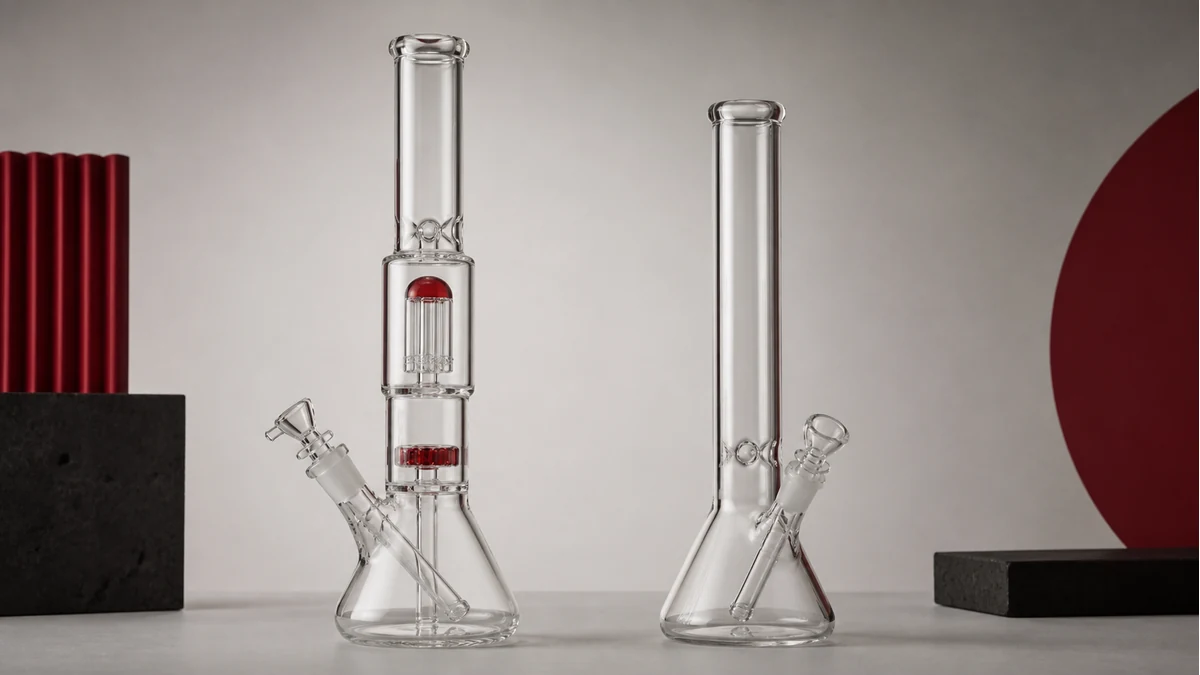
Stacked or offset double chamber designs raise the piece’s center of gravity once both chambers are filled with water, and multi-perc reviews have flagged stability as a real tradeoff alongside splash control and drainage access. A wide, heavy base helps offset this, but base width and glass thickness vary enough between models that it’s worth checking in person or asking about base diameter relative to overall height before buying a tall double chamber piece for a table or shelf where a tip-over would be costly.
🧼 6. Who benefits from the extra chamber
A second chamber makes the most sense for smokers who already value multi-perc diffusion and are comfortable with the maintenance that denser percolation requires generally—people who clean their single-chamber pieces regularly and wouldn’t mind extending that routine to a second reservoir and a connecting tube. If cooler, smoother hits are a priority and the added draw resistance doesn’t bother you, the tradeoff can be worth it.
It makes less sense for smokers who want a piece they can rinse quickly and put away, or who are new to bong maintenance and haven’t yet developed a comfortable cleaning routine. For that audience, a well-designed single-chamber bong with one accessible percolator, or even a bubbler for a smaller, simpler footprint, may provide the preferred draw with without the extra reservoir to drain and the extra internal geometry to flush. AOVAPE’s bubbler vs bong comparison lays out that simpler-piece tradeoff in more detail if a double chamber setup starts to look like more upkeep than you want to take on.
Ultimately, the decision comes down to how much you weigh smoothness and diffusion against reachability and drainage. Controls, exact water levels, cleaning solvents, soak times, and any replacement parts are specific to each model, so the right move before buying is to look closely at how a particular double chamber piece drains, whether its percs are removable, and whether its connecting tube looks like something you can actually keep clean over months of regular use—not just how good the first hit looks in a product photo.
📚 7. Sources and Reader Questions Reviewed
Technical guidance was checked against the manufacturer material below where applicable. Reddit discussions were used only to identify reader questions and failure scenarios, not as proof of technical, health, safety, or legal claims.