The phrase dragon egg dab rig shows up often in searches for compact electronic dab rigs, and it’s worth separating the descriptive term from any single product line. In broad usage, “dragon egg” refers to a rounded, ovoid chassis shape used by several compact e-rig designs, rather than one manufacturer’s exact specification. Some brands have used the name for specific released products, but this article focuses on the shape and engineering trade-offs common to egg-form e-rigs generally, not on copying any particular company’s parts list, coil specs, or firmware details. Understanding the form factor helps when comparing units from different makers or different production years, since egg-shaped rigs share certain design constraints regardless of badge.

🥚 1. What “Dragon Egg” Describes as a Form Factor
An egg-shaped e-rig compresses the traditional glass rig silhouette into a shorter, wider, and rounder body. Instead of a tall cylindrical tube with a foot and a neck, the egg form distributes volume more evenly across a squat oval body. This changes how weight is carried, how water sits inside the chamber, and how the unit sits on a table or in a hand. The shape is popular in compact electronic rigs because it allows a full water chamber and heating assembly to fit into a smaller footprint than a standard beaker or straight-tube design.
Because the term describes geometry rather than internal engineering, two “dragon egg” style rigs from different manufacturers can differ substantially in battery placement, control layout, and airflow design even though the outer silhouette looks similar. Readers comparing units should treat the name as a starting point for shape expectations, not a guarantee of shared internals.
🧱 2. Base, Chamber, and Top Stack Anatomy
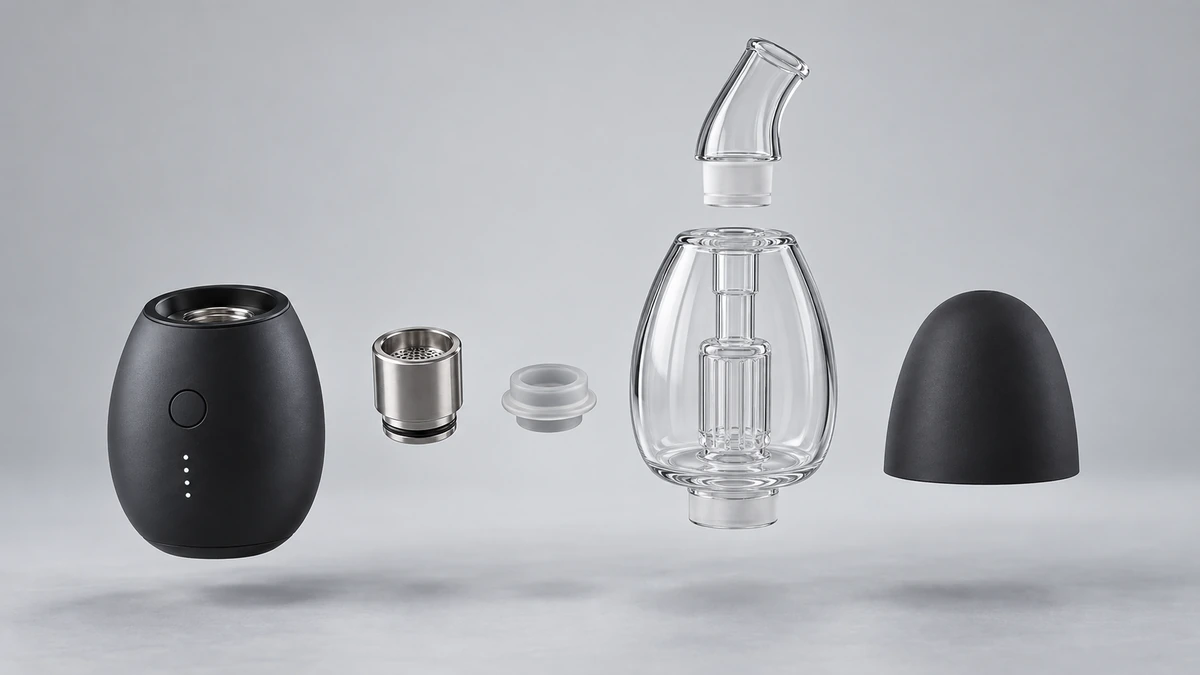
Most egg-form e-rigs are built in three general zones stacked vertically: a base housing electronics and battery, a mid-section water chamber, and a top stack holding the atomizer and mouthpiece. Understanding this stacking helps when troubleshooting airflow, diagnosing leaks, or evaluating a unit’s disassembly points before buying replacement parts.
⚙️ Base
The base typically contains the battery, control board, and any display or button interface. In compact designs, the base is often the heaviest single component, since it houses the densest materials. Some bases also include heat-sinking material to manage temperature from the atomizer above, and a charging port is usually located here.
💧 Chamber
Above the base sits the water chamber, which holds the liquid used for filtration and cooling. In egg-shaped units, this chamber is often rounder and shallower than in tube-style rigs, which affects how much water it holds and how splash behaves during use. Chamber shape also influences how easily the unit can be emptied and rinsed.
🔝 Top Stack
The top stack includes the atomizer housing, any glass or ceramic insert, and the mouthpiece. This is usually the most frequently removed section, since it requires periodic cleaning and occasional replacement of heating components. For a broader breakdown of how these sections relate across dab rig styles generally, see this dab rig parts guide, which covers naming conventions used across both electronic and traditional glass setups.
🌊 3. Water Chamber and Percolation Considerations
The water chamber’s job is to cool vapor and provide some filtration before it reaches the mouthpiece. In egg-shaped bodies, the rounded chamber walls can create different water movement patterns compared to a straight-sided chamber. Some designs include simple diffusion holes or a basic percolator disc, while others rely on a plain open chamber with no internal diffusion at all.
Because the chamber is shorter and wider in most egg designs, water levels matter more precisely than in taller rigs. Overfilling can push water into the airflow path or top stack, while underfilling reduces cooling and filtration effectiveness. Checking manufacturer fill-line markings, when present, is more important on compact chambers than on larger traditional rigs where there’s more margin for error.
🔌 4. Atomizer Interface and Compatibility Caveats
The atomizer interface is where the heating element connects to the base’s power delivery and to the airflow path. This is the area with the most variation across brands and generations, even within rigs that share the same outer egg shape. Threading standards, coil housing dimensions, and electrical contact placement are not universal across the compact e-rig category.
This matters directly for anyone shopping by shape alone. A dragon-egg-style chassis from one release year does not guarantee that its atomizer will physically or electrically match a differently branded or later-generation unit that looks similar. Buyers comparing options, including budget-focused compact rigs, may find it useful to review a electric dab rig under $100 guide for a sense of how atomizer interfaces and included accessories vary at different price points, without assuming any single coil will transfer between models.
🌬️ 5. Airflow Path Design
Airflow path refers to the route vapor takes from the heating chamber, through the water, and out through the mouthpiece. In egg-shaped rigs, this path is often more compact and angled than in tall tube designs, since the overall body has less vertical room to work with. Some units route air through a narrow internal tube that dips below the water line, while others use a wider diffusion path.
Shorter airflow paths in compact rigs can mean less cooling distance for vapor before it reaches the water, which is one reason chamber design and water volume matter more in egg-shaped units than in larger rigs where vapor travels further before reaching the mouth. Draw resistance also tends to vary more between egg-form models than between straight-tube designs of similar size, since internal geometry is less standardized.
⚖️ 6. Center of Gravity and Stability
One practical advantage of the egg shape is a lower, more evenly distributed center of gravity compared to tall cylindrical rigs. Because the battery and heaviest electronics usually sit in the base, and the base is wider relative to its height, egg-form rigs tend to sit more stably on flat surfaces and are less prone to tipping from a bumped table or cord tug.
That stability comes with a trade-off in top-heaviness if the top stack itself is dense (for example, if it includes thick borosilicate glass or a heavy metal housing). Comparing the proportion of top-stack weight to base weight is a reasonable way to judge how tip-resistant a given egg-form unit will actually be in practice, rather than assuming shape alone determines stability.
💦 7. Splash Space and Vapor Path
Splash space is the air gap between the top of the water level and the point where the airflow path narrows toward the mouthpiece. Adequate splash space prevents water from being pulled up into the mouthpiece during a strong draw, which can be an unpleasant and potentially messy experience. In shorter, egg-shaped chambers, splash space is inherently more limited than in taller rigs, simply because there’s less vertical room to work with.
This is one reason fill-line accuracy matters more in compact designs. A slightly overfilled chamber in a tall rig may still leave enough splash space to function normally, while the same overfill amount in a short egg-shaped chamber can eliminate that buffer entirely. Users should treat manufacturer fill guidance as a functional requirement in compact designs, not a general suggestion.
🧩 8. Detachable Parts and Modularity
Most egg-form e-rigs are built with at least some detachable components: a removable mouthpiece, a separable top stack, and often a chamber that can be lifted away from the base for cleaning or water changes. The degree of modularity varies significantly between models. Some designs allow the entire top stack to separate from the base with a simple twist or pull, while others use fixed seals that limit disassembly to just the mouthpiece.
More modular designs generally make cleaning and part replacement easier, but they can also introduce more seal points where leaks or looseness may develop over time. When comparing rigs, it helps to look at how many separable joints exist and what kind of seal (friction fit, threaded, or gasketed) is used at each one, since this affects both maintenance and long-term reliability.

🧽 9. Cleaning Access
Cleaning access refers to how easily internal surfaces can be reached for rinsing or scrubbing. Egg-shaped chambers, being rounder and shorter than tube designs, sometimes have narrower openings relative to their internal volume, which can make manual cleaning tools less effective inside curved interior walls. This is a meaningful consideration for anyone planning routine maintenance rather than occasional wipe-downs.
Removable chambers are generally easier to clean thoroughly than fixed ones, since they can be soaked or rinsed under running water without exposing electronics in the base to moisture. Checking whether the water chamber detaches fully from the base, or whether it’s permanently fused to it, is a practical step before relying on a unit for daily use.
🔄 10. Comparing Generations Without Assuming Coil Compatibility
Manufacturers frequently update egg-form e-rigs across generations, sometimes keeping a similar outer shell while changing internal atomizer design, battery capacity, or control electronics. This creates a common pitfall: assuming that because two units share an outer silhouette or product name, their heating components are interchangeable. In many cases they are not, even across generations from the same brand.
A more reliable way to compare generations is to look at published specifications for atomizer type, resistance, and housing dimensions directly, rather than assuming visual similarity implies parts compatibility. If specifications aren’t published, checking whether the atomizer housing uses a proprietary connector versus a more widely used threading standard can offer a clue, though it’s not a substitute for confirmed compatibility information from the specific listing or documentation for each unit.
It’s also worth checking whether a newer generation has changed the airflow path or chamber shape internally, since external similarity doesn’t always reflect internal redesign. Reviewing detailed part breakdowns, such as the previously mentioned dab rig parts guide, can help build a vocabulary for identifying which components are likely to differ between releases.
🗂️ 11. Where This Fits Among Other Dab Rig Types
Egg-shaped electronic rigs are one of several form factors within the broader dab rig category, sitting alongside traditional glass beaker rigs, straight tubes, recyclers, and other electronic nail (e-nail) style setups. Each form factor makes different trade-offs between portability, stability, percolation complexity, and ease of cleaning. Compact egg-form units generally prioritize a smaller footprint and lower center of gravity over the more elaborate percolation found in larger glass pieces.
For readers trying to place the dragon egg style within this wider landscape, a general overview like types of dab rigs can help clarify how compact electronic designs compare functionally to glass-only setups, without treating any one shape as universally superior. The right form factor depends on priorities like portability, desired vapor cooling, and how much manual maintenance a user is willing to take on.
Understanding a dragon egg dab rig as a form factor, rather than a fixed specification, makes it easier to evaluate any specific product on its actual engineering merits: how its base, chamber, and top stack are proportioned, how airflow and splash space are managed within a compact shell, and how modular its parts really are. Because internal design varies more across egg-shaped e-rigs than the shared silhouette might suggest, comparing generations and brands on documented specifications, rather than shape alone, remains the most reliable approach.
🧭 12. Read the Compact Form as a System
The dragon egg dab rig label usually points to a rounded compact e-rig silhouette, but the useful comparison is underneath that nickname. Trace the relationship among the base, atomizer interface, glass chamber, air inlet, mouthpiece, and charging port. Two similarly shaped devices can place those parts differently and therefore behave differently during filling, carrying, and cleaning.
💧 12.1 Chamber Geometry Sets the Working Water Range
A small chamber leaves less distance between a covered perc and the air outlet. Add water gradually and check the cold draw after each small change. The aim is a waterline that engages the openings without sending water toward the mouthpiece or lower electronic assembly.
🧩 12.2 Replacement Parts Define Long-Term Practicality
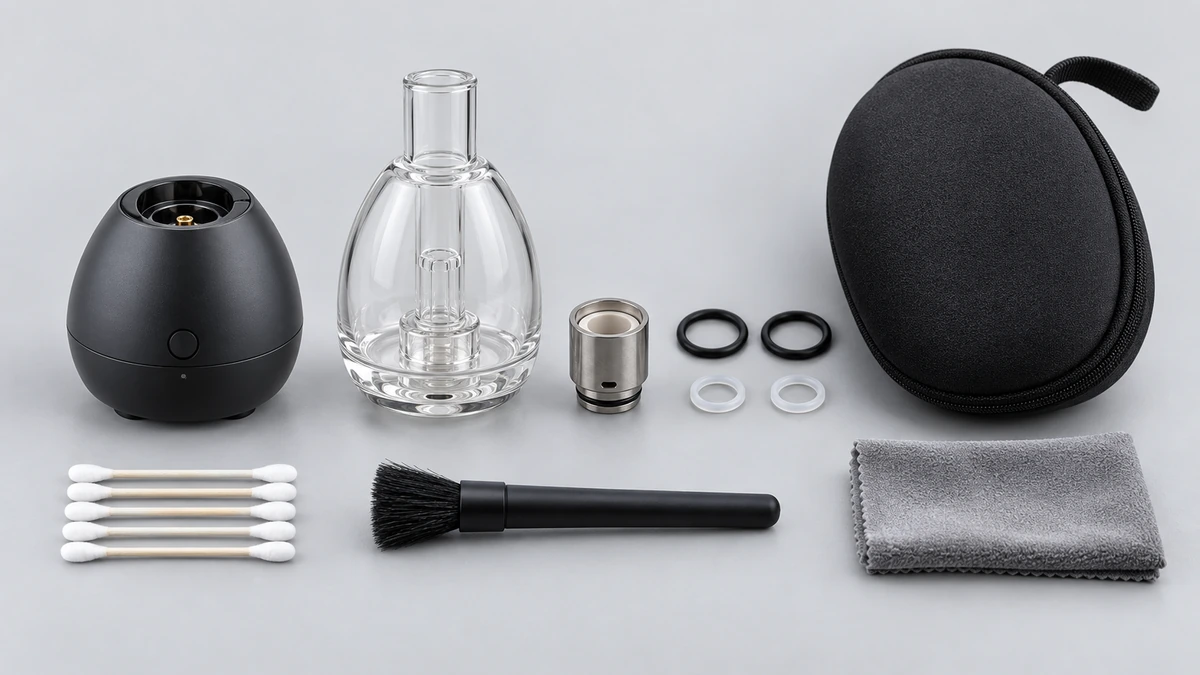
Before comparing colors or display features, identify which glass, seals, caps, and atomizer assemblies are replaceable. Confirm that product photos and part names match the same generation. A compact device is much easier to maintain when wear parts can be identified without relying on silhouette alone.
✅ 13. Let Handling Details Decide
Base stability, glass removal clearance, visible waterline, protected controls, and access around the chamber shape everyday use. These details explain why the same basic form can feel either tidy or fussy. They are also more dependable than broad claims about vapor quality that ignore the installed atomizer and settings.