Shoppers researching a nectar collector glass straw quickly run into inconsistent terminology across listings. “One-piece glass straw,” “glass body with quartz tip,” and “glass water chamber” are used loosely, sometimes to describe genuinely different construction and sometimes to describe the same thing with different marketing language. Understanding what these terms actually refer to helps buyers compare listings accurately rather than guessing based on price or photos alone. This overview walks through material terminology, shape, joint construction, wall thickness, breakage mechanics, replacement logistics, and everyday handling — without recommending any particular product or explaining how a nectar collector is used.
🧪 1. What Sellers Mean by One-Piece, Quartz-Tipped, and Chambered Glass
🔹 1.1 One-Piece Glass Straw
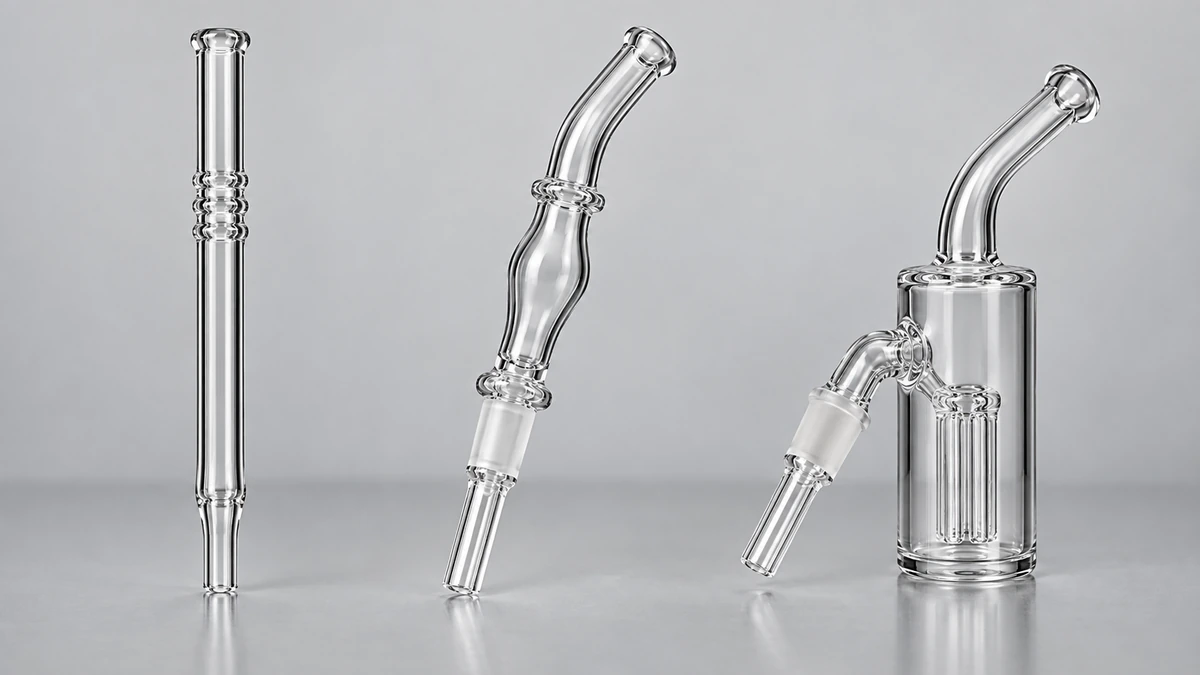
A one-piece glass straw is fabricated from a single continuous tube of glass, formed and tapered in one working session rather than assembled from separate sections. There is no seam, joint, or adhesive anywhere along its length. This construction is generally the simplest to clean because there is no interface where residue can accumulate out of reach. Its main tradeoff is that if any portion is damaged, the entire piece is typically discarded, since there is no modular part to swap out.
🔸 1.2 Glass Body with Quartz Tip
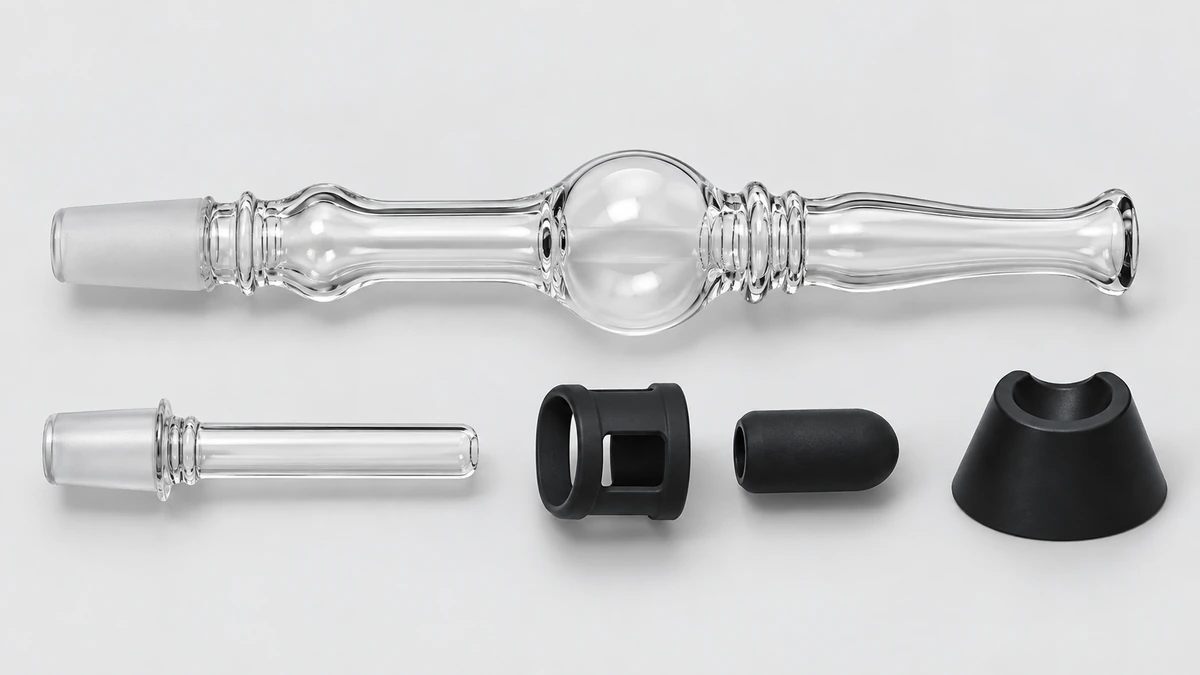
This phrase describes a two-material design: a glass body, usually for the handle and mouthpiece area, paired with a separate quartz tip at the working end. Quartz and glass are different materials with different thermal behavior, so this combination is intentional rather than a marketing quirk. Buyers who want to understand how the tip material affects performance and durability separately from the body should review the material-specific breakdown in the quartz nectar collector guide, which focuses specifically on quartz components rather than the whole-tool comparison covered here.
🔻 1.3 Glass Water Chamber
A glass water chamber refers to an attached or attachable reservoir, typically positioned along the body, that holds a small amount of liquid the vapor path travels through before reaching the user. This is a distinct feature from the tip or the main tube — a straw can have a water chamber or not, independent of whether it is one-piece or two-material. Sellers sometimes list “glass water chamber” as if it were a construction style, but it is more accurately a functional attachment that adds its own joint and its own cleaning requirements.
📏 2. Straight vs Angled Form
➡️ 2.1 Straight Form
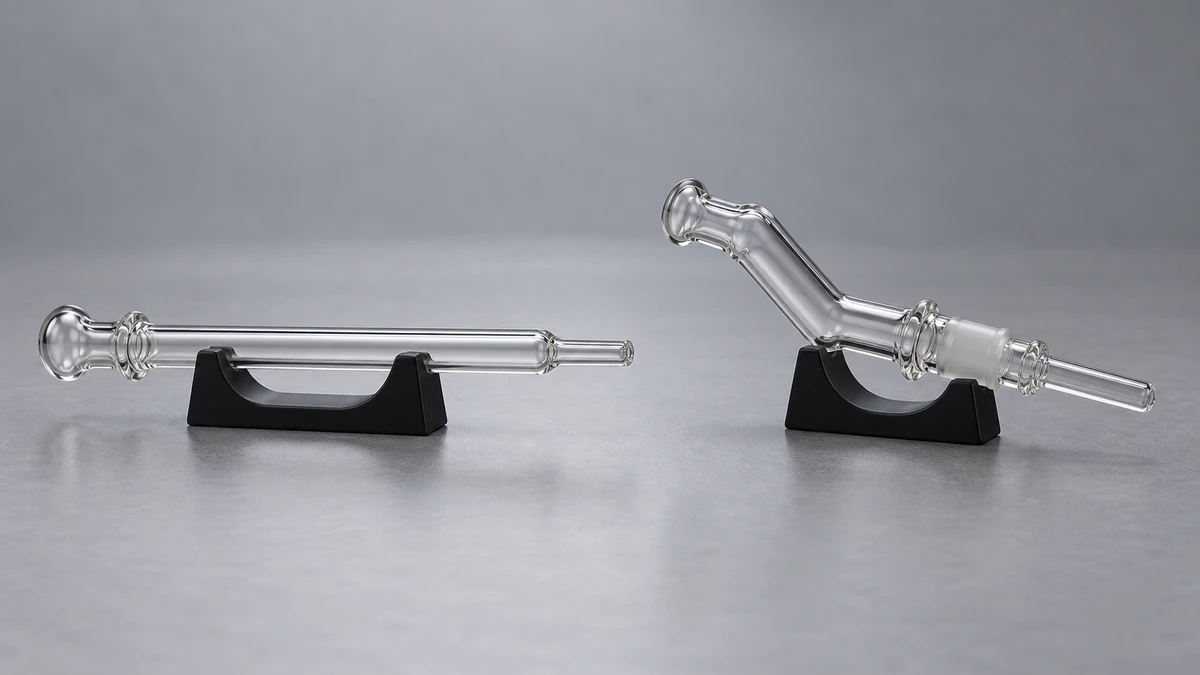
A straight nectar collector glass straw runs in a single unbroken line from tip to mouthpiece. Structurally, this is the simplest shape to manufacture and tends to have fewer stress points, since there are no bends where glass thickness can vary or where stress concentrates during forming. Straight forms are also generally easier to inspect visually along their full length, since there is no angle hiding part of the interior.
↗️ 2.2 Angled Form
Angled designs introduce a bend, usually somewhere in the lower third of the body. The bend itself is a manufacturing step that requires even heating and controlled cooling; if that process is uneven, the bend can end up with thinner glass on the outer curve than the surrounding straight sections. This doesn’t mean angled pieces are inherently weaker, but it does mean the bend is worth closer visual inspection than a straight section would require, since it’s a location where inconsistency is more likely to occur.
🔗 3. Tip and Body Interfaces, Joint Fit
🧩 3.1 Where Interfaces Occur
Any design that isn’t a true one-piece straw has at least one interface — most commonly where a quartz tip meets the glass body, and potentially a second one where a water chamber attaches. Each interface is typically either a fused glass-to-glass joint (permanent) or a friction-fit ground-glass joint (removable). The distinction matters for both durability and maintenance: fused joints don’t come apart for separate cleaning but also can’t loosen with use, while ground joints allow disassembly but rely on a precise physical fit to stay put.
🔍 3.2 Assessing Joint Fit
For removable joints, fit quality is the main thing to evaluate before and during use. A properly matched joint should seat with light, even resistance — not so loose that the piece wobbles, and not so tight that it requires excessive force to separate. A joint that has visibly widening gaps, an uneven seam line, or requires more force over time than it did initially is showing wear and should be checked rather than assumed to be fine. Readers who want a broader look at how these components fit together as part of a full kit, rather than the straw in isolation, can find more detail in the nectar collector kit guide.
📐 4. Wall Thickness as a Visible but Incomplete Clue
👀 4.1 What Wall Thickness Can Tell You
Holding a glass straw up to light or measuring the wall at the open end gives a rough sense of how much material is present at that specific point. Thicker walls at the mouthpiece or tip opening are visible and easy to compare between two pieces side by side. This is a legitimate, if partial, way to compare listings that provide close-up photography of the rim or tip.
⚠️ 4.2 Why It’s Not the Whole Picture
The problem is that wall thickness at one visible point — usually the very end, which is the easiest place to photograph and measure — does not tell you anything about thickness elsewhere along the tube, particularly at bends, joints, or the transition zones near a fused tip. Glass can be thick at the rim and noticeably thinner a few centimeters up, especially in hand-formed pieces. Because manufacturers don’t typically publish thickness specifications the way some product categories do, and because there’s no standardized rating system for this attribute in the category, wall thickness should be treated as one data point among several — alongside overall weight, visual clarity, and joint fit — rather than a definitive durability score.
🌡️ 5. Thermal Shock and Impact: Distinct Failure Modes
🔥 5.1 Thermal Shock
Thermal shock occurs when glass experiences a rapid, uneven temperature change, causing different parts of the same piece to expand or contract at different rates. This kind of stress tends to produce cracking that starts at a specific point and can propagate along the glass rather than at the point of any external contact. Quartz generally tolerates rapid temperature swings better than standard borosilicate glass, which is part of why some designs pair a quartz tip with a glass body — the tip is the area most exposed to temperature extremes, while the body is not.
💥 5.2 Impact Damage
Impact damage is a separate mechanism entirely — it results from a physical strike, drop, or crushing force rather than temperature change. Impact fractures typically originate at the point of contact and can look very different from thermal cracks, often chipping or shattering locally rather than propagating a single fissure. Because these are two unrelated failure modes with different causes, a straw that resists one is not automatically resistant to the other, and neither should be assumed to have a numeric durability rating, since manufacturers in this category generally do not publish standardized impact or thermal test results.
🧰 6. Replacement Parts
🔄 6.1 What Can Typically Be Replaced
Whether a damaged straw can be partially repaired depends entirely on its construction. A one-piece straw has nothing to swap — any breakage means replacing the whole unit. A two-material design with a ground-glass joint may allow the tip or water chamber to be replaced independently, provided a matching joint size is available from the same source. Fused two-material joints behave like one-piece construction for replacement purposes, since the parts cannot be separated without breaking the joint itself.
📋 6.2 Matching Replacement Parts
When replacement is possible, joint size and shape need to match precisely — ground-glass joints are typically sized in millimeters and won’t seat correctly if mismatched, even slightly. Buyers planning to keep a spare tip or chamber on hand should confirm the joint dimensions before purchasing rather than assuming general compatibility across brands.
🎯 7. Rolling Prevention
🛑 7.1 Why Rolling Is a Practical Concern
A straight cylindrical glass straw set on a flat surface will roll with minimal disturbance, which is a common way these pieces end up on the floor. This is a handling issue rather than a defect, but it’s worth planning around given that glass doesn’t tend to survive falls well.
🔘 7.2 Design and Habit Solutions
Some straws include a flattened section, a silicone ring, or a widened base specifically to resist rolling on a flat surface. Where a piece lacks any built-in feature, simple habits — laying it inside a tray, case, or lined drawer rather than directly on a table — reduce the same risk without needing a design change.
📦 8. Padded Storage
🧸 8.1 Purpose of Padding
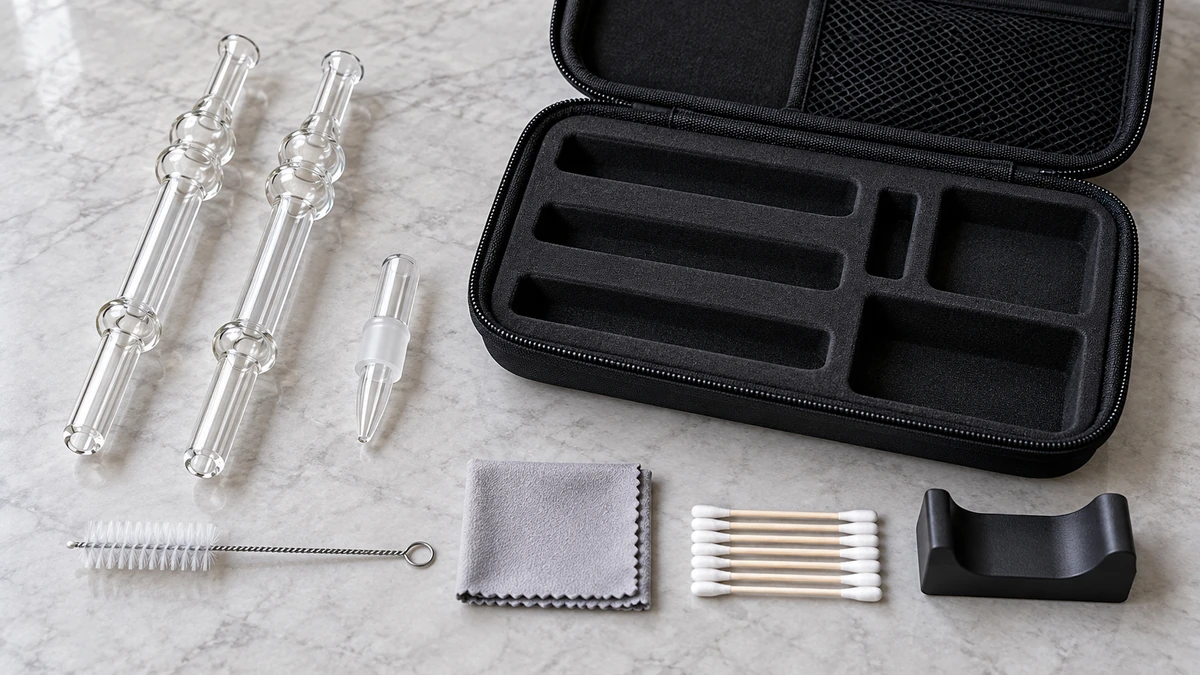
Padded cases or sleeves reduce two separate risks: contact with hard surfaces during storage, and impact from other objects if the piece is stored alongside them. Soft-lined interiors, individual compartments, and snug-fit foam cutouts are all approaches aimed at limiting movement inside a bag or drawer, since movement is what turns incidental contact into an impact.
🚗 8.2 Storage During Transport
Transport conditions add vibration and unpredictable jostling on top of ordinary storage risk, so a case that fits snugly — rather than one where the piece can slide or rattle — offers more meaningful protection. A loose-fitting soft pouch is better than nothing, but a rigid case with a fitted interior compartment limits movement more effectively during travel.
🧽 9. Cleaning Access
🚿 9.1 One-Piece and Straight Designs
A one-piece straight straw offers the most straightforward cleaning access, since a brush or pipe cleaner can typically pass through the full interior length without obstruction. There’s no joint to disassemble and no bend to navigate.
🌀 9.2 Angled, Jointed, and Chambered Designs
Angled bends, tip joints, and water chambers each introduce a spot where a straight brush can’t reach directly, meaning residue can accumulate at these points unless cleaning tools are chosen to match the shape — a flexible brush for a bend, for instance, or removal of a friction-fit joint to clean each side separately. Readers weighing overall maintenance effort as part of choosing a design, including how chamber and joint access compare across styles, may find the broader comparison in the water nectar collector guide useful alongside the construction details covered here.
📌 10. Comparing Listings With These Terms in Mind
Because “one-piece,” “quartz tip,” and “glass water chamber” describe genuinely different construction choices rather than interchangeable marketing phrases, it’s worth confirming which term actually applies to a given listing before comparing price or photos. Checking joint type, shape, and whether any parts are advertised as replaceable gives a clearer sense of what’s actually being purchased than relying on a single photo or a general description alone.
🧭 11. Build a Replacement Checklist Before Ordering
A nectar collector glass straw may refer to the complete glass body, a removable glass tip, or a straight tube sold as one component of a larger assembly. Record the joint diameter, insertion depth, taper direction, overall length, and any retaining seal. A ruler beside the original part in a clear side photograph can prevent an expensive guess.
📐 11.1 Check Clearance Beyond the Joint
Matching joint labels do not prove that an angled tip clears the body or that a long tube fits the storage case. Compare the full outline and note where glass shoulders meet silicone or metal supports. A loose assembly should not be forced deeper to compensate for a missing seal.
📦 11.2 Protect Glass From Point Loads
A thin straw can survive ordinary handling yet fail when a hard tool presses against one small spot in a case. Use separate padded compartments, cap exposed ends, and avoid storing accessories inside the bore. Inspect rims and ground joints under good light before assembly.
✅ 12. Material Names Need Construction Context
Borosilicate, quartz, and glass are often mixed loosely in listings. Ask which exact component the material description covers and whether the heated tip is separate from the body. The answer affects replacement planning, cleaning boundaries, and how the part should be stored.