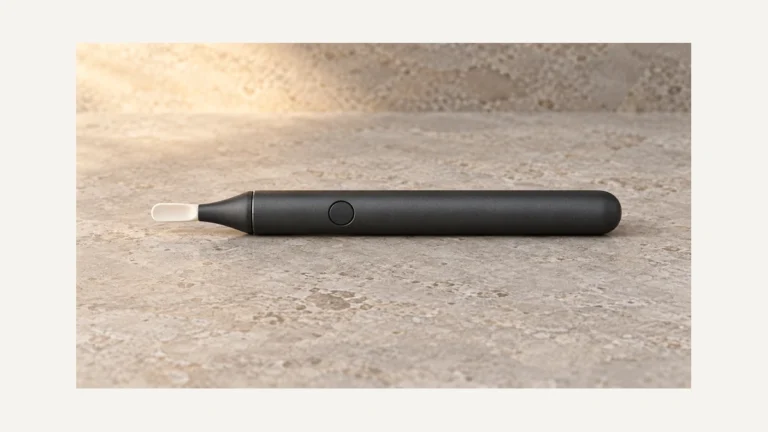
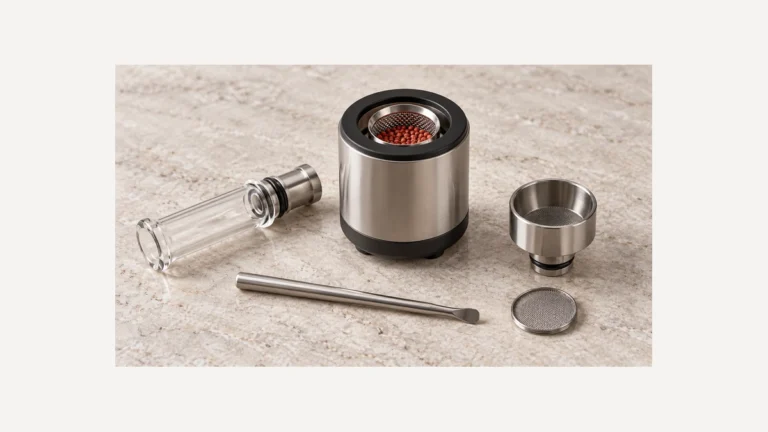
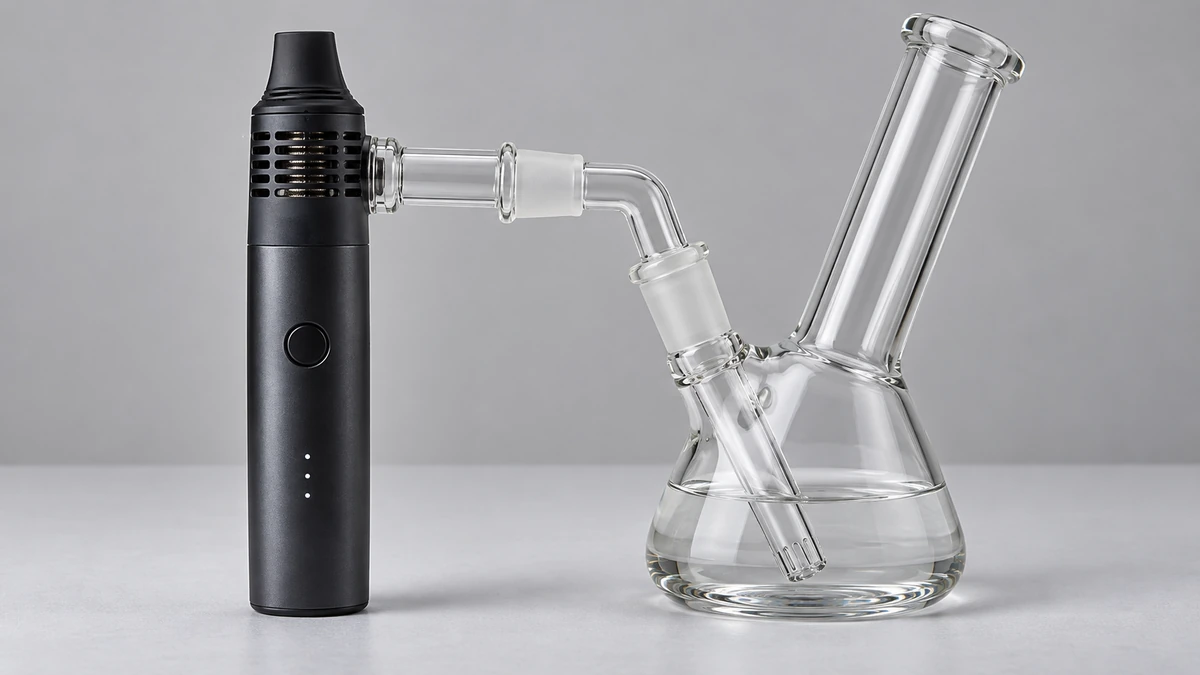
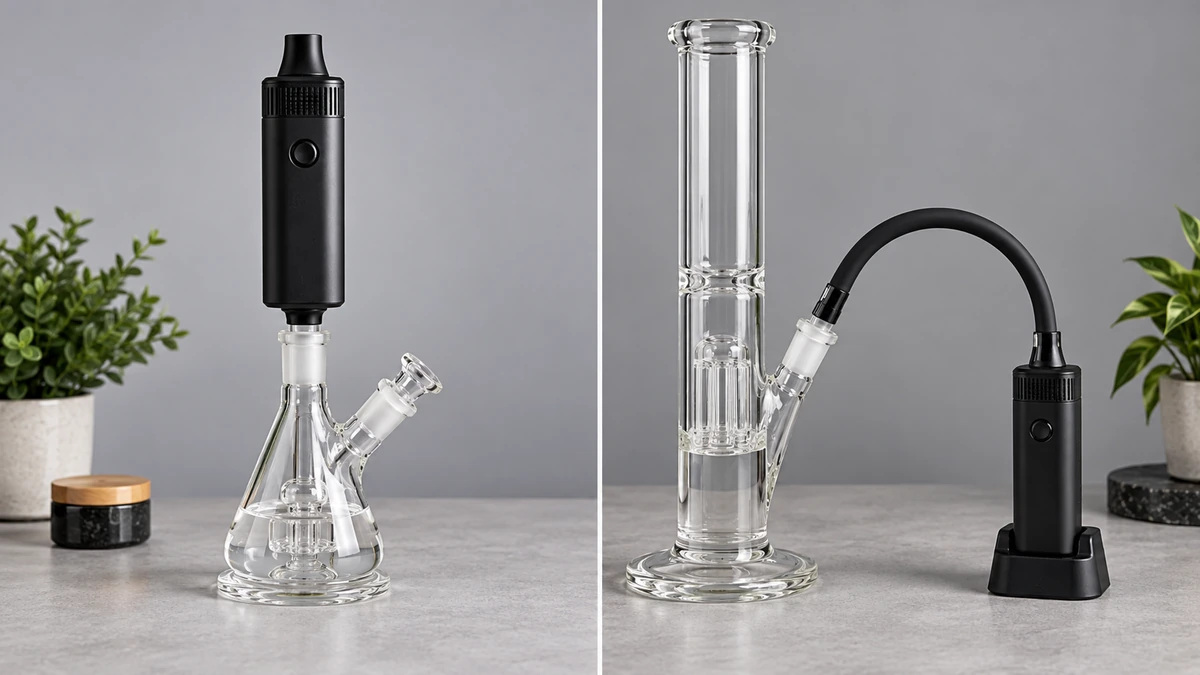
A dry herb vaporizer bong is really two separate devices joined by a piece of glass. One half is the vaporizer itself, with its own heating chamber, battery or cord, and airflow controls. The other half is a water pipe, with its own base, water chamber, and mouthpiece. The connection between them is either a direct adapter — a short, rigid glass or metal tube — or a whip, a flexible hose that routes vapor from the device into the water pipe’s joint. Understanding this setup means understanding where the vaporizer’s job ends and the water pipe’s job begins.
🔧 1. Two Parts, One Airflow: Vaporizer Chamber vs. Adapter
The vaporizer chamber is where the ground herb actually sits and where heat is applied, either through direct contact with a heated surface (conduction) or through heated air passing over the material (convection). The mechanics of how that heat produces vapor are covered in more detail in this explanation of conduction and convection heating, but for the purpose of a bong setup, the key point is simpler: the chamber does the heating, and everything downstream of it just carries vapor along.
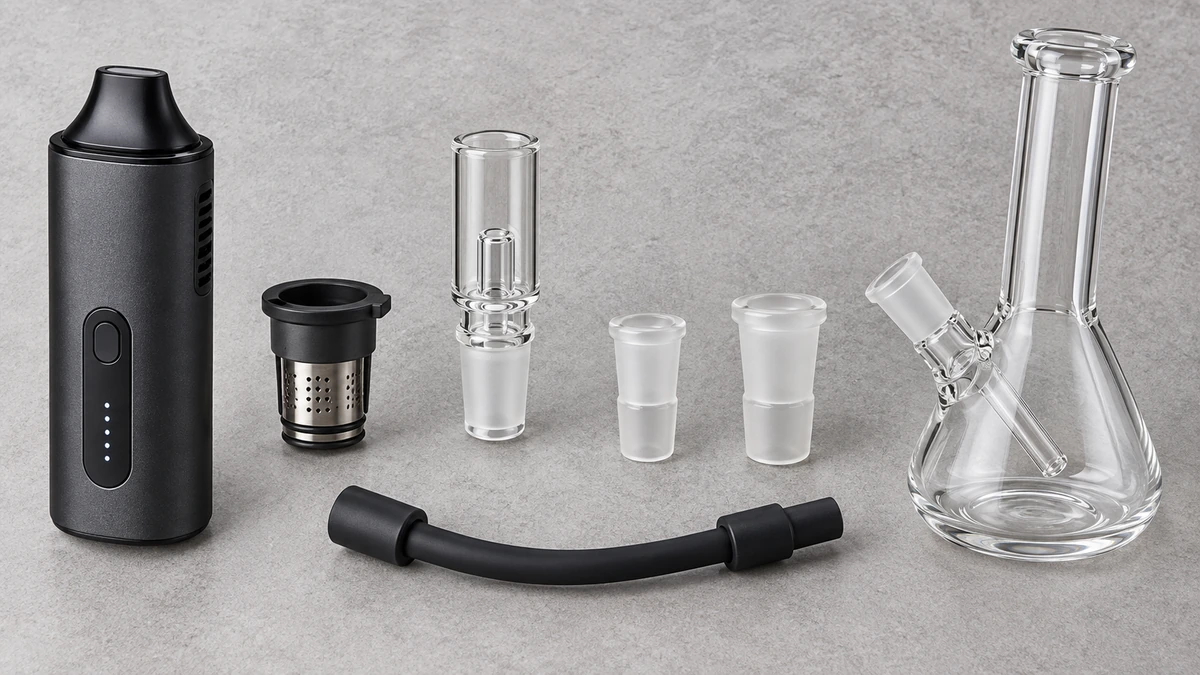
The adapter is not part of that heating process. It is a passive connector — usually a hollow glass or metal tube with a joint on one end sized to fit a water pipe, and an opening on the other end sized to fit the vaporizer’s mouthpiece or output port. Some vaporizers thread or snap directly onto an adapter; others rely on a short length of tubing (a whip) between the device and the joint. Either way, the adapter’s only function is to move vapor from the chamber into the water pipe without leaking air at the seams.
🔩 2. Joint Families: 14 mm and 18 mm, Not a Universal Fit
Water pipe joints are usually described by nominal size, and the two most common nominal sizes are 14 mm and 18 mm. These numbers refer to the diameter of the ground-glass joint, not to any single manufacturer’s standard. Because glassblowing tolerances vary and because “14 mm” and “18 mm” describe a family of similar-sized joints rather than one fixed spec, a joint labeled 14 mm from one glass piece is not guaranteed to seat cleanly in a joint labeled 14 mm from another. Fit within the same nominal family is common, but it is not universal, and mismatched pieces can wobble, leak air at the seal, or simply refuse to seat all the way.
This matters for a vaporizer adapter specifically because the adapter is the piece bridging two separate manufacturing traditions — the vaporizer maker’s mouthpiece dimensions and the glass industry’s joint conventions. An adapter is manufactured to match one nominal joint size on the water pipe side, but it still has to be tested against the actual piece it will be used with rather than assumed to fit based on the nominal number alone.
⚙️ 2.1 Joint Gender: Male and Female Ends
Ground-glass joints come in male and female versions. A male joint tapers to a smaller diameter and inserts into a female joint, which is shaped to receive it. Water pipes are typically built with a female joint at the point where a downstem or adapter is meant to go in, though female-jointed water pipes paired with a female-jointed accessory do exist and require a male adapter on both ends to bridge them. An adapter’s gender needs to be checked against the water pipe’s joint before assuming compatibility — a male adapter cannot seat in another male joint, and a female adapter cannot seat in another female joint.
📐 3. Insertion Depth and Upright Support
How far an adapter seats into the water pipe’s joint affects more than the airtightness of the seal. Insertion depth determines how much of the adapter’s length sits inside the water ppipe versus how much sticks out to hold the vaporizer or whip fitting. A shallow seat leaves more of the assembly cantilevered outward, which shifts weight away from the water pipe’s base and makes the whole setup more prone to tipping, especially once a vaporizer device — which has its own weight from a battery or heating element — is attached at the far end.
Upright support becomes a practical consideration once the adapter and vaporizer are in place. A water pipe with a wide, stable base can usually carry the added weight and leverage of a vaporizer and adapter without issue, but a narrower or lighter base may need to be held or braced rather than left standing on its own, particularly while a whip is being maneuvered or while the vaporizer’s own weight pulls at an angle.
🌬️ 4. Draw Resistance and Added Path Length
Every additional inch of tubing between the vaporizer chamber and the mouth adds path length, and added path length generally adds draw resistance — the effort required to pull air or vapor through the system. A direct adapter adds a relatively short, fixed length to the path. A whip adds more, and the length of the hose itself becomes a variable the user can sometimes choose. Beyond the adapter or whip, the vapor still has to travel down through a downstem, bubble through water, and rise back up through the water pipe’s chamber before reaching the mouthpiece, and each of those stages contributes its own resistance.
Narrower internal diameters, tighter bends, and any screens or diffusion slits along the way all add resistance as well. None of this changes how the vaporizer heats the herb — that process is still governed by the chamber’s own airflow, as described in the conduction and convection breakdown linked above — but it does change how much effort is needed to draw the vapor out once it leaves the chamber and enters the water pipe side of the setup.
💧 5. Waterline Placement and Condensation
The water level in a bong needs to sit high enough to submerge the downstem’s outlet, so vapor is forced to pass through the water, but not so high that it splashes up into the neck or gets pulled toward the mouthpiece during a draw. Because a vaporizer produces a cooler stream than combustion would, the water pipe’s role here is mostly to add a filtration and cooling stage on top of what the vaporizer chamber already does, rather than to cool something that started out hot.
Condensation is a separate issue from the waterline itself. As vapor travels through the adapter, whip, and downstem, some of it can cool and condense on the interior glass surfaces before ever reaching the water. This is normal and shows up as a thin film or visible droplets inside the tubing, and it tends to accumulate faster in longer paths — another reason path length and draw resistance are worth paying attention to when setting up the adapter.
🧴 6. Cleaning Boundaries Between Adapter and Chamber
The adapter, the water pipe’s downstem and base, and the vaporizer’s own chamber are cleaned differently because they are made of different materials and handle different jobs. The adapter and downstem are typically plain glass or metal and can usually tolerate a soak in isopropyl alcohol with coarse salt, followed by a rinse, since they have no electronics or heating surfaces to protect.
The vaporizer chamber is a different matter. It houses the heating element, and depending on the device, that element may be sensitive to moisture, alcohol residue, or aggressive scrubbing. Manufacturer instructions for the chamber and any herb screen inside it should be followed separately from whatever cleaning routine is used on the glass adapter and water pipe. Keeping this boundary in mind — glass parts get one kind of cleaning, the heating chamber gets another — helps avoid damaging the vaporizer while keeping the water pipe side clear of residue. For readers weighing whether the added cleaning routine and setup complexity of a water pipe attachment is worth it for their habits, this overview of dry herb vaporizer tradeoffs covers some of the broader maintenance and usage considerations.
🕸️ 7. Why the Adapter Usually Skips the Herb Screen
Herb screens exist to hold ground material in place inside the heating chamber while still letting air pass through it, and their placement is almost always inside the chamber itself, close to where the material sits. That’s the point in the system where loose plant matter is actually present and needs to be contained.
By the time vapor reaches the adapter, the herb itself has already been filtered out by the chamber’s own screen, so there is generally nothing left for a second screen to catch. This is why many adapters are built as simple open tubes without any screen of their own — adding one wouldn’t serve the herb-containment purpose a screen is designed for, and it would only add another surface for condensation to collect on and another part to clean. Some adapters do include a screen or mesh anyway, usually as a debris catch for stray plant fragments that occasionally make it past the chamber’s own screen, but this isn’t a standard feature across adapters and shouldn’t be assumed to be present.
📋 8. Putting the Setup Together
Mapping out a dry herb vaporizer bong setup comes down to tracking the airflow from one end to the other: heat is applied in the vaporizer chamber, vapor exits through a mouthpiece or output port, travels through a direct adapter or whip sized to a particular joint family and gender, enters the water pipe’s downstem, passes through water, and rises through the chamber to the mouthpiece. Each stage — chamber, adapter, downstem, water, and mouthpiece — has its own role, its own maintenance needs, and its own effect on draw resistance and condensation.
None of these components change the underlying process of vaporization itself; they change how the vapor is transported and filtered after it leaves the chamber. For anyone deciding whether this kind of setup fits their routine, it’s also worth considering how it affects everyday factors like odor, which is discussed separately in this look at dry herb vaporizer smell. Checking joint size and gender against the specific water pipe on hand, seating the adapter fully, watching the waterline, and cleaning the glass and chamber separately are the practical steps that keep the whole assembly working as intended.
🧭 9. Evaluate the Setup as One Air Path
A dry herb vaporizer bong arrangement is easiest to understand when every connection is treated as part of a single route. Air enters the vaporizer, crosses the herb chamber, leaves through an adapter or whip, passes below the waterline, and exits through the neck. A restriction at any point changes the whole draw, so a larger glass piece does not guarantee easier airflow.
📐 9.1 Support Weight at the Table
Glass joints align parts; they should not be asked to carry awkward side loads. A heavy portable vaporizer hanging from an angled joint can make a stable base feel uncertain. A short adapter, supported body, or flexible whip can move that weight closer to the table while preserving the intended connection.
🧼 9.2 Clean by Material and Function
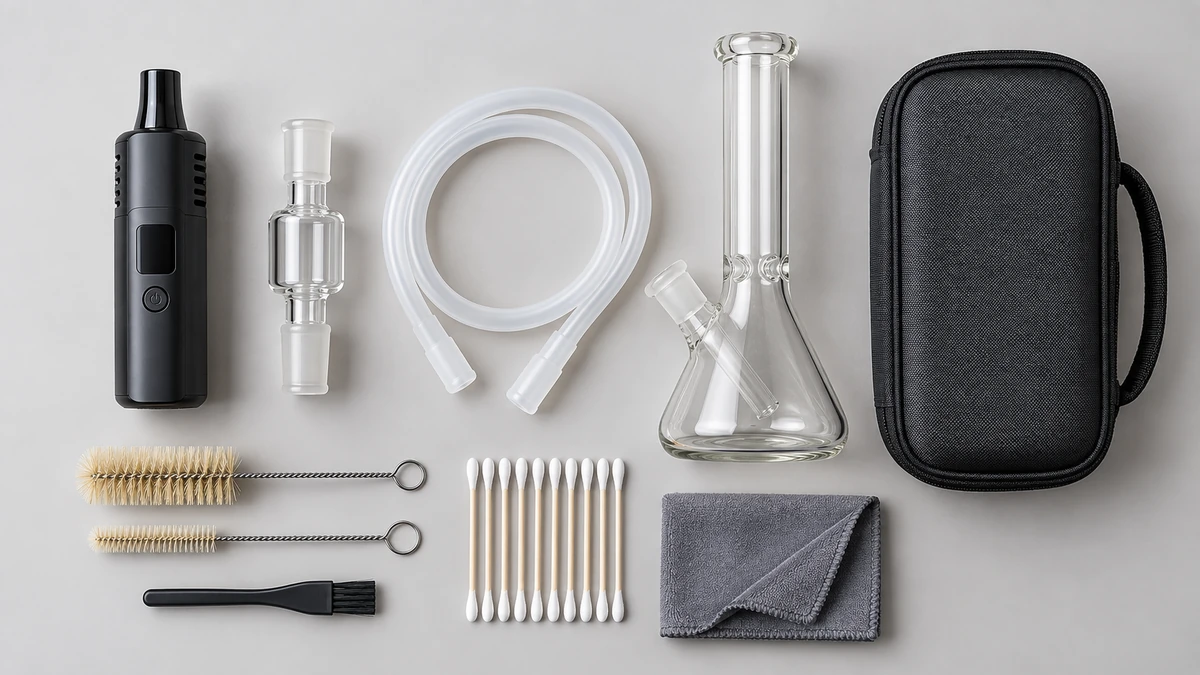
The vaporizer’s air path, silicone tubing, glass adapter, and water piece may require different care. Separate only cooled components, follow the device maker’s cleaning limits, and let washed pieces dry completely before reassembly. Photographing the assembled route first makes small seals and screens easier to return to their correct positions.
✅ 10. Choose the Interface Before the Glass
Joint diameter, joint gender, adapter depth, vaporizer support, and cleaning access decide whether the combination is practical. Once those are settled, chamber size and shape become meaningful preferences rather than guesses. This order also makes replacement parts easier to identify later.