Herb grinder shoppers searching for a “fine” grind are usually chasing a specific texture, not just a smaller particle. Fine grinding is a mechanical outcome shaped by tooth design, chamber geometry, and how a mill’s plates interact as they turn. Understanding those mechanics helps explain why two grinders labeled the same way can produce noticeably different results, and why “finer” isn’t automatically the right answer for every chamber design.
This guide breaks down what physically produces a fine grind, how screens and finishing plates refine texture further, and why particle size has real tradeoffs once material moves from the grinder into a vaporizer or other dry-herb chamber. The goal is mechanical clarity, not a recommendation to grind one specific way.
⚙️ 1. What Actually Makes a Grind “Fine”
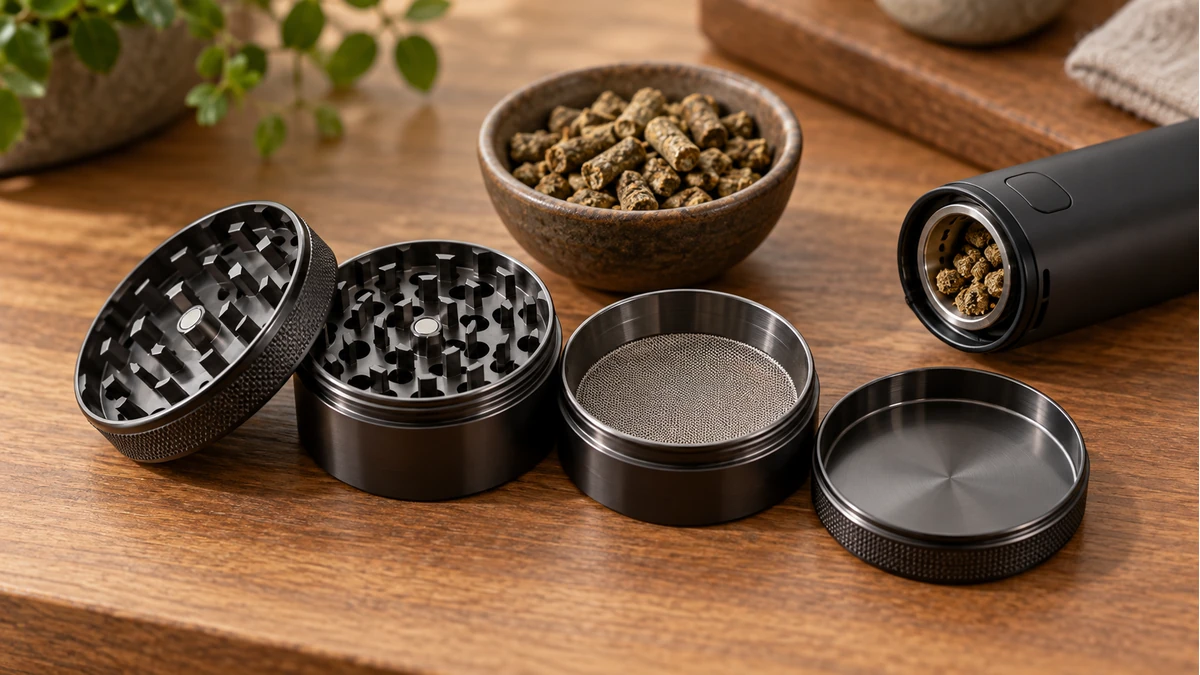
A grind’s fineness comes down to how many times material gets cut before it exits the chamber, and how small the gaps are between cutting surfaces. Every pass through a tooth pattern breaks material into smaller pieces. More teeth per rotation, tighter tooth spacing, and a narrower gap between the top and bottom plates all increase the number of cuts a given piece of material experiences before it’s small enough to fall through to a lower chamber or exit hole.
Fineness is also a function of dwell time. If material sits in the cutting chamber longer, either because the exit holes are small or because the chamber shape encourages material to recirculate, it gets cut more times before it leaves. That’s a structural property of the grinder, not something a user controls beyond how they operate it.
🦷 2. Tooth Geometry and Cutting Path
Tooth design is the first variable that determines grind texture, and it has several distinct components worth separating out.
🦷 2.1 Tooth Count and Spacing
Grinders with more teeth arranged closer together tend to shred material into smaller, more numerous pieces per rotation. Fewer, larger teeth cut in bigger chunks, leaving coarser, less uniform pieces. Tooth count alone doesn’t guarantee fineness, though; spacing matters just as much, since widely spaced teeth on a high-count wheel can still leave room for larger fragments to pass through uncut.
🔺 2.2 Diamond vs Shark-Tooth Profiles
Two common tooth shapes show up across most mills: diamond-shaped teeth and shark-tooth (angled, pointed) profiles. Diamond teeth tend to produce a more even, moderate texture because their symmetrical shape cuts consistently from multiple angles. Shark teeth are typically sharper and angled to shear material more aggressively in one rotational direction, which can produce a finer, more uniform texture but may also increase the shredding force needed and generate more fine dust as a byproduct.
📏 2.3 Chamber Clearance
The physical gap between the top and bottom grinding plates sets an upper limit on particle size. A tighter clearance forces material through a narrower space before it can drop to the next chamber, which mechanically favors smaller particles. Chambers with more clearance let larger pieces pass through after fewer cuts, resulting in a coarser and often less consistent texture even if the tooth pattern itself is aggressive.
🌀 3. Rotation Path and Shear Action
Beyond tooth shape, the rotational path material travels matters. As the top plate turns against the bottom plate, material gets pulled across the tooth field in a circular shear motion rather than a straight chop. This shearing action is what actually separates fibers and breaks material apart, rather than just splitting it into two large halves.
Grinders with a deeper or more contoured chamber encourage material to tumble and recirculate before it settles into the tooth path, which increases the number of shear passes it experiences. A shallow, flat chamber gives material fewer opportunities to be caught and re-cut, which tends to produce a less uniform result even with sharp teeth.
🕸️ 4. Screens, Kief Catchers, and Finishing Plates
Many multi-chamber mills add a screen or finishing plate between the grinding chamber and the collection chamber below. This screen acts as a sieve rather than a cutting surface: it doesn’t grind material further, it filters it, allowing only particles smaller than the mesh openings to pass through while catching everything larger.
Finer mesh screens produce a more consistent final texture because they physically block oversized fragments from mixing in with the fine material below. This is also how kief-catching designs work, since the finest, most powdery particles pass through the mesh into a bottom chamber that larger pieces can’t reach.
Screen mesh size is therefore a second, independent lever on fineness, separate from tooth geometry. A grinder with moderately spaced teeth but a very fine screen can still deliver a highly uniform final texture, because the screen filters out anything the teeth didn’t fully break down.
🔬 5. Fine Grind vs Powder: Where the Line Sits
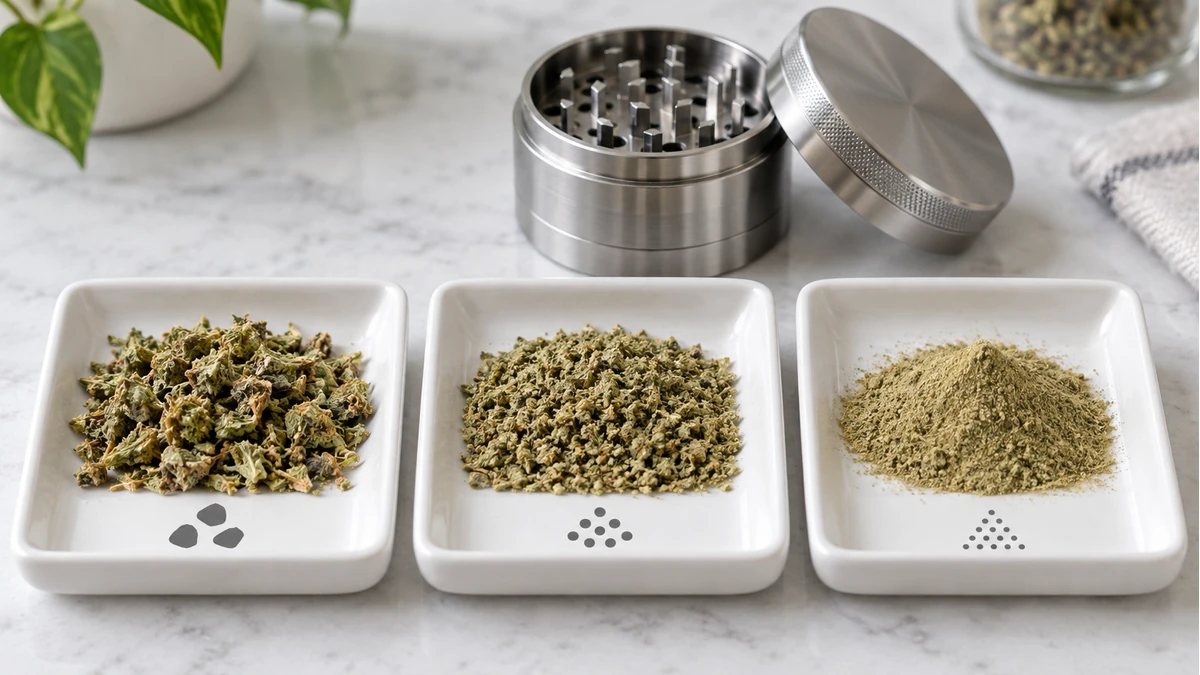
It’s worth drawing a clear line between a fine grind and a true powder. A fine grind still consists of distinct small particles with some texture and irregularity between pieces. Powder, by contrast, has lost almost all particle definition, often because material has been over-processed, left in the chamber too long, or ground with excessive force and very tight clearances.
Powder isn’t simply “extra fine” in a useful sense. Once material crosses into powder territory, it tends to clump, compress, and behave less predictably in almost any chamber, since the fine dust particles pack together far more tightly than a textured fine grind. This distinction is one reason grinder reviewers and forum discussions treat “fine and even” as a different, more desirable target than “as fine as possible.”
💨 6. Why Finer Isn’t Always Better for Every Chamber
A finer grind is often assumed to be the superior choice, but chamber design plays a large role in whether that assumption holds. Discussions among vaporizer owners frequently note that different chambers reward different textures, and that a grind fine enough to suit one device can behave poorly in another.
💨 6.1 Packing Density and Draw Resistance
Very fine particles pack together more densely than coarser ones because there’s less air space between individual pieces. In a dry-herb chamber, denser packing increases airflow resistance, since air has to work harder to move through tightly packed fine material than through a looser, coarser bed. Users comparing textures across chambers, including in threads like r/vaporents discussions on preferred grind for different devices, often note that a grind considered ideal for one chamber shape feels overly restrictive in another. This is closely tied to whether a device relies more on conduction or convection heating, a distinction covered in more depth in AOVAPE’s dry-herb vaporizer conduction/convection guide, since airflow-dependent convection designs are generally more sensitive to packing density than conduction-based ones.
🧵 6.2 Screen Migration and Cleaning
Very fine particles are also small enough to migrate through mesh screens, capsules, or fine-weave filters that are meant to hold material in place. This shows up in owner discussions, including a well-known r/craftymighty thread where users describe fine particles escaping through a capsule despite the capsule being designed to contain ground material. The same physics applies broadly: the finer the particle, the more likely it is to pass through small gaps that were sized with a coarser texture in mind.
Fine material is also harder to clean out of a grinder itself. Powder-like dust clings to tooth surfaces, chamber walls, and screen mesh more persistently than coarser pieces, which tend to fall free more easily. Over time, a very fine grind setting can mean more frequent cleaning of both the grinder and the connected chamber.
🧭 7. Matching Texture to Your Setup
Newcomers often ask a version of a simple question seen in beginner forums like r/saplings: whether a particular grinder texture will simply “match” a particular vaporizer. There isn’t a universal answer, because the right texture depends on chamber shape, airflow design, and screen size in the device itself, not just on the grinder producing the material.
As a general framework, chambers with tighter airflow paths or fine internal screens tend to pair better with a moderate, even grind rather than the finest setting available. Chambers designed with more open airflow can often tolerate finer material without the same draw resistance penalty. The table below summarizes how texture characteristics generally map to grinder features, without prescribing a single “correct” setting.
| Texture | Typical Grinder Trait | General Chamber Behavior |
|---|---|---|
| Coarse | Fewer teeth, wide plate clearance, no screen | Loose packing, lower draw resistance, less screen migration |
| Moderate/even | Diamond teeth, moderate clearance, medium screen | Balanced packing, moderate airflow, easier cleaning |
| Fine | Shark or dense teeth, tight clearance, fine screen | Denser packing, higher draw resistance, more screen migration risk |
| Powder | Over-processing, excessive dwell time | Clumping, inconsistent airflow, harder cleanup |
For anyone comparing manual mill styles as a starting point, AOVAPE’s two-piece herb grinder guide covers how simpler two-chamber designs handle texture differently from multi-chamber mills with screens, while the electric weed grinder guide looks at how motorized cutting speed and consistency affect the same tooth-geometry principles described above.
🧽 8. Keeping a Fine-Grind Mill Clean
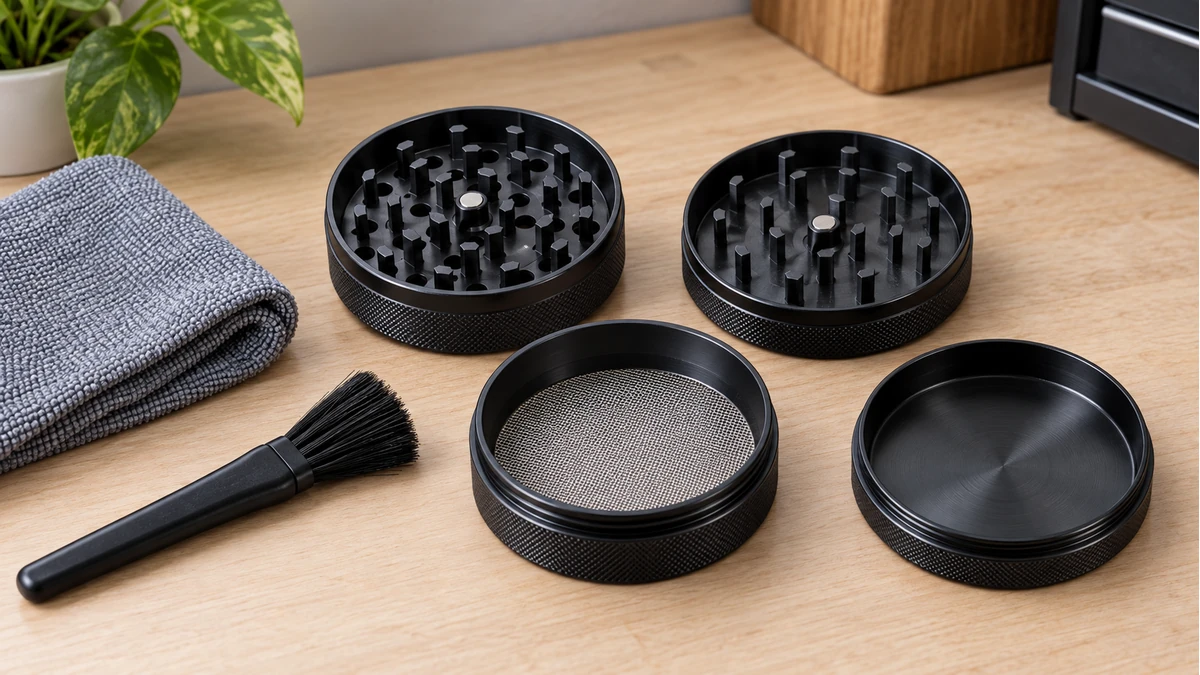
Grinders producing a fine or powder-adjacent texture tend to accumulate residue faster, particularly around tooth edges and screen mesh where small particles get lodged. Routine cleaning between uses, including brushing out tooth channels and checking screen mesh for buildup, keeps a fine-grind mill performing consistently rather than gradually shifting toward a coarser, less even output as debris fills in the cutting gaps. For related hardware context, see AOVAPE’s two-piece herb grinder guide.
Screens in particular benefit from regular attention, since clogged mesh openings reduce the amount of material passing through evenly and can cause the grinder to feel like it’s producing an inconsistent mix of textures rather than a uniform fine grind. A quick inspection of teeth, plate clearance, and screen condition is a simple way to keep fine-grind results predictable over time. For related hardware context, see AOVAPE’s electric weed grinder guide.
🧪 9. Judge Consistency, Not Maximum Fineness
A grinder can produce a fine-looking sample while still leaving a wide spread of particle sizes. Large fragments and powder behave differently in the same chamber, so consistency is often more useful than the smallest possible particle. Inspect several turns of material, not just the dust that settles below a screen. For related hardware context, see AOVAPE’s conduction and convection guide.
Chamber design sets the practical boundary. A deep bowl with an internal screen may tolerate a different texture than a shallow convection chamber with open perforations. Manufacturer instructions and the device’s screen geometry should take priority over a universal “fine grind” rule.
🧹 9.1 Residue Changes the Cut Over Time
Sticky buildup narrows clearances and changes how freely material moves between teeth. That can make an originally even grinder produce clumps or require extra force. A removable plate and accessible tooth roots are therefore part of grind control, not merely cleaning convenience.
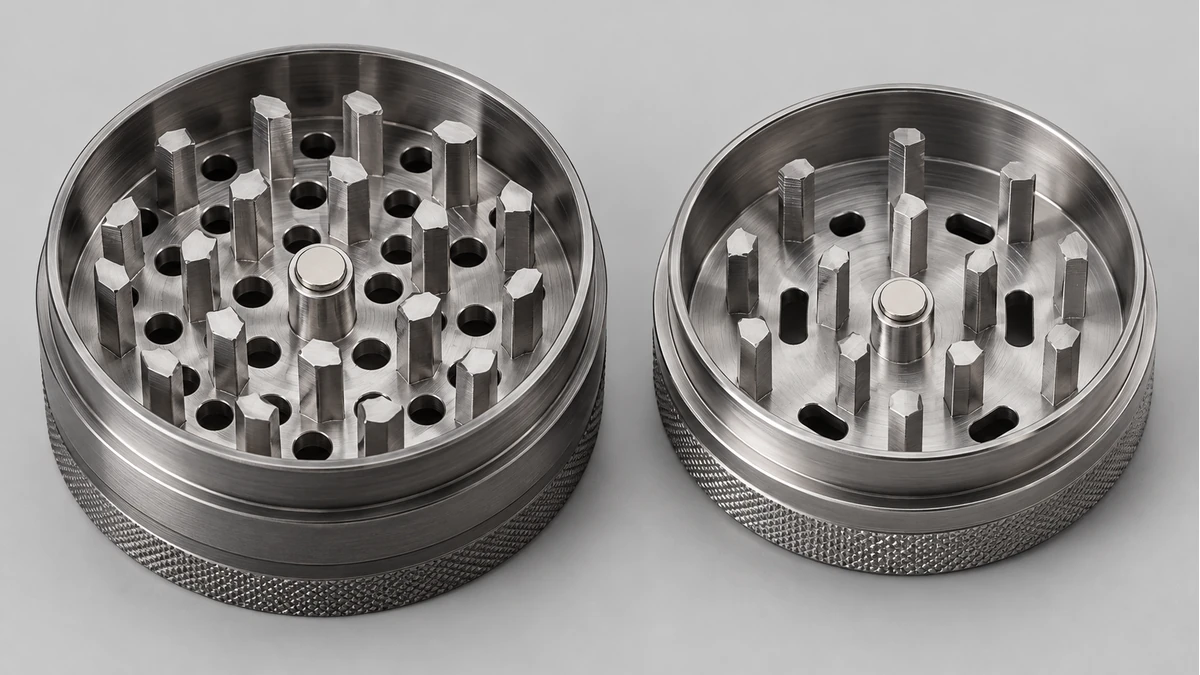
📐 9.2 Plate Geometry Deserves Its Own Comparison
Two grinders with similar teeth can produce different textures because the lower plate controls which particles leave the cutting chamber. Hole diameter, shape, count, and placement all matter. Photos should show that plate directly; a closed exterior reveals almost nothing about the resulting grind.
A finishing grinder adds another pass after the primary cut. That can improve uniformity for a device designed around fine material, but it also adds surfaces that collect residue and small particles. The extra stage is useful only when its output matches the chamber and screen that follow it.