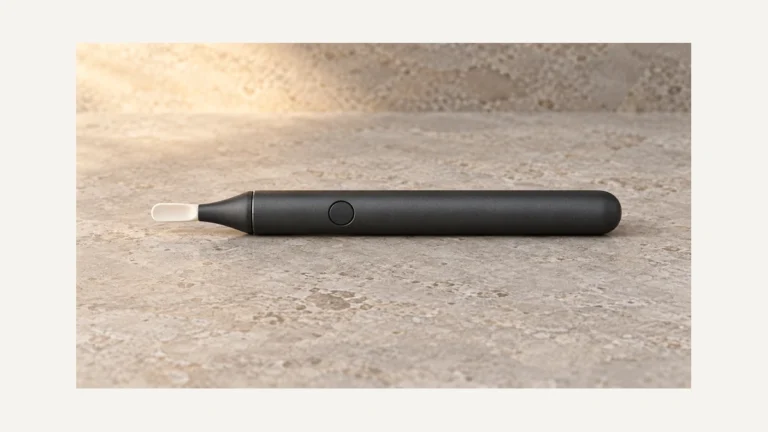
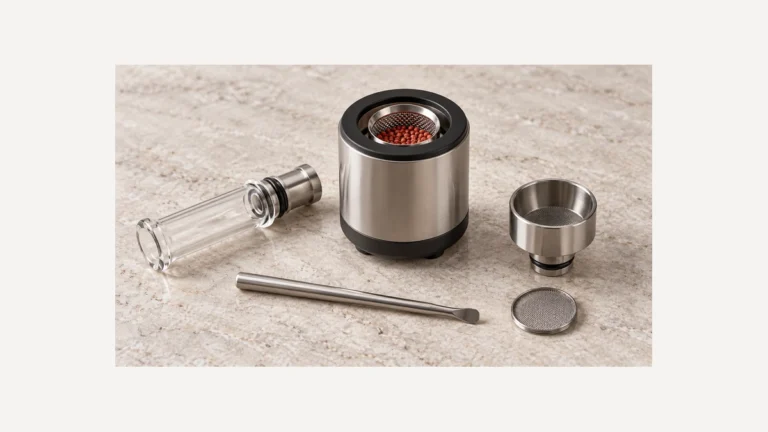
Grinders get lumped together as one category, but the mechanism inside determines almost everything about the final texture. A grinder with actual blades — the kind found in small electric herb grinders — works on a completely different principle than a manual mill with interlocking teeth. Both reduce dry herb to smaller pieces, but the geometry of the cutting surface, the speed of the motion, and the way material moves through the chamber all shape whether you end up with a fluffy, even grind or a mix of fine dust and unbroken chunks. For anyone using a dry-herb vaporizer, that distinction isn’t cosmetic. It affects airflow, draw resistance, and how evenly the device heats what’s packed inside.
This piece looks at how blade-based cutting compares to toothed milling, what “cut,” “tear,” and “crush” actually mean mechanically, and why the resulting particle size matters once material is loaded into a vaporizer’s chamber. None of this is about declaring one design superior — plenty of people are perfectly happy with a blade grinder, and plenty of people can’t stand them. The goal here is to explain the mechanics so the choice makes sense for your specific setup.
🔪 1. Blade-Style Electric Cutters vs. Toothed Mills
The word “grinder” covers two mechanically distinct tools, and conflating them is where a lot of confusion starts.
🧩 1.1 How Blade-Style Electric Cutters Work
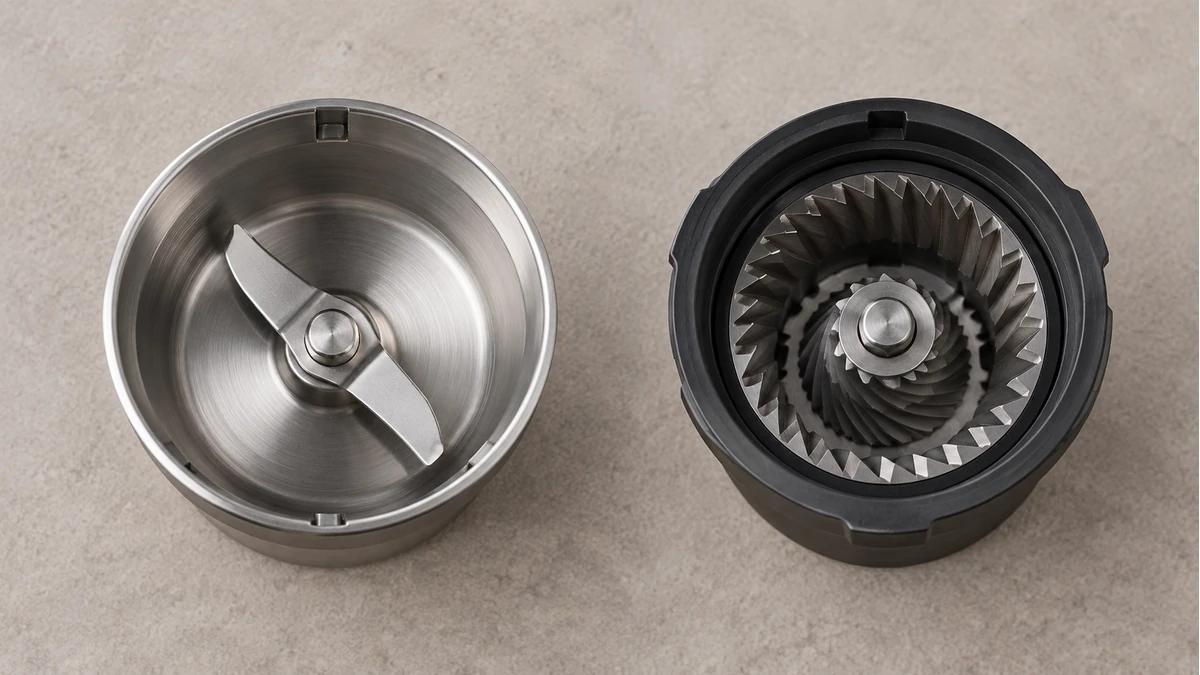
A blade-style electric grinder uses a small motor spinning one or more flat or slightly angled metal blades at the bottom of a chamber. Herb is dropped in loose, the lid is closed, and a button or twist activates the motor. The blades don’t have teeth or a fixed gap the way a manual mill does — they slice through whatever is in their path as they spin, and the size of the resulting pieces depends heavily on how long the motor runs, how much material is loaded, and where in the chamber a given piece happens to sit relative to the blade sweep.
This is a fundamentally different action from milling. A spinning blade doesn’t apply even pressure across a batch of herb — it makes repeated pass-through cuts, and material near the blade gets cut into very small fragments quickly, while material pushed to the chamber walls or resting on top may barely get touched until it falls back into the blade’s path. That unevenness is a direct mechanical consequence of the design, not a manufacturing defect.
🧩 1.2 How Toothed Mills Work
A manual mill, by contrast, uses two plates — usually the lid’s interior and the base — each studded with angled teeth. When you twist the top against the bottom, the teeth interlock and pass by each other at a fixed distance, so herb caught between them gets pulled apart as the teeth pass through it. The gap between teeth is constant across the whole diameter of the plate, which is why toothed mills tend to produce a more uniform particle size than blade grinders: every piece of herb that gets caught between the teeth experiences roughly the same mechanical action, rather than an unpredictable number of blade passes.
Our electric weed grinder guide goes into more detail on the range of motorized designs on the market, including some that use toothed mechanisms driven by a motor instead of a spinning blade — a hybrid that tries to combine the convenience of electric operation with the more predictable cut of a mill.

✂️ 2. Cut, Tear, and Crush: Three Different Mechanical Actions
“Grinding” is a catch-all term, but the actual physical action varies by tool, and that variation is what produces different textures from superficially similar equipment.
🧩 2.1 Clean Cuts vs. Tearing Action
A sharp blade moving at speed produces a clean cut — it severs plant fiber rather than ripping it, similar to a knife versus pulling something apart by hand. Toothed mills, on the other hand, rely more on a tearing and shearing action: the teeth grip and pull material apart as they pass, which is mechanically closer to how manual kitchen mills or coffee grinders with burrs operate. Neither action is inherently better; they just leave different surface characteristics on the plant material. A clean cut tends to expose more surface area evenly, while tearing can leave more irregular fragment shapes, including thin shreds mixed in with denser chunks.
🧩 2.2 Crushing and Compression
There’s a third action that happens in both designs but is more pronounced in some manual grinders, especially cheaper ones with dull teeth: crushing. When teeth or blades aren’t sharp enough to cut or tear cleanly, they instead compress material until it breaks apart under pressure. Crushed herb tends to release more plant material as fine dust and can also compress trichomes into the surrounding plant matter rather than leaving them intact, which is part of why grinder sharpness and tooth geometry matter over time as edges wear down. A well-maintained cutting edge — blade or tooth — does more actual cutting and less crushing, which generally produces a cleaner, more consistent texture.
The Reddit thread in r/trees titled “I hate my grinder for grinding it up so fine” is a good illustration of how this plays out in practice. The poster wasn’t unhappy with the grinder failing to do its job — they were unhappy that it did its job too aggressively, producing a texture finer than they wanted for their preferred method of consumption. That’s a useful reminder that “fine” isn’t automatically “better.” It’s a specific outcome that suits some tools and frustrates others. Our fine grind herb grinder guide covers how to intentionally dial in a finer texture when that’s actually what you’re after, and how to back off when it isn’t.
🌬️ 3. Particle Distribution and Chamber Airflow
Once herb is ground, the next variable that matters is how the resulting particle sizes interact with the chamber of whatever device it ends up in — and this is where blade grinders and mills tend to diverge most noticeably in practice.
🧩 3.1 Why Particle Size Distribution Isn’t Uniform
Because a blade grinder’s cutting action depends on proximity to the spinning blade rather than a fixed gap, the output is typically a wider distribution of particle sizes: some very fine dust mixed with larger, less-processed chunks, especially if the run time was short or the chamber was overfilled. A toothed mill produces a narrower distribution because every piece has to pass through the same fixed gap between teeth to fall through to the collection chamber below. Neither distribution is wrong, but they behave differently once packed into a vaporizer.
🧩 3.2 How Distribution Affects Airflow in the Chamber
Dry-herb vaporizers rely on air moving through packed material to carry heat to the herb, whether that heat comes from a heating element in direct contact with the material or from hot air passing through it — the distinction our guide on how dry-herb vaporizers work with conduction and convection explains in more depth. A wide particle size distribution, with a lot of fine dust packed between larger chunks, tends to restrict airflow and create pockets of dense, compacted material that heat unevenly. A narrower, more consistent particle size generally packs more predictably and allows more even air movement through the chamber, which is part of why a lot of experienced users gravitate toward mills or toward running blade grinders in short controlled bursts rather than one long continuous run.
The r/vaporents thread on preferred grind for different vaporizers backs this up from the user side: there’s no single “correct” grind size across devices, because chamber geometry and airflow design vary so much between models. A convection-heavy device with a deep, airy chamber often tolerates a coarser, chunkier grind better than a small conduction chamber, which may need finer, more evenly sized material to maintain good contact with the heating surface. That’s a design and preference question specific to each device, not a universal ranking of grind textures.

🧹 4. Cleaning and Maintenance Differences
The mechanical differences between blade cutters and toothed mills also show up down the line, in how much maintenance each design demands and how that maintenance interacts with the vaporizer itself. For related context, see AOVAPE’s fine-grind grinder guide.
🧩 4.1 Residue Buildup in Blade Chambers
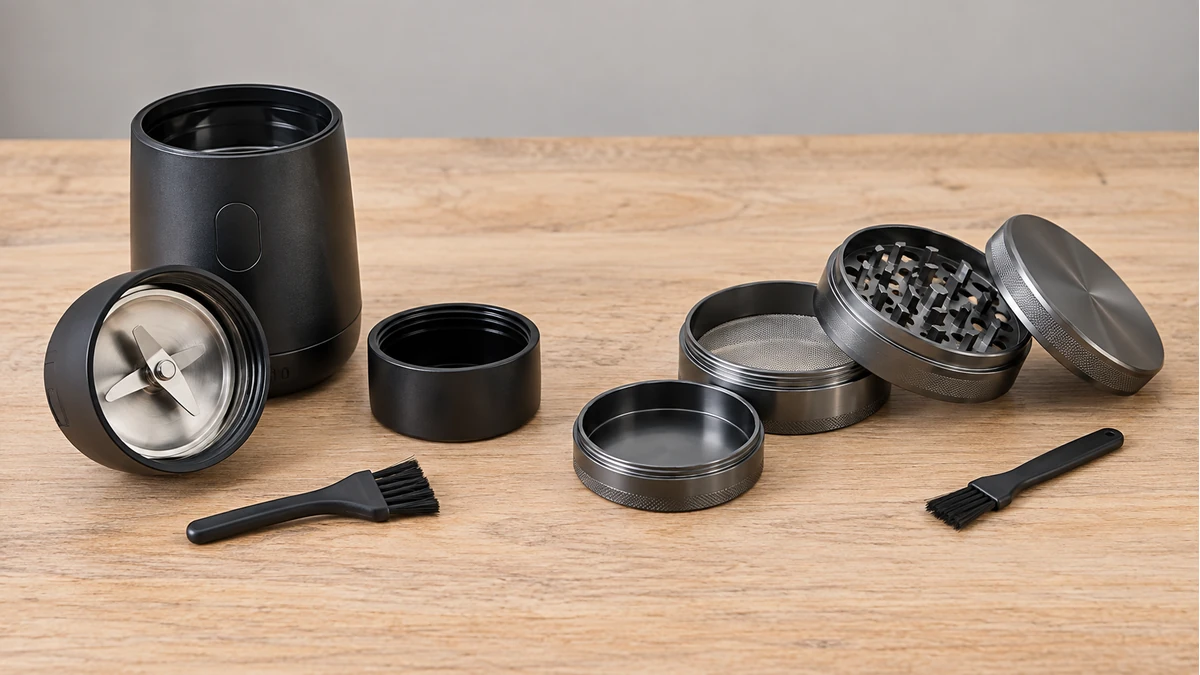
Blade grinders have a small motor housing, exposed electrical contacts, and often a battery compartment, none of which tolerate moisture or plant residue well. Because the cutting chamber sits directly above or adjacent to those components, cleaning has to be done carefully — usually with a dry brush rather than any liquid — to avoid resin or fine dust working its way into the motor or contacts over time. Fine particles are also more prone to sticking to chamber walls due to static and to the stickiness of plant resin, so blade chambers can accumulate a layer of packed residue that’s harder to fully clear out than an open manual mill. For related context, see AOVAPE’s electric grinder guide.
🧩 4.2 Screens, Kief Catchers, and Downstream Cleaning
Manual mills, particularly multi-piece designs with a screen and kief catcher, are generally easier to fully disassemble and clean, since there’s no electronics to protect. But screens introduce their own maintenance consideration: fine particles that fall through the screen mesh accumulate below it and need periodic clearing, or airflow through the screen slows down and grinding efficiency drops. This downstream particle accumulation isn’t unique to grinders — it’s the same basic issue that shows up in vaporizer chambers and screens themselves. The r/craftymighty thread about a device staying dirty even with the screen in place is a good example: fine particles pass through mesh openings regardless of whether they came from a mill or a blade grinder, and they collect in whatever sits on the other side, whether that’s a kief catcher or the airway of the device itself. Finer, more powdery output generally means more frequent screen and airway cleaning downstream, which is a maintenance tradeoff worth weighing against however much you value the finer texture in the first place. For related context, see AOVAPE’s conduction and convection guide.
None of this points toward one design being categorically better than the other. Blade grinders are fast, compact, and require no hand strength or twisting motion, which matters for some users more than texture consistency ever will. Toothed mills take a bit more physical effort but tend to produce a more predictable, evenly sized output with a cutting action that’s easier to reason about and maintain over the long run. The right choice comes down to what a given vaporizer’s chamber and airflow design actually respond well to, how much cleaning routine someone is willing to keep up with, and honestly, how much particle size consistency matters to that person’s day-to-day use. Understanding the mechanics — cutting versus tearing versus crushing, fixed gaps versus blade proximity, narrow versus wide particle distribution — at least makes it possible to match the tool to the outcome you’re actually after, rather than guessing based on price or appearance alone.
🧪 9. Evaluate the Particle Distribution, Not One Sample
A blade cutter can leave both powder and large fragments in the same batch because pieces move through the spinning path unpredictably. A toothed mill generally meters material through a fixed tooth field and drop holes, but its output still depends on clearances, rotation, residue, and how full the chamber is.
Spread a small sample on a contrasting surface and look at the range of sizes. Consistency matters because fine dust can migrate toward a screen while large pieces hold a chamber open. The useful target is the texture the vaporizer chamber was designed to retain without blocking its airflow.
🧹 9.1 Cleaning Access Is Part of Cutting Performance
Residue changes friction and narrows the spaces that move particles through either design. Removable cups, accessible blade hubs, visible tooth roots, and replaceable screens make the original geometry easier to restore without forcing a tool into hidden gaps.